Showing posts with label Parody. Show all posts

Friday, April 1, 2016

No Foolin’

The youth gets together his materials to build a bridge to the moon, or perchance a palace or temple on the earth, and at length the middle-aged man concludes to build a wood-shed with them.
—Henry David Thoreau, quoted in The Writing Life by Annie Dillard.

On the first day of April 2012, about two months after leaving the Laestadian Lutheran Church via the act of publishing a book critical of it, I posted on social media this parody image of a fake Voice of Zion article thoughtfully reviewing the book:

My first Laestadian-related April fool (click to enlarge)

Such a review was, of course, quite the opposite of what actually happened, which was the point of the parody piece. It quoted the conclusion of an actual article that had been published, for real and with refreshing candor, by the church’s sister organization in Finland: “There must be the ability to encounter facts with openness and honesty, even when the facts are not pleasing to us.” Switching from fact to April fool, my “article” went on to say:

This may raise doubts and concerns in the minds of God’s children: Can God’s Kingdom be the subject of legitimate criticism? Is it possible that certain teachings, even those that are being made in sermons and writings today, are simply not correct? These questions, once unthinkable in Zion, are being brought again and again to our attention by recent events.

Now we must confront the issues raised in a 530-page book by a former believer [me] who once wrote articles for this very paper [true]. Traditionally, our tendency would be to dismiss the book’s questions and criticisms by saying that the author just wanted to live a life of sin, or that he is distorting or even lying about what God’s Kingdom has taught. Another common response we have made to these challenges is that faith is childlike and not subject to any human reasoning.

Then the article plowed onward through a field of Bible quotes, just as you’d see in the real Voice of Zion. I selected them verbatim from the same King James Bible pages that Laestadian preachers consult for their articles. But my assortment of quotes told a very different story:

Scripture certainly encourages us to believe as a child (Matthew 18:3). But we should also remember the Apostle Paul’s admonition to “be not children in understanding: howbeit in malice be ye children, but in understanding be men” (1 Corinthians 14:20). Sometimes we need to “put away childish things” (1 Corinthians 13:11) and really understand what it is we claim to believe.

A second column of the “article” that appeared in the fake clipping provided some straight talk about this new book of mine that was giving the preachers such headaches. An unnamed preacher (also fake) being “interviewed” for the article in classic Voice of Zion fashion acknowledged that it was “undeniably true that the Gospel was not preached for several years after Laestadius and Raattamaa received the grace of repentance.” This implausibly candid preacher continued, “The book also correctly notes that Raattamaa favored Takkinen and criticized the followers of Heideman. These are matters of historical record that we must acknowledge somehow.”

Quite true, even if the person saying it was a fiction. Acknowledging the historical record is exactly what the church must do to be intellectually honest, but good luck ever seeing that happen. The real-life response was instead to retreat into a sheltered cocoon of denial and an outright repudiation of human reason in evaluating what the church teaches to be true. The same goes for “another difficult historical question raised in Suominen’s book,”

why our familiar preaching of the forgiveness of sins from believer to believer doesn’t seem to be found in any writings before Luther. The book states that there were “two centuries of writings” after Christ “that not only fail to explicitly mention absolution, but provide many teachings incompatible with it” (Section 5.1.2). It may seem like a far-fetched claim, but he provides several pages of discussion with plenty of references to back it up.

That I did. In response to this significant issue, too, crickets sounded forth in the fields of central Minnesota.

———

On first days of April since then, I published two more parody articles. In 2014, Social Media and the Believer did a dead ringer of an impression (if I do say so myself) of a Voice of Zion article soberly warning about the dangers of Facebook and mixing with unbelievers via this new medium of the Internet. It started pushing plausibility around halfway through:

One of the dangers with “friendship of the world” is the temptation to accept incorrect and sinful beliefs and lifestyles. Today’s society encourages an anything-goes attitude of “tolerance,” but God’s Word has always taught differently. The Old Covenant believers were instructed to let their light shine very clearly about the dead faiths of this world.

Then came a quote from Deuteronomy 13:6-9 about killing family members who tempt you into serving other gods (“Thou shalt not consent unto him, nor hearken unto him; neither shall thine eye pity him, neither shalt thou spare, neither shalt thou conceal him: But thou shalt surely kill him; thine hand shall be first upon him to put him to death”). According to the church, after all, God’s Word, is unchanging and eternal, and not subject to the whims of man’s desires. Somehow these nastier bits of the Old Testament get forgotten in favor of favorite passages warning that you’d better not be using birth control or hunting on a Sunday.
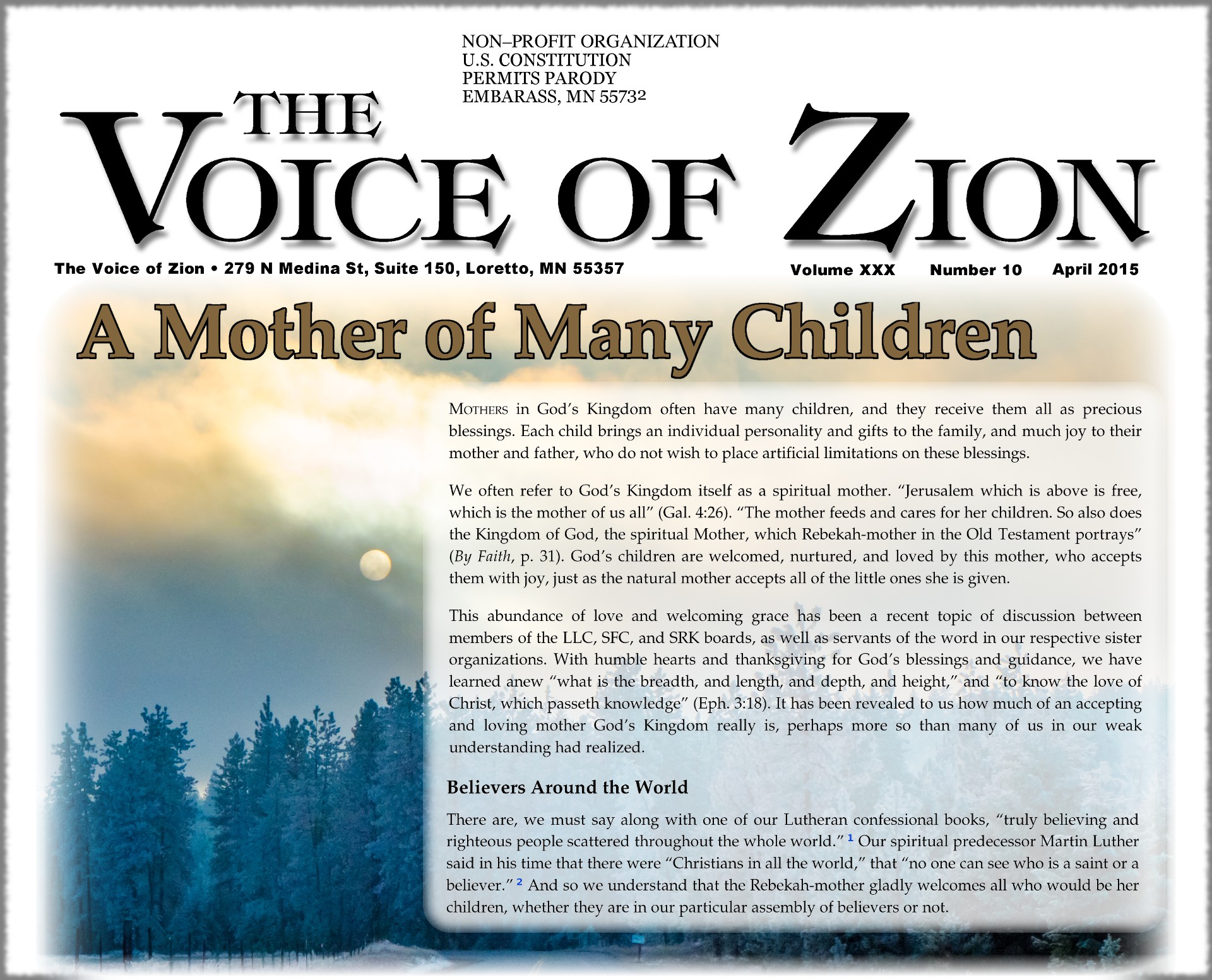
From the April 2015 parody, my last and favorite

April 1, 2015 was the occasion of my favorite of the parodies I’ve done, A Mother of Many Children. It was a heartfelt announcement of a surprising (alas, fictional) change in Conservative Laestadianism’s long-standing doctrine of exclusivity, drawing not just on scripture for support but also on the teachings of Luther himself:

There are, we must say along with one of our Lutheran confessional books, “truly believing and righteous people scattered throughout the whole world.” Our spiritual predecessor Martin Luther said in his time that there were “Christians in all the world,” that “no one can see who is a saint or a believer.”

These quotes and others in the article from Luther are all genuine, as with the Bible quotations. They leave no doubt about what Luther would have thought of the Laestadian Lutheran Church and its sister organizations claiming to be “God’s Kingdom,” the only place where actual Christians might be found. The “article” went on about the

danger of putting too much emphasis on God’s Kingdom as an organization, as an assembly of people, and making God Himself secondary to it. “I will not give my glory unto another” (Isaiah 48:11).

We can also look to the words of Luther in this: He wrote that anyone who “maintains that an external assembly or an outward unity makes a Church, sets forth arbitrarily what is merely his own opinion.” We must humbly agree with our brother in faith that there is not “one letter in the Holy Scriptures to show that such a purely external Church has been established by God.”

Many readers were saddened to know that it was just a parody and not a real article from the LLC. A few realized that only after reading through it and rejoicing that their church had finally come around to the loving, inclusive doctrine they personally believed.

I felt a little bad about causing disappointment for people, but hoped that it would do some overall good in the long term. After all, what possible answer could the preachers give to someone asking why this had to be an April fools joke and not a real article from the Voice of Zion? They would have to shrink their God down, along with the Bible and Luther’s teachings, to fit into their little doctrines.

———

There will be no April fool about the old church this year, or perhaps any in the future. I considered some ideas this past week and then decided it’s not worth the bother. I’m bored with it, and it’s bored with me.

This is just one weird little Protestant sect churning upriver against a flood of contrary facts, bearing its delusions of grandeur, its complicated set of mostly unwritten silly rules, and its steady fuel supply of new members popping into maternity wards and winding their way from day circle to Sunday School to confirmation class. There are many others like it with their own combinations of such features. The tiresome machinery of it all grinds inexorably on.

Rather than writing another parody piece, I dug through the nether reaches of my Facebook timeline to find one I’d posted in October 2012 as a Facebook status update. (I hadn’t yet started my blog then.) You can still see it and the 70 comments that ensued, here.

This dashed a few hopes, too, and got some heated discussion going. Those were the days before believers had been fully warned about not discussing faith matters online. A new wall was hastily constructed around Laestadian brains, and things have quieted down considerably ever since.

So, to conclude, here is a fake “opening statement” from my old church in one of the congregational meetings there were being held (really) in the wake of my book’s publication to address concerns and doubts.

———

We must begin by humbly acknowledging our own weakness and lack of understanding, not just as individuals, but as a battling congregation here in this sinful world. As the Apostle said, “We see through a glass, darkly” (1 Cor. 13:12). If such an important figure as Paul could acknowledge that he only “knew in part,” then we must do the same. We have been quick to cite Proverbs as saying, “The fear of the LORD is the beginning of knowledge,” but there’s a second part of the verse that we all ought to take to heart, where we are told that “fools despise wisdom and instruction” (1:7). Is any of us exempt from the need for wisdom and instruction?

The writer of Proverbs said much about wisdom. “The wisdom of the prudent is to understand his way: but the folly of fools is deceit” (14:8). There is simply no place for deceit in God’s Kingdom. After all, the Church is called “the Pillar and Ground of Truth” (1 Tim. 3:15). We must understand our way. A speaker brother recently quoted another verse from Proverbs, “There is a way which seemeth right unto a man, but the end thereof are the ways of death” (14:12). Yet we must also keep in mind what follows just a few verses later: “The simple believeth every word: but the prudent man looketh well to his going. A wise man feareth, and departeth from evil: but the fool rageth, and is confident” (14:15-16). Some of God’s children have recently decided they simply cannot go on just “believing every word.” We must respect this and learn from their courage.

If we are wrong, we must allow ourselves to be corrected. This applies to all of us. During the last heresy, it was said that the Bibles came off the shelves. We at the LLC have been reading God’s Word more diligently in recent days, too, and must admit that there have been important lessons there for us. For example, the believers of an earlier period in the Old Testament sacrificed thousands upon thousands of animals for sins, yet a later prophet, Micah, asked what he should bring with him when he comes before the LORD, when he bows himself “before the high God? Shall I come before him with burnt offerings, with calves of a year old? Will the Lord be pleased with thousands of rams, or with ten thousands of rivers of oil? Shall I give my firstborn for my transgression, the fruit of my body for the sin of my soul?” (Mic. 6:1-7). No, that was of no use. Instead, Micah concluded, “O man, what is good; and what doth the LORD require of thee, but to do justly, and to love mercy, and to walk humbly with thy God?” (6:8).

Let us do the same. Live in a just manner, love mercy, and walk humbly with God. How much sacrifice we have demanded of ourselves, and each other, when this is all that is required!

We sit before you chastened, knowing how much we have been shown to be wrong about in recent years. Our brothers in Finland have publicly apologized for “spiritual excesses” of the 1970s. We have seen crimes against children by believing men with positions of trust in God’s Kingdom made worse by cover-ups, denial, excuses, and poor behavior toward a courageous woman who attempted to see justice done and further abuse prevented. Here in America, we have advocated for women getting pregnant even at the cost of their lives when in Finland our sister organization is now calling for women to listen carefully to their doctor’s advice. We have concerned ourselves far too much with works– hundreds of confusing rules about dying hair when curling it is OK, about using birth control when a hysterectomy is OK, about watching animated cartoons when documentaries are OK. The words of Jesus are instructive to us, too: “Woe unto you, scribes and Pharisees, hypocrites! for ye pay tithe of mint and anise and cummin, and have omitted the weightier matters of the law, judgment, mercy, and faith: these ought ye to have done, and not to leave the other undone. Ye blind guides, which strain at a gnat, and swallow a camel” (Matt. 23:23-24).

Let us pass the microphone over to you now, the body of Christ. Let us discuss matters in true Christian freedom, not coercion, not intimidation. It is time for us all to learn from each other.

———

“Just kidding,” I finally added. “But for the sake of my loved ones still in the church, I wish I weren’t.” I still do. But life goes on. Those friends and loved ones know they have another option than trudging off to sit in those pews. Some of them have finally found the courage to exercise that option. And it may not be so bad anymore for those who haven’t. From what little I hear about the church nowadays, light and love have started shining through cracks in the wall of judgment and fear.

Inside those walls, and outside where billions of people like me are raising children and making friends and riding bikes and buying groceries, life goes on. 

Wednesday, April 1, 2015

A Mother of Many Children

Jerusalem, God’s Zion, came down from heav’n above.
She’s our beloved mother, whom we, her children, love.
It’s here that God is dwelling, in spirit here is found;
of truth it is the pillar, and is it’s very ground.
Songs and Hymns of Zion No. 188, v. 1.
In this as-yet-unpublished newsletter article, my old fundamentalist church announces a surprising change in its long-standing doctrine of exclusivity. Be sure to read my comments that follow the article at the bottom of this posting. [Suomeksi]

MOTHERS in God’s Kingdom often have many children, and they receive them all as precious blessings. Each child brings an individual personality and gifts to the family, and much joy to their mother and father, who do not wish to place artificial limitations on these blessings.

We often refer to God’s Kingdom itself as a spiritual mother. “Jerusalem which is above is free, which is the mother of us all” (Gal. 4:26). “The mother feeds and cares for her children. So also does the Kingdom of God, the spiritual Mother, which Rebekah-mother in the Old Testament portrays” (By Faith, p. 31). God’s children are welcomed, nurtured, and loved by this mother, who accepts them with joy, just as the natural mother accepts all of the little ones she is given.

This abundance of love and welcoming grace has been a recent topic of discussion between members of the LLC, SFC, and SRK boards, as well as servants of the word in our respective sister organizations. With humble hearts and thanksgiving for God’s blessings and guidance, we have learned anew “what is the breadth, and length, and depth, and height,” and “to know the love of Christ, which passeth knowledge” (Eph. 3:18). It has been revealed to us how much of an accepting and loving mother God’s Kingdom really is, perhaps more so than many of us in our weak understanding had realized.

Believers Around the World

There are, we must say along with one of our Lutheran confessional books, “truly believing and righteous people scattered throughout the whole world.”1 Our spiritual predecessor Martin Luther said in his time that there were “Christians in all the world,” that “no one can see who is a saint or a believer.”2 And so we understand that the Rebekah-mother gladly welcomes all who would be her children, whether they are in our particular assembly of believers or not.

God’s Kingdom is precious to us, “our beloved mother, whom we, her children, love” (SHZ 188). Here we find comfort and the forgiveness of our sins. But there is a danger of putting too much emphasis on God’s Kingdom as an organization, as an assembly of people, and making God Himself secondary to it. “I will not give my glory unto another” (Isaiah 48:11).

We can also look to the words of Luther in this: He wrote that anyone who “maintains that an external assembly or an outward unity makes a Church, sets forth arbitrarily what is merely his own opinion.” We must humbly agree with our brother in faith that there is not “one letter in the Holy Scriptures to show that such a purely external Church has been established by God.”3

During our concluding meeting at the SRK offices in Oulu, we received much loving instruction from God’s Word and a spirit of unity. With tears of joy, one brother read simple instructions from the Bible about how we can know where the Spirit of God is: “Hereby know ye the Spirit of God: Every spirit that confesseth that Jesus Christ is come in the flesh is of God” (1 John 4:2). Every spirit, he repeated, and went on to read how we can know who God’s children are: “Whosoever shall confess that Jesus is the Son of God, God dwelleth in him, and he in God” (1 John 4:15).

Another brother recalled that the Apostle Paul considered the Gentiles as equals in God’s eyes. He noted that this was a significant new revelation for the Old Covenant believers of that time, too. But there is no difference between the Jew and the Greek, Paul wrote, “for the same Lord over all is rich unto all that call upon him. For whosoever shall call upon the name of the Lord shall be saved” (Rom. 10:12-13).

A question arose about the preaching of the Gospel in the verses that follow: How can other people “call on him in whom they have not believed? And how shall they believe in him of whom they have not heard? And how shall they hear without a preacher?” Luther wrote that whoever hears the Gospel and believes on it, and is baptized, is called and saved. And, he added, “the Gospel is nothing else than the preaching of Christ.”4

We cannot allow our traditions about the Gospel and forgiveness to take away from God’s Word. “And if any man shall take away from the words of the book of this prophecy, God shall take away his part out of the book of life, and out of the holy city, and from the things which are written in this book” (Rev. 22:19). This portion says that whoever calls upon His name shall be saved and then simply points out that people cannot call on someone they haven’t yet heard of.

There were many around Paul who had no knowledge about Jesus. We certainly cannot say the same today of the many millions of people who faithfully read the same Bibles we have and praise God’s name in their own churches.

God’s Ways Are Beyond Human Comprehension

The mind of man rebels against such inclusiveness. Who are these strangers we are to consider as possible fellow-travelers on the way that leads to heaven? How do they get their sins forgiven? But these questions arise from our sin-corrupt flesh.

It is important to remember that God’s grace is not limited by the limitations of our carnal reasoning. “Now unto him that is able to do exceeding abundantly above all that we ask or think, according to the power that worketh in us, unto him be glory in the church by Christ Jesus throughout all ages, world without end” (Eph. 3:20).

Random, marginally relevant nature scene [Flickr page]

Apostle Paul reminds us, “Now there are diversities of gifts, but the same Spirit. And there are differences of administrations, but the same Lord. And there are diversities of operations, but it is the same God which worketh all in all” (1 Cor. 12:4). We have seen many sorrowful incidents in our own history since the time of Laestadius where “the weightier matters of the law, judgment, mercy, and faith” (Mat. 23:23) have been forgotten over minor issues and personality differences, leading to needless strife and divisions. There “should be no schism in the body; but that the members should have the same care one for another” (1 Cor. 12:25).

Our brother Juhani Raattamaa, whose portrait hangs alongside Luther and Laestadius in some of our church buildings, honored the Apostle’s message during a spiritual storm that took place in our Zion about a hundred years ago. He continued to show love for a prominent servant of the word who had been rejected over obscure matters few of us can even recall anymore and who was forced to journey in faith with a group called the Esikoinen, or “Firstborn.” After the death of this “beloved brother and fellow laborer,” Raattamaa remembered him “with sorrow and joy, even though his body is resting in the bosom of his Fatherland, but his glorified soul is rejoicing in the Paradise of God.”5

The question about how these other believers get their sins forgiven is easy to answer in the case of our Esikoinen brethren; they preach it in the name and blood of Jesus just as we do. There are thousands of them in the United States and Finland receiving this message with joy every Sunday. That forgiveness, Raattamaa said, has been given “to the flock in living faith which is scattered around the whole world of all peoples and tongues. The sermon of repentance and forgiveness of sins is established with them.”6

Have we been like John when he forbade a stranger from casting out devils in Jesus’ name, just because the man did not walk with the disciples? The Lord of Life did not commend John for doing that. Rather, he said, “Forbid him not: for he that is not against us is for us” (Luke 9:50).

God’s Kingdom is not some entity located in Minnesota or Oulu, just as it was “not bound to Rome” in Luther’s day. Rather, it is “as wide as the world, the assembly of those of one faith, a spiritual and not a bodily thing, for that which one believes is not bodily or visible.”7

Boundless Grace

Paul said that God wants all men to be saved and that they would come to the knowledge of the truth. Therefore it is not the will of God that anyone be lost. He has not prepared hell for men, but for the devil and his angels.8 The Lord, Peter writes, is “not willing that any should perish, but that all should come to repentance” (2 Pet. 3:9).

With our weak understanding, can we say that God has not been able to achieve His will except when it comes to our small Zion? “For my thoughts are not your thoughts, neither are your ways my ways, saith the LORD. For as the heavens are higher than the earth, so are my ways higher than your ways, and my thoughts than your thoughts” (Isaiah 55:8).

Jesus told His disciples, “Fear not, little flock; for it is your Father’s good pleasure to give you the kingdom” (Luke 12:32). Certainly they were a small group when He spoke those words, for the same reason that Paul wrote about those who had not heard. God’s promises of the Old Covenant had only just been fulfilled in the few decades since Jesus’ birth. In our time, two thousand years later, the world is filled with people who are happy to take on the name of a Christian. We should not hasten to pass judgment on their faith. “Judge not, and ye shall not be judged: condemn not, and ye shall not be condemned: forgive, and ye shall be forgiven” (Luke 6:37).

Our Lord and Savior Jesus Christ was sent for the sins of the whole world, not just for ours. “For God so loved the world, that he gave his only begotten Son, that whosoever believeth in him should not perish, but have everlasting life. For God sent not his Son into the world to condemn the world; but that the world through him might be saved” (John 3:16). It is grace of grace to be in God’s Kingdom. “Our faith is the greatest of gifts we could own / Through Christ we are given the hope of a crown” (SHZ 403). But now, in His time, God is revealing unto us that we should not be too quick to say that others are not among His own as well. “God is nigh unto all them that call upon him, to all that call upon him in truth” (Psalm 145:18-20).

———

Important disclaimer and commentary:

It is April 1, and that date for this “article” is no coincidence; none of this was actually written by any church official or for any church newsletter. (The epigraph is indeed a verse from a song in the church songbook, by Anna Tulkki.) It is “as-yet unpublished,” and always will be, because it’s a parody I wrote in honor of the holiday. There have been recent discussions between representatives of the LLC, SFC, and SRK, but I seriously doubt that univeralism or even acceptance of “worldly” Christians was on the agenda.

I can still write like a believer, but I’m not a Laestadian or even a Christian anymore. (Nor am I really convinced at this point that there’s a God behind our astounding yet scientifically explainable mess of a universe, though that’s another topic entirely.) But I know plenty of people who used to be Laestadians, and a few who are still sitting in the pews while enduring their own painful private silences of doubt and cognitive dissonance. Many of those who have left are still Christians of one type or another who get to hear their faith dismissed as worthless and irrelevant by their former brothers and sisters.

This was written for all of them. May our beloved old church evolve toward the kind of compassionate and realistic position this essay describes (alas, still only as parody) within our lifetimes or at least those of our children.

And I wrote it for those readers who are still Laestadians, too. You know who you are: Better clear your browser history before anyone else finds out! I hope you’ve found something to ponder here. Every one of these quotes and cites is real, and relevant. Think about how much you are marginalizing your Savior and the omnipotent creator of the universe (in your beliefs, at least) by making him unable or unwilling to save all but 0.002% of the world’s population. Some further reading along those lines: “God’s Kingdom,” “Sailing in a Sea of Humanity,” and “The Christmas Program.”

Because the Bible is so full of contradictions, either one of two opposite viewpoints often can be selected and amplified via the Laestadian-style quote-bombing I tried to illustrate above. There is certainly another more orthodox essay that could be written about God’s wrath and how he plans to exercise his infinite power to torture almost all of his created humanity for not being Laestadians. But it would be a less honest and compelling one, I think, and certainly more depressing to read.

———
Click on images for full-size versions, as usual. Here is the link to download the full-size 1920x1553 version of the top one, which I created using The GIMP free image processing software and years of looking at way too many real Voice of Zion issues that had arrived in the mail.
Many thanks to an anonymous correspondent for supplying a translation into Finnish, which was completed in a matter of hours, and for correcting one of my Bible references in the process. There are some amazing people out there!

Notes


  1. Philipp Melanchthon, The Apology of the Augsburg Confession, in Concordia: The Lutheran Confessions, Paul T. McCain, ed. (2005), p. 146. Melanchthon, Luther’s co-worker in the Reformation, wrote the Apology to defend The Augsburg Confession that they had published a year earlier. Luther was involved with the writing of the Apology and approved of it. In a 1533 letter, he urged Leipzig Christians to adhere to both works (McCain at p. 70). 

  2. Martin Luther, The Papacy at Rome. In Works of Martin Luther (“Philadelphia Edition”), pp. 361, 391. 

  3. The Papacy at Rome, pp. 350, 355. 

  4. Martin Luther, The Epistles of St. Peter and St. Jude Preached and Explained, “The Second Epistle General of St. Peter,” Ch. 1. 

  5. Juhani Raattamaa, 1892 letter following the death of John Takkinen. From The Streams of Life, Carl Kulla, ed. (1985), p. 393. 

  6. Juhani Raattamaa, sermon given 1894. From The Streams of Life at p. 181. 

  7. The Papacy at Rome, p. 361. 

  8. These three sentences are actually a quote from Journey of Fiery Trials (1961) by Lauri Taskila, a Laestadian preacher, which have ample support in the Bible, e.g., 1 Timothy 2:1-6; 2 Peter 3:1. But in the real world outside of an April 1 parody, Taskila went on with an unsurprising Laestadian qualifier: “Of course, it is the will of many men to die blessed, but the world is dear and its vanishing course is pleasing where slavishness and scorn of men keep them from repentance” (pp. 58-59). Apparently the threat of infinite, eternal torture is not incentive enough for all those uppity folks. 


Tuesday, April 1, 2014

Social Media and the Believer

Concern was expressed about the use of social media websites. It is dangerous to our faith to seek answers about religion and faith from this type of media. These sites answer to our flesh and mind, but not our faith.
—Laestadian Lutheran Church annual meeting minutes, 2011
This as-yet-unpublished newsletter article discusses issues my old fundamentalist church is encountering with social media. Be sure to read my comments that follow the article at the bottom of this posting.

During these last days, the enemy is constantly developing new ways to ensnare God’s Children. He is a cunning adversary who knows how to enlist all the latest technology for his cause, and believers must guard against his tricks. “Be sober, be vigilant; because your adversary the devil, as a roaring lion, walketh about, seeking whom he may devour” (1 Peter 5:8).

It is perhaps easier to be wary against an enemy who announces himself as a roaring lion. Overt temptations like loud music or obscene television shows are easy to recognize as sin and perils to the life of faith. But now, as he did at the very beginning in the Garden of Eden, the enemy is also enticing believers in a sly manner.

Modern Dangers

One of the tempter’s new tricks is social media. There, under the guise of “friendliness” and “acceptance,” he can lure a Child of God into many snares. The Apostle warned against unequal yoking with unbelievers (2 Corinthians 6:14), but in today’s computer-connected society, that happens all the time. Unbelieving Facebook “friends” are easily accumulated and interacted with on a daily basis, to the point where the appeal of wholesome believing companionship is diminished. Even at gatherings of the youth, contact with unbelievers through smartphones can be a constant distraction.

Believers see all the world’s foreign customs and sinful lifestyles online, and even indicate acceptance of them with “likes” and careless “tolerant” comments. We can be drawn into discussions about matters of faith where man’s carnal reasoning can easily lead us astray. We can be tempted to join those who criticize the leaders that God has established for our earthly government. All of this brings sorrow to the heart of the Heavenly Father. “Do all things without murmurings and disputings: That ye may be blameless and harmless, the sons of God, without rebuke, in the midst of a crooked and perverse nation, among whom ye shine as lights in the world” (Philippians 2:14).

God’s Kingdom does not have a set of rules or “dos and don’ts,” about behavior online or anywhere else. But the Internet is certainly a place of watching. We should heed the voice of the Mother when she warns about the dangers online and with social media in particular.

Friendship with the World

We may ask ourselves how important our unbelieving “friends” have become to us. Would the number of unbelievers in our Facebook “friends list” or those we “follow” on Twitter be a cause for concern? “Wherefore come out from among them, and be ye separate, saith the Lord, and touch not the unclean thing; and I will receive you” (2 Corinthians 6:17).

In our time, the Internet has amplified the criticisms of those who would rise up against God’s Kingdom. Are we helping to provide a forum for their bitterness by reading their posts or tweets? “Blessed is the man that walketh not in the counsel of the ungodly, nor standeth in the way of sinners, nor sitteth in the seat of the scornful” (Psalm 1:1). Even counting such vocal critics among our “friends” can raise questions and trouble tender consciences.

Certainly we maintain work and family relationships with some of those who have not been granted the gift of living faith. It is not practical to only have contact with believers, online or elsewhere. We are in the world, though not of it (John 15:19). However, we must be cautious in this matter. The Bible warns, “know ye not that the friendship of the world is enmity with God? Whosoever therefore will be a friend of the world is the enemy of God” (James 4:4). The easy interaction between believer and unbeliever that social media now permits should not change what has been long established by God’s Word.

Letting Our Light Shine Online

One of the dangers with “friendship of the world” is the temptation to accept incorrect and sinful beliefs and lifestyles. Today’s society encourages an anything-goes attitude of “tolerance,” but God’s Word has always taught differently. The Old Covenant believers were instructed to let their light shine very clearly about the dead faiths of this world:

If thy brother, the son of thy mother, or thy son, or thy daughter, or the wife of thy bosom, or thy friend, which is as thine own soul, entice thee secretly, saying, Let us go and serve other gods, which thou hast not known, thou, nor thy fathers; Namely, of the gods of the people which are round about you, nigh unto thee, or far off from thee, from the one end of the earth even unto the other end of the earth; Thou shalt not consent unto him, nor hearken unto him; neither shall thine eye pity him, neither shalt thou spare, neither shalt thou conceal him: But thou shalt surely kill him; thine hand shall be first upon him to put him to death, and afterwards the hand of all the people. [Deuteronomy 13:6-9]

God’s Word is unchanging and eternal, and not subject to the whims of man’s desires. We see this with Jesus’ instructions about the priority of living faith versus even family members and our own lives: “If any man come to me, and hate not his father, and mother, and wife, and children, and brethren, and sisters, yea, and his own life also, he cannot be my disciple” (Luke 14:26).

Faith is the most important matter, and we cannot afford to diminish this precious gift by indicating that other beliefs or sinful practices are somehow acceptable in the eyes of the Heavenly Father. “And be not conformed to this world: but be ye transformed by the renewing of your mind, that ye may prove what is that good, and acceptable, and perfect, will of God” (Romans 12:2).

What message does it send when we “like” a posting or quotation by a spiritual leader who walks in darkness outside God’s Kingdom, or join in approval with any part of the world’s empty philosophies? “Beware lest any man spoil you through philosophy and vain deceit, after the tradition of men, after the rudiments of the world, and not after Christ” (Colossians 2:8).

Not Even the Appearance of Evil

The Apostle admonished the believers of Thessalonica to “abstain from all appearance of evil.” In a time when we can be seen as accepting evil with no more than the careless click of a “like” icon, we must soberly heed Paul’s warning.

Are we “liking” a photo that shows inappropriate physical contact for a courting couple? Are we joining in the world’s approval of those in sinful relationships outside the bounds of Christian marriage? Should we offer congratulations on the engagement of one who recently rejected the gift of living faith to marry an unbeliever? It is also good to remember that remarriage cannot be condoned when either member of a couple has divorced from another (Mark 10:11).

The enemy seeks to trick us into becoming lenient and overly accepting of lifestyles and worldly pursuits that are foreign to the life of a believer. It can seem innocent and appealing to offer kind comments or “likes” on posted photographs of young people in dance uniforms or engaged in school sporting events. But such messages of approval are confusing to the world and other believers when we could not in good conscience engage in those activities ourselves.

In addition, when a child of God “likes” a photo of a young man with long hair or a young woman wearing earrings, make-up, or skimpy clothing, it can be seen as an implied endorsement. The matter is of particular concern when it comes to photos of those who once traveled with the believers but have been lured into the enticements of sin, including worldly fashion. The messages from God’s children should not give false comfort to those who have left the Father’s house, but with unity should remind them of the need to come unto repentance.

Escorts on the Journey

As with any aspect of our life of faith, we so easily stumble in our behavior online. The Heavenly Father has not forgotten us in these last days, but has provided escorts on the journey to point out these modern dangers and offer the forgiveness of sins when we fall. They do not want to just say, like Cain, “Am I my brother’s keeper?”, but wish to help us on the way to Heaven. Sometimes that loving work requires our brothers and sisters in faith to notice our errors in cases where we do not.

This should not be seen as intrusive or “creepy,” but God’s loving care done through His Kingdom. During the Old Covenant, He instructed Moses, “Send thou men, that they may search the land of Canaan” (Numbers 13:1). Moses was obedient to this mission, selecting a man from each of the twelve tribes. “And Moses sent them to spy out the land of Canaan” (Numbers 13:17). In our time, it is sometimes necessary for God’s servants to perform similar missions in the “land of Canaan,” which the enemy has brought so close to believers through social media.

Our carnal pride is so easily bruised, but we should not be offended when a believing family member, friend, or elder gently rebukes us for some careless comment or “like” made on a social media site. “My son, despise not thou the chastening of the Lord, nor faint when thou art rebuked of him: For whom the Lord loveth he chasteneth, and scourgeth every son whom he receiveth” (Hebrews 12:5). The grace fountains are flowing even today in Zion. Through childlike obedience and unity with God’s Children, we shall one day reach that homeland shore in Heaven.

———

Important disclaimer and commentary:

As you’ve probably gathered from the posting date of the above “article,” none of this was actually written for any church newsletter. (The epigraph really is from the 2011 annual meeting minutes, though, reporting a comment by a delegate.) It is “as-yet unpublished,” and always will be, because it’s a parody I wrote in honor of the holiday.

I don’t believe any of this stuff anymore. Neither, I suspect, do a substantial portion of those who still show up in the pews of my old church week after week due to the immense social cost of leaving. But that doesn’t mean I don’t still know how to speak and write fluent Laestadian.

The first four decades of my life were spent in this fundamentalist sect with its obsession about hundreds of “sins,” most of which have no biblical basis, and its exalted self-designation as “God’s Kingdom,” i.e., the one and only true church. My brain is full of deep-seated neuronal connections programmed with the language of Laestadianism, like those of ex-Pentecostals who can still speak in tongues.

One way that formerly religious people like myself apply this otherwise useless programming is to help others stuck in the same situation we were once in. That can take on many different forms. Sometimes it’s a one-to-one effort, serving as an understanding voice on the other end of the phone, chat connection, or email correspondence. On a broader scale, there are talented ex-Christians airing their voices with entertaining and informative podcasts like The Thinking Atheist and A Matter of Doubt. Some of us write books and blogs with critical analysis of our former beliefs, much to the annoyance of those trying to propagate those doctrines without inconvenient questions being raised.

And sometimes our self-expression involves a bit of humor to lighten things for those struggling in repressive belief systems, as with this “article” of mine. Now, I will readily acknowledge that a few parts of it are a bit over the top–that’s what makes something parody and not mere imitation. For one thing, Laestadians use the Old Testament very selectively, and few would cite any of its countless outrages like the business about killing infidel spouses in Deuteronomy 13. (Read the whole chapter; it gets worse.) But they claim that it is all part of God’s unchanging, inerrant Word, and are happy to cite favorite snippets of it when warning that you’d better not be using birth control or hunting on a Sunday.

Another stretch was defending the activities of overzealous “like police” on Facebook (sadly, there are individuals behaving that way) by relating it to the spies who gathered intel for a God with amusingly limited awareness in Numbers 13. Laestadian preaching has gotten less fanciful about its allegories, although there was plenty of imaginative material along those lines decades ago. And Laestadian preachers are definitely still trying to fend off rational inquiry by comparing it to the sales pitch of a certain fruit-peddling reptile in a (mythical) garden ages ago.

Parody pushes the boundaries, just a little in this case, to make a serious statement. And my point is directed to those who would be most offended by this April 1 posting, few of whom will ever see it. Ironically, they are the people most likely to actually say or write something just like this. Think about that!

To them I would ask, do you really believe this stuff when it shows up, for real, in the Voice of Zion? If you find my version of it upsetting or outrageous, why so? Feel free to provide me with specific corrections or distinctions; I’ll be happy to append them here. But I won’t be holding my breath waiting.

To the rest of my former brethren who are just being decent, friendly people and interacting with the rest of us in humanity, keep on being the wonderful people that you are. You’re better than the dreary sermons, groupthink “discussions,” and conformist practices that the authoritarians in your religion try so much to impose on you.