Showing posts with label Fundamentalism. Show all posts

Thursday, September 15, 2016

Poem From a Young Person

If you have to hoodwink–or blindfold–your children to ensure that they confirm their faith when they are adults, your faith ought to go extinct.
—Daniel Dennett,
Breaking the Spell: Religion as a Natural Phenomenon
Still time to change the road you’re on.1

The following poem was written by someone eleven years old in the Laestadian Lutheran Church, which I left a few years back. I reprint it here with permission of the young author who wishes “to see this out there,” and a parent of the author. Except for the visual formatting and the addition of a couple of punctuation marks, it is exactly as written.

Their only proof is a weathered book.

Brainwash the young ones with lies and excuses.

Give ’em someone to worship

to avoid thoughts of reality.

Write the rules on a rock.

If they do otherwise

you’ll make sure they don’t.

Scared, insecure children hiding back from the cult.

Hold in those tears, my friend.

Why let them run? You’ll be questioned.

You’re worried what the Almighty might do.

And maybe his famous son too.

They’re living a living hell.

Believe me it’s never that swell.

They wipe you off and rip you out.

You never got what you deserve!

Boy you’ve got some nerve

To say his name out LOUD!

And if you shame the name of god

to make yourself heard,

Remember what I say:

You’re not a believer!

God I can’t explain

To anyone who’se sane

One single fucking thing

About how I live and

Who I think is “king.”

People handing out diamond rings

At the age of seventeen2

Pumping ’em out to save their souls

In order to be fit for heaven.

They’ve got eleven!3

Don’t even run!

Go and try, they’ll hunt you down

and you’ll be shunned.

I wore the face of an innocent child.

But my bitter thoughts soon made me vile.

If you ever leave the clan I’ll shake your hand.

Honey, you’ll be glad you left.

And overjoyed you’re gone.

Though your memories will always rage on.

There is nothing to add to this heartfelt work, except the hope that it be seen by other young people struggling under the weight of a harsh fundamentalism they did not ask to be part of, and by parents unware of the pain they are inflicting on their children–in service of doctrines those parents privately admit to doubting. And perhaps to repeat the remarkable age of the poet: eleven years old.

Notes


  1. “Stairway to Heaven,” Led Zeppelin (1971). There’s actually a poem in an LLC publication with a line taken right from another 70s rock & roll song. The writer (not me, and I’m not telling who it was) obviously had a sense of humor. The photo is mine, taken deep inside the half-million acre Colville National Forest. 

  2. Since all forms of sexual contact outside marriage are considered sin, teenage engagements are common. Most Laestadian young people are married (for life) by their mid-twenties. 

  3. Readers not familiar with the LLC might not appreciate that “pumping ’em out” refers to children. The church has a strict doctrine that all forms of birth control (even the rhythm method!) are sin. 


Tuesday, June 7, 2016

Bible Brutality

In today’s world, which is so enthralled with the knowledge and wisdom of man, true knowledge and wisdom is still found in the timeless, eternal word of God which is yet today able to make us “wise unto salvation through faith which is in Christ Jesus.”
—Youth Discussion Presentation, Laestadian Lutheran Church, 19991
Now therefore, kill every male among the little ones, and kill every woman who has known man intimately. But all the girls who have not known man intimately, spare for yourselves.
—Moses speaking to the Israelites, Numbers 31:17-18
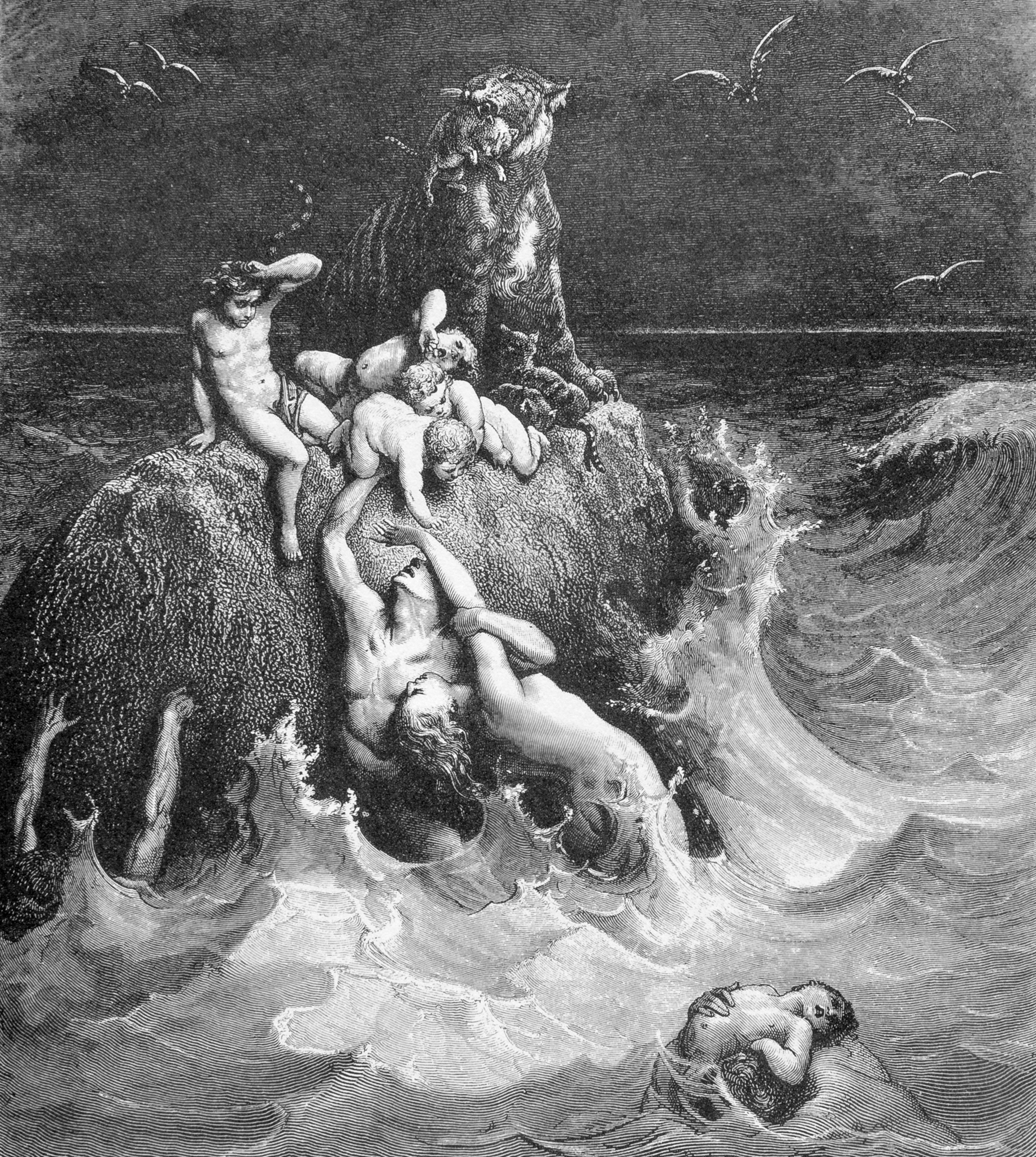
The Deluge, or, If God is Love Then Water is Dry
Announcing, in my roundabout meandering way, the reading of my short story “Stones of Tribulation” by Seth Andrews on his excellent Thinking Atheist podcast. You can listen to it here (or on YouTube or iTunes) and read the text (with footnotes) for free online here. You might even buy my book of these stories when it comes out later in 2016.

The preachers in my old church like to begin their sermons–usually based on some nice familiar text about salvation and forgiveness plucked from the New Testament–by offering up prayers to “our loving and merciful heavenly father.” They mumble the standard intonations requesting God’s assistance with the weak faith of current believers and the lost faith of former ones, occasionally with a mention that He might also lead some of the rest of humanity to His Grace Kingdom. (What’s stopping Him, anyhow?) As a gauzy familiarity descends on the pew-sitters, the image conjured up in their minds is of a slightly crotchety but ultimately benevolent Old Man of a God with this large inheritance to dispose of. In His house are many mansions, and one of them has your name personally engraved on the door.2

Now, He does know exactly what you did last night and with whom. But just as soon as you hear the magic words (as you undoubtedly will during a Laestadian sermon) that all your sins are forgiven in Jesus’ name and blood, He will smile kindly and shake the memory out of His divine head. You will breathe a small sigh of relief, wait for the In Jesus Name, Amen to finally come around, and then go forth from the sanctuary in peace, freedom, and joy. You will avoid being written out of the Old Man’s will, for a few more days, anyhow.

Joshua Spares Rahab

He’s giving you a pretty good deal. The upside is huge after you die (we won’t talk about that nasty potential downside–your sins are forgiven, after all) and in the meantime nobody is getting hurt. At least if you don’t count a little psychological damage, the lost opportunities of a restricted life, and the occasional medical complication from giving birth to that tenth baby.

There’s a problem, though. This vaguely pleasant hands-off deity that I grew up hearing about bears no resemblance whatsoever to the unstable raging psychopath who ranted and threatened and smote his way through the first two-thirds of the Bible. Next time you sit there in the pew, look carefully at the old book’s gilt-edged pages. Most of them will be to the left of where the preacher is reading from, ignored and silent, their horrors left unsaid.

It is impossible to convey here just how much savagery and inhumanity is contained in those pages.3 During the summer of 2009, I spent months reading the Bible from cover to cover. It was tough going, because I kept getting shocked and disgusted by the awful stuff I was encountering for the first time. It certainly wasn’t anything they talked about at church.

One example is enough to make the point.4 Ezekiel 8 tells us that God got upset about some “wicked abominations” that were being committed against him: “seventy elders of the house of Israel” burning incense and surrounded by carvings on the walls of his sanctuary of “creeping things and beasts and detestable things, with all the idols of the house of Israel” (8:10-11), some women weeping for a Babylonian fertility god (8:14), and 25 men prostrating themselves toward the sun and “putting the twig to their nose” (8:16-17). A little weird, but whatever.

God’s response, however, makes the Spanish Inquisition look like small claims court. He called for the executioners of the city to draw near, each “with his destroying weapon in his hand” (Ezekiel 9:1). He commanded that the men of Jerusalem who disapproved of the aforementioned abominations be marked on their foreheads. Then, he directed, “Go through the city after him and strike; do not let your eye have pity and do not spare. Utterly slay old men, young men, maidens, little children, and women, but do not touch any man on whom is the mark; and you shall start from My sanctuary . . . . Defile the temple and fill the courts with the slain. Go out!” (Ezekiel 9:5-7).

It didn’t matter that the women and innocent children had no way to take sides and avoid God’s wrath. When the bodies piled up, theirs lay right alongside those of the men.

———

The Bible-based short stories that Seth Andrews has featured from time to time on his Thinking Atheist podcast are my effort to bring some of this to light, to expose the dark underside of the “Good Book” that fundamentalists would like to foist upon us all. In today’s episode, he reads “Stones of Tribulation,” a bit of Deuteronomy horror fiction I’ve set in a potential future afflicted by climate change, petroleum scarcity, and economic collapse.5

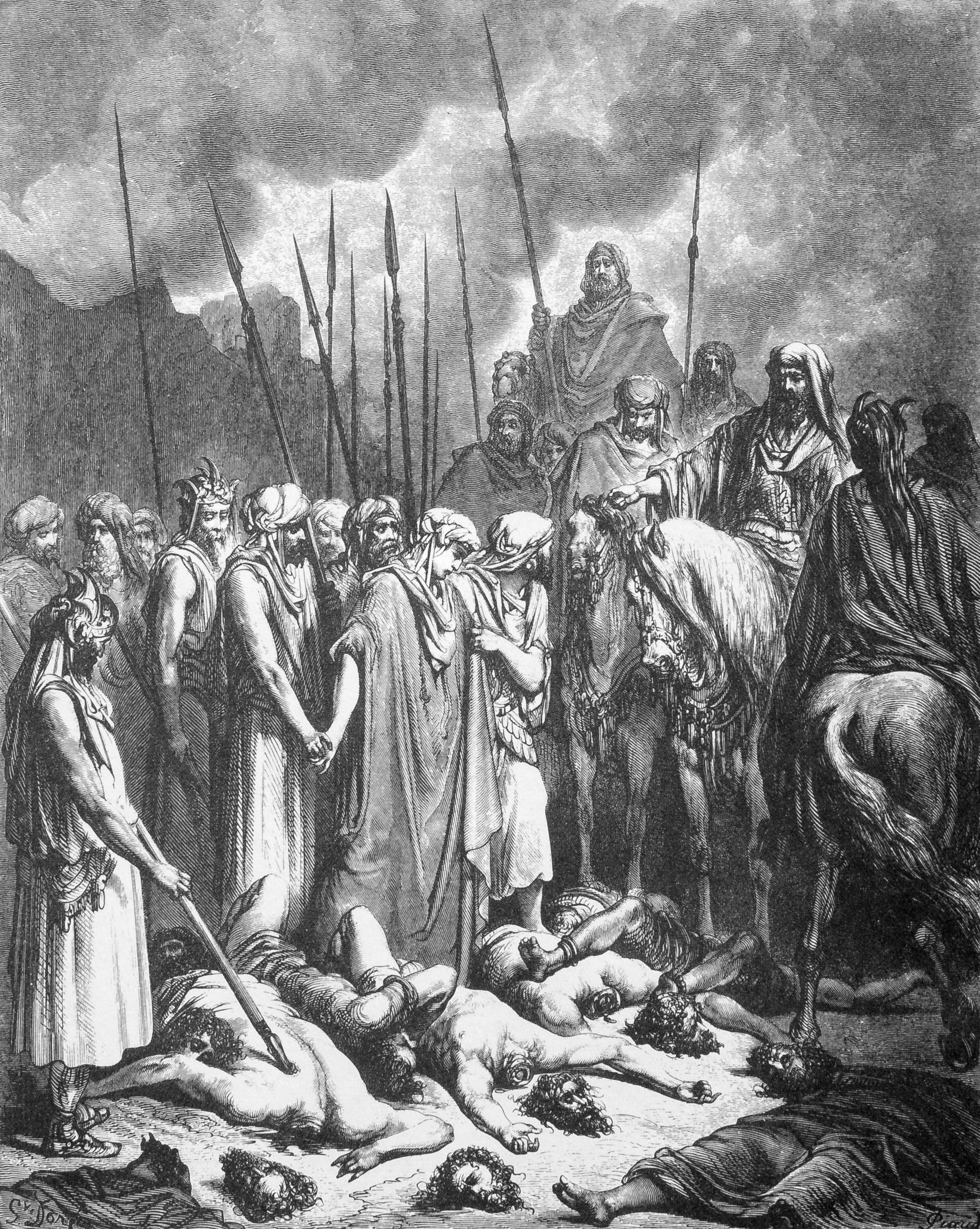
The Destruction of the Armies of the Ammomites and Moabites

You can also read the text for free online here, but I suggest you let Seth’s golden pipes do the reading for you. Check out the footnotes in the online version later, and please consider buying my forthcoming book of all my Bible stories when that comes out later in 2016.

Anyhow, amid all the death and looting, the few remaining authorities were able to spare no attention for the Deuteronomic Church of Holy Reconstruction, a fictional Christian cult using Deuteronomy as a guidebook for con­quering a strech of the Buffalo River in the Arkansas Ozarks. (“So we captured all his cities at that time and utterly destroyed the men, women and children of every city. We left no survivor,” Deut. 2:34.)

With all the cabins and shacks taken over and the former occupants dispatched in proper biblical fashion, the Holy Reconstructionists are keeping things in line with Deuteronomy as a guide there, too. The current project is to carry out God’s judgment against a young woman who did not produce evidence of virginity on her wedding night. The sentence is clear from Deut. 22:20-21:

But if this charge is true, that the girl was not found a virgin, then they shall bring out the girl to the doorway of her father’s house, and the men of her city shall stone her to death because she has committed an act of folly in Israel by playing the harlot in her father’s house; thus you shall purge the evil from among you.

Soon our hero, Jacob Davis, is watching a volley of rocks being thrown at the woman, his sister, by the menfolk of the hollow. She screams and curses at the men, and Jacob wishes he could join in with her cursing, too, but Deuteronomy has a harsh ruling in store for such rebellion: “The man who acts presumptuously by not listening to the priest who stands there to serve the LORD your God, nor to the judge, that man shall die; thus you shall purge the evil from Israel” (Deut. 17:12).

As the narrator then recalls things, there

was sort of a pause as the men reloaded their arms with their remaining rocks Leah’s voice slurred into a long raspy howl as her mouth gaped open, her jaw probably broken now. Levi watched from the porch with folded arms. Jacob stared at his sister, his crude and brave and dying sister, and did not look away. Not from the blood that was trickling out of her nose and gaping mouth. Not from the one eye that was now hooded and bruised. He thought he saw blood coming from there, too. A spinning piece of shale caught her on the cheek, tearing open another gash. A couple of crows rustled and flew out of the pines behind her, spooked by all the noise.

Then the dark and jagged hailstorm opened up again. He watched Leah’s body jerk and flinch and sag with each impact. Every line and color and detail was vivid, and impossibly wrong. He’d seen stonings before, but this one he would remember. There was no call for this. He decided with a sudden spurt of silent rebellion, unfamiliar and shocking and strong in his throat, that he would make it right somehow.

The howling finally stopped. Leah stared up at the sky through the one open eye, her final act a breaking of the endless rules. Jacob figured the last thing she saw was the sun, burning its forbidden image onto her retina until her head slumped forward and hung against her chest, bleeding.

It’s a gruesome scene. But it’s exactly what is commanded by that “loving and merciful heavenly father” in his inerrant and unchanging Holy Bible. You may believe in that God–no concern of mine if you do–but I’m pretty sure you don’t believe in Deuteronomy.

Achan Stoned

There are true believers in Deuteronomy among us, though, and in Joshua, and Leviticus, and all the rest of the Old Testament’s brutal inhumanity. The most hardcore Bible thumpers of them all are Christian Reconstructionists who advocate what one R.J. Rushdoony (rhymes with “loony”) championed as a “biblical worldview.” According to Professor Julie J. Ingersoll, who spent time in Reconstructionist circles and then studied it exhaustively as a scholar of religion, the movement is “rooted in historic Calvinism,” with a Bible that “speaks to every aspect of life and provides a blueprint for living according to the will of God.”6 Reconstructionists, she says,

contend that contemporary re­interp­retations of Old Testament violence are humanistic rejections of what God called justice. The New Testament is not a replacement for the Old; there is no “God of Love” replacing a “God of Wrath.” God is loving and forgiving, and just and vengeful as revealed in the three persons of the Trinity and present at creation. Old Testament biblical law, with its numerous capital offenses, must be the model for Christian life, and civil law today.

Thus they “support the imposition of violent punishments (stoning and death) for all manner of behaviors that they consider sin (or, in their terms, that God considers sin).”

So, you may wonder, why don’t they have the courage of their convictions to put all this biblical wisdom into action? Why aren’t these true believers out there trying to govern some Ozark hollow under Old Testament Shari’a law right now, throwing rocks at back-talking teenagers and brides lacking virginity certification? Because, they insist, “such punishments would only be exacted after society has been transformed by the Holy Spirit such that the overwhelming majority of citizens would be believers who would submit willingly to biblical law.”7

Well, if the failure of Ted Cruz in the Republican primaries is any indication, we may still be safe for a while yet. Thank, er, God.

Rushdooney “argued for the use of the Bible as the only source of authority.”8 He’s dead now, but if you find yourself yearning to have an ancient book control your life without the hassle of, say, converting to Islam and traveling to Syria, there are homegrown Christian alternatives. You might consider my old Laestadianism (“the Holy Bible is the highest authority in questions regarding faith and life”)9 or, for example, the Covenanted Reformed Presbyterian Church. Its list of beliefs begins as follows:

We believe that the Scriptures of the Old and New Testament are inspired by God and thus totally without error. The Bible (not hu­man tradition, not human experience, not alleged sub­jec­tive “revel­ation”) is the sole standard and authority for faith and life.10

And guess what, according to the church’s pastor Brian Schwertley, is the “only standard by which a civil magistrate can rule justly”? The Holy Bible, of course, “the stand-alone infallible Word of God.”11

Pastor Brian writes about “promoting true religion in the land,” which he says is something “godly civil magistrates are very concerned about.” What he seems to have in mind behind those benign-sounding words promoting and concerned is more than just little old ladies handing out flyers at the county fair. He cites First and Second Kings and the story of King Jehu, biblical butcher extraordinaire, to help us understand how these godly civil magistrates are supposed to operate. Jehu, while “not a godly king,” did the right thing: He “was blessed by God for what he did to the prophets, priests, and servants of Baal.”12

The Death of Jezebel (by Jehu’s orders) [Flickr page]

Here’s some of what Jehu did, as described in another one of my short stories, “Jehu’s Jihad,” by a fictional victim of his true-religion promotional efforts:

The chanting stopped, replaced by the screams. There was a mighty rushing roar of shouts and screams, and stamping feet, and the wet smacking thud of iron blades violating flesh. My eyes could make out very little in the dim light with frantic bodies lunging all around me, but I heard and felt, and smelled. Shit and urine voided from panicked and lifeless men. I gulped down nausea with the waves of foul outhouse odors that mingled in my nostrils with the smell of slaughter: dripping, naked guts and the coppery tang of fresh blood.

It was not my own blood, but I made it mine, smearing it on my neck and falling on some bodies and letting more bodies fall on my own. I closed my eyes and lay still as the swords chopped and sliced and swung to chop and slice again. Another body landed, hard, and I wondered if I would still be able to breathe. My chest barely moved as I willed myself to draw long silent breaths from my belly to my gaping mouth. Hot blood dripped onto my arm, first coming in little bursts and then a slow and steady oozing as another life went out.

The screaming became the dying and the dying became the dead, and all was quiet, except the panting and scuffling of the soldiers. I focused my world into the agony of holding my lungs in a measured starvation to stay quiet and alive. My world was the dark mute pressure of dead arms and legs and torsos slick from their bleeding.

Then there were shouted orders and heaving arms, hateful arms, carrying the dead and me outside the temple. I had to let all my weight droop where it fell over the soldier’s shoulder. I stayed silent as ribs cracked under their impossible load and seared my mind with unanswerable pain, my legs swinging with the soldier’s hump-trot to the dirt where he threw my living corpse. Again there were bodies under me, cooler already, and then more on top. Again the silent struggle for secret breath.

It’s another gruesome scene, but massacring an entire worship hall full of helpless people because they don’t share your religion is a messy business. And you will find it in your Bible, a brief, sanitized version of it: 2 Kings 10:18-25.

Slaughter of the Syrians by the Children of Israel

Now, nobody–not even the most rabid Reconstructionist or preciously believing Laestadian–really follows the entire Bible. You actually cannot do it, no matter how crazy you are, because it is impossible to conform to a text that contradicts itself.

Imagine you’re out there at your freshly built backyard altar dripping blood, slaughtering all these cattle and trying to be a good follower of Leviticus. Finally, that old-time religion, you smugly say to yourself while plunging your Ka-Bar into the neck of the next poor beast lined up behind the high compound walls. The BBQ is running out of propane to get it all burnt. Then along comes your wise-ass cousin quoting Micah 6:1-8:

With what shall I come to the LORD

And bow myself before the God on high?

Shall I come to Him with burnt offerings,

With yearling calves?

Does the LORD take delight in thousands of rams,

In ten thousand rivers of oil?

Shall I present my firstborn for my rebellious acts,

The fruit of my body for the sin of my soul?

He has told you, O man, what is good;

And what does the LORD require of you

But to do justice, to love kindness,

And to walk humbly with your God?

Whoops. Beef–it’s what’s for dinner, ex­tra well done.

The less pragmatic reason people don’t actually follow the Bible is that it has a way of interfering with real life. Consider the scene from “Stones of Tribulation” where Jacob is musing about the presence of pork chops at the dinner table of Levi Harding, prophet. Back in Harrison, AR, some of the men had “said Jesus overrode Deuteronomy when it came to what you could eat” (Mark 7:19). But the “others reminded everybody what the Biblical Blueprint Series said about the Old and New Testaments. One guy kept quoting the line Jacob knew all too well: ‘God’s counsel and judgments are not divided!’ That old coot probably couldn’t even taste bacon anymore.”

The Biblical Blueprint Series, edited by Gary North of Fayetteville, Arkansas, is a real work, ten volumes published in 1986 and 1987. It’s one “of the most direct and systematic efforts at popularization” of a “biblical worldview.”13 It teaches some serious biblicism, which would seem to lay to rest any questions about my Holy Reconstruction folks eating cloven-hooved unclean animals, as much as their stoning of Jacob’s sister:

We must never doubt that whatever God did in the Old Testament era, the Second Person of the Trinity also did. God’s counsel and judgments are not divided . . . . If we as Christians can accept what is a very hard principle of the Bible, that Christ was a blood sacrifice for our individual sins, then we shouldn’t flinch at accepting any of the rest of God’s principles. As we joyfully accepted His salvation, so we must joyfully embrace all of His principles that affect any and every area of our lives.14

But somebody else at the Hardings’ (fictional) table “wondered if Deuteronomy really needed to be taken ‘whole hog’ [sorry] when it came to the rules even Jesus said weren’t important. Then Levi’s dad recalled that the guy who edited Biblical Blueprint figured the food laws didn’t apply, and that was the view that finally won out.” Yes, it seems that joyfully embracing all of God’s principles does not quite apply to what’s for dinner. Take a look at North’s 1984 position paper to see how he rationalizes that one.15 If you can stomach it.

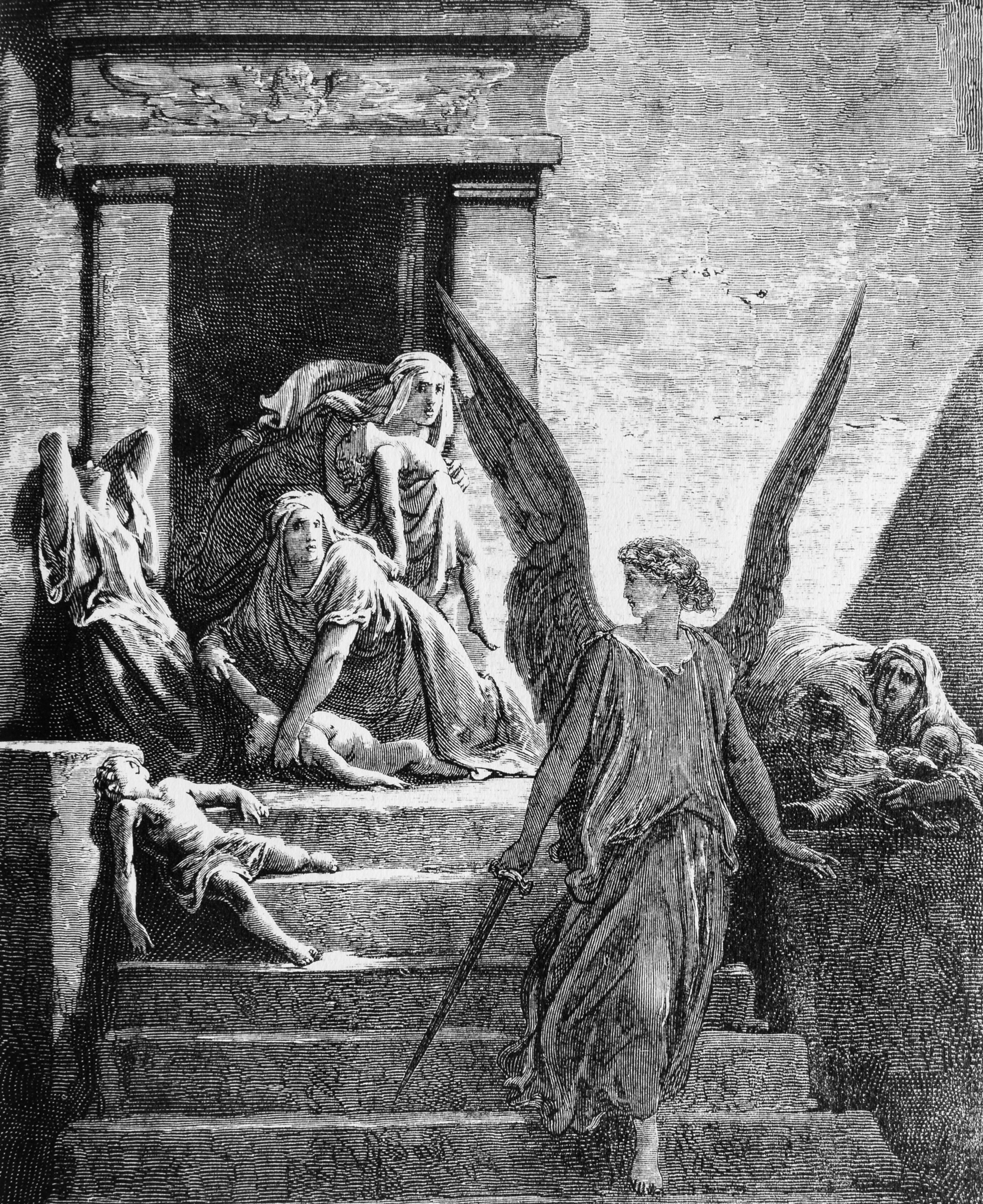
The First-Born Slain [Flickr page]

Many Christians remain blissfully unaware of the Old Testament’s brutality. It barely grazed my consciousness for most of the decades I remained in Christian fundamentalism. For those who do know about it and “ponder why God would allow, much less command, such horrors,” Robert M. Price offers some strong words in Blaming Jesus for Jehovah, a book whose publication I’m proud to have been a part of via my little indie publishing company Tellectual Press.16

Just knowing and wondering isn’t good enough, Dr. Price says. That is “stopping short of the real question,” which “is this: ‘Why should I believe that a God who issues such orders is more than a tribal totem embodying and justifying the bloodlust and hatreds of an ancient people? How can I, with any shred of conscience, profess allegiance to such a figure?’”

Fine, you have the information. You have the doubts, the questions. Now, what are you going to do with them?

What if you are willing to discount those passages in which God commands genocide and infanticide as merely the biases of primitive worshipers of a God whose loving nature is clearer to us moderns? Then plainly you must realize that, even if scripture explicitly says, “God commanded so-and-so,” that doesn’t mean he did. Don’t you realize you’re admitting the Bible was mistaken? And then, how do you know when it’s not mistaken? I come back to my point: Your judgment is your authority, not the Bible, which many seem to “believe” only when they agree with it.

And that’s nothing to be ashamed of! The only thing to be ashamed of is hiding behind the supposed authority of the Bible to buttress your own opinions. If you have the courage of your convictions, surely you should be able to present to another person the solid reasons that led you to think as you do. Assuming there were any real reasons.

If you were raised believing in the murderous faith of the Islamic Caliphate, you might have qualms about some of the things your leaders said Allah had commanded, but you’d be looking at things from the inside, and you’d chalk it up to “one of those divine mysteries.” But you are, thankfully, viewing their atrocities from outside, so you have no difficulty recognizing the horrors of a death cult for what they are.

“If the Old Testament Jehovah is portrayed as the blood-spattered totem of a slaughter cult,” and Dr. Price thinks the Bible does a fine job of that, as do I, then “it is high time you stepped out of the Bible bubble for an objective look at it. It is time you decided if you really belong there.”17

Dr. Price goes on to discuss the equivocation of “God’s defenders” when confronted with all this. “They like to point out that God is so astronomically far above us that it’s futile for us to imagine ‘good’ meaning the same thing for him as it does for us.” Uh huh. OK, fine; say

that a deity who commands genocide, religious persecution, and the abduction of virgins is nonetheless “good” if you want to. But then you will just be spewing pious gibberish. God’s ostensible goodness is no longer any guide to what we may expect from him. Oh yes, he’s “good,” thank goodness, but that doesn’t mean he won’t victimize or exterminate the innocent. Whatever he did, the pious apologist has ready excuses for his God. “He’s all-righteous, so he must have some good reason for it!” If you woke up in hell one fine morning, despite your Christian faith and God’s promise that it would save you, I guess you’d have to conclude he must know what he’s doing.

Ours is not to reason why; ours is but to boil and fry. Maybe so, but why empty the word “good” of what we all mean and understand by it by applying it to such a being?18

It’s not just Christians who are compelled to make excuses for these ancient books. Todd Kadish, a former Orthodox Jew, tells me that “the atrocities contained in them are “an albatross weighing down the moral authority of ethical monotheism.” Worse, they can offer a “license for ethnocentrism or even atrocities” perpetuated today, in some pious fantasy world where the ability to do so would actually present itself. The Orthodox can’t just wave away the sacred words on the Torah scroll, because they “consider the Five Books of Moses the vehicle through which a transcendent God touched humanity, and the eternal guidebook he personally authored for his chosen people.”

Kadish acknowledges that the real-world consequences are very different for a reluctantly tolerated albatross and an enthusiastically embraced bad-behavior license. But he warns Jews and others who revere the Hebrew Bible to focus on the common source of the two positions:

The views of a liberal (“Modern”) Or­thodox rabbi writing apologetics and a radical Orthodox Jew who justifies the murder of innocent Palestinian children by citing Biblical precedent are both seeking to apply the morality of a being they consider the source of (or at least guide to) morality to the modern world. But the world largely moved beyond total warfare centuries ago, and most of us are now trying to lay to rest a history of racial and religious genocide which stretched into the modern era (with Jews as some of its primary victims). And the Hebrew Bible is a truly terrible foundation doc­ument for a moral code that demands ethics in warfare and respects all human life, because it leaves one with apologetics at best or license for atrocities at worst.19

———

Happily, for those of us outside the fanatic fringes of Christianity or Judaism, the Hebrew Bible is in no position to make any more demands. We have read it and tossed it aside in disgust, dismissed it as irrelevant to our lives, or rationalized it away under some comfortable theory about Jesus fulfilling the Law. Reconstructionism, never a big part of American religion to begin with, has retreated to its bunkers.

Though Professor Ingersoll notes that “conservatives (Christian and secular) have not disappeared” and expresses concern about lingering influence from the Reconstructionist lunacy she’s studied for so long,20 today’s conservativism seems to be a largely secular phonenomen. The snarling theocratic fantasy of Ted Cruz’s candidacy has evaporated, and the amoral authoritarian gasbag left standing at the head of God’s Own Party exhibits no significant religious convictions. Meanwhile, one contender for the Democratic Party nomination says he is “not particularly religious,” and the other one–the woman who will be the next U.S. President–is a pro-choice Methodist not exactly beloved by the Religious Right.

Through no fault of the Bible, our nation and world remain infested with ignorance, superstition, bigotry, and violence. We certainly are not headed for any secular utopia as we leave that nasty old book behind. But perhaps some of what another Ingersoll–the genius orator Robert Green Ingersoll–promised a hundred years ago finally might be happening:

Day by day, religious conceptions grow less and less intense. Day by day, the old spirit dies out of book and creed. The burning enthusiasm, the quenchless zeal of the early church have gone, never, never to return. The ceremonies remain, but the ancient faith is fading out of the human heart. The worn out arguments fail to convince, and denunciations that once blanched the faces of a race, excite in us only derision and disgust.21

It is long overdue.

Paul wrote that he was pressing “toward the mark for the prize of the high calling of God in Christ Jesus.” Forget those things that are behind us, he said, and reach forth unto those things which lie before us (Phillipians 3:13-14). Lofty words, and a worthwhile thing to adapt for ourselves as we smile at Paul and Peter and whoever wrote all the rest of it: Let us press toward the prize of our own high calling, of our best and noblest selves and community and shared humanity.

Let’s forget the tribal atrocities and cruel punishments in this tired old text that’s occupied too many of us for far too long, and look to what lies before us–writings and thoughts that speak to us where we are today as compassionate, decent human beings, that serve us, that earn the space they ask for inside our minds.

———
All images are my photographic reproductions of Gustav Doré‘s incomparable (and, thankfully, public domain) engravings of Bible illustrations. Taken in full sun from The Bible in Pictures, Wm. H. Wise & Co. (1934) with a Panasonic Lumix DMC-LX7 camera and post-processed in Adobe Lightroom. Click on any image for an enlarged version.
“Stones of Tribulation” is a work of fiction. Names, characters, businesses, places, events, and incidents are either the products of the author’s imagination or used in a fictitious manner. Any resemblance between characters and living persons is purely coincidental.
Scripture quotations taken from the NASB unless otherwise indicated.

Notes


  1. llchurch.org/​topics/fromachild1.pdf 

  2. John 14:2. I actually heard a preacher say the “personally engraved” line once. 

  3. This paragraph and those that follow up to the next section break are adapted from my essay “Fighting Words,” originally posted May 11, 2012 on the Learning to Live Free blog. 

  4. You can read about many more examples in my book An Examination of the Pearl (2012). See my discussion of the Old Testament in Section 6

  5. It’s a topic for another essay entirely, but I do believe those three issues–climate change, petroleum scarcity, and economic collapse–may well lead us to a dystopian future like what I wrote about in “Stones of Tribulation,” and in not too many decades down the road. And you can count on all sorts of religious crazies to come out of the woodwork if it does. 

  6. Julie J. Ingersoll, Building Gods Kingdom: Inside the World of Christian Reconstruction (Oxford University Press, 2015), p. 14. 

  7. Ingersoll at p. 214. 

  8. Ingersoll at p. 211. 

  9. “How We Believe,” llchurch.org/​ourbeliefs.cfm

  10. reformedonline.com/​about.html 

  11. Brian Schwertley, “Political Polytheism,” 2003, reformedonline.com, p. 60. 

  12. Schwertley at p. 60. 

  13. Ingersoll at p. 54. 

  14. Quoted in Ingersoll at pp. 54-55. 

  15. Gary North, “The Annulment of the Dietary Laws,”
    I.C.E. Position Paper No. 2 (Nov. 1984),
    garynorth.com/​freebooks/docs/a_pdfs/​newslet/position/​8411.pdf

  16. Robert M. Price, Blaming Jesus for Jehovah: Rethinking the Righteousness of Christianity. (Tellectual Press, 2016), p. 61. 

  17. Price at pp. 61-63. 

  18. Price at pp. 63-64. 

  19. Todd Kadish, personal communication June 6, 2016. 

  20. Ingersoll at p. 244. 

  21. Robert Green Ingersoll, “Lecture on Gods.” 


Wednesday, April 27, 2016

Metamorphosis

It is not that we have a short time to live, but that we waste a lot of it. Life is long enough, and a sufficiently generous amount has been given to us for the highest achievements if it were all well invested.
—Seneca, On the Shortness of Life, trans. C.D.N. Costa
Tracks toward the light [Flickr page]

My very public departure from the Laestadian Lutheran Church–a conservative, exclusivist sect of Protestant Christianity–has put me in touch with many others who struggle inside this group and who have left it. One of them recently sent me these thoughts about her metamorphosis from fundamentalism to freedom. She gave me permission to convey them anonymously through this blog to those who had–with the very best of intentions–cocooned and caged her.

———

GENERATIONS have told you how to mold me. What to think. How to feel.

Bring her to the sacred place.

She will follow your lead.

Separate her from the world.

Tuck her into your safe cocoon.

Clip her wings and put her in a cage.

Feed her with approval of her obedience

and shame her with guilt over her transgressions.

I let this happen. I let your fear tactics rule my thoughts and actions until I could no longer hear my heart song.

I tried to find my own way, but it threatened to separate me from all I had ever known. I was scared. You made me fear the world outside of my cocoon. So I took your medication and ate your damn poison until I was too sick to fight back.

You almost broke me. Almost.

My consciousness is finally agitated enough by the imprisonment of my spirit.

I see it now. . .

The big picture!
I’m breaking out of my cocoon!

Slowly but violently shedding the old. It’s uncomfortable at times in this transformative state. Loss and grief are an essential part of this transformation.

Destroying the old brings separation from those you love. I feel their love is conditional. But I am remembering what I forgot, before my world was darkened with fear and shame. Moments of unhindered bliss and awakening joy are replacing the old. Transformed and reset!

My only regret is that I didn’t see this sooner. I made a life for myself, only to realize it’s never really what I wanted. My soul didn’t want this hectic production of being so busy you can’t hear yourself think.

I’ve literally gone out of my mind, to truly use my mind for myself! I’ve had to scramble myself in order to put me back together in a new form. The next level of my life requires a new me!

I’m ready.

———

Yes, indeed, I think she is.

Eventually, so will you others whose anguished stories I’ve heard, who know that you no longer believe what you were told as children–what some of you have in turn told your children. Someday, the painful metamorphosis will finally occur for you. But don’t let too much of your life continue to pass you by before it finally happens.

Day after day, in newfound bursts of frightening clarity, your mind shouts the truth at you, and the only response your preachers have is to tell you not to listen to it. “One of Christianity’s most toxic teachings is that we must not trust our own minds and emotions,” Dr. Valerie Tarico, a psychologist and former Christian, told me after reading this piece, which she thought was powerful, as do I.

“In particular,” she added, Christianity asserts that “we dare not trust our intuitive sense of the basic goodness in people around us and ourselves.” But when you finally dare to make those first tentative friendships with the scary people of “the world,” when you see the continued love and joy in those former brethren whose longtime friendships you refuse to end, you see that basic goodness. You can’t help but see it, and delight in it, and witness yet another case of your dreary preachers being wrong.

New life [Flickr page]

Another amazing thing happens when you open up that cocoon and expose yourself to the experiences of all those “unbelievers” outside the church walls. You see not just how varied and fascinating they all are, but how similar many of their experiences are to yours. You realize that the fear and pain of leaving their “dead faith” churches is every bit as real to them as leaving yours has been to you. And then another chink appears in the wall that separates you from all of them, that great undifferentiated mass of outsiders who now have faces and voices and feelings, and the hole is almost big enough for you to finally crawl through.

“Reading this was very much like looking at my own reflection in a mirror,” said Brenda Nicholson, a survivor of the Fundamentalist Latter Day Saints (FLDS) cult. It took her a few minutes to respond to my question because she was still in class (“Foundations of Business and Elements of Effective Communications”), a quite different setting than she could have imagined for herself while back in Colorado City, wearing the required swept-up hairdo and plain pastel dress and trying to have all the required babies, despite miscarriage after miscarriage. “I found myself unconsciously nodding in agreement to every line. Yes, it is the same story from different backgrounds! The aspects of control through ‘breaking’ a person is so real–and far too often so effective.”

She also wishes that she’d seen the truth sooner, “that I hadn’t sacrificed so many years of my life to a lie.” Our stories, she said, “have a different background, but our journey is the same.”

Like Dr. Tarico, Brenda used the word “powerful” to describe this piece. “It touched deep inside at the hurt I’ve experienced.” She asked me to give my anonymous correspondent her “most sincere congratulations and admiration” and best wishes on this new life. Mine, too, along with my hope that all those others will soon find their own freedom as well.

Tuesday, November 10, 2015

Frozen and the Chosen

It hit me as I was walking home–I could think anything! I could have any opinion on any subject, and it would be my own! No longer would I have to check against Scripture and other doctrine to make sure that my opinions were in line with God; I could decide my opinions with my own reason! . . . That moment was one of the most liberating, beautiful, and happy experiences of my life.
—Michael Amini in Generation Atheist, Dan Riley, editor (2012)
[T]he whores of the world wash their hands in the blood of creatures, but the daughters of Jerusalem do not wash themselves in the blood of the innocent Lamb, but with soap and with lye, and nevertheless their filthiness is visible.
—Lars Levi Laestadius, randomly selected passage from a random sermon (Palm Sunday 1854).
Kristoff Levi Laestadius, reindeer fan

Last week, I went with my wife and some of our kids to see the Disney on Ice figure-skating adaption of the musical movie Frozen. It was great fun to see Anna and Elsa zipping around the rink with Olaf, Kristoff, and Sven, who materialized as a rather large reindeer comprised of two skaters inside a furry brown costume. When Elsa went out on the ice under blue light for her big solo act, two little girls sitting behind us sang along at the top of their lungs: “Let it go, let it GO!”

A husband-and-wife pair of composers wrote Let it Go as “Elsa’s Badass Song,” specifically intended to be sung by Idina Menzel, “one of the most glorious voices of Broadway.” They succeeded brilliantly. The song is the highlight of the film and has sold over 10 million copies on its own.1

Lamplit Tree [Flickr page]

I first heard it while sitting in a theater with my family nearly two years ago. This was still a fairly novel experience after a lifetime of being told–and then allowing it to be told to my children–that seeing movies is a sin. Laestadianism and its oddities were still very much on my mind as I watched Anna make her cute wisecracks and accompany a socially-inept ice merchant and his furry best friend on a quest that included, among other delightful implausibilities, a visit with some witty and wise rock-rodents who dispensed relationship advice.

“So he’s a bit of a fixer-upper,” they sang about Kristoff while working on setting him up with Anna. Aren’t we all, I thought, musing about all the mental remodeling my wife and I were doing on ourselves and our older children, after the nonsense we’d all heard for years and years sitting alongside each other in a very different setting.

When Elsa finally broke out of her self-imposed shell, flung out her arms, tossed back her head, and proclaimed that she wasn’t going to hold back anymore, I felt like applauding.

Conceal, don’t feel, don’t let them know

Well, now they know!

Yes! You go, girl! I silently cheered, feeling a bit embarrassed about how emotional I was getting watching this movie. But there was a good reason for it. For a year, I’d had to “conceal, don’t feel, don’t let them know” what I’d learned from some diligent and sincere research about my childhood faith. Sharing that information with a few friends in the church got me hauled into a meeting with my local congregation’s preachers and board of trustees.

After a two-hour inquisition, having been told I was to retrieve the dozen or so copies of the book I’d given away, “I went home and told my wife, ‘You are about to witness the intellectual disintegration of your husband.’ Then the years of doubt, fear, and frustration–culminating in being muzzled into silence by a church far more interested in rebuke than reality–boiled over. I collapsed into my wife’s arms in tears, and went to bed for a fitful night.”2

Let it go, let it go

Can’t hold it back anymore

Let it go, let it go

Turn away and slam the door!

After some months, I just couldn’t hold it back anymore, either. My half-hearted promises to stay away from dangerous studies didn’t stick, of course, and I “learned and questioned more about church history, the Bible, and aspects of science that conflicted with important points of doctrine.” I also “lost the energy to continue swimming against the current of the church’s clannish, insular social scene,” which treated my family and me like we all had some dangerous and contagious disease once my doubts became known.

I was ready to “shake off the muzzle” and put into print what had “been swirling around my head and flagged in the pages of my library of books.” The result, An Examination of the Pearl, wound up being more than twice the size of the print-shop copy that had gotten the elders so bent out of shape.

Given the outraged reaction I encountered to a very limited, private distribution of the book, which consisted mostly of church statements and relatively restrained footnotes about those statements, I have no illusions that this published edition will be well received. As Ken Daniels noted about his own book, “whether I take a gentle or harsh approach, I am sure to elicit criticism. The very act of confronting deeply cherished religious convictions is unforgivable to some, regardless of my tactics.”3

Frost on Ponderosa [Flickr page]

I’m not the only one who has been moved by Let it Go as an anthem of liberation from fundamentalism. Blogger “Libby Anne” wrote about that in March 2014, after being shocked at how much her conservative evangelical mother obsessed over the movie. “How could they see Frozen and not realize that it was about self acceptance and freedom from others’ expectations–and moral standards?” she wondered.

When she first watched Let it Go on YouTube,

before seeing the movie in theaters, I completely choked up at the line “no right no wrong, no rules for me.” Tears started streaming down my cheeks. It was beautiful. I grew up in a conservative evangelicalism that I eventually found highly restrictive. As I began to extricate myself, my family and friends put me through a special kind of hell. But even through all of the pain and the tears, I entered into freedom when I left behind their rules, their expectations, their control. This song spoke to so many emotions. I’ve watched it again and again many times since that first time, and each time I’ve achieved some form of catharsis.

It’s now her personal theme song, she says.4 Another blogger, Maranda Russell, says she fell in love with the song as soon as she heard it:

At times in my life I felt like I had to hide my true self to get approval and love from friends, family and the church. I had to pretend to be a “good girl” who never questions anything and believes blindly what I am told. I still feel like many wish I would just shut up and believe what they tell me is true, but I just can’t do that anymore.5

I don’t care

What they’re going to say

Let the storm rage on,

The cold never bothered me anyway!

Maranda admits that “maybe I still care a little (after all I am still human), but I won’t let it rule me.” I did, too, about what I knew my “brothers and sisters in faith” were going to say, but I went ahead anyway. A storm would rage, friendships would be lost–most of those that I’d forged since childhood, it turned out, in a church that discouraged social contact with the outside world.

And the stakes were infinitely higher than what one friend called “social suicide”: Publishing the book against the wishes of the Laestadian Lutheran Church would inevitably be viewed as an act of apostasy, no matter how balanced I tried to be in presenting my findings. Eternal damnation loomed in my future.

To those who tell me my writing was courageous, I reply that it took less courage then what many of them have done–simply walking away. I needed to have my brethren push me out instead, simply for making the facts known, asking difficult questions about them, and refusing to accept the tired old insistence that the most important matter of one’s life “cannot be understood by reason.”

My introduction to the book quoted Clement of Alexandria from 18 centuries earlier: “If our faith is such that it is destroyed by force of argument, then let it be destroyed; for it will have been proved that we do not possess the truth.” Recalling the “faith” of a board member who said he won’t read anything critical about what he supposedly believes,” I asked if that was

really faith in anything other than the people around him who are repeating the old slogans? They, too, are ignoring the facts about their “faith,” making the whole thing a self-sustaining doctrinal bubble that quivers unsteadily in the air, vulnerable to being poked by the slightest intrusion of fact.6

Looking Back [Flickr page]

Now, nearly four years later, these words from Let it Go are exactly my experience:

It’s funny how some distance

Makes everything seem small

And the fears that once controlled me

Can’t get to me at all!

There is simply no fear anymore. And it’s not for any lack of knowledge about what this weird little sect thinks my eternal fate will be. Hell, I still listen to sermons sometimes to get to sleep, because the preachers’ somber, familiar, repetitive intonations send me drifting off faster than anything else. Sometimes I get several nights’ worth of use out of a single sermon, because I start the iPod at different points in the recording and am out within ten minutes.

One correspondent told me, “My old Laestadian world view is gone. If I talk to certain people or listen to sermons I can feel the world view there and experience it sometimes. I don’t think it’s ever coming back, though, and I am the better for it.”

Yes, my friend, you are. And, as Elsa sings out, fully embracing her unique identity and abilities, “one thought crystallizes like an icy blast”: You’re “never going back. The past is in the past!”

———
The picture of Lars Levi wearing Kristoff’s reindeer-hide coat was fair-use adapted from a Frozen wallpaper image and a classic portrait of Lars Levi Laestadius. Take a look online at Laestadius’s sermons and you’ll quickly see what I mean by the “People suck” paraphrase. He was not a happy man. The fictional Kristoff of Frozen seems to have had a more meaningful “conversion” experience with Anna than old Lars ever did.
The other photos are Copyright © 2013-15 Edwin A. Suominen. Click to enlarge, or check out my Flickr photostream. You may freely use them for non-commercial purposes, with attribution, under the Creative Commons Attribution-NonCommercial 3.0 Unported License.
See the online Dictionary of Christianese for an interesting discussion of the expression “frozen chosen.”

Notes


  1. Wikipedia, Let it Go

  2. An Examination of the Pearl, §1.2 (“Introduction–Disputation– The June 2010 Edition”). 

  3. §1.2 (“Introduction–Disputation–Alienation”), quoting Ken Daniels, Why I Believed: Reflections of a Former Missionary (self- published, 2010). 

  4. “Let It Gay? Subversive Messages from Disney’s Frozen,” Love, Joy, Feminism blog, March 4, 2014 

  5. “What the Disney ‘Frozen’ song ‘Let It Go’ means to me,” Maranda Russell blog (April 25, 2014). 

  6. §1.2, quoting from Clement’s Stromata, 6.10.80. William Wilson’s translation, freely available online, goes as follows: “But if the faith (for I cannot call it knowledge) which they possess be such as to be dissolved by plausible speech, let it be by all means dissolved, and let them confess that they will not retain the truth. For truth is immoveable; but false opinion dissolves.” 


Tuesday, September 22, 2015

The Forgiver

For we, like children frightened of the dark

Are sometimes frightened in the light–of things

No more to be feared than fears that in the dark

Distress a child, thinking they may come true.

—Lucretius, On the Nature of Things, c. 50 BC, tr. Ronald Melville.
Forbidden fruit: The new Receiver tries to do some giving.
Review: The Giver by Lois Lowry. Houghton Mifflin (1993). Movie adaptation produced by The Weinstein Co. (2014).

The other week, I watched The Giver on DVD with my wife and a few of my kids. It’s a 2014 film adaptation of Lois Lowry’s 1993 book about a future collectivist society that does away with all but a bland, utilitarian remnant of human emotion and ambition. “The community” has even eliminated history from the minds of its people, with one significant exception.

A single chosen individual, the “Receiver of Memory,” is designated to take care of recalling past civilizations and events. This exalted and burdened person is set apart with an exclusive collection of books and memories, which he keeps to himself except to cryptically advise the Elders in their decision-making.

Eventually, the Receiver takes on an apprentice, to whom he passes all that knowledge and memory. The selection of a new Receiver “is very, very rare,” as the community’s Chief Elder tells her community at the Ceremony of Twelve,1 where young people are being assigned their occupations with much fanfare, and without any say in the matter. “Our community has only one Receiver. It is he who trains his successor.”2

The story’s hero, Jonas, is named as that successor. “I thought you were The Receiver,” Jonas tells him during their first teaching session, “but you say that now I’m The Receiver. So I don’t know what to call you.” Call me The Giver, the old man says.3 And from him Jonas goes on to learn some amazing and troubling things. His life will never be the same again.

———

Around the end of 2010, one of my daughters had been assigned the book in school, and I wound up reading it myself. At the time, I was in the early stages of researching the doctrine and history of my old church. The things I was starting to learn would turn my own life upside-down and result in my first book, An Examination of the Pearl, about a year later.4

I was stunned by the parallels between Lowry’s sheltered, intellectually stunted community and the “Kingdom of God” in which I’d been struggling. After a lifetime as one of “God’s children,” I’d finally started to look at my odd little church in a clear-headed way. What I was seeing disturbed me a great deal, and so I put together a listing of church writings with footnotes stating some of my concerns. I had it printed and bound into a dozen softcover copies that I shared with a few friends in the church. Oops.

In September 2010, I was hauled before the church board of trustees and preachers for a stressful, coercive, and emotional meeting about my little copy-shop book. “Are you really believing?” I was asked. Beyond some concern about how I could dispute what “God’s Word” teaches regarding Adam and Eve and Noah’s Ark, there wasn’t much substantive discussion of what the book actually had to say. It was mostly about me for having said it.

Repent or Else

They told me the book was an expression of my doubts, which would have been best kept to myself or private conversations. It could be dangerous if it fell into the wrong hands, they said. It would leave the impression among outsiders that there are dif­ferences of opinion in “God’s Kingdom.” And it is certainly not something that believers should be reading. After over two hours of this, the meeting concluded with the understanding that I was to retrieve copies of the book.5

Just a few months after that experience, here I was reading about a closed community of myriad rules and “appropriate remorse” and public apologies, where uncomfortable history was extinguished from memory, where intractable rule-breakers were released to “Elsewhere.” And I was seeing a frightful near-future version of myself in Jonas, not some lofty hero but simply a wide-eyed seeker of truth–unable to tolerate cen­sorship and propelled by an irresist­ible call to look at reality, at long last, come what may.

Comparing Lowry’s all-controlling community with Christian funda­mentalism doesn’t seem to be a unive­rsal or even a com­mon interpretation of her book,6 but she would be happy to let me keep it as my own. “A book, to me, is almost sacrosanct: such an individual and private thing. The reader brings his or her own history and beliefs and concerns, and reads in solitude, creating each scene from his own imagination as he does.” And I was certainly interested to see her recall a “man who had, as an adult, fled the cult in which he had been raised” telling her “that his psychiatrist had recommended The Giver to him.”7

———

The first thing that jumped out at me was the rigid structure of rules that govern life both in Lowry’s dystopia and for the “believers” in the Laestadian Lutheran Church. Community members are careful to maintain “precision of language,”8 while believers do not swear, tell dirty jokes, or speak light-heartedly about faith matters. Each family unit of the community receives two children–no more–while believing parents are to accept as many children as they are “given”–no less. Community girls are instructed to keep their hair ribbons “neatly tied at all times”9 while believing girls are instructed not to wear earrings, make-up, or spaghetti straps.

Even a minor rule like the one against bragging (there is “never any comfortable way to mention or discuss one’s successes without breaking the rule against bragging, even if one didn’t mean to”) is best followed by steering clear of occasions where breaking it would be too easy.10 Thus believers have restrained themselves from playing violins in orchestras where they might get “puffed up” in their talents, even if they would just be one of many players helping to produce one of the few types of music to which they can listen in good conscience. Thus many an athletic Laestadian boy has walked home while his unbelieving sort-of friends go off to football practice. God’s glory must not be given to another, and the world cannot become too close.

And then there are those Stirrings, which begin for young Jonas with a dream about a girl his age. He describes it to his parents during a “sharing-of-feelings” rap session they are expected to do over dinner each day. (“Be free,” the board members would tell us during the many congregational meetings of my youth.) In the dream, he and the girl were in front of a tub in the House of the Old, where the elderly get cared for in their final days.11

“I wanted her to take off her clothes and get into the tub,” he explained quickly. “I wanted to bathe her. I had the sponge in my hand. But she wouldn’t. She kept laughing and saying no.”

His father asks Jonas about the strongest feeling he experienced during the dream.

“The wanting,” he said. “I knew that she wouldn’t. And I think I knew that she shouldn’t. But I wanted it so terribly. I could feel the wanting all through me.”12

His parents look at each other and Jonas is then told about the Stirrings.

He had heard the word before. He remembered that there was a reference to the Stirrings in the Book of Rules, though he didn’t remember what it said. And now and then the Speaker mentioned it. ATTENTION. A REMINDER THAT STIRRINGS MUST BE REPORTED IN ORDER FOR TREATMENT TO TAKE PLACE.13

In the dystopia of The Giver, the treatment is medication, taken every day to deaden a person’s natural sex drive until it finally disappears in old age. In Laestadianism, the treatment is the forgiveness of sins–dispensed in a sermon every Sunday and, if parents are following recommended procedure, in the words of absolution being preached to their children at bedtime every night.

Believe all sins forgiven in Jesus’ name and precious blood, the young innocents are told, night after night by parents or siblings. That proclamation offers redemptive relief for all sins, and does the job in most cases, certainly from sinful thoughts of providing erotic bathing assistance to the cute girl or boy next door. If one’s Stirrings have moved beyond mere fantasy to masturbation or–heaven forbid–to a little kissing and heavy petting behind the garage where the yard light don’t shine, guilt pangs may persist despite the generic assurance of forgiveness. The preachers recommend confession in such cases.

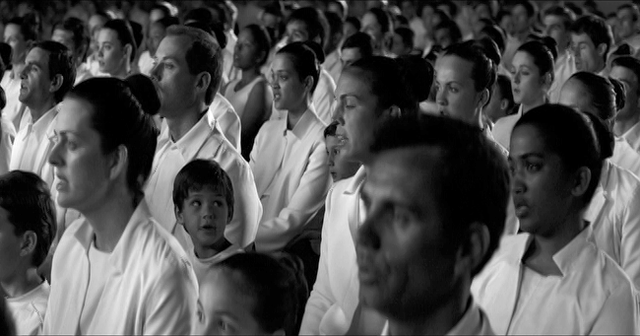
The assembled community: Looks a lot like church to me.

Confession was a big deal in Laestadianism during my childhood. Most sins beyond mere impure thoughts, doubts, etc. were considered to remain on the conscience until one had spoken of them “by name.” It was not an absolute requirement to confess, but was widely expected, at least for those infractions falling into a non-biblical category of “name sins,” a category that was often referred to but never very specifically defined.14 A 1978 article from the church newsletter pretty well encapsulates how things were back then:

It is never an easy matter to repent of sins for the flesh fights against the Spirit. But sin has a name, and those named sins will not go away without our speaking of them to a dear brother or sister. We are assured that we can freely go to a dear one and open our heart. But those sins that have affected the congregation of God are to be re­pented of before the con­gregation; otherwise we will not receive freedom.15

That last part about repentance before the congregation offers a hint of the public confessions that people often made after the Sunday morning service when I was a kid. In my congregation and at least some others in North America, members would head up to the front of the church after the ser­mon and ask the en­tire con­gregation for forgiveness of various sins.

During the congregational “caretaking” meetings that were a regular Saturday night event, where some issue or person(s) of concern would be discussed with much emotion, such repentances would go on and on.16 I’ll always remember one of them in particular, from a young father who dutifully walked up to the microphone and asked forgiveness of the congregation for “reading filthy literature.” Poor guy. It was probably just a paperback novel with a vague sex scene or two.

With all those memories in my head, you can see why I saw some Laestadian parallels in Jonas’s recollection of his friend Asher showing up late to class:

“When the class took their seats at the conclusion of the patriotic hymn, Asher remained standing to make his public apology as was required.”

“I apologize for inconveniencing my learning community.” Asher ran through the standard apology phrase rapidly, still catching his breath. The Instructor and class wait­ed patient­ly for his ex­planation. The students had all been grinning, because they had listened to Asher’s explanations so many times before.

“I left home at the correct time but when I was riding along near the hatchery, the crew was separating some salmon. I guess I just got distraught, watching them.

“I apologize to my classmates,” Asher concluded. He smoothed his rumpled tunic and sat down.

“We accept your apology, Asher.” The class recited the standard response in unison.17

“I’d like to ask forgiveness for, er, reading filthy literature,” the Laestadian Asher stammered, looking down at the floor. Believe all your sins forgiven in Jesus’ name and blood, replied the congregation with their standard response, in unison.

———

Back in those bad old days, there was another chilling parallel to The Giver. It was release from the community, the Laestadian form of which we called “binding.” Believers would be bound in their sins, and any requests they made to be forgiven would be denied unless it was decided that they were being specific and penitent enough about the issue at hand. Usually, there was some “false spirit” at the heart of the matter, which needed to be exorcised by being named in the confession.

This was a sad outcome of many “care­taking meet­ings” that were common­ly held to discuss the spiritual state of individual congregation members. Such a meeting was considered the third step in Jesus’ instructions regarding the rebuke of a brother who has caused offense (Matt. 18:15-16). Offense was taken not so much for individual actions against another member but as a result of the wayward one’s observed sins (e.g., acquiring a television) or erroneous doctrinal views.

In a 1971 newpaper article, the Finnish counterpart to my North American Laestadian church had set forth the binding procedure in no uncertain terms: “If the ones spoken to do not humble themselves to repentance, consider them pagans and publicans and refuse them membership in the association. The disobedient are not to be greeted with the greeting of God’s children.” My old church took “precisely the same stand in America” three years later.18

“For a contributing citizen to be released from the community was a final decision, a terrible punishment, an overwhelming statement of failure.”19 In The Giver, release was just to “Elsewhere.” Nobody but the Planning Committee knew exactly where the released person went.20 We readers, along with a wiser and sadder Jonas, come to realize that release actually involves death, not mere departure.

The horror and injustice of the community killing off its members–not just for disobedience, but for perceived unfitness at birth or just running out the clock on one’s old age–is what propels Jonas to take drastic action as the apprentice Receiver. Obviously, it would be a stretch to draw much of a parallel there, but it’s worth mentioning what a sad impact the Laestadian practice of binding did have on people.

Beyond the gate: Actually a good place to be. [Flickr page]

I personally witnessed it several times as a youth. It is quite unforgettable to see people ask the congregation for forgiveness at a meeting held concerning their spiritual affairs and receive only cold silence as a response. Sometimes they would sit gamely at their table at the front of the church while the meeting continued to the bitter end, often late into the night. And sometimes they would reach their breaking point and storm out of the building, ending the meeting of their own accord. I saw it go either way. Both outcomes were heartbreaking to the subjects as well as the congregation members who sincerely believed that the soul of their brother or sister hung in the balance that night.

There could be a good deal of secret resentment even when one had jumped through the hoops set before him. Grumbling behind the back of the church elders was the only possible relief. To approach them with concerns about their activities carried the very real danger of seeming unrepentant and becoming subject to yet another meeting. Instead, for a couple of years to come, the public face remained one of compliance and thankfulness for the opportunity of correction. In many cases the corrected one was probably so beaten down by the experience as to feel a Stockholm-syndrome sense of gratitude.21

The last case of binding I’ve heard of happened ten years ago, and that’s quite a late anomaly. The Finnish counterpart to my old church issued an apology of sorts in 2011 for “errors [that] were able to expand almost everywhere in our Christianity,” though it puts the blame on individuals rather than the supposed­ly inerrant community, er, Mother con­gregation.22 But the trauma and col­lective memory of it still lurks behind the rebukes taking place in every private board meeting with a wayward believer. There is usually no alternative but to accept what you are told and repent of your supposed sin if you want to continue being considered “heaven acceptable.”

———

One “morning, for the first time, Jonas did not take his pill. Something within him, something that had grown there through the memories, told him to throw the pill away.”23 He has gotten some of the forbidden knowledge into his head, and a bit of color has started seeping into his black-and-white world.

It hasn’t been an altogether pleasant transformation:

He found that he was often angry, now: irrationally angry at his groupmates, that they were satisfied with their lives which had none of the vibrance his own was taking on. And he was angry at himself, that he could not change that for them.

He tried. Without asking permission from The Giver, be­cause he feared–or knew–that it would be denied, he tried to give his new awareness to his friends.24

The reactions are mixed. Asher gets uneasy when Jonas tells him to look at some flowers very carefully, wondering if something is wrong. In the film adaptation, Fiona (the girl of Jonas’s bathtub dream) takes more readily to this scary new Jonas and his crazy ideas. “There is something wrong. Everything’s wrong. I quit,” Jonas tells her in response to the same question Asher had asked.25 He persuades her to quit taking her own stirring-stopper medication, too, and some difficult consequences ensue.

Ultimately, the Receiver of Memory cannot remain in the community. He knows too much. He feels too much. The community insists on keeping itself ignorant of what he has learned. It will not raise up its eyes from the safe grey sameness of doctrinal familiarity to look–really look–at the world he now sees all around.

“Listen to me, Jonas,” the old Giver tells a sobbing Jonas. “They can’t help it. They know nothing.”26 And then Jonas leaves the community of his birth and up­bring­ing, to a new and scary but joy­ous place–outside for the first time, inside never again, and the better for it.

———
The film (IMDb page) hasn’t been highly rated by critics or viewers. But I loved it, and not just because of the connection I felt with the story. The book is a Newberry Medal winner and has sold more than 10 million copies.
The three screenshots are from The Giver film, reproduced under “fair use” for purposes of review and commentary. The photo is Copyright © 2013 Edwin A. Suominen. Click to enlarge, or check out my Flickr photostream. You may freely use it for non-commercial purposes, with attribution, under the Creative Commons Attribution-NonCommercial 3.0 Unported License.

Notes


  1. “Ceremony of Advancement” in the film adaptation, since it has the kids being 16 years old, not 12, at the time their assignments are given (DVD playback at 06:50). 

  2. The Giver, p. 61. 

  3. p. 87. 

  4. Self-published January 2012, for Amazon Kindle, in print, and available for free reading at examinationofthepearl.org

  5. Adapted from An Examination of the Pearl, Section 1.2, “Disputation.” 

  6. Daniel D’Addario, “Lois Lowry: The dystopian fiction trend is ending,” Salon (July 10, 2014). salon.com/​2014/07/10/​lois_lowry_the_dystopian_fiction_trend_is_ending. Lowry: “People who are very conservative and feel they represent family values find that in this book. And ultraliberal people the same thing will hold true at the other end of spectrum. It happens also with theology, they’ll find it. I’ve had very conservative Baptist churches use the book as part of religious cur­riculum. Also ultra­conservative religious groups want it banned. It’s something that speaks to whomever wants to hear it. I have no control over that. I did not plan any specific political or theological interpretation, but people seem to find it.” 

  7. Lois Lowry, “Reflecting on 20 Years of The Giver,” Huffington Post (June 24, 2014). huffingtonpost.com/​lois-lowry/​the-giver-movie_b_5527063.html

  8. Once, before the midday meal at school, Jonas had said, “I’m starving.” Oops, that was a no-no. “Immediately he had been taken aside for a brief private lesson in language precision. He was not starving, it was pointed out. He was hungry. No one in the community was starving, had ever been starving, would ever be starving. To say ‘starving’ was to speak a lie. An unintentioned lie, of course. But the reason for precision of language was to ensure that un­intent­ional lies were never uttered. Did he understand that? they asked him. And he had” (pp. 70-71). 

  9. p. 23 

  10. p. 27. 

  11. Until being killed off, that is, in a nice little “release” ceremony that nobody seems to really recognize for what it is. 

  12. p. 36. 

  13. p. 37. 

  14. The following excerpt from An Examination of the Pearl, at the end of Section 4.6.3, provides some context about the Laestadian concept of “name sins”: It “is probably based on the ‘mortal sins’ that in Catholic theology must be confessed by name: ‘All mortal sins of which penitents after a diligent self-examination are conscious must be recounted by them in confession, even if they are most secret . . .’ (Catechism of the Catholic Church, para. 1456). But Luther downplayed and criticized the distinction between mortal and venial sins, criticizing theologians who ‘strive zealously and perniciously to drag the consciences of men, by teaching that venial sins are to be distinguished from mortal sins, and that according to their own fashion’ (Discussion of Confession, 89-90). Not all sins of either type ‘are to be confessed, but it should be known that after a man has used all diligence in confessing, he has yet confessed only the smaller part of his sins.’ Furthermore, he wrote, ‘we are so far from being able to know or confess all the mortal sins that even our good works are damnable and mortal, if God were to judge with strictness, and not receive them with forgiving mercy. If, therefore, all mortal sins are to be confessed, it can be done in a brief word, by saying at once, “Behold all that I am, my life, all that I do and say, is such that it is mortal and damnable”’” (p. 89). 

  15. Voice of Zion, October 1978. 

  16. These two paragraphs are adapted, with the quotation, from An Examination of the Pearl, Section 4.6.3, “Confession.” The psychological health of the current generation of Laestadians owes much to a greatly reduced emphasis on confession, and public confessions are now pretty much unheard of. 

  17. The Giver, pp. 3-4. 

  18. Päivämies No. 29, 1971, and then Voice of Zion, October 1974. These two paragraphs are adapted, with quotations, from An Examination of the Pearl, Section 4.6.4, “Rebuke.” 

  19. The Giver, p. 2. 

  20. p. 32. 

  21. These two paragraphs are also adapted from An Examination of the Pearl, Section 4.6.4. 

  22. See An Examination of the Pearl, Section 4.10.2 (“Rethinking the 1970s”). 

  23. The Giver, p. 129. 

  24. p. 99. 

  25. Film, DVD playback at 52:19. 

  26. p. 153.