Showing posts with label Reason. Show all posts

Wednesday, April 27, 2016

Metamorphosis

It is not that we have a short time to live, but that we waste a lot of it. Life is long enough, and a sufficiently generous amount has been given to us for the highest achievements if it were all well invested.
—Seneca, On the Shortness of Life, trans. C.D.N. Costa
Tracks toward the light [Flickr page]

My very public departure from the Laestadian Lutheran Church–a conservative, exclusivist sect of Protestant Christianity–has put me in touch with many others who struggle inside this group and who have left it. One of them recently sent me these thoughts about her metamorphosis from fundamentalism to freedom. She gave me permission to convey them anonymously through this blog to those who had–with the very best of intentions–cocooned and caged her.

———

GENERATIONS have told you how to mold me. What to think. How to feel.

Bring her to the sacred place.

She will follow your lead.

Separate her from the world.

Tuck her into your safe cocoon.

Clip her wings and put her in a cage.

Feed her with approval of her obedience

and shame her with guilt over her transgressions.

I let this happen. I let your fear tactics rule my thoughts and actions until I could no longer hear my heart song.

I tried to find my own way, but it threatened to separate me from all I had ever known. I was scared. You made me fear the world outside of my cocoon. So I took your medication and ate your damn poison until I was too sick to fight back.

You almost broke me. Almost.

My consciousness is finally agitated enough by the imprisonment of my spirit.

I see it now. . .

The big picture!
I’m breaking out of my cocoon!

Slowly but violently shedding the old. It’s uncomfortable at times in this transformative state. Loss and grief are an essential part of this transformation.

Destroying the old brings separation from those you love. I feel their love is conditional. But I am remembering what I forgot, before my world was darkened with fear and shame. Moments of unhindered bliss and awakening joy are replacing the old. Transformed and reset!

My only regret is that I didn’t see this sooner. I made a life for myself, only to realize it’s never really what I wanted. My soul didn’t want this hectic production of being so busy you can’t hear yourself think.

I’ve literally gone out of my mind, to truly use my mind for myself! I’ve had to scramble myself in order to put me back together in a new form. The next level of my life requires a new me!

I’m ready.

———

Yes, indeed, I think she is.

Eventually, so will you others whose anguished stories I’ve heard, who know that you no longer believe what you were told as children–what some of you have in turn told your children. Someday, the painful metamorphosis will finally occur for you. But don’t let too much of your life continue to pass you by before it finally happens.

Day after day, in newfound bursts of frightening clarity, your mind shouts the truth at you, and the only response your preachers have is to tell you not to listen to it. “One of Christianity’s most toxic teachings is that we must not trust our own minds and emotions,” Dr. Valerie Tarico, a psychologist and former Christian, told me after reading this piece, which she thought was powerful, as do I.

“In particular,” she added, Christianity asserts that “we dare not trust our intuitive sense of the basic goodness in people around us and ourselves.” But when you finally dare to make those first tentative friendships with the scary people of “the world,” when you see the continued love and joy in those former brethren whose longtime friendships you refuse to end, you see that basic goodness. You can’t help but see it, and delight in it, and witness yet another case of your dreary preachers being wrong.

New life [Flickr page]

Another amazing thing happens when you open up that cocoon and expose yourself to the experiences of all those “unbelievers” outside the church walls. You see not just how varied and fascinating they all are, but how similar many of their experiences are to yours. You realize that the fear and pain of leaving their “dead faith” churches is every bit as real to them as leaving yours has been to you. And then another chink appears in the wall that separates you from all of them, that great undifferentiated mass of outsiders who now have faces and voices and feelings, and the hole is almost big enough for you to finally crawl through.

“Reading this was very much like looking at my own reflection in a mirror,” said Brenda Nicholson, a survivor of the Fundamentalist Latter Day Saints (FLDS) cult. It took her a few minutes to respond to my question because she was still in class (“Foundations of Business and Elements of Effective Communications”), a quite different setting than she could have imagined for herself while back in Colorado City, wearing the required swept-up hairdo and plain pastel dress and trying to have all the required babies, despite miscarriage after miscarriage. “I found myself unconsciously nodding in agreement to every line. Yes, it is the same story from different backgrounds! The aspects of control through ‘breaking’ a person is so real–and far too often so effective.”

She also wishes that she’d seen the truth sooner, “that I hadn’t sacrificed so many years of my life to a lie.” Our stories, she said, “have a different background, but our journey is the same.”

Like Dr. Tarico, Brenda used the word “powerful” to describe this piece. “It touched deep inside at the hurt I’ve experienced.” She asked me to give my anonymous correspondent her “most sincere congratulations and admiration” and best wishes on this new life. Mine, too, along with my hope that all those others will soon find their own freedom as well.

Tuesday, September 22, 2015

The Forgiver

For we, like children frightened of the dark

Are sometimes frightened in the light–of things

No more to be feared than fears that in the dark

Distress a child, thinking they may come true.

—Lucretius, On the Nature of Things, c. 50 BC, tr. Ronald Melville.
Forbidden fruit: The new Receiver tries to do some giving.
Review: The Giver by Lois Lowry. Houghton Mifflin (1993). Movie adaptation produced by The Weinstein Co. (2014).

The other week, I watched The Giver on DVD with my wife and a few of my kids. It’s a 2014 film adaptation of Lois Lowry’s 1993 book about a future collectivist society that does away with all but a bland, utilitarian remnant of human emotion and ambition. “The community” has even eliminated history from the minds of its people, with one significant exception.

A single chosen individual, the “Receiver of Memory,” is designated to take care of recalling past civilizations and events. This exalted and burdened person is set apart with an exclusive collection of books and memories, which he keeps to himself except to cryptically advise the Elders in their decision-making.

Eventually, the Receiver takes on an apprentice, to whom he passes all that knowledge and memory. The selection of a new Receiver “is very, very rare,” as the community’s Chief Elder tells her community at the Ceremony of Twelve,1 where young people are being assigned their occupations with much fanfare, and without any say in the matter. “Our community has only one Receiver. It is he who trains his successor.”2

The story’s hero, Jonas, is named as that successor. “I thought you were The Receiver,” Jonas tells him during their first teaching session, “but you say that now I’m The Receiver. So I don’t know what to call you.” Call me The Giver, the old man says.3 And from him Jonas goes on to learn some amazing and troubling things. His life will never be the same again.

———

Around the end of 2010, one of my daughters had been assigned the book in school, and I wound up reading it myself. At the time, I was in the early stages of researching the doctrine and history of my old church. The things I was starting to learn would turn my own life upside-down and result in my first book, An Examination of the Pearl, about a year later.4

I was stunned by the parallels between Lowry’s sheltered, intellectually stunted community and the “Kingdom of God” in which I’d been struggling. After a lifetime as one of “God’s children,” I’d finally started to look at my odd little church in a clear-headed way. What I was seeing disturbed me a great deal, and so I put together a listing of church writings with footnotes stating some of my concerns. I had it printed and bound into a dozen softcover copies that I shared with a few friends in the church. Oops.

In September 2010, I was hauled before the church board of trustees and preachers for a stressful, coercive, and emotional meeting about my little copy-shop book. “Are you really believing?” I was asked. Beyond some concern about how I could dispute what “God’s Word” teaches regarding Adam and Eve and Noah’s Ark, there wasn’t much substantive discussion of what the book actually had to say. It was mostly about me for having said it.

Repent or Else

They told me the book was an expression of my doubts, which would have been best kept to myself or private conversations. It could be dangerous if it fell into the wrong hands, they said. It would leave the impression among outsiders that there are dif­ferences of opinion in “God’s Kingdom.” And it is certainly not something that believers should be reading. After over two hours of this, the meeting concluded with the understanding that I was to retrieve copies of the book.5

Just a few months after that experience, here I was reading about a closed community of myriad rules and “appropriate remorse” and public apologies, where uncomfortable history was extinguished from memory, where intractable rule-breakers were released to “Elsewhere.” And I was seeing a frightful near-future version of myself in Jonas, not some lofty hero but simply a wide-eyed seeker of truth–unable to tolerate cen­sorship and propelled by an irresist­ible call to look at reality, at long last, come what may.

Comparing Lowry’s all-controlling community with Christian funda­mentalism doesn’t seem to be a unive­rsal or even a com­mon interpretation of her book,6 but she would be happy to let me keep it as my own. “A book, to me, is almost sacrosanct: such an individual and private thing. The reader brings his or her own history and beliefs and concerns, and reads in solitude, creating each scene from his own imagination as he does.” And I was certainly interested to see her recall a “man who had, as an adult, fled the cult in which he had been raised” telling her “that his psychiatrist had recommended The Giver to him.”7

———

The first thing that jumped out at me was the rigid structure of rules that govern life both in Lowry’s dystopia and for the “believers” in the Laestadian Lutheran Church. Community members are careful to maintain “precision of language,”8 while believers do not swear, tell dirty jokes, or speak light-heartedly about faith matters. Each family unit of the community receives two children–no more–while believing parents are to accept as many children as they are “given”–no less. Community girls are instructed to keep their hair ribbons “neatly tied at all times”9 while believing girls are instructed not to wear earrings, make-up, or spaghetti straps.

Even a minor rule like the one against bragging (there is “never any comfortable way to mention or discuss one’s successes without breaking the rule against bragging, even if one didn’t mean to”) is best followed by steering clear of occasions where breaking it would be too easy.10 Thus believers have restrained themselves from playing violins in orchestras where they might get “puffed up” in their talents, even if they would just be one of many players helping to produce one of the few types of music to which they can listen in good conscience. Thus many an athletic Laestadian boy has walked home while his unbelieving sort-of friends go off to football practice. God’s glory must not be given to another, and the world cannot become too close.

And then there are those Stirrings, which begin for young Jonas with a dream about a girl his age. He describes it to his parents during a “sharing-of-feelings” rap session they are expected to do over dinner each day. (“Be free,” the board members would tell us during the many congregational meetings of my youth.) In the dream, he and the girl were in front of a tub in the House of the Old, where the elderly get cared for in their final days.11

“I wanted her to take off her clothes and get into the tub,” he explained quickly. “I wanted to bathe her. I had the sponge in my hand. But she wouldn’t. She kept laughing and saying no.”

His father asks Jonas about the strongest feeling he experienced during the dream.

“The wanting,” he said. “I knew that she wouldn’t. And I think I knew that she shouldn’t. But I wanted it so terribly. I could feel the wanting all through me.”12

His parents look at each other and Jonas is then told about the Stirrings.

He had heard the word before. He remembered that there was a reference to the Stirrings in the Book of Rules, though he didn’t remember what it said. And now and then the Speaker mentioned it. ATTENTION. A REMINDER THAT STIRRINGS MUST BE REPORTED IN ORDER FOR TREATMENT TO TAKE PLACE.13

In the dystopia of The Giver, the treatment is medication, taken every day to deaden a person’s natural sex drive until it finally disappears in old age. In Laestadianism, the treatment is the forgiveness of sins–dispensed in a sermon every Sunday and, if parents are following recommended procedure, in the words of absolution being preached to their children at bedtime every night.

Believe all sins forgiven in Jesus’ name and precious blood, the young innocents are told, night after night by parents or siblings. That proclamation offers redemptive relief for all sins, and does the job in most cases, certainly from sinful thoughts of providing erotic bathing assistance to the cute girl or boy next door. If one’s Stirrings have moved beyond mere fantasy to masturbation or–heaven forbid–to a little kissing and heavy petting behind the garage where the yard light don’t shine, guilt pangs may persist despite the generic assurance of forgiveness. The preachers recommend confession in such cases.

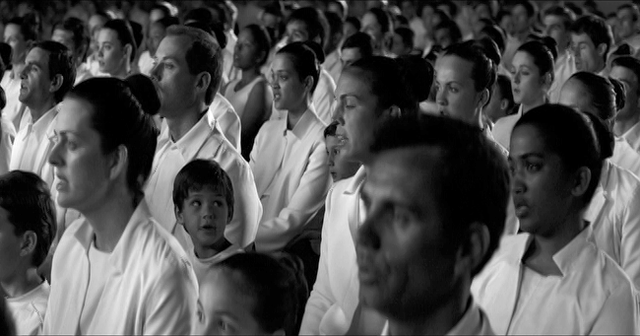
The assembled community: Looks a lot like church to me.

Confession was a big deal in Laestadianism during my childhood. Most sins beyond mere impure thoughts, doubts, etc. were considered to remain on the conscience until one had spoken of them “by name.” It was not an absolute requirement to confess, but was widely expected, at least for those infractions falling into a non-biblical category of “name sins,” a category that was often referred to but never very specifically defined.14 A 1978 article from the church newsletter pretty well encapsulates how things were back then:

It is never an easy matter to repent of sins for the flesh fights against the Spirit. But sin has a name, and those named sins will not go away without our speaking of them to a dear brother or sister. We are assured that we can freely go to a dear one and open our heart. But those sins that have affected the congregation of God are to be re­pented of before the con­gregation; otherwise we will not receive freedom.15

That last part about repentance before the congregation offers a hint of the public confessions that people often made after the Sunday morning service when I was a kid. In my congregation and at least some others in North America, members would head up to the front of the church after the ser­mon and ask the en­tire con­gregation for forgiveness of various sins.

During the congregational “caretaking” meetings that were a regular Saturday night event, where some issue or person(s) of concern would be discussed with much emotion, such repentances would go on and on.16 I’ll always remember one of them in particular, from a young father who dutifully walked up to the microphone and asked forgiveness of the congregation for “reading filthy literature.” Poor guy. It was probably just a paperback novel with a vague sex scene or two.

With all those memories in my head, you can see why I saw some Laestadian parallels in Jonas’s recollection of his friend Asher showing up late to class:

“When the class took their seats at the conclusion of the patriotic hymn, Asher remained standing to make his public apology as was required.”

“I apologize for inconveniencing my learning community.” Asher ran through the standard apology phrase rapidly, still catching his breath. The Instructor and class wait­ed patient­ly for his ex­planation. The students had all been grinning, because they had listened to Asher’s explanations so many times before.

“I left home at the correct time but when I was riding along near the hatchery, the crew was separating some salmon. I guess I just got distraught, watching them.

“I apologize to my classmates,” Asher concluded. He smoothed his rumpled tunic and sat down.

“We accept your apology, Asher.” The class recited the standard response in unison.17

“I’d like to ask forgiveness for, er, reading filthy literature,” the Laestadian Asher stammered, looking down at the floor. Believe all your sins forgiven in Jesus’ name and blood, replied the congregation with their standard response, in unison.

———

Back in those bad old days, there was another chilling parallel to The Giver. It was release from the community, the Laestadian form of which we called “binding.” Believers would be bound in their sins, and any requests they made to be forgiven would be denied unless it was decided that they were being specific and penitent enough about the issue at hand. Usually, there was some “false spirit” at the heart of the matter, which needed to be exorcised by being named in the confession.

This was a sad outcome of many “care­taking meet­ings” that were common­ly held to discuss the spiritual state of individual congregation members. Such a meeting was considered the third step in Jesus’ instructions regarding the rebuke of a brother who has caused offense (Matt. 18:15-16). Offense was taken not so much for individual actions against another member but as a result of the wayward one’s observed sins (e.g., acquiring a television) or erroneous doctrinal views.

In a 1971 newpaper article, the Finnish counterpart to my North American Laestadian church had set forth the binding procedure in no uncertain terms: “If the ones spoken to do not humble themselves to repentance, consider them pagans and publicans and refuse them membership in the association. The disobedient are not to be greeted with the greeting of God’s children.” My old church took “precisely the same stand in America” three years later.18

“For a contributing citizen to be released from the community was a final decision, a terrible punishment, an overwhelming statement of failure.”19 In The Giver, release was just to “Elsewhere.” Nobody but the Planning Committee knew exactly where the released person went.20 We readers, along with a wiser and sadder Jonas, come to realize that release actually involves death, not mere departure.

The horror and injustice of the community killing off its members–not just for disobedience, but for perceived unfitness at birth or just running out the clock on one’s old age–is what propels Jonas to take drastic action as the apprentice Receiver. Obviously, it would be a stretch to draw much of a parallel there, but it’s worth mentioning what a sad impact the Laestadian practice of binding did have on people.

Beyond the gate: Actually a good place to be. [Flickr page]

I personally witnessed it several times as a youth. It is quite unforgettable to see people ask the congregation for forgiveness at a meeting held concerning their spiritual affairs and receive only cold silence as a response. Sometimes they would sit gamely at their table at the front of the church while the meeting continued to the bitter end, often late into the night. And sometimes they would reach their breaking point and storm out of the building, ending the meeting of their own accord. I saw it go either way. Both outcomes were heartbreaking to the subjects as well as the congregation members who sincerely believed that the soul of their brother or sister hung in the balance that night.

There could be a good deal of secret resentment even when one had jumped through the hoops set before him. Grumbling behind the back of the church elders was the only possible relief. To approach them with concerns about their activities carried the very real danger of seeming unrepentant and becoming subject to yet another meeting. Instead, for a couple of years to come, the public face remained one of compliance and thankfulness for the opportunity of correction. In many cases the corrected one was probably so beaten down by the experience as to feel a Stockholm-syndrome sense of gratitude.21

The last case of binding I’ve heard of happened ten years ago, and that’s quite a late anomaly. The Finnish counterpart to my old church issued an apology of sorts in 2011 for “errors [that] were able to expand almost everywhere in our Christianity,” though it puts the blame on individuals rather than the supposed­ly inerrant community, er, Mother con­gregation.22 But the trauma and col­lective memory of it still lurks behind the rebukes taking place in every private board meeting with a wayward believer. There is usually no alternative but to accept what you are told and repent of your supposed sin if you want to continue being considered “heaven acceptable.”

———

One “morning, for the first time, Jonas did not take his pill. Something within him, something that had grown there through the memories, told him to throw the pill away.”23 He has gotten some of the forbidden knowledge into his head, and a bit of color has started seeping into his black-and-white world.

It hasn’t been an altogether pleasant transformation:

He found that he was often angry, now: irrationally angry at his groupmates, that they were satisfied with their lives which had none of the vibrance his own was taking on. And he was angry at himself, that he could not change that for them.

He tried. Without asking permission from The Giver, be­cause he feared–or knew–that it would be denied, he tried to give his new awareness to his friends.24

The reactions are mixed. Asher gets uneasy when Jonas tells him to look at some flowers very carefully, wondering if something is wrong. In the film adaptation, Fiona (the girl of Jonas’s bathtub dream) takes more readily to this scary new Jonas and his crazy ideas. “There is something wrong. Everything’s wrong. I quit,” Jonas tells her in response to the same question Asher had asked.25 He persuades her to quit taking her own stirring-stopper medication, too, and some difficult consequences ensue.

Ultimately, the Receiver of Memory cannot remain in the community. He knows too much. He feels too much. The community insists on keeping itself ignorant of what he has learned. It will not raise up its eyes from the safe grey sameness of doctrinal familiarity to look–really look–at the world he now sees all around.

“Listen to me, Jonas,” the old Giver tells a sobbing Jonas. “They can’t help it. They know nothing.”26 And then Jonas leaves the community of his birth and up­bring­ing, to a new and scary but joy­ous place–outside for the first time, inside never again, and the better for it.

———
The film (IMDb page) hasn’t been highly rated by critics or viewers. But I loved it, and not just because of the connection I felt with the story. The book is a Newberry Medal winner and has sold more than 10 million copies.
The three screenshots are from The Giver film, reproduced under “fair use” for purposes of review and commentary. The photo is Copyright © 2013 Edwin A. Suominen. Click to enlarge, or check out my Flickr photostream. You may freely use it for non-commercial purposes, with attribution, under the Creative Commons Attribution-NonCommercial 3.0 Unported License.

Notes


  1. “Ceremony of Advancement” in the film adaptation, since it has the kids being 16 years old, not 12, at the time their assignments are given (DVD playback at 06:50). 

  2. The Giver, p. 61. 

  3. p. 87. 

  4. Self-published January 2012, for Amazon Kindle, in print, and available for free reading at examinationofthepearl.org

  5. Adapted from An Examination of the Pearl, Section 1.2, “Disputation.” 

  6. Daniel D’Addario, “Lois Lowry: The dystopian fiction trend is ending,” Salon (July 10, 2014). salon.com/​2014/07/10/​lois_lowry_the_dystopian_fiction_trend_is_ending. Lowry: “People who are very conservative and feel they represent family values find that in this book. And ultraliberal people the same thing will hold true at the other end of spectrum. It happens also with theology, they’ll find it. I’ve had very conservative Baptist churches use the book as part of religious cur­riculum. Also ultra­conservative religious groups want it banned. It’s something that speaks to whomever wants to hear it. I have no control over that. I did not plan any specific political or theological interpretation, but people seem to find it.” 

  7. Lois Lowry, “Reflecting on 20 Years of The Giver,” Huffington Post (June 24, 2014). huffingtonpost.com/​lois-lowry/​the-giver-movie_b_5527063.html

  8. Once, before the midday meal at school, Jonas had said, “I’m starving.” Oops, that was a no-no. “Immediately he had been taken aside for a brief private lesson in language precision. He was not starving, it was pointed out. He was hungry. No one in the community was starving, had ever been starving, would ever be starving. To say ‘starving’ was to speak a lie. An unintentioned lie, of course. But the reason for precision of language was to ensure that un­intent­ional lies were never uttered. Did he understand that? they asked him. And he had” (pp. 70-71). 

  9. p. 23 

  10. p. 27. 

  11. Until being killed off, that is, in a nice little “release” ceremony that nobody seems to really recognize for what it is. 

  12. p. 36. 

  13. p. 37. 

  14. The following excerpt from An Examination of the Pearl, at the end of Section 4.6.3, provides some context about the Laestadian concept of “name sins”: It “is probably based on the ‘mortal sins’ that in Catholic theology must be confessed by name: ‘All mortal sins of which penitents after a diligent self-examination are conscious must be recounted by them in confession, even if they are most secret . . .’ (Catechism of the Catholic Church, para. 1456). But Luther downplayed and criticized the distinction between mortal and venial sins, criticizing theologians who ‘strive zealously and perniciously to drag the consciences of men, by teaching that venial sins are to be distinguished from mortal sins, and that according to their own fashion’ (Discussion of Confession, 89-90). Not all sins of either type ‘are to be confessed, but it should be known that after a man has used all diligence in confessing, he has yet confessed only the smaller part of his sins.’ Furthermore, he wrote, ‘we are so far from being able to know or confess all the mortal sins that even our good works are damnable and mortal, if God were to judge with strictness, and not receive them with forgiving mercy. If, therefore, all mortal sins are to be confessed, it can be done in a brief word, by saying at once, “Behold all that I am, my life, all that I do and say, is such that it is mortal and damnable”’” (p. 89). 

  15. Voice of Zion, October 1978. 

  16. These two paragraphs are adapted, with the quotation, from An Examination of the Pearl, Section 4.6.3, “Confession.” The psychological health of the current generation of Laestadians owes much to a greatly reduced emphasis on confession, and public confessions are now pretty much unheard of. 

  17. The Giver, pp. 3-4. 

  18. Päivämies No. 29, 1971, and then Voice of Zion, October 1974. These two paragraphs are adapted, with quotations, from An Examination of the Pearl, Section 4.6.4, “Rebuke.” 

  19. The Giver, p. 2. 

  20. p. 32. 

  21. These two paragraphs are also adapted from An Examination of the Pearl, Section 4.6.4. 

  22. See An Examination of the Pearl, Section 4.10.2 (“Rethinking the 1970s”). 

  23. The Giver, p. 129. 

  24. p. 99. 

  25. Film, DVD playback at 52:19. 

  26. p. 153. 


Monday, October 27, 2014

Moral Midgetry

The defenders of slavery relied on the Bible. The Bible was the real auction block on which every negro stood when he was sold. I never knew a minister to preach in favor of slavery that did not take his text from the Bible.
—Robert G. Ingersoll, Interview in The Denver Republican (1884).
Slave Shackles [Flickr page]

On a Sunday evening in October 2014, a kind and decent man sat at the pulpit of a Minnesota Laestadian church before a bunch of kind and decent people and asked for God to open His word during their services. The grace of Jesus Christ is a gift that gives perspective to all things in life, he noted in his mild midwestern voice during two minutes of prayerful conversation with the Heavenly Father.

Then it was time to read from God’s Word. The sermon text was the entirety of a “very beautiful letter” of the New Testament, the Epistle to Philemon. This letter was supposed to have accompanied an escaped slave, Onesimus, back to his Christian master Philemon. It requested that Philemon treat the runaway as he would treat Paul himself, charging any wrongdoing to Paul’s account instead of the slave’s.

This text came to mind, the preacher said, because it fit in with the theme for that Sunday: the commandment of love. A haze of peaceful familiarity settled over the proceedings as the preacher’s words about love and grace rang out in the room. And then he started talking about slavery:

But it so happened that this Onesimus departed–left, fled–his post as a slave or as a servant. Of course, we have our own history in our country with slavery that goes back to the time of the Civil War. None of us knew that time, but it was a reality in our country, and has been a reality in many, many areas of the world through the world’s history.1

A reality, yes, and a horrible one. Where was this headed?

In many “worldly” churches–the ones whose pastors fifty years ago had stood arm in arm with protesters against fire hoses and snarling dogs, asking for equality and dignity–the listeners would sit contentedly, knowing they were starting on an uplifting trajectory. In some of those sanctuaries, their ride would be smooth and steady, the brotherhood of all men quietly affirmed by the time they all walked with polite little smiles toward the exits and their separate lives. In other places with words like “Full Gospel” and “Holiness” on the signs outside, the listeners would brace themselves in roller-coaster pews, knowing that they were all ratcheting slowly upward toward a climax of indignation and then wave after wave of praise and pleas for justice and eventual deliverance from this vale of tears.

But those things do not happen in Laestadian services. What happened was the preacher saying slavery indeed had been a reality “and it was acceptable in the time.”

Acceptable to whom? Not to the slaves, one would imagine, or to that Jesus character who said you should do unto others as you would have done unto you.2 But it was certainly acceptable to those who claimed ownership of other human beings. And to the Roman ruling elite whose grudging favor was being courted by the guys writing Gospels and Epistles of this new Christian religion, slavery was an indispensable part of the system.3 Proper moral stories had to be told, a delicate political line had to be walked, or all bets were off for this emerging competitor to the Roman gods.

None of that was discussed in the sermon, nor could it be even if the preacher privately appreciated such nuances. The text was set firm and black and durable on the gilt-edged page that lay open before him, bound tight with all the rest of its pages written by a hundred nameless men but really, We Believe, by God Himself. Human factors, historical factors, simply do not apply to these particular words.

And so the preacher, a fine man who grew up in an ethnically diverse neighborhood and had recently spoken eloquently about respecting other cultures and people who are different, kept his mouth open while his religion made crazy words come out about slavery:

And, as contrary as it is to our human mind, we see that believing people also had slaves, like this Philemon. And the instruction to God’s Children is: Whatever calling you have been called into, that we would fulfill that calling. God’s word did not give slaves of that time permission to flee their masters. They were possessions, human possessions of people, and so by fleeing you were transgressing the law and the will of your master.

These issues “are too big for us to understand in our time,” he added, perhaps wincing at the ugliness of what he had just left dangling in the air. Better shroud the awful sight from view, add a little of what Daniel Dennett calls the pious fog of modest incomprehension. “But so it was,” the preacher said, and then went on to talk about “something great that had happened in the life of Onesimus,” his conversion to the religion of his slave master.

Poor Onesimus, not yet a Believer, might have had a pang of “conscience over the fact that he fled his master.” We can imagine, the preacher said, “that Paul would have told him that it’s not acceptable that you do this, that you flee from your master.”

The sin, you see, was not on the part of the man who presumed to own another person as a slave, who forced a fellow human being into servitude and treated him as property. Rather, the one who needed repenting was the slave escaping captivity. By fleeing his master, “he did wrong to Philemon.”4 But, happily, Onesimus repented and became one of God’s Children. The sermon then turned to weightier matters, eventually touching on the recent Ministers’ and Wives camp where concerns about contraception, school sports, and certain types of jewelry had been discussed.

———

Is there any rational voice loud enough to be heard in a place where such a sermon is taken seriously? Is there a message clear enough to penetrate such profound isolation from the very basics of human decency? I browse through my catalog of words, deliberate over my tidy and efficient combinations of words, and my sentences are as frail little twigs poking against a concrete dam.

The people who sat and listened politely to this sermon are educated and intelligent. They work and function and raise children in a civilized society of the year 2014. They have smartphones in their pockets and purses. They bid on contracts and buy cereal when it is on sale and consult with teachers about how their children are doing in school.

But what a thick wall of devotion encloses their otherwise functional minds when the preachers start talking! It is an environment designed to suffocate all independent thought, and does so with marvelous effectiveness. It so completely blocks anything said from “the world”–no matter how clearly written or loudly shouted–that people with tender consciences remain sitting in their pews while a man tells them about the need for submission to the ownership of human beings as property.

I give the preacher credit, at least, for not sugarcoating or avoiding the reality of his chosen text. Perhaps a few of his listeners might consider, if nothing else, what some other parts of the Bible have to say about slavery.

Exodus 21 provides God’s Children (you know, those “Old Covenant believers”) with detailed instructions on slave ownership. They could force one of their own people into slavery, so long as freedom was made available after six years. But if one of those Believing masters had supplied his Hebrew slave with a wife during that time, neither the wife nor any children they had together could leave with him. They were the master’s property, the result of his divinely approved slave breeding program.

Only if “the slave plainly says, ‘I love my master, my wife and my children; I will not go out as a free man’” could he remain with them, in permanent servitude that was marked by a hole punched in his ear.5 Thus the system twisted the bonds of ordinary family love into chains around its victims’ wrists. It reminds me of the way cult-like religions keep their troubled followers within the walls. Sure, you can leave, they say. Everyone is free to believe or not believe. But your family stays with the Master, and the relationship between you will never be the same again.

God’s unchanging, eternal Word makes some further provisions for when “a man sells his daughter as a female slave.” Yes, his daughter. She “is not to go free as the male slaves do” after the six years are up. Not unless the new master first explores his three additional options: to get a refund on the merchandise (“he shall let her be redeemed”), to pass her off to his son, or, if “he takes to himself another woman,” to keep feeding, clothing, and screwing the slave as well.6

Slaves could get beaten, but not to death. At least not immediately. “If a man strikes his male or female slave with a rod and he dies at his hand, he shall be punished. If, however, he survives a day or two, no vengeance shall be taken; for he is his property.”7

Those who adopt such madness as the Word of God forfeit all credibility about matters of morality. When they shrug and accept the idea of people being consigned as chattel in the forced service of others–because an ancient Book says so–you can ignore their proclamations about right and wrong. When they tell you that it is human reasoning that makes you hesitate to join them in their conclusions, you may rightly suspect everything else you are hearing from them as nonsense.

And when they preach about a Heavenly Father who approved slavery but frowns on kids playing sports at school or desperate mothers slowing their endless floods of pregnancies or young women putting jewelry in their ears, you might consider what kind of company you are keeping.

———
“Moral Midgetry” was also the title of Episode 8 in Season 3 of HBO’s TV program The Wire. My watching that program is of course a sin, unlike the enslavement of human beings in the ancient world. I am wracked with guilt.

Notes


  1. I am reluctant to give a citation for these quotes because I think this preacher really is a good and loving person, far better than the doctrines he is called to preach. But a defense of slavery is just not something I’m willing to let go unchallenged. Nor will I critique it without leaving a reference to the source that people can check out for themselves. As of this writing, the sermon is available here, and this first portion of interest starts at the 9:45 mark. Today’s writing has saddened me. But I feel a moral imperative of my own, no less urgent than the stirrings of the Spirit that drive these guys to say often fine but sometimes outrageous things. 

  2. Mark 12:28-34; Matthew 22:35-40. See Wikipedia’s article on the Great Commandment

  3. Ever wonder why the Gospel of John goes on so much about “the Jews,” in that faintly menacing tone? It was written late, long after Rome had destroyed Jerusalem and lost patience with its Jewish subjects. Christianity was trying to distance itself from its Semitic roots and doing its best at political ass-kissing. The fourth version of its hero’s history pointed the finger of blame about the crucifixion in a convenient direction, away from the Romans who were the ones routinely ordering and carrying out brutal executions of insurrectionists. 

  4. So, apparently, did the Israelites cheat Pharoah of his due when they escaped from Egypt. Oops, never mind–that time, God was on the side of the slaves. 

  5. Exodus 21:2-6. Scripture quotations taken from the NASB

  6. Exodus 21:7-11. 

  7. Exodus 21:20-21. 


Thursday, October 31, 2013

Another 95 Theses

Proportion your beliefs to the evidence you have for them, and expect no less of others. As with love, if you doubt something, set it free. If it finds a footing in the spaces of your mind, it is yours to believe with true conviction and joy.

Imagine that you were born into an exclusivist sect of fundamentalist Christianity, as was a certain “brother in faith” whom you have known for years, possibly a lifetime. He raised his numerous children there along with yours, wrote articles about Luther for the church’s monthly newspaper, taught Bible Class and Sunday school, frequently offered comments during church discussions, occasionally stood in the back of the church at a microphone, leading the congregation in its singing of the beloved old songs.

All was well until a few years ago, when you heard some whisperings about doubts he had expressed. But a meeting was held and the gospel of forgiveness was preached. Carry on; offer the greeting of “God’s Peace,” if a bit hesitantly.

Then, suddenly, this brother does the unthinkable: self-publishing a book that candidly and irreverently examines the teachings, history, and problems of “God’s Kingdom,” in hundreds of carefully referenced pages. He turns out not to be a mere doubting Thomas, but a Judas.

———

If you’ve had doubts of your own, you may be tempted to sneak a peek or two at the book’s online version, as thousands of people have now done. You may come back to the website from time to time, checking out this or that issue that has nagged at you, confirming with morbid fascination that, yes, it is a real problem and not just a doubt arising from your personal failings as a weak believer. If your doubts go far enough, or if you have completely left the faith but remain interested, you might go so far as to obtain a full copy, in ebook or print.

A troubled church [Flickr page]

But what you almost certainly will not do–cannot do–is accept the book as an honest assessment of your faith, not if you want to retain it unscathed. The claims you have grown up hearing as a “child of God” (what a self-designation!) are sadly incompatible with the facts outlined in the book, on point after point.

So, if you wish to remain “believing” while lacking any substantive response to these points (and I have heard none), you basically have three options. You can avoid reading any more of the book, ignoring its existence as much as possible. You can resort to the old catch-all excuse that “faith” cannot be understood by reason. (In other words, anything goes!) And if none of that helps, you could just dismiss me and my research.

People who feel threatened by the justification they lack for their professed beliefs have a strong need to point at an enemy. Since writing An Examination of the Pearl, along with a few blog postings critical of Conservative Laestadianism here and on extoots.blogspot.com, I’ve been called plenty of things by the faithful: blind, crazy, false prophet, tool of the devil, and a pretender at being another Luther.

Regarding that last one, let me assure my former brethren in the Laestadian Lutheran Church, which takes its name from two upstart leaders of rebellions against the established church of their day, that one Luther was quite enough. I have no interest in trying to be another. Certainly, I admire the man, though not so much the grim and creepy Laestadius. But there are some pretty unsettling things about Der Reformator, too. He labored under a slavish devotion to biblical literalism. In his later years, he oozed anti-semitism and authoritarianism.

I’m just some guy who knows how to research and write, and is no longer subject to being intimidated out of saying what I think. That’s it. Unlike Luther and Laestadius, I’ve never been at risk of my life or career, claimed divine revelation, had visions of the devil, or started a rival religious movement.

All that I’ve offered is the honest product of devoting a year of my life to full-time research of my inherited religion. After thousands of hours of effort, after the gut-wrenching anguish of seeing a once-cherished faith crumble to dust before my eyes, would you expect anything less than my candid assessment of things?

No more theses wanted here. We’re good now.

Today is Reformation Day, the holiday on which Protestantism celebrates its founder doing something most Protestants would never tolerate in their own churches anymore. As the story goes (possibly apocryphal), the young monk nailed a list of issues he had with the church to its door. It was an invitation to debate. Now, of course, debate has become a dirty word in church. That hypocrisy actually started with Luther himself: Once his heterodoxy become a new orthodoxy, he expressed vicious contempt for those who dared to disagree with it. Reformations don’t waste much time getting settled in and saying, “That’s enough. We’re good. No more changes.”

But look past that parochialism for a moment, and ask if you are any less deserving of the truth about the most important matter of your life than the poor residents of Wittenberg who stood in line paying for indulgences five hundred years ago. I certainly don’t think so. Call me whatever you want, but my book was written with the same motivation that Luther expressed in his 95 Theses, “out of love for the truth and the desire to bring it to light.”

On this point, at least, I am willing to let the church’s defenders claim that I want to be compared with Luther. Perhaps they should consider where they stand.

So, to those selling the modern-day indulgences of forgiveness for manufactured guilt, and to those handing over their valuable currency of intellectual honesty and a lifetime of foreclosed options, I present my own 95 Theses. You are free to write your own. Grab a readable Bible translation and some history books, and go to it!

As a bonus, here is the entirety of my “religious” teaching, which is hardly original: Proportion your beliefs to the evidence you have for them, and expect no less of others. As with love, if you doubt something, set it free. If it finds a footing in the spaces of your mind, it is yours to believe with true conviction and joy.

———
The church door image was adapted from a CC-licensed photo by Michael Elleray. Check out my interactive 95 Theses here There is also a plain-vanilla version for mobile devices and tablets.
Fairness calls for me to mention a positive development countering the tendency of church members to demonize critics: The remarkable presentation given at the LLC’s 2014 Summer Services, “Approaching Another Person.” I was happy to give credit where credit is due in my essay “Open Dialogue over the Faith Boundary,” posted August 2014.

Monday, July 15, 2013

Looking in the Faith Mirror

Book review: The Outsider Test for Faith: How to Know Which Religion Is True. John W. Loftus. Amherst, NY: Prometheus Books (2013).

John Loftus is an insightful critic of religion—especially the Christianity he formerly professed as a seminary student and pastor—and an excellent writer of his atheist views. (With his public and private encouragement of my own co-authored work, including a very nice blurb, he has also proven himself a gracious friend as well.) The book I consider John’s masterpiece, Why I Became an Atheist, had a profound impact on me.

I still remember the evening when I almost bought that book; the little black paperback was hastily set aside when a young couple from church and I spotted each other in the checkout line. Then I got a Kindle, which lets you buy evil atheist books with nobody watching but Amazon and perhaps the NSA. You might add God to that list of unwanted observers, at least before you start reading. But then the devastating lucidity of John’s writing and that of other notables like Richard Dawkins, Christopher Hitchens, Daneiel Dennett, and Sam Harris clears out what Dennett calls the “pious fog of modest incomprehension” in your brain, reducing your anxiety about some celestial Big Brother frowning over your choice of reading material.1

The fear can run deep, though, if you’ve been indoctrinated into the double standard of accepting with “childlike faith” a bunch of crazy propositions that would never stand up to scrutiny outside a fragile doctrinal bubble, as I was. It is breathtaking but a little unnerving to finally let your mind roam free.

Many people resolutely forbid themselves from ever doing so, heeding warnings like the ones I heard in a recent sermon by an intelligent but pious lay preacher with a notable technical career and numerous patents. The Spirit of God, he said,

keeps us away from the vain philosophies and the rationalizations of the people of this world, of the prince of darkness, by which he attempts to ensnare us. It keeps us away from those former travelers of the Kingdom of God who have fallen from faith and decided that there is a more rational way to attain heaven.2

Even to many followers of this sort of blinkered faith, these words must have a suspicious odor to them. The most important matter of one’s life is—with no justification whatsoever—simply off-limits to “rationalization.” Anything goes: The preachers can make whatever claims they wish.

It’s a point on which the preacher and atheist would seem to agree. In his new book The Outsider Test for Faith, John says that

adopting and justifying one’s religious faith is not a matter of independent rational judgment. Rather, to an overwhelming degree, one’s religious faith is causally dependent on brain processes, cultural conditions, and irrational thinking patterns. [pp. 15-16]

And why is it “that most believers cannot think rationally in assessing their culturally inherited faith” (p. 172)? Not because of some divine protection for the faithful against a spiritual bogeyman like “the prince of darkness,” but our evolutionary origins.

Believers and heathen alike, we are all the genetic legacy of pre-human ancestors who had survival rather than salvation as their primary concern. The resulting “human mind is a belief engine,” whose owners were prone to suspect some unseen agency behind every rustling noise in the brush and “are not really rational about religious faith” (p. 15).

In the animal world, where any hesitation in fleeing from a predator could lead to being eaten alive, these senses … are beneficial for survival. Human beings transformed these survival mechanisms into seeing divine beings active behind the scenes, orchestrating such natural and human-made phenomena as thunderstorms, droughts, victory or defeat in war, births of sons, bumper crops, and so forth. Anthropological data have shown us that we overwhelmingly adopt what our respective cultures teach us and that we are unable to see our own cultural biases because we are completely immersed in our inherited culture. [p. 16]

John extensively but skillfully cites the book of a professor of psychology to remind us how inherently unreasonable we are with these tacked-together, evolved brains of ours. He sums it up with a humbling list of limitations:

We accept that which is familiar. We seek to confirm what we have accepted as true on other grounds. We cling to our treasured truths despite evidence to the contrary. More often than not we fail to consider disconfirming evidence. [p. 65]

Those of us outside the doctrinal bubble, from whose dangerous company the preachers would have the faithful “keep away,” can readily recognize these as tools of the trade in religious fundamentalism.

John Loftus. Photo by Randy Tyson

As I’ve written about in an earlier post, though, even we religious skeptics have our own blind spots in many other aspects of life, which the limitations of our evolved brains keep us from fully recognizing. What John lists are not necessarily deliberate tactics exercised by clerical power brokers, at least not in most cases of my old church. They are, rather, coping strategies for people who will never leave their childhood faith, no matter what, because the “more that a person has commitment to an idea, the more it’s virtually impossible for him or her to take a different path” (p. 66).

At least considering the possibility of taking a different path is what John wants believers to do with his “Outsider Test for Faith” challenge. This book is all about that test, thus adopting that as its title. It’s subtitled How to Know Which Religion is True, to which you might as well add Or None at All, because no religion gets a free pass with the Outsider Test. Not even your religion, the One True Faith that was ingrained into your innocent little mind drawing pictures of Jesus with purple crayons in the earliest grades of Sunday School, whose oversimplified cartoon capsules of doctrines and cherry-picked, familiar Bible passages you now hear repeated in sermon after sermon, week after week.

And that’s the whole point. John challenges believers to look at their own “culturally adopted religious faith” as the rest of us do: “from the perspective of an outsider, a nonbeliever, with the same level of reasonable skepticism believers already use when examining the other religious faiths they reject” (pp. 16-17). He makes a brilliant parallel to Jesus’ own words in The Golden Rule: The Outsider Test “simply asks believers to do unto their own faith what they already do unto other faiths*” (p. 169, emphasis added).

You don’t lie awake nights worrying about the hell to which various branches of Laestadianism, the local Church of Christ, Iglesia ni Cristo, or many other finger-wagging exclusivists are condemning you? You don’t think the Pope is really Christ’s vicar on earth? You aren’t buying the story about Mohammed being God’s prophet, exalted over all other men? Well, then, John Loftus has some words for you: Why the double standard, one for your own religious faith and a different standard for the religious faiths you reject? (p. 169).

There are many other words in this excellent work; John really knows how to turn a phrase. If you haven’t dared expose yourself much of anything other than the copy-and-paste piety of your preachers and church newsletter, start with this book. It will lay the groundwork for all of the examination you do going forward.

If your halo has started to slip a bit and you’ve been doing some of this sort of unauthorized reading, add to it with this book. It’ll remind you not just to accept a raft of new craziness to replace the old. And if you are already hopelessly, irredeemably lost to “the vain philosophies and the rationalizations of the people of this world,” you will probably still enjoy this book. It will remind you why you made a courageous and principled move, and probably paid a very real social cost for doing so.

———
See the Prometheus website for more information. Get the book from Amazon.com in trade paperback or for the Kindle, or for the Barnes & Noble Nook.

Notes


  1. Dennett, Daniel. Breaking the Spell, p. 10. 

  2. The recording previously linked to here, dated May 12, 2013, has been removed from the LLC’s web site along with all the others in the z_Older_Archives directory. For reference: the quoted material began at the 22:52 minute:second mark in the sermon, given by Russell Roiko in Minneapolis. 

Wednesday, April 24, 2013

An Unpopular Truth is a Cold Companion

An unpopular truth is a cold companion. But it cannot be anything other than truth, no matter how hard we try to persuade it otherwise.
An Examination of the Pearl, Epilogue
Leftover Leaf [Flickr page]

I’ve heard the stories firsthand, all too many of them, about friends and even family lost. The threat of “social suicide,” as one friend put it after leaving our old church, keeps many more unbelieving believers in their pews every Sunday.

They sit there making empty, fearful professions of a faith long gone dead and stale because they cannot imagine life as an “unbeliever,” rejected or at best cooly tolerated by the intricate network of beloved people the church has woven them into since childhood. Countless similar stories are available online, from people questioning and leaving various other denominations of Christianity, Mormonism, the Jehovah’s Witnesses, and Islam, to name a few.

To those of you who have borne this loss because you could not pretend to believe that which you know is not true, you have my respect. There is hope: A whole world–yes, the World–of wonderful people awaits you. Get out there and find them!

To those of you still and perhaps forever trapped by the social walls–or content to remain within them, with or without a genuine belief in what you hear and preach–you have my understanding. If you had my friendship and want to keep it, it is yours, no matter what.

To those of you hounding, demonizing, and marginalizing the people you claim to love in the name of a faith you yourself do not understand, you have my contempt.

———
First posted on Facebook, 3/24/13, with a link to the Examination of the Pearl Facebook page. Slight edits and image added, 1/13/​15.

Friday, November 30, 2012

Appealing our Convictions

Our mental limitations prevent us from accepting our mental limitations,” writes Robert Burton, M.D., in his thought-provoking book, On Being Certain: Believing You Are Right Even When You’re Not. He explains the power of “deep down conviction,” that “feeling of knowing” we have about cherished convictions that enables us to shake off seemingly any contradictory facts that threaten them.

Does your stomach clench in a knot when reading or hearing viewpoints contrary to your own? That is a threat response. Your brain has invested a lot of time, if not effort, toward establishing sets of strong beliefs about many important things–religion of course, but also politics, relationships, your own special place in the world–and it wants to defend them.

Of two minds

Intellectually, you may recognize that the objective truth is more important than your established viewpoints, but there is far more lurking within our brains than what we have conscious awareness of. Burton: “Because our minds have evolved to operate largely outside of consciousness, it may not be possible to gain direct access to unconscious processing.”

Consciously or otherwise, we just don’t want to lose the sense of purpose and meaning we get from our deepest convictions. We “are nearly always aware of the sickening feeling when we don’t possess them,” he says. “This isn’t an intellectual misapprehension; it is a gut sense of disorientation and a loss of personal direction. Rarely are brute mental effort and self-help pep talks able to rekindle the missing feeling.”

I have experienced this not just with religion but also in other aspects of life. One example is my urgent advocacy to family and friends several years ago of “peak oil” apocalypticism. On sites like The Oil Drum and Energy Bulletin (recently renamed), I read for hours about limited petroleum supplies, about the prospect of declining yields from the big oil fields of Mexico and Saudi Arabia. The facts seemed to fully support the sense of panic that was fostered by eloquent authors like James Howard Kunstler (The Long Emergency), and I wondered why people weren’t talking about it, doing something.

No peak in sight, at least not as of April 2015

Well, many of those facts still seem compelling, but we are still here, driving our cars, buying container loads of cheap plastic trinkets from China, with no dystopian nightmare in sight. New extraction technologies have boosted the yields of old fields and there are drilling rigs in places that were once thought unpromising. The number of barrels pumped per day is at an all-time high. The environmental travesties of oil sand mining and the BP oil spill have barely put a bubble in the relentless flow of crude.

I look at all this and wonder, was I so wrong? Was I led along a path of alarmism by people who I thought knew what they were talking about? Or should I still cling to the belief, slightly adjusting aspects of it to maintain the general idea? The temptation is also there to restrict my reading to those who continue beating the drum for my erstwhile beliefs (and there is no shortage of such writers), but I have learned all too well that a painful truth is ultimately far more useful than a comforting falsehood.

My answer for now is not to have a clear answer, and that is a difficult state for the human brain to maintain. It craves decisiveness, the neat packaging of convictions in a box, a satisfying end to the difficult work of questioning. The brain’s structure and the reinforcement it experiences over a lifetime makes us highly value the “feeling of knowing,” Burton says. Any search for objective truth must override our innate bias, and often causes us pain in the process–cognitive dissonance, hurt to our self image, sometimes even social rejection. Small wonder that we so often choose to shrug our shoulders and plod onward down the well-trodden path.

———
Adapted from a Facebook posting on 11/30/​12.
Update, August 30, 2015: The graph was generated from EIA Total Oil Supply data (link) from January 1994 to April 2015. As the graph shows, world oil production has gone even higher in the nearly three years since I first posted this.

Wednesday, April 18, 2012

The Truth Shall Make You Free

“The simple believeth every word: but the prudent man looketh well to his going.” –Proverbs 14:15

According to John 18:37-38, Jesus told Pilate that the reason he came into the world was to “bear witness unto the truth.” As the story goes, Pilate replied dismissively with the rhetorical question, “What is truth?” Such evasions aside, truth is simply this: the inescapable reality that is established by a certain framework of indisputable facts. Whether Pilate liked it or not–whether you or your preachers like it or not–there is such a thing as truth, and you cannot exempt yourself from its rules.

If the facts are inconsistent with a claim I am making, then that claim is not true. If the claim is not true, then it is false, and so is every other claim that depends on it. It’s really that simple.

Buyer Beware

“For the living know that they shall die: but the dead know not any thing, neither have they any more a reward; for the memory of them is forgotten.” –Eccl. 9:5

If I am trying to sell you a used car, it had better start when you turn the key. My statement that it “runs fine” will be proved false otherwise, and you will have little patience with my excuses. That spectacular failure of my claim to conform with the facts will make you inclined to distrust everything else I try to tell you about the car.

There is no way for me to get around this problem. A protest that your “carnal understanding” cannot comprehend the qualities of the car would make me look just plain crazy. So would the assertion that it is only your “wrongful pride” that keeps you from truly considering the qualities of my non-functioning car. Your money would remain in your purse or back pocket as you move slowly away.

“God shall send them strong delusion, that they should believe a lie” –2 Thess. 2:11

It is a testament to the power of religion in the human psyche that it can exempt itself from the evidentiary standards of even a used car salesman. The same question you would be a fool for not asking–Is it true?–in the one case is considered downright offensive in the other.

When you give the analogy just a little space to play out, you quickly realize how sad the whole spectacle really is: The car does not only fail to start, but by any objective indication seems not to exist at all. The salesman cannot get his story straight about what kind of car it is, claims it is the only car you could ever possibly own, and threatens you with sadistic tortures if you decide not to buy it. And if you walk down the street, you will find hundreds of equally impassioned salespeople selling their own invisible cars, all claiming to have the only one that actually exists.

But This Is Different...

“Drink no longer water, but use a little wine for thy stomach’s sake and thine often infirmities.” –1 Tim. 5:23

“In matters of faith and salvation, however, we must set our carnal mind and understanding aside.” So claims an article “The Gospel Is Not Earthly Wisdom,” published in the April 2012 issue of the Voice of Zion newspaper of the Laestadian Lutheran Church (LLC). The images you see throughout this posting are scanned excerpts from the article. Its author cites various well-worn Bible passages to make his warnings against “rational understanding.” The old citations are thrown at the reader one after another, wrapped in such familiarity and piety that one can easily disregard the human hand of the article’s author in selecting them. But selected they were–from a sprawling, contradictory hodgepodge of all-too-human ancient thought that has been compiled over many centuries, argued about, imperfectly copied and translated, and finally transformed into an object of veneration as “God’s Word” (§4.3.4).

The Bible texts themselves are seldom read in their full context. Instead, the pious eye hastily glances over the atrocities and outrages, the inconsistencies and failed prophecies, to find familiar passages that will shore up a doctrinal conclusion that was predetermined before the book was ever opened. As with the used car with all its dings and scratches, a sale is most likely if you don’t look too closely at what you’re buying.

“I rejoice in my sufferings for your sake, and in my flesh I do my share on behalf of His body, which is the church, in filling up what is lacking in Christ’s afflictions” –Col. 1:24 (NASB)

To expose the illusion and show the quote-mining subjectivity for what it is, my caption to each scanned excerpt is another passage from the very same book of the Bible that a Laestadian preacher would never find occasion to cite. And this provides only a small example of the selective reading that goes on every Sunday, in every Voice of Zion article, in every discussion about “faith matters.” The Word itself, it turns out, needs quite a bit of earthly wisdom from Laestadian editors to stay on message.

The writers and expounders of scripture protest that what they are selecting and saying is actually what God wants to say. As the article puts it, God “has revealed the mysteries of faith through His Spirit in His kingdom.” It is latter-day Gnosticism, with a privileged few sharing “esoteric knowledge” among themselves.

Within the sacred enclave, curious transformations take place in language. Acknowledging the possibility of error is no longer humility but dangerous pride. Childhood is associated not with its natural curiosity and search for knowledge, but a passivity and resignation more suited to those with one foot in the grave. All is done in the service of “God’s kingdom, the pillar and ground of truth” where, in a bitter irony, the very meaning of truth is cast aside. Instead, as Sam Harris puts it, faith “obscures uncertainty where uncertainty manifestly exists, allowing the unknown, the implausible, and the patently false to achieve primacy over the facts.”

“[I]t is impossible for those who were once enlightened ... if they shall fall away, to renew them again unto repentance” –Heb. 6:4-6

Never mind why the omnipotent God “who will have all men to be saved, and to come unto the knowledge of the truth” (1 Tim. 2:4) would provide his spiritual guidance to 0.002% of the world’s population within just one of many groups claiming to have the One True path to salvation (§4.2.2). Never mind how that claim of sectarian exclusivity conflicts with the teachings of Martin Luther, whom the group claims as its most prominent spiritual founder (§5.2). Never mind why the Spirit would allow abusive practices to dominate the group’s operations for over a decade (§4.6.4, §4.10.2).

No, you are not supposed to give any consideration to these and the literally hundreds of other issues with “the simple doctrine of faith.” The salesman is talking, and he doesn’t want to be interrupted by your impertinent complaint that the engine won’t start.

“The truth shall make you free,” Jesus is reported to have said (John 8:32). Yes, it will–if only you let it.

Further Reading

  • Another article from the April 2012 Voice of Zion describes how the preachers at the LLC’s Winter Services lamented “‘attacks against God’s kingdom,’ questioning the validity of God’s Word in today’s world.”

  • An Examination of the Pearl, free online version with various sections linked with the “§” hyperlinks above. The section on reason (§4.5.4) is relevant to this posting as a whole.

  • Gnosticism entry on Wikipedia.

  • Harris, Sam. 2005. The End of Faith. New York: W.W. Norton and Co.

  • New American Standard Bible. 1995. La Habra, CA: The Lockman Foundation.

———
I first posted this on the Learning to Live Free blog, 4/18/​12. In August 2014, I reformatted and slightly edited the version you see here. Between this one and the version originally posted two years earlier, it’s been viewed over 8,000 times.