Showing posts with label Tellectual Press. Show all posts

Saturday, February 27, 2016

Judging Jesus

Think not that I am come to send peace on earth: I came not to send peace, but a sword.
—Jesus of Nazareth (Matt. 10:34)
Book review (and promotion): Blaming Jesus for Jehovah by Robert M. Price. With a Foreword by Valerie Tarico. Tellectual Press (2016).
Bob Price’s new book

Growing up as a Christian, there was one hero figure in my imagination who stood above all others, even above my parents. I didn’t have quite as distinctive a picture of him as I did of my father who helped me string wire on the roof for ham radio antennas or my mother who managed a photography studio, but somehow he was still better than they were. For the most part, I believed this.

Jesus was, you see, utterly perfect. He was so amazing and special that it really isn’t even appropriate to refer to him as a person, even though he walked the earth for some thirty years in human form, performing amazing feats and never succumbing to any of the sins that endlessly plague all of us mere mortals.

I was told that, having risen from the dead up to heaven to be with God (an even less clearly defined hero figure), Jesus looked down at us all the time and sat with us during church services. “Where two or three are gathered in his name,” there he’d be.1 And of course we were constantly telling each other that our sins were forgiven in his “name and precious blood.”

There was no room for any human failings in “our Lord and Savior Jesus Christ,” the innocent unblemished Lamb who offered himself as a final, perfect sacrifice on our behalf. The preachers never tired of reminding us how frequently and miserably we all sin, but not so with Jesus. He never did, not even once. If he had sinned, the implication went and was sometimes even expressed out loud, then all that forgiveness we were doing in his name and blood just wouldn’t work.

———

It took the sharp eye of a young friend who’d left the church while I was still in it to make me aware of any problems with this narrative. He pointed out that Matthew 5:22 has Jesus teaching, “whosoever shall say, Thou fool, shall be in danger of hell fire,” and yet Jesus himself calls people fools in Matthew 23.2

I came across other examples of behavior that didn’t seem particularly Jesus-like as I tiptoed warily into reading what skeptics had to say and–for the first time with clear eyes–the Bible itself. One of those skeptics, Valerie Tarico, pointed out how Jesus’ behavior could seem downright bigoted. In her book Trusting Doubt, she recalled how

a Canaanite woman, a non-Jew, calls out, begging Jesus to heal her daughter, who is possessed by demons. “Lord, Son of David,” she calls him. But he ignores her. Finally, his disciples get sick of her following them and shouting, and they ask him to send her away.

Then “Jesus tells her he was sent only to the lost children of Israel. She keeps begging.” In the end, Jesus heals her daughter, but not before enduring a degrading conversation with him. She “came and knelt before him. ‘Lord, help me!’ she said.”

He replied, “It is not right to take the children’s bread and toss it to their dogs.”

“Yes, Lord,” she said, “but even the dogs eat the crumbs that fall from their masters’ table.”

Then Jesus answered, “Woman, you have great faith! Your request is granted” (Matt. 15:25-28).

This did not impress Dr. Tarico:

If the image doesn’t bother you, try to imagine an American slave or a South African Black having to do and say the same things to get health care for her child. “Please, sir, even the dogs eat the crumbs that fall from their masters’ table.”3

Savior Bro: Not as meek and mild as you thought

Something troubling I came across in my own Bible reading was Jesus telling a bald-faced lie. In John 18:20, he said to the high priest, “I spake openly to the world; I ever taught in the synagogue, and in the temple, whither the Jews always resort; and in secret have I said nothing” (emphasis added). But, according to Mark 4:34, Jesus expounded on the meaning of his parables “when they were alone.”

In fact, all three Synoptic Gospels (Matthew, Mark, and Luke) give an example of Jesus doing the secret teaching he explicitly claimed he’d never done. It happened after Jesus told the crowd the parable of the sower, “when he was alone” with the disciples (Mark 4:10). They asked him about the parable.

Did Jesus say, “What’s wrong with you guys? Can’t you understand plain Aramaic?” Nope. He told them they were being let in on the mysteries (mystery, singular, in Mark) of the Kingdom that were being kept hidden from the unwashed masses (Mark 4:11; Matt. 13:11; Luke 8:10).4 He then proceeded to explain the parable to them–and them alone.

It’s a pretty bad situation for those who believe the 66 books of the Bible make up the inerrant Word of God with no contradictions. If both John and the Synoptics are telling the truth about what happened, then Jesus did not.5

So Jesus became something of a disappointment, though I could’ve lived with a slightly sub-par savior if church doctrine cut him any slack. (Alas, it doesn’t.) And a careful reading of the Old Testament left me utterly repulsed by the shitty attitude and horrible actions of our Father which art in heaven. He is, to quote Richard Dawkins’s memorable one-liner,

jealous and proud of it; a petty, unjust, unforgiving control-freak; a vindictive, bloodthirsty ethnic cleanser; a misogynistic, homophobic, racist, infanticidal, genocidal, filicidal, pestilential, megalomaniacal, sadomasochistic, capriciously malevolent bully.6

This really is no exaggeration. Read the bloodstained pages in the first half of your Bibles and you will soon see how devastatingly true it is.

———

Having long since absorbed the shock of these realizations about both Father and Son, I was delighted to have my little publishing company Tellectual Press take on Robert M. Price’s new book, Blaming Jesus for Jehovah. In it, he presents a grave and devastating conflict for Christianity: “the sheer logical impossibility that God and Jesus, as defined by the Christian creeds, could have commanded and taught the hateful things the Bible says they commanded and taught, and still be loving, just, forgiving, and merciful.”7

Dr. Valerie Tarico–much more pleasant than the God she writes about [Flickr page]

The book begins with a Foreword that was kindly provided by Dr. Tarico. She cites Dawkins’s description of the “malevolent bully” and observes that “trying to separate Old Testament from New–trying to separate Jesus from Jehovah–doesn’t solve the problem.” In fact, she says, “it is impossible,” because “Jesus himself won’t let us.”8

Bob makes that clear right away in the first chapter, entitled “The Son Who Is the Father.” He cites several passages in Matthew and John where Jesus claims a special relation to his Father in heaven and speaks about “‘inside information’ concerning his divine Father and his celestial realm.”9 Jesus knows all about God, Bob says, “because he has intimate familial knowledge, ‘a chip off the old block.’” I especially like the way Dan Barker put it in a recent interview: Jesus isn’t just “a chip off the old block”; he is the block.10

That, of course, refers to the doctrine of the Trinity, a weird theological superposition of three distinct persons of God into a single divine entity. Bob devotes a few pages to what present-day Christians think the Trinity is (but is not) and concludes with the observation that, according to that doctrine, “Jesus and Jehovah are one and the same God.”11 And even without it, there’s plenty in the Gospels to put responsibility for all those Old Testament atrocities on Jesus as Jehovah Junior.

Remember, Jesus explicitly declined to nullify the Old Testament or distance himself from what it describes his Father doing. Bob dismisses the view of many Christians “that the New Testament either exonerates the God of the Old or just plain renders him irrelevant,” which he finds a strange thing to think for those who “profess to believe that both Testaments are the inspired Word of God.” His

considered guess is that they are thinking of the Pauline notion that Christ and his gospel have superseded the Torah, the Old Testament Law. But that is quite a different matter. Paul says that the ceremonial provisions of Judaism (circumcision, kosher laws, holy days, etc.) are no longer binding since their proper purpose has been fulfilled as of the coming of Christ (Col. 2:16-17; Gal. 2:15-21; Rom. 10:4). But that has nothing to do with genocide, as if something so morally repugnant could be proper in the Old Testament dispensation but not in the New.

But, hey, who wants to look too closely? If you’re looking for an excuse to sweep Old Testament atrocities under the rug, any old broom will do.12

After spending a chapter (“Artists’ Conceptions of Jesus”) acknowledging some good stuff about Jesus, Bob goes on to summarize some of those atrocities. We are rightly horrified by the grotesque savagery of ISIS, yet

the Christian holy scripture, the Bible, explicitly ascribes the very same moral crimes to God. Islamic Caliphate killers don’t even need the Koran. There are hundreds of passages in the Holy Bible which would be more than enough to inspire their horrors. These are strong words, I know. I hate to have to write them. I hope you will have the courage to read them. It comes down to a question of your own integrity. I hope you will see that.13

Any torture that the sick minds of ISIS fanatics can cook up is, of course, a mere pinprick compared to the novel bit of nastiness introduced in the New Testament: eternal condemnation in the agonizing fires of hell. Bob gives that horror the full attention it deserves. In a couple of ample chapters, he covers the various theological attempts to justify unlimited punishment for limited humans and reveals the absurdity of the whole idea of blood atonement.

And there is more: The failure of Jesus’ prophecy about his imminent return, the failure of the Bible to provide a consistent and reliable story about him, and the problems with expecting ant-like humans to heed the warnings of an omniscient God who knows they’ll screw up regardless. This book has a lot of good stuff packed into its 166 or so pages, and I’m very proud to have been a part of its publication.

Fun while it lasts (screenshot taken Feb. 27, 2016)

There is one issue I scratched my head about while editing the book, which bears mentioning. Bob is well known as a skeptic about the existence of any actual person behind the Bible character of Jesus.14 Here’s how he put it to me in a recent phone conversation:

I think there was no Historical Jesus and the Jesus story is almost entirely based on rewriting Old Testament passages. But another likely influence was the dying and rising God myths in the Mediterranean world and also ancient Israelite religion.

In Blaming Jesus for Jehovah, however, Bob treats the existence of Jesus as a given. I asked him about that, particularly where he calls the doctrine of Original Sin “a matter of reverse engineering” by early Christians who “had to deal with the death of Jesus somehow.”15

He was executed as a criminal, but they believed he wasn’t one. So if he didn’t die for any sins of his own, and his death couldn’t have been a meaningless tragedy, whose sins did he die for? Must have been everybody else’s!16

Well, I asked, if you think there wasn’t any such person who actually lived or died, why would those early Christians have been troubled by his death? His answer was that

those who wrote our New Testament documents were not mythicists. They believed there was a Historical Jesus martyred at the hands of Rome, who died innocently. They had the problem of explaining how this could happen.

He dates the earliest Gospel, Mark, at possibly 70-80 years after the reported events, but more likely a full century afterwards. Those early Christians were thinking and writing a couple of generations removed from the event they imagined had happened. That’s plenty of time for a whole myth about a messianic savior to have developed–a “major theological adjustment” to Second Temple Judaism following the destruction of Solomon’s temple by the Romans.

With this book, Bob wanted to avoid the whole controversy of the Historical Jesus vs. the Christ Myth Theory by simply accepting the Bible’s assertions about Jesus at face value. It’s a “look through the lens of mainstream criticism,” as he put it. Even so, it’s still quite a critical and much-needed look, at the superhero figurehead of the world’s largest religion whose flaws thus far have remained largely off-limits to scrutiny.

———
The cover image is Copyright © 2016 by Tellectual Press, an imprint of Tellectual LLC. Used by permission.
Nature photography is much more my line than portraits, but I was glad to have a chance to offer Valerie Tarico some additional publicity photos, including the one shown here, during a visit in Seattle last summer. She’s a wonderful, gracious individual who just inspires you to do your best to keep up with her gentle goodwill. The picture is Copyright © 2015 Edwin A. Suominen, but it’s hers to do what she wishes with, and she’d probably be open to your inquiry should you have a good use for it.
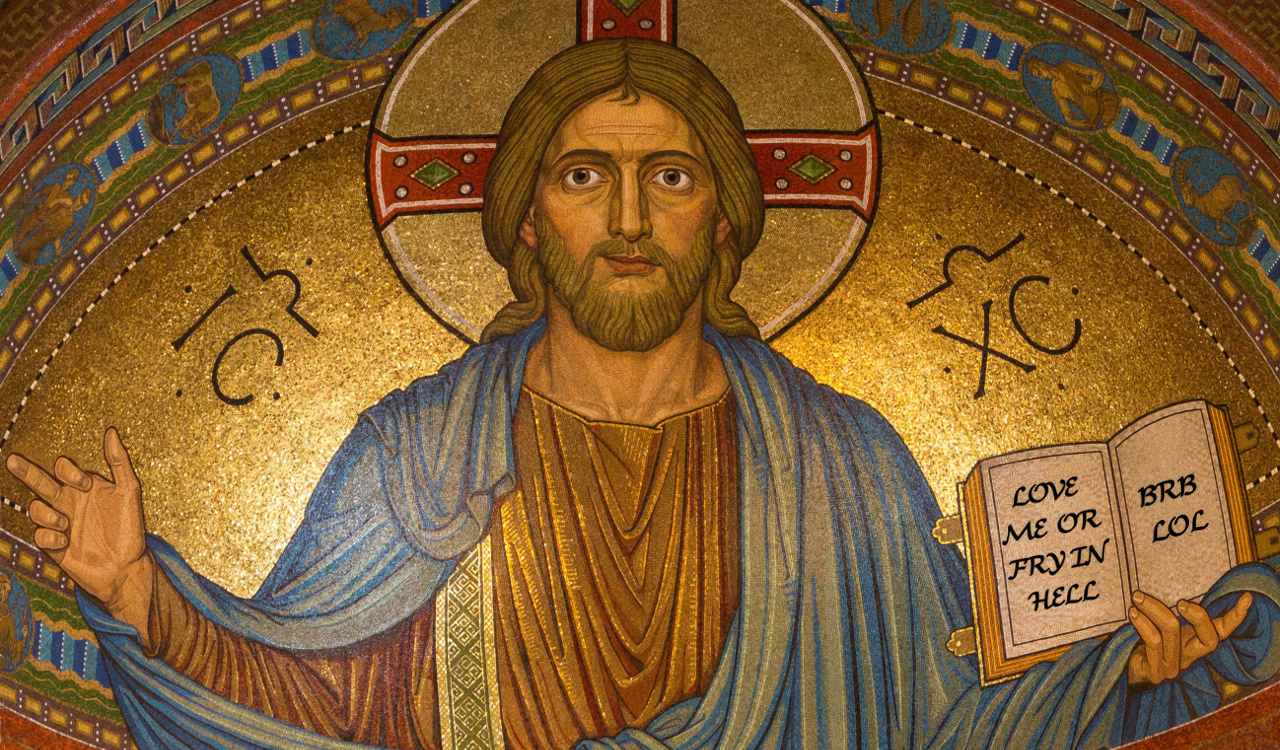
The Jesus mosaic image is adapted (obviously) from a photo reproduction of the apse mosaic of Christ Pantocrator inside the Maria Laach Abbey. The mosaic “was completed in 1911 by Father Andreas Goeser” (link), long enough for the unfortunate Fr. Goeser’s beautiful work to pass into the public domain and get co-opted with the GIMP free image processing software. My irreverent modifications consist of the smirk, the folding over of one additional finger, and a considerably revised text on the open pages. I cannot take credit for “BRB LOL,” having seen it in a meme image some time ago.

Notes


  1. Matt. 18:20. It should be added, however, that the only qualified gatherings for his attendance were those of my own church’s few hundred congregations around the world. He skipped all the untold thousands of other ones because they weren’t part of “God’s Kingdom.” 

  2. “Ye fools and blind: for whether is greater, the gold, or the temple that sanctifieth the gold? And, Whosoever shall swear by the altar, it is nothing; but whosoever sweareth by the gift that is upon it, he is guilty. Ye fools and blind: for whether is greater, the gift, or the altar that sanctifieth the gift?” (Matt. 23:17-19). 

  3. Valerie Tarico, Trusting Doubt: A Former Evangelical Looks at Old Beliefs in a New Light (Oracle Institute Press, 2010; previously published 2006 as The Dark Side), Ch. 5 (available online). 

  4. The Revised Standard Version translates the word as “secrets” (secret, singular, in Mark), which makes the problem even more apparent. Both the KJV and NASB use the term “mysteries” (and “mystery”). 

  5. These four paragraphs, the footnote above, and the rest of this one are adapted from my first book, An Examination of the Pearl, Section 7.1 (“The Gospels”). Robert M. Price told me in 2011 that he believes this to be a case of an intentional contradiction between John and the Synoptics. The writer of John “rejects the esotericism of Mark and changes the story,” which he also did to avoid the “unseemly” stories of Jesus not carrying his own cross and not wanting to go through with his suffering. “For John, there was no private teaching in the Markan, Gnostic sense.” (Gnosis was secret spiritual knowledge not shared with everybody else.) “Everything is public, though some do not hear because they are not of his flock. Thus within John’s retold narrative Jesus is telling the truth.” 

  6. Richard Dawkins, The God Delusion (Houghton Mifflin, 2006). 

  7. Robert M. Price, Blaming Jesus for Jehovah: Reconsidering the Righteousness of Christianity (Tellectual Press, 2016), p. 19. 

  8. Price (Tarico Foreword) at p. 8. 

  9. Price at p. 29. 

  10. Dan Barker, interviewed by Seth Andrews on The Thinking Atheist podcast, Feb. 16, 2016

  11. Price at p. 38. 

  12. Price at p. 65. 

  13. Price at p. 55. 

  14. See, e.g., my blog posting Myth, Method, and the Will to Believe about a lecture by the same name that Bob gave on the topic. 

  15. Hat tip to Jonathan Bernier, who noted this issue in a Facebook post

  16. Price at p. 95. 


Wednesday, February 11, 2015

Eden Found

“You put them in your mouth,” she laughed, “and you press your tongue against them, and you revel in the sweetness of the flesh and the juice, and then you swallow them. There, I told you that you knew nothing about life. Behold, your first experience!”
—Lilith to Adam in Eden, by Murray Sheehan
Book review (and promotion): Eden by Murray Sheehan (1928). Reprinted with an Introduction by Robert M. Price and Edwin A. Suominen, Tellectual Press (2015).

Last summer I stopped at one of our remaining used bookstores in town and picked up an old hardback “Treasury of Great Bible Fiction.” Most of the stories in it are pretty cheesy, but one of them really impressed me with its beautiful, powerful writing and realistic depiction of the underlying Bible tale. It was an excerpt from a 1928 novel Eden by Murray Sheehan.

An Amazon search led me to one of those oddball used & rare booksellers online. Soon I had myself a hardback copy of Eden, almost ninety years old. After reading through its 200 or so yellowed pages, I came away just as impressed with the rest of the book as I’d been with the excerpt. It’s a great retelling of the Genesis human-origins story, wonderfully written and still very engaging to read nearly a century later.

This thing deserves to be a treasured classic, I thought. Why isn’t there an ebook version of it, or at least a paperback reprint? To my delight, I found that it has passed into the public domain.1 Eden has been set free, the best work of Bible fiction I’ve come across yet. And now my indie publisher Tellectual Press is making a reprint available, not just as a paperback but also for the Amazon Kindle.

———

Bob Price, my friend and collaborator on another Edenic effort, agreed with my assessment of the book, and we co-authored an Introduction for the reprint. As we explain there, what Sheehan came up with was a fine contemporary example of a time-honored literary art known as midrash.2

Eden, Ch. 3 (paperback reprint)

The ancient rabbis peering through their treasured scrolls of the Hebrew Bible practiced this literary art, interpreting scripture passages (especially the difficult ones) by retelling them. They provided their own versions, wider in scope, which contained plot details and additional characters and circumstances that they hoped might make more sense of the originals. The biblical original was just the tip of an iceberg to be revealed by their literary sonar.

Their results are creative and charming, whether or not they really cast light on the biblical texts that inspired them. And, as shown by Sheehan’s fine novel as well as the release of Bible-themed movies from The Ten Commandments (1956) to Noah (2014), the art of midrash has never died.

Murray Sheehan’s midrash puts narrative meat on the bones of an old rabbinic effort to explain a contradiction between the Bible’s first and second chapters. They are both there in our Bibles today, contradictions and all, because whoever compiled them together didn’t want to omit anything. It had already became sacred tradition in a lot of people’s eyes, if not his own. Cut any detail and you could be sure that some busybody from the ancient Israelite equivalent of a KJV-only Bible College would complain.3

Eden, Ch. 4 (Kindle reprint)

And so Genesis 1:27 has God creating Adam with a wife at the very outset while Genesis 2:18-22 has Him4 making one out of the lonesome Adam’s rib after the dust of His creation project had already settled.5 That gives Sheehan a great villain for his novel, the wily and sensual Lilith.6

In Eden, Adam and Lilith have something of a relationship before Eve shows up, but it never gets consummated with anything other than “a wild kiss, the first in all Creation” (Part 1, Ch. 10). God doesn’t like the way things are headed, so He closes Adam’s heart to Lilith and brings Eve into the picture. He provides Adam with a mate who’s less likely to get him into trouble.

But He has counted Lilith out too soon. She manipulates Mr. Serpent into tempting Adam and Eve into eating that apple. (Then things go badly, as we all know.) In a clever twist on the Christian interpretation of the story, Sheehan replaces Satan with Lilith. She, not the Hoofed One, becomes the mastermind behind the Serpent’s mischief.

Creation of Man [Flickr page]

Another fascinating bit of midrash in this novel deals with the puzzling vestiges of polytheism that remain in the Genesis creation accounts. Understandably, those are never even noticed by most casual Bible readers. We provide some details in the Introduction, but the bottom line is that this is another biblical contradiction between older and newer texts.

The only thing Christian theologians could think of to account for the leftover polytheism was the Christian Trinity. And so, they figured, the Father was conferring with the Son and the Holy Ghost back in Eden. Sheehan follows this tradition, providing some snatches of dialogue between the Persons of the Trinity at a few points throughout his story. He has God shaking His head from His divine vantage point in the skies above, watching Lilith plot Eve’s downfall and muttering about it, consoling Himself with a “second Voice within the Father,” and–via yet another Voice–philosophizing about free will.

Sheehan showed a lot of courage in letting his dialogue explore the inevitable implication of a tree-tending Trinity in Genesis: God doesn’t just talk to Himself; He winds up like some poor guy off his meds who carries on a full conversation between separate voices in his head. And since nobody who defends Trinitarianism thinks God is psychotic, the inevitable result is that He is essentially polytheistic anyway!

———

Eden also bravely and cleverly tackles the dilemmas of omniscience and omnipotence vs. the Fall, the oddities of the First Marriage (perhaps the only one with any real claim to being a match made in heaven), and the sibling rivalry between Cain and Abel. And as a parting gift to the reader, he goes the old rabbis one better and answers the oldest of biblical paradoxes as no one has ever thought to do before.

It’s a great book, and I hope you enjoy it, too.

You can still get original hardbacks of Eden from those oddball online booksellers, for not much more than the $9.99 cover price of Tellectual Press’s paperback reprint. They obviously won’t include the Introduction from which I’ve adapted (in part) this posting, though, or the reprint’s crisp formatting, in both paperback and ebook. (The Kindle version is $6.99.) Plus, you can get the book in both formats for just an additional $0.99 with Amazon’s matchbook feature.

———
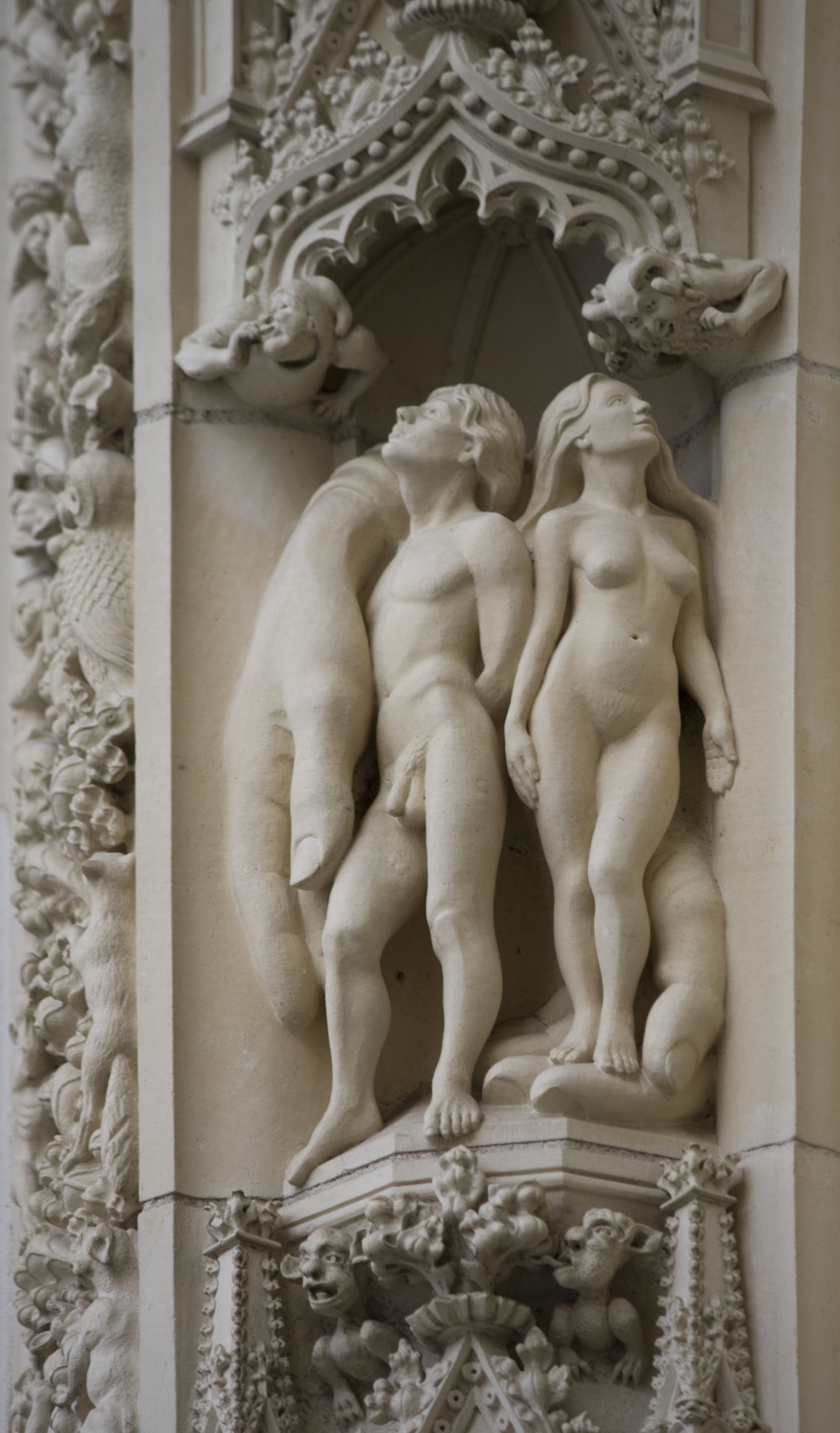
Cover image and Introduction are Copyright © 2015 by Tellectual Press, an imprint of Tellectual LLC. Used by permission. You may freely copy the portions adapted here and the cover image, with attribution. The statuary of Adam and Eve is from “one of the gorgeous new carvings around the west door of York Minster,” photographed by Fr. Lawrence Lew, O.P. and CC-NC-ND licensed for free non-commercial use. Since I’m promoting a book that my company is publishing–in search of some modest profit–with this particular post, I asked Fr. Lew for permission to use his photo in it, which he graciously granted.
I’m planning to review Arthur and Elena George’s The Mythology of Eden soon. That excellent book deserves its own separate essay. Meanwhile, it’s available on Amazon.com. It’s not cheap, but worthwhile if you’re interested in a fascinating and comprehensive analysis of the Eden story and its authorship.

Notes


  1. Based on some searches of Stanford University’s Copyright Renewal Database and then a perusal of the Library of Congress’s record of copyright renewals for books. Another book by Sheehan had been renewed, but not this one. 

  2. The remainder of this posting is adapted from the Introduction that Dr. Price and I co-authored for the Eden reprint, by permission of Tellectual Press. Though mine is a personal blog, this particular posting obviously has promotional value for both the company and myself. 

  3. See Arthur and Elena George’s analysis of the Eden story’s authorship and mythological underpinnings in their book The Mythology of Eden. The Georges agree that both accounts “had been well known for centuries and hardly could be ignored.” The task of the ancient compiler, they write, “was to unify the Israelite religion in the hope that this would help an Israelite state to rise again. So he opted for an inclusive approach.” Since he “was charged with restoring the Law to post-exilic Judea, it was important to have [the Gen. 1] version emphasizing the importance of the Sabbath.” The “Eden story and the remainder of his primeval history narrative also demonstrated the need for Yahweh’s strictures to guide human behavior.” Both “stories served his purpose. Despite the contradictions in the factual details of the two stories, the most essential truths that they convey about God and man’s relationship to God are fairly consistent, so [the compiler] and the Israelites were not concerned with the stories at the level of factual consistency” (loc. 680). 

  4. Neither Bob nor I typically use the pious convention of divine capitalization for pronouns referring to God. But we did so in the Introduction, and I’m doing so here as well, to stay consistent with Sheehan’s usage. 

  5. At Kindle loc. 669 of The Mythology of Eden, the Georges discuss Lilith’s “medieval rabbinic” origins, which “were made possible only because Genesis 1 already had mentioned the creation of at least one man and woman.” 

  6. Alas, “once we recognize that Genesis 1 was a separate story written by a different author much later and that it does not purport to dovetail into J’s story, any such possible connection with the woman in Genesis 1 is lost” (George & George, loc. 671). Sheehan knew his stuff, but Lilith sure is a great character for his fictional Eden


Tuesday, June 10, 2014

Problems with Paul

To see that one has been mistaken in one’s manner of apprehending the past is not a loss but a gain. It is always better, safer, and more profitable, to know that one does not know, than to go on building on a basis that is imaginary.
—W.C. van Manen, “Paul” (1902)
Book review (and promotion): A Wave of Hypercriticism: The English Writings of W.C. van Manen, edited by Robert M. Price. Tellectual Press (Valley, WA 2014). For the Amazon Kindle and Barnes & Noble Nook, and in trade paperback.

My former church, like many other forms of Christian fundamentalism, teaches that “the Holy Scriptures are the highest authority and standard by which matters of soul and doctrines of salvation are judged.” One must simply accept, “by faith” and without interference from biblical scholarship, “the Holy Scriptures, both Old and New Testaments, as the divinely inspired and revealed Word of God.” This little formula of blind acceptance is articulated in the church’s monthly newspaper, which laments, “We live in a time in which the authority, holiness, and inerrancy of the Holy Bible has been placed under doubt and suspicion by those who challenge it as a divine revelation of God’s will toward men.”1

Actually, though, there have been waves of questions lapping at the scriptural foundations for a long time now. As have the complaints from those trying to keep things propped up, like this one from the second century A.D.: “Now this heresy of yours does not receive certain Scriptures; and whichever of them it does receive, it perverts by means of additions and diminutions, for the accomplishment of its own purpose; and such as it does receive, it receives not in their entirety.”2

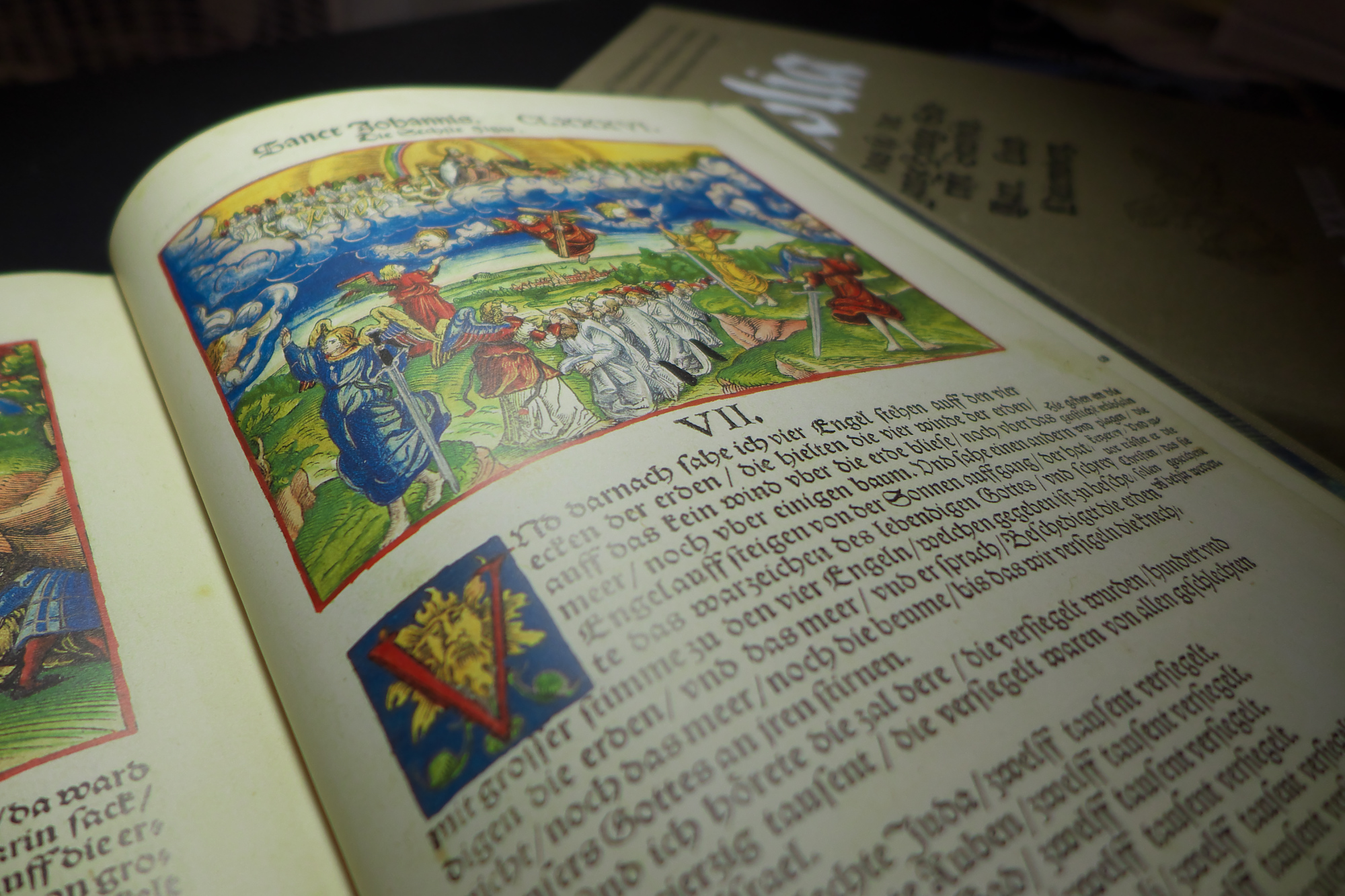
Facsimile reproduction of Luther’s German Bible  [Flickr page]

For all his literalism, sola scriptura, and fervent medieval piety, Martin Luther did a bit of picking and choosing of scripture himself. There were some surprised expressions on the faces of my former brethren when I told them that Luther was critical of the book of James, who he said

does nothing more than drive to the law and its works; and he mixes the two up in such disorderly fashion that it seems to me he must have been some good, pious man, who took some sayings of the apostles’ disciples and threw them thus on paper; or perhaps they were written down by someone else from his preaching.

That wasn’t all; Luther wrote that he could not put Hebrews “on the same level with the apostolic epistles,” noting that some of its teachings seem “to be against all the Gospels and St. Paul’s epistles.” Jude clearly seemed to him a copy of 2 Peter, and he also had problems with Revelation and Esther.3

One of the many theological squabbles Luther got himself into was with the humanist Catholic reformer Desiderius Erasmus, who was “perhaps the real progenitor of what would become the thoroughly modern approach to reading the Bible,” the Higher Criticism.4 This approach led to questions about Moses and then Jesus. Had Moses really delivered the 613 commandments of the Torah? Had Jesus really preached the Sermon on the Mount? Or were these much later collections of material from disparate sources?5

By the early 1800s, some of the epistles that had been attributed to the Apostle Paul were being questioned. Now this was a big deal, because the Pauline epistles are critical to Protestant Christianity. As my friend Robert M. Price puts it, Paul was not crucified for you, but it is Paul who tells you what Jesus’ death meant.

Dr. Price summarizes what the 19th-century critics were doing to Paul in his new book The Amazing Colossal Apostle. The first to deny Pauline authorship to one of the epistles was Friedrich Schleiermacher (1768-1834): “Although he accepted 2 Timothy and Titus as Pauline, he rejected what he termed ‘the so-called First Epistle of Timothy.’ In an 1807 essay, he showed how this epistle contradicted all other Pauline materials in the New Testament.” Before long, “other scholars widened the scope of the investigation and discovered many of the same relations and contrasts between the Pastoral Epistles (1 and 2 Timothy and Titus) on the one hand and the remainder of the Pauline letters on the other. Today, virtually all critical scholars agree that the Pastoral Epistles are not the work of the historical Paul.”6

Then F.C. Baur (1792-1860), “the founder of the Tübingen School of New Testament criticism, whittled down the Pauline canon even further.” He was left “with only the four Hauptbriefe (‘principal epistles’), 1 and 2 Corinthians, Galatians, and Romans, as authentic and unassailable, minus a few questionable passages here and there.”7 The waves were getting stronger, crashing against the old foundations that Luther had lain. But at least his cornerstone, Paul’s Epistle to the Romans, remained. It was, Luther said in his preface to Romans, “the most important piece in the New Testament. It is purest Gospel.”

Bible Criticism: A Prickly Issue  [Flickr page]

Around the turn of the twentieth century, along came a “wave of hypercriticism” from some impudent Dutch theologians. Nothing was to be spared, not even Romans. Notable among these critics, the so-called Dutch Radicals, was Willem Christiaan van Manen. In a 1898 essay, “A Wave of Hypercriticism,” he observed of the situation, “Was it not enough that criticism had left untouched only four authentic epistles” in the New Testament? The critics had been a demanding bunch, now that the penalties for questioning Holy Writ were limited to verbal attacks and no longer involved a gruesome and painful death. Their efforts were not appreciated by the old guard:

“Righteous” indignation, reasonable trembling, ill-concealed conservatism, joined hands with lukewarmness and lack of desire for impartial research. Yet the fact cannot be denied that this wave of hypercriticism is rejected by the “best critics of Germany.” But rejected does not mean destroyed. The scruples mentioned are not done away with, the arguments are not weakened.

Van Manen’s 1898 essay is one of a few that he wrote in English, which have seen little exposure. In The Amazing Colossal Apostle, Dr. Price suggests “that the revolutionary hypotheses of van Manen were never given a chance.” He thinks “it is not that the Dutch Radical critical paradigm was tried and found wanting; it was found distasteful and not tried. But the rationalizations of our vested interests lose some of their hold on us if we come to recognize them for what they are.” He hopes that “the time is finally ripe for van Manen, once dismissed with scorn like Nietzsche’s mad prophet, to receive his due and a sympathetic hearing. Like light from the farthest stars, his shocking tidings have taken a long time to reach us, but perhaps now we are ready to see and comprehend”7

Tellectual Press’s new book

In furtherance of that, Dr. Price has asked my company Tellectual Press to publish a book compilation of these English-language essays by van Manen, which we have entitled, like van Manen’s introductory work quoted above, A Wave of Hypercriticism. He’s contributed an Introduction and an Afterword, and oversaw my efforts to make van Manen readable by splitting up his monumentally long paragraphs. The book is now available for the Amazon Kindle, the Barnes & Noble Nook, and in trade paperback.

Van Manen “began as a skeptic, eager to debunk and to refute” those few of his fellow countrymen who were questioning even the Hauptbriefe, says Dr. Price in his Introduction, adding that the deeper van Manen “delved into the issues and the arguments, the more he began to see their point and, worse yet, to suspect they were right.” Van Manen was finally able to shrug off the shackles of pious obligation, directing himself, as he urged others in 1898, to undertake “free and impartial research as to the authenticity of the Pauline leading epistles.”

Bob Price proclaims van Manen. Apologies to Gustav Doré.

If you want to get “acquainted with the Pauline leading epistles” for the purpose of arriving at “a possible answer to the question as to their origin,” van Manen urges you to “read and study them according to form and contents without cherishing beforehand a decided opinion as to their origin.” Simple, sensible advice. Who can argue with it?

Yet how many Bible readers and proponents (the latter category far outnumbering the former) are mentally capable of such a dramatic step, even today? They “cherish beforehand” a most decided opinion indeed, not just about Romans, Corinthians, et al., but the entire motley collection of sixty-six ancient books. Many have a hard time acknowledging any flaws in the supposedly inerrant “Word of God,” even about the most blatant and transparent contradictions.8

Whether they “begin by accepting the authenticity or not,” van Manen admonishes his fellow scholars to “always leave room for the opposite opinion.” Otherwise, their attempts to explain the text “is not free but bound, bound to tradition, bound to fiction.”

You can see why even liberal Protestants have a hard time with this. What’s at stake, says Dr. Price in his Afterword, “is the undermining of the very foundation of Protestant theological authority: the Apostle Paul.” A hundred years after the Wave of Hypercriticism reached the last bricks in the edifice of a Christianity that still dominates our social and political discourse, perhaps it’s time to take uncover our eyes and take a look.

Notes


  1. Laestadian Lutheran Church, Voice of Zion, March 2007. Similarly, the Päivämies newspaper of the LLC’s Finnish counterpart complained, “Nowadays, even in Finland, some church workers call into question the Bible’s revelation of God” (No. 17, 2006). 

  2. Tertullian, “Prescription Against Heresies,” Ch. 17. In Philip Schaff, ed., Ante-Nicene Fathers, Vol. 3. 

  3. It is quite an irony that one of the two men for whom the Laestadian Lutheran Church was named would have been in hot water with the church elders for his reservations about these books. See An Examination of the Pearl, §4.3.4, for my original of this summary with references. 

  4. Theodore P. Letis, “From Lower Criticism to Higher Criticism: Joseph Priestly and the Use of Conjectural Emendation.” Journal of Higher Criticism, 9/1 (Spring 2002), 31-48. Available at depts.drew.edu/jhc/LetisPriestley.pdf

  5. Thanks to Dr. Price for these three sentences, as well as his thoughtful review of this entire blog posting. 

  6. Robert M. Price, The Amazing Colossal Apostle: The Search for the Historical Paul (Signature Books), loc. 729. 

  7. Id., loc. 1003. 

  8. For example, was Jesus’ grandfather Jacob or Heli? Was Abiathar the high priest when King David ate the consecrated bread, as Jesus said, or his father Ahimelech, as 1 Samuel says? Did Judas splatter his guts out after falling headlong (on something sharp, presumably) in the field he bought, or did he hang himself? Matthew says one, while Acts says another, and doing both would be quite a trick. 

Saturday, November 16, 2013

Freedom to Doubt

Book review (and promotion): Freedom to Doubt by Charles Shingledecker. Tellectual Press (Valley, WA 2013).

A few years ago, when I was beginning to actually think about the religion that had occupied a central place in my life for decades, I began listening to Robert M. Price’s The Bible Geek podcast. Dr. Price provides detailed answers to the varied questions listeners ask him about the Bible and theology, Christian or otherwise. One of those listeners whose questions really resonated with me in my fearful, doubting state was some anonymous guy who called himself “Chuck the agnostic Christian.”

I emailed Dr. Price and asked if he would put me in contact with this Chuck character, who seemed like a kindred spirit. At that point, there were precious few such people in my life, Christians who were honest enough about their doubts to even admit the possibility that our cherished beliefs might in fact be wrong, who could nod their heads in understanding instead of shaking them in judgment. We corresponded, compared notes about our dark nights of the soul, traded stories about some people in our respective branches of Christianity considering themselves the only true Christians, and each of us felt just a little bit less alone.

Since then, I have put Christianity aside—reluctantly but firmly—while Chuck has not. I’ve also met many more people like him, to whom honesty is more important than mere piety. Some of them can only afford to be honest with themselves. Others express their doubts and disbelief more openly, sometimes paying a steep social price for doing so.

For many, changing the religious label has been important, even a long-sought milestone. They can finally claim an authentic self-identity. Chuck’s current view of himself seems to me like a healthy one, even if there remains some tension in it:

Why do I remain a Christian despite all of my doubts, having so much in common with the doubters, skeptics, and religious critics out there who dig into the foundations of Christianity, only to discover that the entire structure is held together by nothing more than a thin and tattered piece of twine that appears as if it might snap at any moment? The answer is that I simply remain a person of faith.

[D]espite all my doubts, and the intellectual knowledge that there might not actually be anything beyond the shadows of this world, my faith is not something I could easily discard. Nor would I want to. It is a part of who I am, as much as my doubt is.

Charles Shingledecker, doubter

That confession of emphatically lukewarm faith is from Chuck’s new book Freedom to Doubt (p. 186), which my tiny publishing company Tellectual Press has made its second project. Chuck approached me about possibly publishing his work after reading Tellectual’s first book, Evolving out of Eden. I looked over his manuscript, and liked what I saw.

After thoroughly examining and getting tired of making excuses for my childhood religion, I wound up ditching the whole thing, unlike Chuck. But I appreciate depth of thought, humor, and honesty, and saw all of those qualities in Chuck’s writing. And he doesn’t make excuses; he discusses quite a few of Christianity’s trouble spots in all candor.

This is not a book of canned reassurance for fundamentalists, nor is it some angry atheist attack on religion. It is a source of light and comfort for those who have already started down a difficult journey of questioning their faith. While editing the book, I thought many times of various friends stuck in my own old sect of very conservative Christianity, and how much they might benefit from reading it. Here’s one passage (pp. 176-77) that I would particularly like to highlight for troubled Laestadians:

Some days, my mind tells me that all religion is bogus while at the same time my heart tells me there simply must be something more to this earthly existence. And through it all, I’ve come to one conclusion: For those of us who constantly wrestle with doubt, the famous words of Mark 9:24 (“Lord I believe: help my unbelief”) will surely “remain our constant prayer right up to the very gates of death” (Ware 2001 [The Orthodox Way], 16).

Such honesty about our faith may not be what others want, or expect of us. It may not be enough to convince our friends, neighbors, priests, and pastors that we’re “good and faithful Christians.” But it may very well be the best we can offer. Unfortunately, sometimes the best we can offer simply isn’t enough for some denominations. Especially those that claim they are the “one true Church,” by which they mean the only true Church. Often the truth claims of these fundamentalist communities are intolerant of doubt, and sometimes openly hostile to it. For them, the act of questioning is opposed to their entire religious worldview.

Why might they feel that way? Well, doubt is often the intuitive side of our brain telling us there is something wrong with what it is we’ve been taught. If your Church is opposed to honest inquiry about its particular doctrines or even the depths of Christian belief itself, you might find it necessary to look for a more balanced community. Not only out of respect for the faith that you once held close to your heart, but also out of respect for yourself. Why should you force yourself to remain “in communion” with people who won’t accept you for who you are—doubts and all? After all, if the prayer of Mark 9:24 was good enough for the one who truly matters—Jesus Christ. It ought to be good enough for our Christian brethren, too.

Yes, it should be, and in many branches of Christianity today, actually is good enough. There are “balanced communities” of Christians out there, where doubt and honest inquiry are tolerated. Even the Finnish counterpart to the Laestadianism inherited by many readers of this blog has, it turns out, quite a liberal subculture full of doubters and practical piety. (Despite the wishes of the old guard who have been itching for a “heresy” to clean house, many of the marginal Laestadians in Finland are happy to remain in the pews, singing their hearts out at services without taking the dogma or rules too seriously.)

Figure 3 of the book: “Jephthah’s daughter meets her father. Oops.” Apologies to Gustav Doré.

Liberalizing one’s faith without losing it entirely is not for everyone. I personally couldn’t deal with the horrible old Bible stories like Chuck does, retaining a sense of devotion while shrugging about Old Testament heroes burning their daughters to thank God for allowing the slaughter of enemies in their thousands. (See Figure 3, the travesty I helped Chuck make of the Bible illustration by poor old Gustav Doré.) For me, when I got done peeling the onion, there was no core left. And for many in my old sect and many other “only true churches” like it, there simply is no other form of Christianity that would provide a plausible alternative.

It’s either this or nothing, I’d said, and heard other Laestadians say as well. But for them as well as those who are seeking some safe ground for a graceful retreat, either in another church or at least in the honest silence of their own minds, I warmly recommend this book. I think it will help, no matter what you decide to do, and give you a few smiles in the process.

———
See FreedomToDoubt.com for more information. Available in trade paperback (208 pages), for the Amazon Kindle, and for the Barnes & Noble Nook.

Monday, May 20, 2013

Book #2: Evolution & Christianity

My second book, co-authored with the gentle genius Robert M. Price, is Evolving out of Eden: Christian Responses to Evolution. It was truly an honor to work with this man. I’ve learned a great deal from him, not just about the Bible (which he seems to have memorized several times over), but also about the history and theological nuances of my former faith as well as the craft of writing itself. He sure knows how to turn a phrase, making serious points in an engaging, even amusing way.

The book’s layout centers around three main “branches” of theological conception that are each profoundly impacted by evolution:

I: The Word (the Bible) that was produced by human beings,

II: The Creature (Homo sapiens) who wrote and now expounds on the Word,

III: The Creator, whose recognition and appeasement is the ultimate object of Christian theology.

This tree-branch metaphor is inspired by the idea of an evolutionary “tree of life,” which Darwin illustrated in an 1837 notebook. We’ve adapted his drawing for this image. A different version of it heads up each of our book’s six major sections.

You can read the first half of our “Cast of Characters” chapter online for free. You’ll learn not just about the book and the faith journeys of its authors, but perhaps also a few things you didn’t already know about the wonders of evolution.

The Amazon reviews have been very gratifying. As of September 2014 (when this post was last updated), it’s got 4.4 out of 5 stars there.