Showing posts with label Jesus. Show all posts

Saturday, February 27, 2016

Judging Jesus

Think not that I am come to send peace on earth: I came not to send peace, but a sword.
—Jesus of Nazareth (Matt. 10:34)
Book review (and promotion): Blaming Jesus for Jehovah by Robert M. Price. With a Foreword by Valerie Tarico. Tellectual Press (2016).
Bob Price’s new book

Growing up as a Christian, there was one hero figure in my imagination who stood above all others, even above my parents. I didn’t have quite as distinctive a picture of him as I did of my father who helped me string wire on the roof for ham radio antennas or my mother who managed a photography studio, but somehow he was still better than they were. For the most part, I believed this.

Jesus was, you see, utterly perfect. He was so amazing and special that it really isn’t even appropriate to refer to him as a person, even though he walked the earth for some thirty years in human form, performing amazing feats and never succumbing to any of the sins that endlessly plague all of us mere mortals.

I was told that, having risen from the dead up to heaven to be with God (an even less clearly defined hero figure), Jesus looked down at us all the time and sat with us during church services. “Where two or three are gathered in his name,” there he’d be.1 And of course we were constantly telling each other that our sins were forgiven in his “name and precious blood.”

There was no room for any human failings in “our Lord and Savior Jesus Christ,” the innocent unblemished Lamb who offered himself as a final, perfect sacrifice on our behalf. The preachers never tired of reminding us how frequently and miserably we all sin, but not so with Jesus. He never did, not even once. If he had sinned, the implication went and was sometimes even expressed out loud, then all that forgiveness we were doing in his name and blood just wouldn’t work.

———

It took the sharp eye of a young friend who’d left the church while I was still in it to make me aware of any problems with this narrative. He pointed out that Matthew 5:22 has Jesus teaching, “whosoever shall say, Thou fool, shall be in danger of hell fire,” and yet Jesus himself calls people fools in Matthew 23.2

I came across other examples of behavior that didn’t seem particularly Jesus-like as I tiptoed warily into reading what skeptics had to say and–for the first time with clear eyes–the Bible itself. One of those skeptics, Valerie Tarico, pointed out how Jesus’ behavior could seem downright bigoted. In her book Trusting Doubt, she recalled how

a Canaanite woman, a non-Jew, calls out, begging Jesus to heal her daughter, who is possessed by demons. “Lord, Son of David,” she calls him. But he ignores her. Finally, his disciples get sick of her following them and shouting, and they ask him to send her away.

Then “Jesus tells her he was sent only to the lost children of Israel. She keeps begging.” In the end, Jesus heals her daughter, but not before enduring a degrading conversation with him. She “came and knelt before him. ‘Lord, help me!’ she said.”

He replied, “It is not right to take the children’s bread and toss it to their dogs.”

“Yes, Lord,” she said, “but even the dogs eat the crumbs that fall from their masters’ table.”

Then Jesus answered, “Woman, you have great faith! Your request is granted” (Matt. 15:25-28).

This did not impress Dr. Tarico:

If the image doesn’t bother you, try to imagine an American slave or a South African Black having to do and say the same things to get health care for her child. “Please, sir, even the dogs eat the crumbs that fall from their masters’ table.”3

Savior Bro: Not as meek and mild as you thought

Something troubling I came across in my own Bible reading was Jesus telling a bald-faced lie. In John 18:20, he said to the high priest, “I spake openly to the world; I ever taught in the synagogue, and in the temple, whither the Jews always resort; and in secret have I said nothing” (emphasis added). But, according to Mark 4:34, Jesus expounded on the meaning of his parables “when they were alone.”

In fact, all three Synoptic Gospels (Matthew, Mark, and Luke) give an example of Jesus doing the secret teaching he explicitly claimed he’d never done. It happened after Jesus told the crowd the parable of the sower, “when he was alone” with the disciples (Mark 4:10). They asked him about the parable.

Did Jesus say, “What’s wrong with you guys? Can’t you understand plain Aramaic?” Nope. He told them they were being let in on the mysteries (mystery, singular, in Mark) of the Kingdom that were being kept hidden from the unwashed masses (Mark 4:11; Matt. 13:11; Luke 8:10).4 He then proceeded to explain the parable to them–and them alone.

It’s a pretty bad situation for those who believe the 66 books of the Bible make up the inerrant Word of God with no contradictions. If both John and the Synoptics are telling the truth about what happened, then Jesus did not.5

So Jesus became something of a disappointment, though I could’ve lived with a slightly sub-par savior if church doctrine cut him any slack. (Alas, it doesn’t.) And a careful reading of the Old Testament left me utterly repulsed by the shitty attitude and horrible actions of our Father which art in heaven. He is, to quote Richard Dawkins’s memorable one-liner,

jealous and proud of it; a petty, unjust, unforgiving control-freak; a vindictive, bloodthirsty ethnic cleanser; a misogynistic, homophobic, racist, infanticidal, genocidal, filicidal, pestilential, megalomaniacal, sadomasochistic, capriciously malevolent bully.6

This really is no exaggeration. Read the bloodstained pages in the first half of your Bibles and you will soon see how devastatingly true it is.

———

Having long since absorbed the shock of these realizations about both Father and Son, I was delighted to have my little publishing company Tellectual Press take on Robert M. Price’s new book, Blaming Jesus for Jehovah. In it, he presents a grave and devastating conflict for Christianity: “the sheer logical impossibility that God and Jesus, as defined by the Christian creeds, could have commanded and taught the hateful things the Bible says they commanded and taught, and still be loving, just, forgiving, and merciful.”7

Dr. Valerie Tarico–much more pleasant than the God she writes about [Flickr page]

The book begins with a Foreword that was kindly provided by Dr. Tarico. She cites Dawkins’s description of the “malevolent bully” and observes that “trying to separate Old Testament from New–trying to separate Jesus from Jehovah–doesn’t solve the problem.” In fact, she says, “it is impossible,” because “Jesus himself won’t let us.”8

Bob makes that clear right away in the first chapter, entitled “The Son Who Is the Father.” He cites several passages in Matthew and John where Jesus claims a special relation to his Father in heaven and speaks about “‘inside information’ concerning his divine Father and his celestial realm.”9 Jesus knows all about God, Bob says, “because he has intimate familial knowledge, ‘a chip off the old block.’” I especially like the way Dan Barker put it in a recent interview: Jesus isn’t just “a chip off the old block”; he is the block.10

That, of course, refers to the doctrine of the Trinity, a weird theological superposition of three distinct persons of God into a single divine entity. Bob devotes a few pages to what present-day Christians think the Trinity is (but is not) and concludes with the observation that, according to that doctrine, “Jesus and Jehovah are one and the same God.”11 And even without it, there’s plenty in the Gospels to put responsibility for all those Old Testament atrocities on Jesus as Jehovah Junior.

Remember, Jesus explicitly declined to nullify the Old Testament or distance himself from what it describes his Father doing. Bob dismisses the view of many Christians “that the New Testament either exonerates the God of the Old or just plain renders him irrelevant,” which he finds a strange thing to think for those who “profess to believe that both Testaments are the inspired Word of God.” His

considered guess is that they are thinking of the Pauline notion that Christ and his gospel have superseded the Torah, the Old Testament Law. But that is quite a different matter. Paul says that the ceremonial provisions of Judaism (circumcision, kosher laws, holy days, etc.) are no longer binding since their proper purpose has been fulfilled as of the coming of Christ (Col. 2:16-17; Gal. 2:15-21; Rom. 10:4). But that has nothing to do with genocide, as if something so morally repugnant could be proper in the Old Testament dispensation but not in the New.

But, hey, who wants to look too closely? If you’re looking for an excuse to sweep Old Testament atrocities under the rug, any old broom will do.12

After spending a chapter (“Artists’ Conceptions of Jesus”) acknowledging some good stuff about Jesus, Bob goes on to summarize some of those atrocities. We are rightly horrified by the grotesque savagery of ISIS, yet

the Christian holy scripture, the Bible, explicitly ascribes the very same moral crimes to God. Islamic Caliphate killers don’t even need the Koran. There are hundreds of passages in the Holy Bible which would be more than enough to inspire their horrors. These are strong words, I know. I hate to have to write them. I hope you will have the courage to read them. It comes down to a question of your own integrity. I hope you will see that.13

Any torture that the sick minds of ISIS fanatics can cook up is, of course, a mere pinprick compared to the novel bit of nastiness introduced in the New Testament: eternal condemnation in the agonizing fires of hell. Bob gives that horror the full attention it deserves. In a couple of ample chapters, he covers the various theological attempts to justify unlimited punishment for limited humans and reveals the absurdity of the whole idea of blood atonement.

And there is more: The failure of Jesus’ prophecy about his imminent return, the failure of the Bible to provide a consistent and reliable story about him, and the problems with expecting ant-like humans to heed the warnings of an omniscient God who knows they’ll screw up regardless. This book has a lot of good stuff packed into its 166 or so pages, and I’m very proud to have been a part of its publication.

Fun while it lasts (screenshot taken Feb. 27, 2016)

There is one issue I scratched my head about while editing the book, which bears mentioning. Bob is well known as a skeptic about the existence of any actual person behind the Bible character of Jesus.14 Here’s how he put it to me in a recent phone conversation:

I think there was no Historical Jesus and the Jesus story is almost entirely based on rewriting Old Testament passages. But another likely influence was the dying and rising God myths in the Mediterranean world and also ancient Israelite religion.

In Blaming Jesus for Jehovah, however, Bob treats the existence of Jesus as a given. I asked him about that, particularly where he calls the doctrine of Original Sin “a matter of reverse engineering” by early Christians who “had to deal with the death of Jesus somehow.”15

He was executed as a criminal, but they believed he wasn’t one. So if he didn’t die for any sins of his own, and his death couldn’t have been a meaningless tragedy, whose sins did he die for? Must have been everybody else’s!16

Well, I asked, if you think there wasn’t any such person who actually lived or died, why would those early Christians have been troubled by his death? His answer was that

those who wrote our New Testament documents were not mythicists. They believed there was a Historical Jesus martyred at the hands of Rome, who died innocently. They had the problem of explaining how this could happen.

He dates the earliest Gospel, Mark, at possibly 70-80 years after the reported events, but more likely a full century afterwards. Those early Christians were thinking and writing a couple of generations removed from the event they imagined had happened. That’s plenty of time for a whole myth about a messianic savior to have developed–a “major theological adjustment” to Second Temple Judaism following the destruction of Solomon’s temple by the Romans.

With this book, Bob wanted to avoid the whole controversy of the Historical Jesus vs. the Christ Myth Theory by simply accepting the Bible’s assertions about Jesus at face value. It’s a “look through the lens of mainstream criticism,” as he put it. Even so, it’s still quite a critical and much-needed look, at the superhero figurehead of the world’s largest religion whose flaws thus far have remained largely off-limits to scrutiny.

———
The cover image is Copyright © 2016 by Tellectual Press, an imprint of Tellectual LLC. Used by permission.
Nature photography is much more my line than portraits, but I was glad to have a chance to offer Valerie Tarico some additional publicity photos, including the one shown here, during a visit in Seattle last summer. She’s a wonderful, gracious individual who just inspires you to do your best to keep up with her gentle goodwill. The picture is Copyright © 2015 Edwin A. Suominen, but it’s hers to do what she wishes with, and she’d probably be open to your inquiry should you have a good use for it.
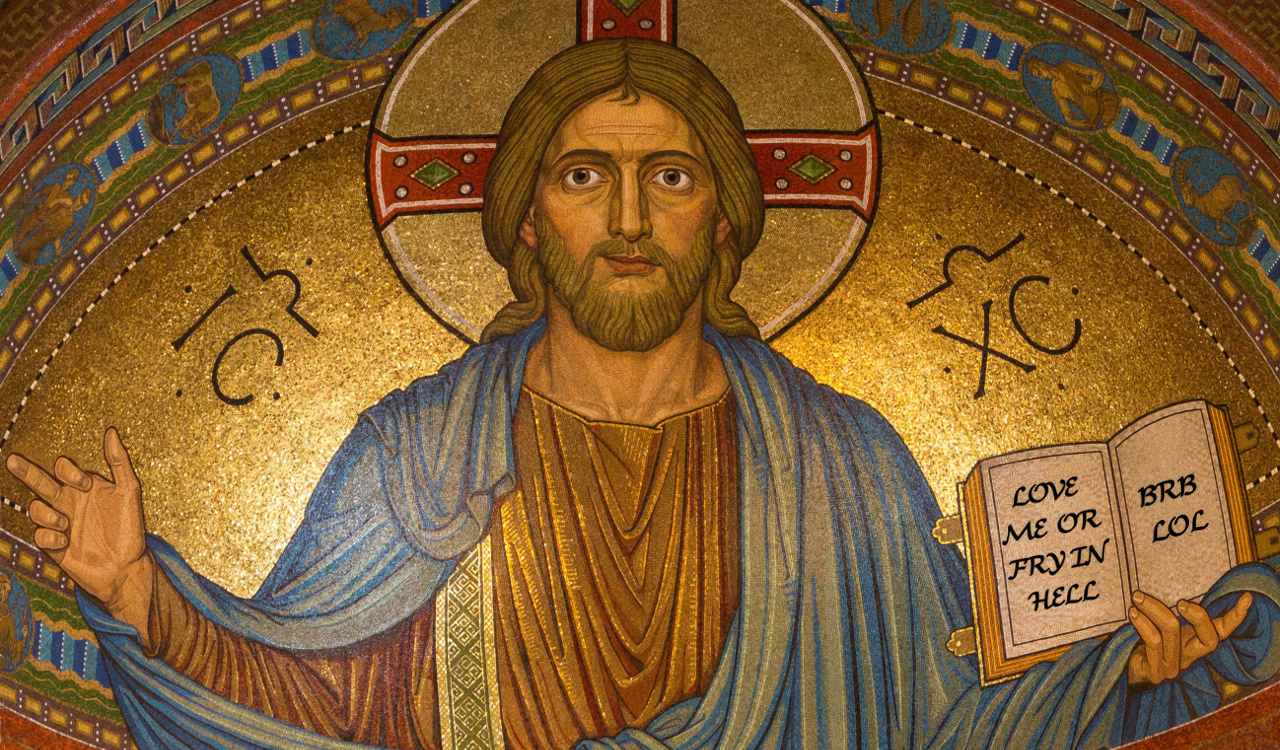
The Jesus mosaic image is adapted (obviously) from a photo reproduction of the apse mosaic of Christ Pantocrator inside the Maria Laach Abbey. The mosaic “was completed in 1911 by Father Andreas Goeser” (link), long enough for the unfortunate Fr. Goeser’s beautiful work to pass into the public domain and get co-opted with the GIMP free image processing software. My irreverent modifications consist of the smirk, the folding over of one additional finger, and a considerably revised text on the open pages. I cannot take credit for “BRB LOL,” having seen it in a meme image some time ago.

Notes


  1. Matt. 18:20. It should be added, however, that the only qualified gatherings for his attendance were those of my own church’s few hundred congregations around the world. He skipped all the untold thousands of other ones because they weren’t part of “God’s Kingdom.” 

  2. “Ye fools and blind: for whether is greater, the gold, or the temple that sanctifieth the gold? And, Whosoever shall swear by the altar, it is nothing; but whosoever sweareth by the gift that is upon it, he is guilty. Ye fools and blind: for whether is greater, the gift, or the altar that sanctifieth the gift?” (Matt. 23:17-19). 

  3. Valerie Tarico, Trusting Doubt: A Former Evangelical Looks at Old Beliefs in a New Light (Oracle Institute Press, 2010; previously published 2006 as The Dark Side), Ch. 5 (available online). 

  4. The Revised Standard Version translates the word as “secrets” (secret, singular, in Mark), which makes the problem even more apparent. Both the KJV and NASB use the term “mysteries” (and “mystery”). 

  5. These four paragraphs, the footnote above, and the rest of this one are adapted from my first book, An Examination of the Pearl, Section 7.1 (“The Gospels”). Robert M. Price told me in 2011 that he believes this to be a case of an intentional contradiction between John and the Synoptics. The writer of John “rejects the esotericism of Mark and changes the story,” which he also did to avoid the “unseemly” stories of Jesus not carrying his own cross and not wanting to go through with his suffering. “For John, there was no private teaching in the Markan, Gnostic sense.” (Gnosis was secret spiritual knowledge not shared with everybody else.) “Everything is public, though some do not hear because they are not of his flock. Thus within John’s retold narrative Jesus is telling the truth.” 

  6. Richard Dawkins, The God Delusion (Houghton Mifflin, 2006). 

  7. Robert M. Price, Blaming Jesus for Jehovah: Reconsidering the Righteousness of Christianity (Tellectual Press, 2016), p. 19. 

  8. Price (Tarico Foreword) at p. 8. 

  9. Price at p. 29. 

  10. Dan Barker, interviewed by Seth Andrews on The Thinking Atheist podcast, Feb. 16, 2016

  11. Price at p. 38. 

  12. Price at p. 65. 

  13. Price at p. 55. 

  14. See, e.g., my blog posting Myth, Method, and the Will to Believe about a lecture by the same name that Bob gave on the topic. 

  15. Hat tip to Jonathan Bernier, who noted this issue in a Facebook post

  16. Price at p. 95. 


Monday, August 4, 2014

A Christ-Myth Carol

Our reason is quite satisfied, in nine hundred and ninety-nine cases out of every thousand of us, if it can find a few arguments that will do to recite in case our credulity is criticised by some one else. Our faith is faith in some one else’s faith, and in the greatest matters this is most the case.
—William James, “The Will to Believe” (1896)
Raphael Lataster [Photo credit: Emma Crancher]
Book Review: There Was No Jesus, There Is No God. By Raphael C. Lataster (2013).

The directness of Raphael C. Lataster’s new book is indicated by its title: There Was No Jesus, There Is No God. It’s an easy and informative read, but by no means a lightweight one. The scholarly rigor is there, as evidenced by an abundance of footnotes.

The book includes a discussion of the age-old question of God’s existence, but it’s the larger first half that I find of particular interest: Was there a Historical Jesus on which to build the “Christ of Faith” that we non-Christians reject as supernatural? In just over 150 fast-moving pages, Lataster explains why he thinks there wasn’t.

Criteria Crunch

After some introductions and a brief discussion of Bayesian inference, Lataster begins by describing the “criteria of authenticity” that are “used by Bible scholars to judge the reliability of certain aspects of the Bible” (p. 18). There really isn’t that much judgment going on, though. These “criteria” are waved around by apologists to distract the audience from the Bible’s very real problems and give the show the air of intellectual respectability. It’s a dodge, and Lataster explains why.

Multiple attestation? “Few individual units of the Jesus tradition are multiply attested, and even then, establishing independence is incredibly difficult” (p. 18). Embarrassment? That’s “highly speculative,” for several reasons (pp. 19-20). Coherence? “Without a solid base of certain sayings and deeds that do stem from a historical Jesus, using this criterion would be circular” (p. 21). And on he goes for a couple more pages, dismantling stuff like vividness of narration and the contradictory criterion of least distinctiveness.

Lastaster notes the biased nature of this effort. With one little-used exception, there “are no definitive criteria for inauthenticity” (p. 23). The Bible defenders touting their checklist offer “no criteria that confidently assert that Jesus could not have existed historically” (my emphasis). The game is rigged. It’s all in the direction of “proving” what they desperately need to show.1

Lord, I Believe, Help Thou My Scholarship

Jesus scholars tend to be a goal-oriented bunch. The evangelists’ slogan “You need Jesus” applies to almost all of these guys in a very practical way. Without him, their entire subject of study–and, almost always, their faith–disappears. He’s not just some itinerant preacher and healer wandering around the Levant two thousand years ago. On his historically dubious shoulders rests the full weight of a religion claimed by nearly a third of the world’s people. Being embedded in, and dependent on, a culture with such crying need to assure itself of the past reality of a single man cannot help but influence even those who don’t share that need themselves.2

One Bible scholar who defends the existence of a historical Jesus without worshiping him or even being convinced of God’s existence is Bart Ehrman of the University of North Carolina. Erhmans’s popular work Did Jesus Exist? is a legitimate point of reference and discussion for any recent book about the Historical Jesus, and Lataster does not shirk from doing so. Yes, is Ehrman’s answer to his title question, but based on arguments that have been fiercely panned by critics.3 Lataster points out (p. 38) problems with one–Ehrman’s claim in Did Jesus Exist? that we “have numerous, independent accounts of [Jesus’] life in the sources lying behind the Gospels.”

Which lurking sources are these? In my view–that of a well-read layman whose rejection of Christianity does not depend on the absence of a historical Christ–they seem about as tangible as the Ghost of Christmas Past. The intellectually guilty consciences of devoted Jesus scholars seem to be giving them nightmares, causing them to see rich visions of source material instead of the handful of decades-late manuscript fragments that actually appear on their followers’ barren tables. The poor faithful souls bowing their heads in prayer over these scraps don’t know how bad off they’ve really got it. The more sophisticated Christian apologists, the elites of the Jesus-Industrial complex, are trying their best to keep it that way.4

The scrawniness of the Gospel goose is evident in Ehrman’s own words. A non-Christian, he is “all too happy to discredit the Gospels when it comes to opposing the resurrection of Jesus,” Lataster says, citing a 2009 debate between Ehrman and Christian apologist Michael Licona. Yet

somehow (and inconsistently) when it comes to the existence of Jesus, he concludes that the gospels “make a convincing case.” Suddenly, these terrible sources are quite good! He completely trashes the Gospels as unreliable, yet feels that at least on Jesus’ existence, he has access to some absolute truth. [p. 33]

So quit complaining and eat up, kids. We’ve got ourselves a fine dinner here:

Ehrman is even able to turn these few Gospels into numerous independent sources, by making reference to oral tradition, hypothetical sources such as Q, M and L, and the “second degree” hypothetical (and supposedly multiple) sources behind these hypothetical sources, which is hardly an acceptable historical method of dealing with the issue of a lack of primary sources. These sources don’t exist. [p. 33]

The sad fact is that the food sucks, and we are entitled to expect better. This Jesus character was an astounding figure, after all: “the King of Kings, who wrought many miracles, died for our sins, and according to the Bible, was known throughout the land.” Yet, as Lataster notes, he “fails to produce even one single primary source” (p. 43). Jesus rose from the dead, for God’s sake (actually, ours), and then appeared not just to a few disciples behind locked doors, but, according to 1 Corinthians 15:6, to five hundred people. And what do we get? A few contradictory and yet mutually dependent accounts, written by devotees at least several decades after the fact. The earliest of them–Mark without its tacked-on later ending–does not even mention a resurrection.5

The Sound of Silence

If this were “a historically significant figure,” Lataster observes, “someone would have written about him, in a time when there were ample historians and authors (such as Philo of Alexandria), and especially considering the Biblical claims of Jesus’ fame, controversies, miracles and other great achievements” (pp. 41-42).

But none of them did. The scholar who summarizes this situation best may well be Ehrman himself, and again Lataster is at the ready to point that out for us. “What sorts of things do pagan authors from the time of Jesus have to say about him?” he quotes Ehrman.6 “Nothing. As odd as it may seem, there is no mention of Jesus at all by any of his pagan contemporaries. There are no birth records, no trial transcripts, no death certificates; there are no expressions of interest, no heated slanders, no passing references–nothing.”

As Lataster himself observes,

there exists only one non-Christian attestation to Jesus within approximately one hundred years of his birth: an author who was born after Jesus’ supposed death (Josephus, who was obviously not an eyewitness), and whose two small passages on Jesus attract the suspicion of critical scholars and historians. [p. 26]

Lataster goes into some detail about issues with the Josephus references, as well as a later, problematic one by Tacitus. Both, I learned from Lataster (p. 62), were ignored by the early Christian writers Origen and Tertullian. Those guys would not have hesitated to tout the two historians’ references to the founder of Christianity–what a PR coup that would’ve been! But they didn’t, probably because there were no such references. “Lying for the Lord” is not a new phenomenon; the early fourth-century historian Eusebius, Lataster says, “is well known as a defender of pious fraud” (p. 57).

The crux of the matter, as Lataster summarizes it, somewhat incongruously among his pages of comprehensive arguments:

One of the most curious problems the historian faces when researching Jesus is not posed by the sources, but by the lack of sources. There are no extra-Biblical references to Jesus that are contemporary and by eyewitnesses. Absolutely none. Even when including the Biblical books, there are no primary sources whatsoever, for the life of Jesus. The books of the Bible were penned decades after Jesus’ death, and do not provide us with direct eyewitness accounts. [p. 37]

Paul does not provide as much help as apologists would like to claim, either. Lataster quotes (p. 94) Gerd Lüdemann for his observation of this remarkable fact: “Jesus’ teachings seem to play a less vital role in Paul’s religious and ethical instruction than does the Old Testament. . . not once does Paul refer to Jesus as a teacher, to his words as teaching, or to Christians as disciples.”

Lataster also raises (though not claiming credit for it) the fascinating “possibility that Paul’s Jesus is a ‘celestial Christ’, who appeared in visions, and may have existed in outer space rather than on Earth” (p. 119). Paul, he thinks, adapted into his own Jesus concept the “purely supernatural figure” of the Logos, which Philo of Alexandria posited not too many decades beforehand (p. 120).

The sources are so bad, Lataster concludes later, that “it is entirely rational to doubt the existence even of a stripped-down, insignificant, non-miraculous Historical Jesus” (p. 123). And nobody should fault us for doubting, either. “If the great Apostle Paul was only convinced due to the miracle on the Damascus Road, and supposedly lived around the same time as Jesus,” Lataster asks, “surely we lesser mortals, raised in an increasingly-secular and rational world, far-removed from those impressive times, should be given at least the same opportunities?” (p. 148).

But we’re not so fortunate, concerning Jesus, as we’ve seen, or indeed even concerning the existence of God. For reasons that Lataster discusses in the second half of his book (not reviewed further here), God “gives us no good reason to accept his existence. He just refuses to come out of the closet” (p. 148). The Historical Jesus is right in there with him.7

A Recommended Read

I highly recommend this book, though with a couple of complaints. First, Lataster really could have benefited from some editing, for grammar and punctuation. It was also a bit jarring to see this problematic statement right up front: “Ehrman is an atheist (formerly a Christian) who believes in a historical Jesus, [Robert M.] Price is a Christian who promotes the JMT [Jesus Myth Theory], while Carrier is a sceptical historian previously critical of the JMT” (p. 10).

Ehrman is actually an agnostic who says, “I no longer know whether God exists.”8 Bob is a friend of mine, and I know how much fondness and respect he has for Christianity, as well as other religions. He has attended an Episcopal church “for the music and the stained glass,” though not much anymore. But he doesn’t believe in God or the probable existence of even a historical, non-miraculous Jesus. To call him a Christian would be stretching that label far beyond any real meaning, indeed farther than I think he would himself.

But, those quibbles aside, this is an excellent work. It’s full of valuable insights and information, and presents them in an engaging way. It’s also a bargain at $2.99 for the Kindle version. With that reasonable price, Lataster seems to know what he’s doing in the marketing department as well as Jesus scholarship: There Was No Jesus, There Was No God has been selling very well ever since it came out in September of last year.

Its success is justifiable, and gratifying to see in an ocean of bestselling nonsense. If you wish (and dare!) to learn a bit about why some of us aren’t too convinced about even the most basic historical grounds for Christianity, take a look at this book.

Notes


  1. For further reading on these bogus criteria and the motivated reasoning of apologists, see my essay Myth, Method, and the Will to Believe

  2. “The worst-kept secret in the academic world,” says Lataster, “is that the majority of Biblical scholars (as well as Philosophers of Religion) are Christians who believe in the Christian God and in the Biblical Jesus” (p. 133). 

  3. See, e.g., my review of Bart Ehrman and the Quest of the Historical Jesus of Nazareth, Frank R. Zindler and Robert M. Price, eds., American Atheist Press (2013). 

  4. October 1, 2015: I wish and had hoped I was the first to use this phrase, inspired of course from Eisenhower’s 1960 warning to “guard against the acquisition of unwarranted influence, whether sought or unsought, by the military-industrial complex.” It does show up on the first page of Google search results for those three words, and I’ve gotten page views from that. Alas, the phrase appeared elsewhere at least four years earlier. See this article about the separation of church and state by Bruce Barry, January 7, 2010: “The simpleminded mistake that FACT and other organizations comprising the Jesus-Industrial Complex make is assuming that the absence of the “separation” phrase in the Constitution means that the doctrine of separation has no legal value in our constitutional system.” 

  5. As discussed later in my review, there are also a few vague spiritual references by “Paul,” traditionally dated to within a decade or so of Jesus’ death. But it has been argued that the Pauline epistles were written late in the game, too, and by people other than Apostle Paul. 

  6. Lataster’s cite is: Bart D. Ehrman, Jesus: Apocalyptic Prophet of the New Millennium (Oxford: Oxford University Press, 1999), pp. 56-57. I haven’t checked the source, but I’ve read something similar elsewhere in Ehrman’s writings. 

  7. Such divine caginess is not inconsistent with the disturbing principle that Jesus describes in the Gospel of Mark. He spoke to the public only in opaque riddles, explaining things to his disciples in secret. Only to them were the mysteries revealed. To “them that are without, all these things are done in parables: That seeing they may see, and not perceive; and hearing they may hear, and not understand; lest at any time they should be converted, and their sins should be forgiven them” (Mark 4:11). So much for Jesus’ claim, in the words of a later Gospel, that he “spake openly to the world; I ever taught in the synagogue, and in the temple, whither the Jews always resort; and in secret have I said nothing” (John 18:19-20). Did Jesus lie, or is one of the Gospels in error? Christians who know about this must pick one of two unpalatable options, besides dealing with the cruelty and absurdity of a savior who would deliberately withhold the opportunity for salvation from all but a select few. 

  8. See Ehrman’s intereview at bartdehrman.com/​powells_interview/​powells_interview.htm 


Monday, September 9, 2013

Evolution Exposure

This June, during a quick trip to Seattle, I had lunch with Valerie Tarico. She is an ex-Christian psychologist who works to “heal a world that is being fractured by cultural and religious zealots,” as she puts it on her website. Also joining us at the table were two other refugees from religion, Rich and Deanna Joy Lyons of the Living After Faith podcast. These are smart, loving, delightful people, and our time together was a memorable one full of laughs, ideas, and shared experiences.

On the shoulders of giants. And these
are just some of the print books we cite.

Now Dr. Tarico has published an article about my faith story and the background of Evolving out of Eden, a book I co-authored with Dr. Robert M. Price about the conflicts between evolutionary science and Christian theology. Her introduction and questions in the Q&A that follows were insightful and thought-provoking, and the article is getting wide exposure on Alternet.org, Salon.com, and the website of the Richard Dawkins Foundation for Reason and Science. Between them, the article has nearly 2,000 Facebook “likes” and 300 tweets.

And there are a lot of comments by readers, too. These three links go to the different editions of the article with their respective sets of comments: Alternet, Salon, and the RDFRS. I’ll get back to those in a minute.

The book is also getting attention from John Loftus’s Debunking Christianity blog. It is running an excerpt that goes into some theological depth about a nuance to the evolution vs. Christianity conflict, significant but little discussed: How could the half-human, half-divine nature of Jesus possibly be rationalized scientifically?

The problems aren’t just scientific: An evolved or even half-evolved Jesus would’ve had all the supposedly sinful natural inclinations that Christianity gives humans so much grief about—lust, anger, etc.—because he carried Mary’s human DNA and a supposedly divine portion that would have needed to be defective by design in order to match up with it. Besides all that, there is the issue of divine deception: Jesus wouldn’t be a man without a Y chromosome faked to look like it had been passed down, with occasional mutations, from an endless line of human paternal ancestors. What a mess, and that’s just from this one small part of the overall problem that makes this book cover 340 pages and eighteen chapters.

Now, about those comments. I am amazed at how much people will say based on so little actual information. And I’m not talking about the silly “I didn’t come from some monkey” or “you weren’t there when the world was made” nonsense that pervades all public discussion of evolution in the United States, including in the pages of comments that follow these articles. That is easily disregarded by anyone who has honestly read a real science book on the subject. More vexing are the assumptions people flippantly make about all the solutions to the Christanity-vs-evolution puzzle that I must have missed, the sophisticated metaphorical reading of the Bible that muffles its inconvenient passages into a mystical, benign chant thrumming in the background.

The current top comment on the Alternet edition is representative of this. It complains, “One of the most frustrating aspects of ‘conversion’ stories like these is the lack of understanding of Biblical exegesis even after the conversions. In other words, even after a conversion from Christian to atheist, the converted still do not understand the Bible and the literalists’ misinterpretation.”

Hmmm. Perhaps my co-author’s two PhD degrees—one in the New Testament and the other in systematic theology—provide some counterbalance to the two Bible courses the commentator says he took in college, if not some glimmer of understanding about biblical exegesis. Certainly reading our book, skimming its Table of Contents, or even glancing at this paragraph from page 9 would address his concerns about our being trapped in literalism:

The Bible, of course, is the beginning of sorrows for the theistic evolutionist. In many cases (indeed it is fast becoming the rule) Christian evolutionists are not merely accommodating the reading of the Bible to the facts of science. They seem ready to accept Bultmannian demythologizing of the Old Testament, admitting it is marked by obsolete cosmology and mythical tales from the ancient world. (Rest assured, they comfort their readers, who can see what ought to come next; the gospels are in no such danger. But aren’t they?) In this way they claim (as Rudolf Bultmann did) not to be rejecting scripture but rather to be reinterpreting it. This distinction, they hope, will enable them to “sell” evolution to their evangelical brethren, suspicious as they are of the product. But one must suspect also that they are trying to cover their own posteriors, rightly sensing that their evangelical membership cards are in imminent danger of being canceled.

Another commentator (“Mike V” on Salon) is concerned that we former fundamentalists “think that the only legitimate form of religion is essentially the fundamentalist one. That is why they just can’t grasp the sophisticated and interesting theologies that are out there. It’s nice that he actually took the time to even look at [John] Haught, but his cavalier dismissal of it speaks volumes.” This is another article-skimmer who I would love to see become an actual reader of the book. Or perhaps just a glance at our index would help his own cavalier dismissal of our work: We have twenty separate index entries for Haught, John, citing his works on about as many pages. Haught is just at one end of the spectrum of science-savvy theologians we’ve identified, with, for example, the “evolutionary creationist” Denis Lamoureux near the other. (He gets 33 index entries, in case you were curious.)

Most baffling of all are those commentators who think I somehow co-authored a book subtitled Christian Responses to Evolution without being aware of, well, Christian responses to evolution. Like “kenkapkk” on Salon: “But why is Suominen desperately clinging to an attempt to reconcile creationism with evolution? It’s the THEOLOGY that’s a mess. Has he taken time to read the plethora of progressive Christian scholars or studied the evolution of the New Testament as a literary-historical document that is primarily mythological?”

Uh, yes. Yes, we have. I conclude this posting (below the update) with a copy of our References section. It’s in really small print, because there are 180 entries, but you get the idea.

———

Update—April 30, 2014: When Seth Andrews of The Thinking Atheist podcast shared a link to the Salon.com article on Facebook, the comments from his audience were a pleasant contrast. My favorite, from Sara Greenwood: “I’m such a sentimental sap. I was relieved when I got to the part about his wife. Apparently they are very well suited to each other.” Yes we are, Sara, and I’m a sentimental sap, too.

I sent Seth a note of appreciation and, to my delight, that wound up resulting in an appearance on his April 29, 2014 episode with co-author Bob. With a million downloads of his podcasts every month, a full travel schedule, and a regular career besides, Seth is a very busy and prominent figure in the secular movement. I was truly honored to be a small part of his show.

———

Al-Khalili, Jim. 2004. Quantum: A guide for the perplexed. London: Weidenfeld and Nicolson.

Alexander, Denis. 2008. Creation or evolution: Do we have to choose? Oxford: Monarch/Grand Rapids: Kregel.

Aus, Mike. 2012. Conversion on mount improbable: How evolution challenges Christian dogma. The Richard Dawkins Foundation for Reason and Science. richarddawkins.net/articles/645853-conversion-on-mount-improbable-how-evolution-challenges-christian-dogma (accessed May 2012).

Babinski, Edward T. Interpretations of biblical cosmology. etb-cosmology.blogspot.com/2012/03/interpretations-of-biblical-cosmology.html (accessed June 2012).

———, ed. 2003. Leaving the fold: Testimonies of former fundamentalists. Amherst, NY: Prometheus Books.

———. 2010. The cosmology of the Bible. In Loftus 2010, loc. 1298-1848.

———. 2012. Personal communication.

Balantekin, A.B. and N. Takigawa. 1998. Quantum tunneling in nuclear fusion. Rev. Mod. Phys. 70, 77-100.

Barbour, Ian G. 2000. When science meets religion: Enemies, strangers, or partners? New York: HarperCollins.

Barr, James. 1977. Fundamentalism. Philadelphia: Westminster Press.

Beegle, Dewey M. 1963. The inspiration of scripture. Philadelphia: Westminster.

Blackmore, Susan. 1999. The meme machine. Oxford University Press.

———. 2010. Why I no longer believe religion is a virus of the mind. The Guardian. September 16. guardian.co.uk/commentisfree/belief/2010/sep/16/why-no-longer-believe-religion-virus-mind (accessed February 2013).

Blish, James. 1970. Spock must die! New York: Bantam Books.

Bishop, Robert. 2009. Chaos. The Stanford Encyclopedia of Philosophy. Ed. Edward N. Zalta. plato.stanford.edu/archives/fall2009/entries/chaos (accessed December 2012).

Boardman, William W., William W. Boardman (Jr.), Robert Frank Koontz, and Henry Madison Morris. 1973. Science and creation. N.p.: Creation-Science Research Center.

Bonhoeffer, Dietrich. 1962. Letters and papers from prison. Trans. Reginald H. Fuller. Ed. Eberhard Bethge. New York: Macmillan. (Orig. German pub. 1951 by Christian Kaiser Verlag.)

Bright, John. 1971. The authority of the Old Testament. Nashville: Abingdon Press.

Bultmann, Rudolf. 1958. Jesus Christ and mythology. New York: Charles Scribner’s Sons.

———. 1960. This world and the beyond: Marburg sermons. Trans. Harold Knight. London: Lutterworth Press.

———. 1961. New Testament and mythology. In Kerygma and Myth: A Theological Debate. Ed. Hans Werner Bartsch, trans. Reginald H. Fuller, 1 44. New York: Harper & Row Torchbooks.

Burton, Robert A. 2008. On being certain: Believing you are right even when you’re not. New York: St. Martin’s Press.

Carroll, Sean B. 2005. Endless forms most beautiful: The new science of evo devo. New York: W.W. Norton & Co.

Collins, C. John. 2011. Did Adam and Eve really exist? Wheaton, IL: Crossway.

Collins, Francis S. 2006. The language of God: A scientist presents evidence for belief. New York: Simon & Schuster.

Collins, Robin. 2003. Evolution and original sin. In Miller 2003, 469-501.

Coyne, Jerry. 2009. Why evolution is true. New York: Penguin Books.

———. 2009. John Haught’s “sophisticated” theology: Evolution is God’s drama. Why Evolution is True website. whyevolutionistrue.wordpress.com/2009/12/03/john-haughts-sophisticated-theology-why-evolution-is-really-part-of-gods-plan (accessed August 2012).

———. 2011. Making religious virtues from scientific necessities. Why Evolution is True website. whyevolutionistrue.wordpress.com/2011/07/17/making-religious-virtues-from-scientific-necessities (accessed May 2012).

———. 2011. How big was the human population bottleneck? Another staple of theology refuted. Why Evolution is True website. whyevolutionistrue.wordpress.com/2011/09/18/how-big-was-the-human-population-bottleneck-not-anything-close-to-2 (accessed July 2012).

———. 2012. Science, religion, and society: The problem of evolution in America. Evolution, doi:10.1111/j.1558-5646.2012.01664.x.

Craig, D.P. and T. Thirunamachandran. 1998. Molecular quantum electrodynamics. Mineola, NY: Dover.

Cunningham, George C. 2010. Decoding the language of God: Can a scientist really be a believer? Amherst, NY: Prometheus Books.

Cupitt, Don. 1988. The sea of faith. Cambridge: Cambridge University Press.

Darwin, Charles. 1859. On the origin of species by means of natural selection. London: Murray.

———. 1888. The descent of man, and selection in relation to sex. 2nd ed. London: Murray.

Dawkins, Richard. 2006. The selfish gene: 30th anniversary edition with a new introduction by the author. New York: Oxford University Press.

———. 2008. The God delusion. New York: Houghton Mifflin.

———. 2009. The greatest show on earth. New York: Simon and Schuster.

de Waal, Frans. 2002. Evolutionary psychology: The wheat and the chaff. Current Directions in Psychological Science 2, no. 6 (December): 187-91.

———. 2006. Primates and philosophers: How morality evolved. Princeton, NJ: Princeton University Press.

DeBruine, Lisa M. 2002. Facial resemblance enhances trust. Proceedings of the Royal Society: Biological Sciences 269, no. 1498 (July 7): 1307-12.

Deméré, T.A., M.R. McGowen, A. Berta, and J. Gatesy. 2008. Morphological and molecular evidence for a stepwise evolutionary transition from teeth to baleen in mysticete whales. Systematic Biology 57:15-37.

Dennett, Daniel C. 1995. Darwin’s dangerous idea: Evolution and the meanings of life. New York: Simon and Schuster.

———. 2006. Breaking the spell: Religion as a natural phenomenon. New York: Penguin Group.

Dillard, Annie. 1974. Pilgrim at Tinker Creek. New York: HarperCollins.

Distin, Kate. 2005. The selfish meme: A critical reassessment. New York: Cambridge University Press.

Domning, Daryl P. 2001. Evolution, evil and original sin. America: The National Catholic Weekly. November 12. americamagazine.org/content/article.cfm?article_id=1205 (accessed June 2012).

Ebeling, Erich. 1915-23. Keilschrifttexte aus Assurreligiösen Inhalts. Wissenschaftliche Veröffentlichung der deutschen orientgesellschaft 28. Leipzig: C. Hinrichs.

Ehrlich, Paul R. 2000. Human natures: Genes, cultures, and the human prospect. Washington: Island Press.

Eliade, Mircea. 1969. Yoga: Immortality and freedom. Trans. Willard R. Trask. Bollingen Series, vol. 61. Princeton: Princeton University Press.

Enns, Peter. 2012. The evolution of Adam. Grand Rapids, MI: Brazos Press.

Everett, Daniel L. 2008. Don’t sleep, there are snakes: Life and language in the Amazonian jungle. New York: Pantheon Books.

Fagan, Brian. 2010. Cro-Magnon: How the Ice Age gave birth to the first modern humans. New York: Bloomsbury Press.

Fairbanks, Arthur, ed. and trans. 1898. The first philosophers of Greece. London: K. Paul, Trench, Trubner.

Fairbanks, Daniel J. 2007. Relics of Eden: The powerful evidence of evolution in human DNA. Amherst, NY: Prometheus Books.

Flew, Anthony. 1950. Theology and falsification. Reprinted on The Unofficial Stephen Jay Gould Archive. stephenjaygould.org/ctrl/flew_falsification.html (accessed April 2012).

Foley, Jim. 2008. Comparison of all skulls. Fossil Hominids: The Evidence for Human Evolution. talkorigins.org/faqs/homs/compare.html (accessed October 2012).

Ford, Kenneth W. 2005. The quantum world: Quantum physics for everyone. Cambridge, MA: Harvard University Press.

Forster, Lucy, Peter Forster, Sabine Lutz-Bonengel, Horst Willkomm and Bernd Brinkmannet. 2002. Natural radioactivity and human mitochondrial DNA Mutations. Proceedings of the National Academy of Sciences 99, no. 21 (October 15): 13950-13954.

Freud, Sigmund. 1964. The future of an illusion. Trans. W.D. Robson Scott. Garden City: Doubleday Anchor.

Fry, Iris. 2000. The emergence of life on Earth: A historical and scientific overview. New Brunswick, NJ: Rutgers University Press.

Gibbons, Ann. 2007. The first human: The race to discover our earliest ancestors. New York: Random House.

Giberson, Karl W., and Francis S. Collins. 2011. The language of science and faith. Downers Grove, IL: InterVarsity Press.

Giovannoni, Stephen J., et al. 2005. Genome streamlining in a cosmopolitan oceanic bacterium. Science 309 (August 19), 1242-45.

Gish, Duane T. 1973. Evolution: The fossils say no! San Diego: Creation-Life Publishers.

Goren-Inbar, Naama, Nira Alperson, Mordechai E. Kislev, Orit Simchoni, Yoel Melamed, Adi Ben-Nun, and Ella Werker. 2004. Evidence of hominin control of fire at Gesher Benot Ya’aqov, Israel. Science, New Series 304, no. 5671 (April 30), 725-27.

Gosse, Philip Henry. 1857. Omphalos: An attempt to untie the geological knot. London: John van Voorst.

Graves, Leslie, Barbara L. Horan, and Alex Rosenberg. 1999. Is indeterminism the source of the statistical character of evolutionary theory? Philosophy of Science 66 no. 1 (March): 140-57.

Graves, Robert. 1960. The Greek Myths. Vol. 1. Baltimore: Penguin Books.

Haarsma, Loren. 2003. Does science exclude God? Natural law, chance, miracles, and scientific practice. In Miller 2003, 71-94.

Haarsma, Loren and Terry M. Gray. 2003. Complexity, self-organization, and design. In Miller 2003, 288-310.

Ham, Ken. 2011. The pope on the big bang. Around the world with Ken Ham. blogs.answersingenesis.org/blogs/ken-ham/2011/01/07/the-pope-on-the-big-bang (accessed May 2012).

———. 2012. Beware of those who want the church to compromise. Around the World with Ken Ham. blogs.answersingenesis.org/blogs/ken-ham/2012/07/28/beware-of-those-who-want-the-church-to-compromise (accessed August 2012).

Harris, Sam. 2005. The end of faith: Religion, terror, and the future of reason. New York: W.W. Norton & Co.

Haught, John F. 2000. God after Darwin: A theology of evolution. Boulder, CO: Westview Press.

———. 2009. Darwin, God, and the drama of life. Washington Post, November 30. newsweek.washingtonpost.com/onfaith/georgetown/2009/11/darwin_god_and_the_drama_of_life.html (accessed August 2012).

———. 2010. In Atoms and Eden: Conversations on religion and science, ed. Steve Paulson, 83-98. New York: Oxford University Press.

———. 2010. Making sense of evolution: Darwin, God, and the drama of life. Louisville, KY: Westminster John Knox Press.

Hawks, John. 2011. Mailbag: Y chromosome Adam. John Hawks weblog. johnhawks.net/weblog/mailbag/y-chromosome-adam-2011.html (accessed July 2012).

Horn, Stephan Otto and Siegfried Wiedenhofer, eds. 2008. Creation and evolution: A conference with Pope Benedict XVI in Castel Gandolfo. San Francisco: Ignatius Press.

Hulsbosch, Ansfridus. 1966. God in creation and evolution. Lanham, MD: Sheed and Ward.

Hurd, James P. 2003. Hominids in the garden? In Miller 2003, 208-33.

Hyers, M. Conrad. 1984. The meaning of creation: Genesis and modern science. Atlanta: John Knox Press.

Ingersoll, Robert G. [1833-1899]. All cited lectures and interviews are from The Complete Lectures and Interviews of Robert G. Ingersoll. Kindle edition.

James, William. 1958. The varieties of religious experience: A study in human nature. New York: New American Library/Mentor Books. (Orig. pub.  1902.)

Jaspers, Karl. 1953. The origin and goal of history. Trans. Michael Bullock. New Haven, CT: Yale University Press.

Kitcher, Philip. 2007. Living with Darwin: Evolution, design, and the future of faith. New York: Oxford University Press.

Kobe, Donald H. 2004. Luther and Science. Leadership University. leaderu.com/science/kobe.html (accessed July 2012).

Kolts, Russell. 2011. The compassionate mind approach to managing your anger. London: Robinson.

Koonin, Eugene V. 2011. The logic of chance: The nature and origin of biological evolution. Upper Saddle River, NJ: FT Press Science.

Kouwenhoven, Arlette P. 1997. World’s oldest spears. Archeology Newsbriefs 50, no. 3 (May/June), archaeology.org/9705/newsbriefs/spears.html (accessed February 2013).

Korsmeyer, Jerry D. 1998. Evolution and Eden: Balancing original sin and contemporary science. Mahwah, NJ: Paulist Press.

Krauss, Lawrence M. 2012. A universe from nothing: Why there is something rather than nothing. New York: Free Press.

Kuhn, Thomas S. 1996. The structure of scientific revolutions. 3rd ed. Chicago: University of Chicago Press.

Lamoureux, Denis O. 2008. Evolutionary creation: A Christian approach to evolution. Eugene, OR: Wipf & Stock.

Lanz von Liebenfels, Jörg. 2001. Theozoologie: Das Urchristentum neu Erschlossen. Was lehrt die Bibel wirklich? N.p.: Deutschherrenverlag.

Lévi-Strauss, Claude. 1955. The structural study of myth. Journal of American Folklore 68, no. 270, 428-44.

Levine, Joseph S. and Kenneth R. Miller. 1991. Biology: Discovering life. Lexington, MA: D.C. Heath and Company.

Loftus, John W, ed. 2010. The Christian delusion: Why faith fails. Amherst NY: Prometheus Books.

———. 2011. The end of Christianity. Amherst NY: Prometheus Books.

Lovecraft, H.P. 1926. The call of Cthulhu. The H.P. Lovecraft archive.hplovecraft.com/writings/texts/fiction/cc.asp (accessed April 2012).

Luper, Steven. 2009. The philosophy of death. Cambridge: Cambridge University Press.

Luther, Martin. 1535-1536. Lectures on Genesis, Vol. 1. George V. Schick, trans., 1958. Saint Louis, MO: Concordia Publishing House.

Mark, Joshua J. 2011. Enuma Elish—The Babylonian epic. Ancient History Encyclopedia. ancient.eu.com/article/225 (accessed January 2013).

McFadden, Johnjoe. 2002. Quantum evolution: How physics’ weirdest theory explains life’s biggest mystery. New York: W.W. Norton & Co.

Mendez, Fernando L., et al. 2013. An African American paternal lineage adds an extremely ancient root to the human Y chromosome phylogenetic tree. The American Journal of Human Genetics 92, no. 3 (February 28): 454-59.

Meyer, Klaus-Dieter. 2005. Zur Stratigraphie des Saale-Glazials in Niedersachsen und zu Korrelationsversuchen mit Nachbargebieten. Eiszeitalter und Gegenwart 55, no. 1, 25-42.

Meyer, Marvin, ed. 2007. The Nag Hammadi scriptures. New York: HarperCollins.

Meyers, Stephen. 1989. A Biblical Cosmology. Th.M. Thesis, Westminster Theological Seminary.

Miller, Keith B., ed. 2003. Perspectives on an evolving creation. Grand Rapids, MI: W.B. Eerdmans.

Miller, Kenneth R. 1999. Finding Darwin’s God: A scientist’s search for common ground between God and evolution. New York: HarperCollins.

Monod, Jacques. 1974. Chance and necessity: An essay on the natural philosophy of modern biology. Trans. Austryn Wainhouse. London: Collins Fontana Books.

Mohler, Albert, Jr. 2011. False start? The controversy over Adam and Eve heats up. albertmohler.com/2011/08/22/false-start-the-controversy-over-adam-and-eve-heats-up (accessed May 2012).

Morris, Henry M. 1969. Evolution and the modern Christian. Phillipsburg, NJ: Presbyterian and Reformed Publishing Co.

Murphy, George L. 2003. Christology, Evolution, and the Cross. In Miller 2003, 370-89.

Münzel, S.C., F. Seeberger, and W. Hein. 2002. The Geißenklösterle flute: Discovery, experiments, reconstruction. In Studien zur Musikarchäologie III; Archäologie früher Klangerzeugung und Tonordnung; Musikarchäologie in der Ägäis und Anatolien, eds. E. Hickmann, A.D. Kilmer, R. Eichmann. Orient-Archäologie 10, 107-18. Verlag Marie Leidorf GmbH.

Noll, Mark A., and David Livingstone. 2003. Charles Hodge and B.B. Warfield on Science, the Bible, Evolution, and Darwinism. In Miller 2003, 61-71.

Nowak, Martin A. 2012. Why we help. Scientific American, July, 34-39.

Otto, Rudolf. 1924. The idea of the holy: An inquiry into the non-rational factor in the idea of the divine and its relation to the rational. Trans. John W. Harvey. London: Oxford University Press.

Paget, James Carleton. 1994. The Epistle of Barnabas. Tübingen: Mohr.

Pittenger, Norman. 1979. The lure of divine love. New York: Pilgrim Press.

Polkinghorne, John C. 2005. Science and Providence: God’s interaction with the world. West Conshohocken, PA: Templeton Foundation Press.

Price, Robert M. 1980. The return of the navel: The “Omphalos” argument in contemporary creationism. Creation Evolution Journal 1, no. 2, 26-33. As republished at ncse.com/cej/1/2/return-navel (accessed June 2012).

———. 2006. The reason-driven life. Amherst, NY: Prometheus Books.

———. 2007. Biblical criticism. In The new encyclopedia of unbelief, ed. Tom Flynn, 123-134. Amherst, NY: Prometheus Books.

———. 2009. Inerrant the wind: The Evangelical crisis of biblical authority. Amherst, NY: Prometheus Books.

———. 2010. Apex or Ex-Ape? The Humanist, Jan./Feb. thehumanist.org/january-february-2010/apex-or-ex-ape (accessed July 2012).

———. 2011. Myth in the New Testament. Christian New Age Quarterly 20, no. 1.

Price, Robert M., and Reginald Finley Sr. Heaven and its wonders, and earth: The world the biblical writers thought they lived in. infidelguy.com/heaven_sky.htm (accessed May 2012).

Prothero, Donald R. 2007. Evolution: What the fossils say and why it matters. New York: Columbia University Press.

Ramachandran, V.S. 2011. The tell-tale brain: A neuroscientist’s quest for what makes us human. New York: W.W. Norton & Co.

Ramm, Bernard L. 1954. The Christian view of science and scripture. Grand Rapids, MI: W.B. Eerdmans.

Reinikainen, Erkki. 1986. Näin on kirjoitettu (Thus it is written). Oulu, Finland: Suomen Rauhanyhdistysten Keskusyhdistys. (Quotations translated by Ed Suominen based an anonymous English translation.)

Ridley, Matt. 1996. The origins of virtue: Human instincts and the evolution of cooperation. New York: Penguin Books.

Roach, Jared C., et al. 2010. Analysis of genetic inheritance in a family quartet by whole-genome sequencing. Science 328 (April 30), 636-39.

Robinson, George L. 1913. Leaders of Israel: A brief history of the Hebrews. New York: Association Press.

Robson-Brown, Kate. 2011. Hominins. In Evolution: The human story, ed. Alice Roberts, 56-173. New York: DK Publishing.

Roughgarden, Joan. 2006. Evolution and Christian faith: Reflections of an evolutionary biologist. Washington: Island Press.

Ruse, Michael. 2000. Can a Darwinian be a Christian? New York: Cambridge University Press.

———. 2010. Science and spirituality: Making room for faith in the age of science. New York: Cambridge University Press.

Russell, Robert John. 2003. Special providence and genetic mutation: A new defense of theistic evolution. In Miller 2003, 335-69.

Schaff, Philip, ed. 1886. Recompiled for Kindle as The collected works of 46 books by St. Augustine. Amazon Digital Services. Unless otherwise indicated, source for Augustine: On marriage and concupiscence (loc. 154472-156915); A treatise on the merits and forgiveness of sins, and on the baptism of infants (loc. 167511-170865).

———, ed. 1885. Ante-Nicene fathers. Kindle version: Christian Classics Ethereal Library. Unless otherwise indicated, source for Barnabus, Justin Martyr, and Irenaeus (Vol. 1); Tatian, Theophilus, and Clement of Alexandria (Vol. 2); Tertullian (Vol. 3); Minucius Felix (Vol. 4).

Schleiermacher, Friedrich. 1958. On religion: Speeches to its cultured despisers. Translated by John Oman. New York: Harper & Row Torchbooks.

Scholem, Gershom G. 1941. Seventh Lecture: Isaac Luria and his school. In Major trends in Jewish mysticism. Jerusalem: Schocken Publishing House. Reprinted frequently by Schocken Books, New York.

Schroeder, Gerald L. 1997. The science of God: The convergence of scientific and biblical wisdom. New York: Bantam Doubleday.

Shanahan, Timothy. 2003. The evolutionary indeterminism thesis. BioScience 53 no. 2 (February): 163-69.

Shingledecker, Charles P. 2013. Personal communication.

Slevin, Peter . 2005. Teachers, scientists vow to fight challenge to evolution. Washington Post. May 5. washingtonpost.com/wp-dyn/content/article/2005/05/04/AR2005050402022_2.html (accessed August 2012).

Sparrow, Giles. Cosmos: A field guide. London: Quercus.

Stamos, David N. 2001. Quantum indeterminism and evolutionary biology. Philosophy of Science 68 no. 2 (June): 164-84.

Stark, Thom. 2011. The human faces of God. Eugene, OR: Wipf & Stock.

Stenger, Victor J. 2009. Quantum gods: Creation, chaos, and the search for cosmic consciousness. Amherst, NY: Prometheus Books.

———. 2011. The fallacy of fine-tuning: Why the universe is not designed for us. Amherst, NY: Prometheus Books.

Stern, David P. 2005. Quantum tunneling. From stargazers to starships. phy6.org/stargaze/Q8.htm (accessed December 2012).

Strong, James. 1979. Strong’s exhaustive concordance of the Bible with Greek and Hebrew dictionaries. N.p.: Royal Publications.

Suomen Rauhanyhdistysten Keskusyhdistys (Finnish Associations of Peace). Päivämies weekly newspaper, from translations published in the Laestadian Lutheran Church’s Voice of Zion newspaper unless indicated otherwise.

Suominen, Edwin A. 2012. An examination of the pearl. Published by the author (also available at examinationofthepearl.org).

Taylor, Arch B. Jr. 2003. The Bible, and What It Means to Me. In Babinski 2003, 153-68.

Teilhard de Chardin, Pierre. 1933. Christology and Evolution. In Christianity and Evolution, trans. René Hague. 1971. N.p.: Harcourt. (Kindle ed., pub. 2002).

———. 1934. How I believe. In Christianity and Evolution, trans. René Hague. 1971. N.p.: Harcourt. (Kindle ed., pub. 2002).

The 1000 Genomes Project Consortium. 2010. A map of human genome variation from population-scale sequencing. Nature 467 (Nov. 28), 1061-73, doi:10.1038/nature09534.

Tillich, Paul. 1958. Dynamics of faith. NY: Harper & Row Torchbooks.

Velikovsky, Immanuel. 1950. Worlds in collision. Garden City, NY: Doubleday.

Wade, Nicholas. 2006. Before the dawn: Recovering the lost history of our ancestors. New York: Penguin Group.

Wellhausen, Julius. 1957. Prolegomena to the history of ancient Israel. Translated by A. Menzies. Cleveland: World Publishing Company/Meridian Books.

Wells, Spencer. 2006. Deep ancestry: The landmark DNA quest to decipher our distant past. Washington D.C.: National Geographic Society.

Wheless, Joseph. 1926. Is it God’s word? An exposition of the fables and mythology of the Bible and of the impostures of theology. New York: Alfred A. Knopf.

White, Andrew Dickson. 1895. History of the warfare of science with theology in Christendom. Ithaca, NY: Cornell University.

Wilcox, David. 2003. Finding Adam: The genetics of human origins. In Miller 2003, 234-52.

Wiley, Tatha. 2002. Original sin: Origins, developments, contemporary meanings. Mahwah, NJ: Paulist Press.

Williams, Sam K. 1975. Jesus’ death as saving event: The background and origin of a concept. Harvard Dissertations in Religion 2. Missoula: Scholars Press.

Winston, Robert and Don E. Wilson, eds. 2006. Human. New York: DK Publishing.

World Health Organization. 2012. Lymphatic filariasis: Fact sheet no. 102. who.int/mediacentre/factsheets/fs102/en (accessed August 2012).

Wright, J. Edward. 2000. The early history of heaven. New York: Oxford University Press.

Wright, Robert. 2009. The evolution of God. New York: Little, Brown and Company.

Young, Stephen. 1989. Wayward genes play the field. New Scientist, September 9, 49-53.

Zimmer, Carl. 2001. Evolution: The triumph of an idea. New York: HarperCollins. ———. 2011. A planet of viruses. Chicago: The University of Chicago Press.

Thursday, June 6, 2013

Myth, Method and the Will to Believe

I do not promote the Christ-Myth theory as a dogma; I merely prefer it as the best reading of the evidence. Even so, I have committed professional suicide by advocating the theory, so let no one think I am gaining anything by it. As far as I know, my conscience is clear on the matter. I retain from my Christian period the desire to understand the Bible as best I can, without cheating and making it say what I want it to say.
—Robert M. Price, “Myth, Method, and the Will to Believe”
The (Gideon) Bible Geek, reading Psalm 23 during a break in our work on Evolving out of Eden

When I learned about evolution and realized that that my church was wrong about Adam and Eve, Original Sin, and all the dogma based on it, I was seized by the separate and conflicting drives to learn the truth about my religion and also to salvage my faith in it. I voraciously read books, blogs, and discussion forums, and listened to podcasts, about religion. One of those podcasts was the very entertaining and informative The Bible Geek by Robert M. Price, an ex-Christian theologian with dual PhDs, in New Testament and systematic theology.

After receiving nothing but unsatisfying non-answers to my questions from my church brethren, I contacted Dr. Price and asked if he could act as a sort of theological counselor. He graciously agreed, and served as a reasonable and sympathetic partner for intelligent discussion of these vexing issues.1 Over time, we became good friends. He reviewed and wrote a foreword for my first book, a critical examination of my church (which I’ve since left, along with Christianity), and then co-authored a book with me about the original issue that had begun my long journey out of fundamentalism.

Adapted (obviously) from Kramskoi’s Christ in the Desert

One of the signature issues of Dr. Price’s scholarship is the question of a historical Jesus. Setting aside the obviously faith-based claim that Jesus was the Son of God (and even the writer of Mark didn’t seem too sure about that), did such a person even exist? Or was he a mythical figure constructed in hindsight based on archetypes borrowed from the other hero savior and dying-and-rising god cults of that time and place? This is the Christ Myth viewpoint, which is championed by Dr. Price along with Dr. Richard Carrier, Frank Zindler, Earl Doherty, D.M. Murdock, René Salm, and David Fitzgerald, among others.

An Apologetic Ex-Apologist

Bob’s scholarship about the absence of a historical Jesus is not motivated by a desire to debunk the figure revered by over two billion Christians, but the honest result of his attempts to vindicate him. In a speech he recently presented to the Warren Christian Apologetics Center, he explains how he “came to find the historical arguments on his behalf bitterly disappointing and entirely unpersuasive.” The whole proposition seemed to become arbitrary. His speech in the lion’s den of an apologetics conference was not, he said, to make a pitch for a position to which he wanted to convert his former brethren, but merely to account for his own present status.

Bob offered a preview of his prepared remarks to his Bible Geek audience on the May 7, 2013 episode. It’s well worth a listen if you’re intrigued by the intellectual challenges of Christianity or the Historical Jesus question. The Warren Center has posted some video; Bob starts at the 01:33:30 mark, and the camera occasionally provides interesting views of his not-thrilled Christian audience. They will also be publishing of book and DVD of his speech along with the others at the event (all Christian apologists) and with responses, rejoinders, and questions and answers that followed the talks.2 The quotations that follow are all from the essay, “Myth, Method, and the Will to Believe.”

The speech defines three fundamental misunderstandings that Dr. Price believes “underlie the historical defense of the Jesus character.” The first one concerns the Principle of Analogy. Apologists “have incessantly, and falsely, accused biblical critics of allowing a ‘naturalistic presupposition’ or ‘philosophical presupposition against the miraculous’ to skew their results.” But Bob notes that “historical criticism presupposes no particular worldview. It makes no demands of the historian that he or she disdain a belief in the supernatural. It just refuses to confuse those distinct realms of discourse.” The apologist’s real concern, by contrast, is not to find out what happened, “but to defend what he thinks he already knows happened, at least in the case of Jesus” (emphasis added).

Next we have the matter of Ideal Types, “a kind of textbook definition collecting significant features held in common among various similar-seeming phenomena. Apologists and their allies seek to head off dangerous comparisons between features of the New Testament and alleged parallels to ancient mythology.” They fear any “comprehensive comparison between scriptural features and others in other religions or mythologies,” threatening claims about the Bible being unique. Since “the other religions are deemed to be false, their miracle stories, etc., must also be deemed lying wonders, or rather lies about wonders” (emphasis added).

The Jesus story just isn’t that distinct from what was being said by Pagans about their heroes at the time. The only reason we aren’t seeing Attis or Osiris apologists saying the same thing about their guys is that their religions are long gone. Otherwise, it wouldn’t be hard to picture a rival apologist from the First Church of Attis touting the uniqueness of that Attis’ resurrection story or the scandal of the savior castrating himself and bleeding to death, like Jesus apologists now point to the supposed scandal of the Son of God being executed in a humiliating, painful way as “proof” that the crucifixion really must have happened.

Then there is the issue of Speculation versus Documentation. Some prominent defenders of the Historical Jesus argue “that the gospels must be historically accurate because too few decades separate their composition from the underlying events.”3 But there were “other messiahs and miracle-workers, the growth of whose legends could be tracked during a shorter period.” And this “whole approach substituted what might have happened (some scenario convenient for apologists) for what must have happened (which we do not know).” If “the question is whether the Jesus figure has not merely been adorned with glittering legend, but was actually created whole out of mythic cloth of gold, it is useless to talk about how quickly legends do or do not develop.”

Bob has “come to think it likely that the Jesus character emerged from the prevalent redeemer myths of the Mediterranean world, perhaps from the ancient cult of Yahweh himself as a dying and rising god like Marduk. And there’s no telling when that would have happened.”

He suggests “that the stories of Jesus bear the marks of derivation from Old Testament stories and from Jewish and Hellenistic genre conventions, and that once these are peeled away, there’s not much left to call a historical Jesus.” And the historical figures mentioned in the stories of Jesus (Herod the Great, Caiaphas, Pontius Pilate) “serve to anchor Jesus in contemporary history just as the legend-laden Caesar Augustus was nonetheless stitched into the fabric of his times.”

In their zealous attempts to defend the faith (that’s what “apologetics” means), apologists crank out one creative rationalization after another to get God and the Bible off the hook. But, as Bob explains in the essay, the

more difficulties you have to try to explain with the gospels, the greater the degree of implausibility you are admitting marks their narrative. And then you are having to do apologetics for your apologetics—which hints at the largely ritual nature of the whole exercise. Finally the pegs come loose, and the historical Jesus is in danger of floating away into the mythic atmosphere along with the other mythic heroes, like so many parade balloons having slipped their tenuous moorings.

Post-Game Perorations

I asked Bob how this speech was received, given that he was preaching against the choir, criticizing apologetics at a conference of apologists. Here’s what he said.

———

The “adversarial dialogue” hosted by the Church of Christ’s Thomas B. Warren Apologetics Center in West Virginia was actually more of a trialogue, as I had to deal with two opponents. One was Roy Abraham Varghese, whose name you may recall as the near-posthumous collaborator with the failing and confused Antony Flew on “his” final book in which he embraced Deism (or something). The other was named Ralph Gilmore. The organizer was the wonderfully friendly Charles Pugh. I could not help liking Varghese, who would give me an eye-twinkling grin as he stepped away from the podium after trashing my views. Gilmore, on the other hand, struck me as very much like William Lane Craig, presenting a cordial front when he wasn’t caricaturing my arguments in a seemingly disingenuous manner. I may add that all the attendees to whom I spoke were the nicest people I could hope to meet. And it was a great plus that the yummy sandwiches they provided for lunch were not pre-polluted with condiments. As a dry sandwich man, I appreciate the consideration!

One of the finest books I’ve ever read

Dr. Varghese’s paper, though he did not have time to read these comments, was a bit off-putting, to put it mildly, as he grouped Christ Myth theorists with paranoids who deny the Holocaust and the moon-landing, and actually relegated Mythicism to a type of schizophrenia and recommended psychiatric treatment. I had the feeling he had not really imagined he would have to answer for these remarks in the presence of a live opponent. His major argument, as I remember, was that one must take a “wholistic approach,” using the growth of Christianity and the subjective experiences of Christians as evidence relevant to the historical existence of Jesus. Anyone but an apologist can readily see what a stacking of the deck this is.

Gilmore, also a young earth creationist (as one quip revealed), appealed to the great number of extant New Testament manuscripts as evidence for a historical Jesus, a total non-sequitur. He complained that I was not taking the position I was billed as taking, this because I explained that I did not believe it was provable that Jesus never existed, just that it seemed to me the best reading of the evidence. He accused me of waffling, since it was announced I would be defending the proposition that there was definitely no historical Jesus (or so he inferred). I replied that I assumed the organizers had read my books and were aware of the nuances of my position and wanted me to present that. He apologized for the confusion, then kept repeating the accusation!

Similarly, as regards the Mythic Hero Archetype, I had already pointed out that, though there were examples of real historical figures who had been mythologized, we cannot be sure Jesus was one of them, not pure myth, since his story is not intertwined with the secular history of the times, like Augustus Caesar’s was. Gilmore made the same distinction (as between “Buddha and Beowulf”) as if I had not, then challenged me to decide which Jesus was.

He misread my books as saying we can use the Talmud to date the gospels (somehow) and sought to refute me with quotes (one from Jacob Neusner) about the lateness and unreliability of the Talmud. I pointed out in response that Neusner himself had pronounced my “New Testament Narrative as Old Testament Midrash” to be henceforth the standard work on the subject. Gilmore responded, “So he’s your friend,” as if to imply Neusner’s opinion, so authoritative when Gilmore thought he could smite me with it, was irrelevant.

There was more, but you can check it out for yourself when the organizers publish a book containing the texts of our three statements (plus one by yet a third apologist who listened to the debate), plus a DVD of the event. I can only say I had to shake my head at the shabby and even stupid character of the arguments to which my “adversaries in dialogue” were reduced. In my mind the words of Albert Schweitzer kept flashing in neon lights: He said it was his love for Christianity that made him despise the crooked and fragile thinking of Christian apologetics.

My hosts and opponents bade me, “Dr. Price, come back to Jesus.” They said it light-heartedly and with a real sense of humor, but I could tell they meant it, desirous of adding my notch alongside Flew’s on their gun belt. Let me tell you, arguments for the faith such as I heard that day only thrust me in the opposite direction. With defenders like these, who needs attackers?


Notes


  1. If you are immersed in a similar struggle, and your concerns involve theology or the Bible, I’d recommend contacting him. Just be aware that Bob isn’t a licensed therapist, and doesn’t provide any sort of mental health or other professional counseling services. 

  2. The book is now available on Amazon.com. With a sales rank in the millions as of this footnote (March 2014), Bob’s essay deserves a lot more press than it’s getting as part of the book. 

  3. E.g., Bart Ehrman, F.F. Bruce, John Warwick Montgomery, J.N.D. Anderson.