Showing posts with label Laestadianism – vs World. Show all posts

Wednesday, April 1, 2015

A Mother of Many Children

Jerusalem, God’s Zion, came down from heav’n above.
She’s our beloved mother, whom we, her children, love.
It’s here that God is dwelling, in spirit here is found;
of truth it is the pillar, and is it’s very ground.
Songs and Hymns of Zion No. 188, v. 1.
In this as-yet-unpublished newsletter article, my old fundamentalist church announces a surprising change in its long-standing doctrine of exclusivity. Be sure to read my comments that follow the article at the bottom of this posting. [Suomeksi]

MOTHERS in God’s Kingdom often have many children, and they receive them all as precious blessings. Each child brings an individual personality and gifts to the family, and much joy to their mother and father, who do not wish to place artificial limitations on these blessings.

We often refer to God’s Kingdom itself as a spiritual mother. “Jerusalem which is above is free, which is the mother of us all” (Gal. 4:26). “The mother feeds and cares for her children. So also does the Kingdom of God, the spiritual Mother, which Rebekah-mother in the Old Testament portrays” (By Faith, p. 31). God’s children are welcomed, nurtured, and loved by this mother, who accepts them with joy, just as the natural mother accepts all of the little ones she is given.

This abundance of love and welcoming grace has been a recent topic of discussion between members of the LLC, SFC, and SRK boards, as well as servants of the word in our respective sister organizations. With humble hearts and thanksgiving for God’s blessings and guidance, we have learned anew “what is the breadth, and length, and depth, and height,” and “to know the love of Christ, which passeth knowledge” (Eph. 3:18). It has been revealed to us how much of an accepting and loving mother God’s Kingdom really is, perhaps more so than many of us in our weak understanding had realized.

Believers Around the World

There are, we must say along with one of our Lutheran confessional books, “truly believing and righteous people scattered throughout the whole world.”1 Our spiritual predecessor Martin Luther said in his time that there were “Christians in all the world,” that “no one can see who is a saint or a believer.”2 And so we understand that the Rebekah-mother gladly welcomes all who would be her children, whether they are in our particular assembly of believers or not.

God’s Kingdom is precious to us, “our beloved mother, whom we, her children, love” (SHZ 188). Here we find comfort and the forgiveness of our sins. But there is a danger of putting too much emphasis on God’s Kingdom as an organization, as an assembly of people, and making God Himself secondary to it. “I will not give my glory unto another” (Isaiah 48:11).

We can also look to the words of Luther in this: He wrote that anyone who “maintains that an external assembly or an outward unity makes a Church, sets forth arbitrarily what is merely his own opinion.” We must humbly agree with our brother in faith that there is not “one letter in the Holy Scriptures to show that such a purely external Church has been established by God.”3

During our concluding meeting at the SRK offices in Oulu, we received much loving instruction from God’s Word and a spirit of unity. With tears of joy, one brother read simple instructions from the Bible about how we can know where the Spirit of God is: “Hereby know ye the Spirit of God: Every spirit that confesseth that Jesus Christ is come in the flesh is of God” (1 John 4:2). Every spirit, he repeated, and went on to read how we can know who God’s children are: “Whosoever shall confess that Jesus is the Son of God, God dwelleth in him, and he in God” (1 John 4:15).

Another brother recalled that the Apostle Paul considered the Gentiles as equals in God’s eyes. He noted that this was a significant new revelation for the Old Covenant believers of that time, too. But there is no difference between the Jew and the Greek, Paul wrote, “for the same Lord over all is rich unto all that call upon him. For whosoever shall call upon the name of the Lord shall be saved” (Rom. 10:12-13).

A question arose about the preaching of the Gospel in the verses that follow: How can other people “call on him in whom they have not believed? And how shall they believe in him of whom they have not heard? And how shall they hear without a preacher?” Luther wrote that whoever hears the Gospel and believes on it, and is baptized, is called and saved. And, he added, “the Gospel is nothing else than the preaching of Christ.”4

We cannot allow our traditions about the Gospel and forgiveness to take away from God’s Word. “And if any man shall take away from the words of the book of this prophecy, God shall take away his part out of the book of life, and out of the holy city, and from the things which are written in this book” (Rev. 22:19). This portion says that whoever calls upon His name shall be saved and then simply points out that people cannot call on someone they haven’t yet heard of.

There were many around Paul who had no knowledge about Jesus. We certainly cannot say the same today of the many millions of people who faithfully read the same Bibles we have and praise God’s name in their own churches.

God’s Ways Are Beyond Human Comprehension

The mind of man rebels against such inclusiveness. Who are these strangers we are to consider as possible fellow-travelers on the way that leads to heaven? How do they get their sins forgiven? But these questions arise from our sin-corrupt flesh.

It is important to remember that God’s grace is not limited by the limitations of our carnal reasoning. “Now unto him that is able to do exceeding abundantly above all that we ask or think, according to the power that worketh in us, unto him be glory in the church by Christ Jesus throughout all ages, world without end” (Eph. 3:20).

Random, marginally relevant nature scene [Flickr page]

Apostle Paul reminds us, “Now there are diversities of gifts, but the same Spirit. And there are differences of administrations, but the same Lord. And there are diversities of operations, but it is the same God which worketh all in all” (1 Cor. 12:4). We have seen many sorrowful incidents in our own history since the time of Laestadius where “the weightier matters of the law, judgment, mercy, and faith” (Mat. 23:23) have been forgotten over minor issues and personality differences, leading to needless strife and divisions. There “should be no schism in the body; but that the members should have the same care one for another” (1 Cor. 12:25).

Our brother Juhani Raattamaa, whose portrait hangs alongside Luther and Laestadius in some of our church buildings, honored the Apostle’s message during a spiritual storm that took place in our Zion about a hundred years ago. He continued to show love for a prominent servant of the word who had been rejected over obscure matters few of us can even recall anymore and who was forced to journey in faith with a group called the Esikoinen, or “Firstborn.” After the death of this “beloved brother and fellow laborer,” Raattamaa remembered him “with sorrow and joy, even though his body is resting in the bosom of his Fatherland, but his glorified soul is rejoicing in the Paradise of God.”5

The question about how these other believers get their sins forgiven is easy to answer in the case of our Esikoinen brethren; they preach it in the name and blood of Jesus just as we do. There are thousands of them in the United States and Finland receiving this message with joy every Sunday. That forgiveness, Raattamaa said, has been given “to the flock in living faith which is scattered around the whole world of all peoples and tongues. The sermon of repentance and forgiveness of sins is established with them.”6

Have we been like John when he forbade a stranger from casting out devils in Jesus’ name, just because the man did not walk with the disciples? The Lord of Life did not commend John for doing that. Rather, he said, “Forbid him not: for he that is not against us is for us” (Luke 9:50).

God’s Kingdom is not some entity located in Minnesota or Oulu, just as it was “not bound to Rome” in Luther’s day. Rather, it is “as wide as the world, the assembly of those of one faith, a spiritual and not a bodily thing, for that which one believes is not bodily or visible.”7

Boundless Grace

Paul said that God wants all men to be saved and that they would come to the knowledge of the truth. Therefore it is not the will of God that anyone be lost. He has not prepared hell for men, but for the devil and his angels.8 The Lord, Peter writes, is “not willing that any should perish, but that all should come to repentance” (2 Pet. 3:9).

With our weak understanding, can we say that God has not been able to achieve His will except when it comes to our small Zion? “For my thoughts are not your thoughts, neither are your ways my ways, saith the LORD. For as the heavens are higher than the earth, so are my ways higher than your ways, and my thoughts than your thoughts” (Isaiah 55:8).

Jesus told His disciples, “Fear not, little flock; for it is your Father’s good pleasure to give you the kingdom” (Luke 12:32). Certainly they were a small group when He spoke those words, for the same reason that Paul wrote about those who had not heard. God’s promises of the Old Covenant had only just been fulfilled in the few decades since Jesus’ birth. In our time, two thousand years later, the world is filled with people who are happy to take on the name of a Christian. We should not hasten to pass judgment on their faith. “Judge not, and ye shall not be judged: condemn not, and ye shall not be condemned: forgive, and ye shall be forgiven” (Luke 6:37).

Our Lord and Savior Jesus Christ was sent for the sins of the whole world, not just for ours. “For God so loved the world, that he gave his only begotten Son, that whosoever believeth in him should not perish, but have everlasting life. For God sent not his Son into the world to condemn the world; but that the world through him might be saved” (John 3:16). It is grace of grace to be in God’s Kingdom. “Our faith is the greatest of gifts we could own / Through Christ we are given the hope of a crown” (SHZ 403). But now, in His time, God is revealing unto us that we should not be too quick to say that others are not among His own as well. “God is nigh unto all them that call upon him, to all that call upon him in truth” (Psalm 145:18-20).

———

Important disclaimer and commentary:

It is April 1, and that date for this “article” is no coincidence; none of this was actually written by any church official or for any church newsletter. (The epigraph is indeed a verse from a song in the church songbook, by Anna Tulkki.) It is “as-yet unpublished,” and always will be, because it’s a parody I wrote in honor of the holiday. There have been recent discussions between representatives of the LLC, SFC, and SRK, but I seriously doubt that univeralism or even acceptance of “worldly” Christians was on the agenda.

I can still write like a believer, but I’m not a Laestadian or even a Christian anymore. (Nor am I really convinced at this point that there’s a God behind our astounding yet scientifically explainable mess of a universe, though that’s another topic entirely.) But I know plenty of people who used to be Laestadians, and a few who are still sitting in the pews while enduring their own painful private silences of doubt and cognitive dissonance. Many of those who have left are still Christians of one type or another who get to hear their faith dismissed as worthless and irrelevant by their former brothers and sisters.

This was written for all of them. May our beloved old church evolve toward the kind of compassionate and realistic position this essay describes (alas, still only as parody) within our lifetimes or at least those of our children.

And I wrote it for those readers who are still Laestadians, too. You know who you are: Better clear your browser history before anyone else finds out! I hope you’ve found something to ponder here. Every one of these quotes and cites is real, and relevant. Think about how much you are marginalizing your Savior and the omnipotent creator of the universe (in your beliefs, at least) by making him unable or unwilling to save all but 0.002% of the world’s population. Some further reading along those lines: “God’s Kingdom,” “Sailing in a Sea of Humanity,” and “The Christmas Program.”

Because the Bible is so full of contradictions, either one of two opposite viewpoints often can be selected and amplified via the Laestadian-style quote-bombing I tried to illustrate above. There is certainly another more orthodox essay that could be written about God’s wrath and how he plans to exercise his infinite power to torture almost all of his created humanity for not being Laestadians. But it would be a less honest and compelling one, I think, and certainly more depressing to read.

———
Click on images for full-size versions, as usual. Here is the link to download the full-size 1920x1553 version of the top one, which I created using The GIMP free image processing software and years of looking at way too many real Voice of Zion issues that had arrived in the mail.
Many thanks to an anonymous correspondent for supplying a translation into Finnish, which was completed in a matter of hours, and for correcting one of my Bible references in the process. There are some amazing people out there!

Notes


  1. Philipp Melanchthon, The Apology of the Augsburg Confession, in Concordia: The Lutheran Confessions, Paul T. McCain, ed. (2005), p. 146. Melanchthon, Luther’s co-worker in the Reformation, wrote the Apology to defend The Augsburg Confession that they had published a year earlier. Luther was involved with the writing of the Apology and approved of it. In a 1533 letter, he urged Leipzig Christians to adhere to both works (McCain at p. 70). 

  2. Martin Luther, The Papacy at Rome. In Works of Martin Luther (“Philadelphia Edition”), pp. 361, 391. 

  3. The Papacy at Rome, pp. 350, 355. 

  4. Martin Luther, The Epistles of St. Peter and St. Jude Preached and Explained, “The Second Epistle General of St. Peter,” Ch. 1. 

  5. Juhani Raattamaa, 1892 letter following the death of John Takkinen. From The Streams of Life, Carl Kulla, ed. (1985), p. 393. 

  6. Juhani Raattamaa, sermon given 1894. From The Streams of Life at p. 181. 

  7. The Papacy at Rome, p. 361. 

  8. These three sentences are actually a quote from Journey of Fiery Trials (1961) by Lauri Taskila, a Laestadian preacher, which have ample support in the Bible, e.g., 1 Timothy 2:1-6; 2 Peter 3:1. But in the real world outside of an April 1 parody, Taskila went on with an unsurprising Laestadian qualifier: “Of course, it is the will of many men to die blessed, but the world is dear and its vanishing course is pleasing where slavishness and scorn of men keep them from repentance” (pp. 58-59). Apparently the threat of infinite, eternal torture is not incentive enough for all those uppity folks. 


Friday, March 20, 2015

Round Trip Trauma

Now that she had seen the world, now that she had been in it–she could not go back. She tried to imagine it, for a minute, being like Brita or Nels, accepting life where you had babies and had babies, where she would have to marry some carpenter from Minnesota. Never, she thought, and she thought of Will, his apartment with exposed brick walls–small, yes, but his, and the place quiet and clean. The two futures were so dissimilar she was sure they did not exist on the same continent.
—Hanna Pylväinen, We Sinners
Round trip [Flickr page]

A friend of mine from my old Laestadian Lutheran church told me the other day that he once went back so he could drink and get stoned with the guys there. It seems that their parents had forbidden them from hanging out with him once he attained unbeliever status, and he didn’t care for the hard-core attitude of the party crowd at his school. The school kids he did like didn’t party as much as the Laestadian guys.

So he “repented” and was allowed back into the company of his lifelong friends, free to live it up with them on Saturday nights and sit through sermons alongside them on Sunday mornings. Their well-meaning parents only witnessed the second part of that social interaction, of course. That was a while ago; his partying days are over and he has left the church for good now.

There are a lot of people who go back for a while on their way out, for a variety of reasons that are seldom so amusing as I found his to be. Fundamentalist religion exerts a powerful social and psychological pull that forces them into a return trip or two before–if they can achieve escape velocity–their final trajectory to the universe beyond. They might spend years or even lifetimes stuck in unsettled orbits around Planet Faith, well within sight of everyone down there but at a tolerable distance from whatever absurd rules and doctrines made them take off in the first place.

———

Another person provided me with a fascinating little story about how this worked in his own life for over 20 years. He “encountered something that seriously strained” his faith and “started running up against all kinds of” conflicts between science, the Bible, and faith. “I didn’t know how to deal with this stuff and eventually I even began to doubt God,” he said. There was a lot of guilt,

even though I was living a life that would seem very moral and praiseworthy by most peoples’ standards. Unable to reconcile my conflicts, I simply unplugged and became religiously inactive. I did my best to simply switch off religion from my life and I found a lot of joy and richness in my new way of being but, having never really dealt with my faith issues, I still carried a lot of my old worldview under the hood. Also, coming from a very conservative and faith-oriented family, I had to keep up appearances for my parents’ sake.

He became close with a woman in the church he “had loved from afar for years,” and

eventually it became obvious that we were headed for marriage. But she was committed to marrying someone who was strong in the faith. And to me, a faithful life together with her sounded like a wonderful future. I committed to her and to myself that I would recommit myself. And boy did I try. From the beginning I had no intention of just going along to get her to marry me. I was going to be that man of faith that I thought I should be.

But his issues with the faith remained, as did his feelings of being inadequate and unacceptable. He diligently studied the church’s publications that attempted to address those issues, but they just weren’t cutting it anymore. Indeed, he said, they were

introducing me to more problems than I had been aware of originally. More and more it seemed like the apologetic answers were falling flat. After more than 20 years I finally realized the problem. This method of answering questions, which appeared to be scientific, was actually the exact opposite of science. If you start with your conclusion and cherry pick your evidence you can “prove” anything you want. It was anti-science.

A few times around [Flickr page]

Finally one day, he came across a passage of scripture that he just couldn’t reconcile. “My brain hurt from trying,” he said. “Finally I thought, ‘Hey, maybe I don’t have to believe all of it!’ Then, a few seconds later, ‘Maybe I don’t have to believe any of it!’” And then his “entire world changed. It was like the parallax shift when you close one eye and open the other, but the view from the other eye was of a completely new world.”

His wife remains in the church but is supportive of her husband, he said, and a “huge weight has been lifted. My greatest joy now is to be able to say ‘I don’t know’ and to ponder the possibilities. The need for certainty was so much more of a burden than I realized at the time.”

It’s a powerful story, isn’t it? Does it make any difference when you learn that my correspondent wasn’t a Laestadian or even a Protestant Christian? He’d never heard of Laestadianism before running into me.1 That last deal-breaker passage of scripture he encountered was in the Book of Mormon, and the sign out in front of the building he still visits with his wife reads, “Church of Jesus Christ of Latter-Day Saints.”

There are certainly differences between the church buildings and some of their troublesome scriptural passages. But they build upon the same shifting sands of the Bible–with all its contradictions, ancient outrages, and indisputable errors. And the stories–the hundreds of stories from people disillusioned with all their varied religions–sound much the same.

Bend in the path [Flickr page]

The author of I’m (No Longer) a Mormon: A Confessional writes eloquently about her own orbit around the LDS Church. “I felt like Eve in the Garden of Eden: My eyes had been opened. I had been lied to. Worse, I had spent decades living my life for those lies, trying to fashion myself into a being that conformed to the standard of those lies.”2

Yet she stays, as do many others, and asks her readers to understand “our absolute desperation to believe what we’ve been taught, even if it makes absolutely no sense at all. Please pity us. This is no way to live, and coming out of it is pure and absolute agony.”3

She does a frank assessment of the costs and benefits. “If I walk away from this church, everything I have ever known evaporates instantly.” She would forsake her faith along with her “understanding of the way the universe operates.” She would be largely ostracized or at least “publicly lambasted” by her entire social network, and lose the support of most of her and her husband’s family.

And if she leaves? What does she get from that? “The rug pulled out from under me. Live a lie, or live with the consequences. And I’m not abandoning all and following after Truth. I’m not leaving everything for something better. I’m just leaving.”4

———

One ex-Laestadian correspondent “wanted to cave many times” but “knew I’d be back to square one.” That pull has lessened over the years, though it certainly can be a strong one. My own process of leaving is a testament to that, requiring a year of full-time effort to research and write a hefty doorstop of a book about the church: “Examining this pearl of Conservative Laestadianism was in some sense to cherish and value it. But I also had a very personal need to confront it, to stare down its threats and dismantle–to my own satisfaction at least–its most outrageous claims.”5 There is, another correspondent notes, “such a huge codependency on everything church.”

Others leave and never look back. My favorite story in that regard was one I heard secondhand about a guy who announced to his family, “Not believing. Don’t want to talk about it.” And for him, that was that. An ex-Laestadian friend of mine has much the same mindset: “No interest in returning to the dark abyss.” Another says, “Knowing how hard it was to leave the first time was part of what kept me from caving in to pressure to come back. I didn’t want to go through it again, and once I was out, I knew I wasn’t going back to stay.”

Some ex-LLCers frame the matter in terms of personal integrity:

  • “The pressure is real, although I don’t know how I would look at myself in the mirror if I went back.”

  • “I have never considered going back. Even if I did in the future for who knows what reason, I would never be a ‘real’ believer again because I don’t agree with the church, so I would just be pretending.”

“Feeling very vulnerable, awkward and emotional,” another person “cracked and repented. Two hours later I started feeling the same old anxiety creeping in.” There was the old “doubt and disbelief,” which had started going away the further this person got from the LLC. “So I knew it wasn’t a real thing, I just had put myself in a very vulnerable spot. And when I went to church, people I didn’t know very well were more happy about it than I ever was. I knew nothing had changed inside, I had to decide–did I want to be truthful to myself or did I want to conform to the group?”

It’s not an easy path, still difficult in fact, “but I think it is the right way for me to go.”

Intersection [Flickr page]

The difficulty of the path is beautifully described–again with reference to Mormonism–in Libbie Hawker’s lyrical book Baptism for the Dead. The first-person protagonist reflects on an emotionally difficult departure from her childhood faith. She’d been having a passionate affair with “X,” a traveling photographer and painter right out of The Bridges of Madison County. He’s a shadowy outsider who fit his key into the lock of her latent doubts, revealing the broader perspective of a world outside the small-town Mormonism that had so frustrated her.

They flee Rexburg, Idaho for a photography road trip, taking in the natural beauty of the American West by day and each other in motel room beds by night. But the church follows her.

A beautiful book well worth reading.

She appreciates a certain irony about that, one that contributes to the return-trip phenomenon: Only after leaving Rexburg had she “come to doubt my doubt.” Everyone she’d “ever known was in that town. I could not picture a life that didn’t revolve around my community, assuming I could still call it my community at all. Yet what else did I have? An artist I had met only days before, the interior of his car, and the shifting crowds at scenic overlooks and highway rest stops.”

As she and X drive through the Grand Tetons and she reflects on her poor gay husband back home who’d tried to fit into the Mormon mold just like she had, unsuccessfully, she muses about “this ember inside of me, an animal red, an awful crimson. No matter how I try to smother it, it continues to glow.”

She feels crippled, silently wondering to herself and to X “how even a God I don’t believe in still has the power to rub the scales from my wings, how even when I am with you I can still feel that miserable brand inside me, smoking, and how sometimes I wish I did believe, just for the simplicity of it, for the ease of knowing that to want you and to have you is wrong, absolutely, unmistakably, simply–even though it feels as right as breathing.”6

But she experienced all this with no belief in and thus no “fear of a vengeful God.” So why, she asks,

even after I left, did that wretched guilt consume me? It smoldered inside me; it obscured the world with its sickening smoke. And how could I feel so splendidly alive, so awakened to the world, with the bird in the pine trees scolding inside my head, with the pines moving in the breeze of my pulse, with the sunrise coloring my skin and my skin coloring the sunrise, and yet feel so ashamed of you, X, of my love for you, which was the very thing that had finally made me live?7

———

Our other Mormon author, Regina Samuelson, concludes her book still in the closet, still uncertain about what to do, moving “forward one step at a time, hurt but hopeful, and desperately seeking Truth, no matter how difficult that truth may be for me to cope with or accept.”

“Please help me,” she asks from behind the veil of her pen name:

Please help us. While you cannot exactly understand our position unless you, too, have experienced it, I pray fervently that this book has helped in some small way for you to relate to those of us who are searching for answers, for understanding, and for love.

We are alone.8

It does seem that way at times. But she is not alone, and neither are you. Viewed as a whole, there are thousands of people leaving Mormonism and Laestadianism and many other high-control religious groups. There are online forums and websites for apostates from the Jehovah’s Witnesses, the Exclusive Brethren, Iglesia ni Cristo, the “Truth”, and even Islam–often at significant personal risk in that last case.

You can leave, for good, if that’s what you want to do. If you’re not ready–now or ever, for your own set of entirely understandable reasons–that’s perfectly fine. Lots of people manage to have happy, fulfilled lives inside of restrictive religions. For some of them, I’d wish nothing better. And it’s not like there’s any sort of hell awaiting you after you die because you decided not to become an unbeliever.

The reality, even from the vast majority of the Bible’s indications on the subject, is that there’s no hell at all. There is just this single brief lifetime, and the grains of its remaining days are dropping through that little passage in your hourglass one by one. So, if you are ready to leave, then do it already! Enjoy those remaining days free of that “dark abyss,” making your own choices about your life and with a set of your own beliefs–whatever they are–that you can openly and honestly call your own.

———
See also my essay “Getting Out.” Click on (most) individual images to enlarge, or check out their photo pages in my Flickr photostream. All except for the cover of Libbie Hawker’s fine book are Copyright © 2014-15 Edwin A. Suominen. You may freely use them for non-commercial purposes, with attribution, under the Creative Commons Attribution-NonCommercial 3.0 Unported License.

Notes


  1. He told me, “I had to look up Laestadianism. I didn’t even know there was a fundamentalist pressure cooker form of Lutheranism. I come from Norwegian stock, so maybe I’m already LLC at the core. Double-jeopardy.” Well, there are some Norwegian Laestadians, but alas, they are the wrong kind of Laestadian in the eyes of my old church, along with the OALC, ALC, FALC, and IALC. 

  2. Regina Samuelson (a pseudonym), I’m (No Longer) a Mormon: A Confessional. Self-published (2012), p. 18. 

  3. Samuelson at p. 85. It seems she might be making more of an official exit soon, though: nolongeramormon.blogspot.com/​2014/01/im-officially-ex-mormon-by-regina.html 

  4. Samuelson at p. 176-77. 

  5. An Examination of the Pearl, Epilogue. It took me quite a while, but I can honestly say that I am over being a Laestadian or even an ex-Laestadian. These in-depth Laestadian-related essays, inspired though they are by stories I hear about people’s difficult experiences, are becoming something of a chore to write at this point. There are unlikely to be many more of them, though you can probably expect a little something on April 1 for years to come. 

  6. Libbie Hawker, Baptism for the Dead, Running Rabbit Press (2013), pp. 162-63. If you read just one book I recommend on this blog, make it that one. See libbiehawker.com/​baptism-for-the-dead

  7. Hawker at p. 179. 

  8. Samuelson at p. 183. 


Thursday, January 15, 2015

God’s Kingdom

There are not many spirits by which we have access to the Father through Jesus Christ. There is only one, the Holy Spirit, which is of God. Neither are there many kingdoms, as the world would believe. There is only one kingdom that has the foundation of the faith and doctrine of the prophets and the apostles with Jesus Christ the chief cornerstone.
The Voice of Zion, September 1979
But what people find difficult to accept is the Church of Christ that emerged in the Philippines.
Pasugo (God’s Message), August 2014
The Kingdom of God–about 0.002% of the world’s population (click to enlarge)

One fascinating aspect of my old church is its claim to be “God’s Kingdom,” the one little flock of true believers that exists anywhere on earth. Almighty God, who wants everybody saved, has for some reason stashed his keys of reconciliation in a place where almost nobody would know to look.1 But, the story goes, he is going to damn almost everybody for not finding them.

The (Finnish) True Church

You see, after getting Christianity spread across the planet over the course of two thousand years, God has chosen those 100,000 or so Finns and descendants of Finns who were lucky enough to have been “born into a Christian home,” plus maybe another thousand converts, as his “grace children.” They comprise about 0.002% of the world’s population. Everybody else–other kinds of Laestadians (there are several), other kinds of Lutherans, all those generic Christians in their innumerable “dead faiths”–God is unwilling or unable to help.2

It’s quite a story, breathtaking in its audacity. Yet it’s so deeply ingrained into Conservative Laestadian doctrine that it’s hardly ever spelled out in sermons.3 When a preacher laments the loved ones who have given up this precious gift of living faith or forsaken the fellowship of God’s Children or left the Kingdom, everybody knows what he’s talking about. Those poor misguided saps are no longer members of the Laestadian Lutheran Church, and they’d better not die in that condition. It doesn’t matter if they still profess the basics of Christianity, perhaps more sincerely then ever, or became (spoken in hushed tones) one of those people who don’t even believe in God. They’re spiritually dead just the same, and headed for hellfire if physical death completes the equation to yield eternal death.

Just that one orange dot.

“God’s Kingdom has an address” is one old saying I heard in sermons and discussions from time to time. But the church doesn’t go out of its way to inform the outside world about just how detailed the directions are. “The kingdom of God is to be found on earth according to the teachings of Jesus,” says its How We Believe web page. “It is a kingdom of grace on earth and a kingdom of glory in heaven. The kingdom of God is one-minded in faith, doctrine, and love.” Another page, The Kingdom of Heaven, gives a few hints of something a bit more specific: “In this world God’s kingdom is hidden beneath the flaws and faults of believing people ... What we can offer you is God’s forgiveness in Jesus Christ.”

That’s a nice enough offer, but it omits the unpleasant yet absolutely essential detail that no other offer will do, from anyone else and that you will fry in hell forever if you don’t take them up on it. It’s like a doctor knowing that a certain 70-person clinic down a side road somewhere near the Maltby Cafe off Highway 522 has the only batch of experimental chemo in the entire Seattle Metro area that can cure your rare and imminently fatal form of cancer. Imagine her just telling you to head north from Olympia looking for a good oncology center, mentioning some obscure one nobody’s ever heard of that’s a two-hour drive away, and then hanging up.4

Why not just come out with the bracing truth and “call a spade a spade,” as one LLC preacher is fond of saying? If you believe that your clinic has this indispensable medication, that your church is the only way people can avoid the horrors of hellfire, it seems that you would want to convey the absolute urgency of the situation. “Don’t go anywhere else, you hear? This is the place!” I asked an LLC elder about it some years ago: Why wasn’t the church website clearer about who will be saved and who will not? He replied, “Well, we don’t want to scare people off.”5

Perhaps vagueness is considered desirable for PR purposes, but the exclusivity doctrine is certainly something that members are expected to believe. The LLC’s paper “Unity of Faith and Understanding” makes that very clear, at least to those who know the intended meanings of “house of God” and “saving faith”:

It is no small matter when an individual or group, either secretly or openly, begins to believe that the house of God is not necessarily “the pillar and ground of truth” in all matters of soul and conscience or that there is more than one saving faith.6

So I will provide the public with some clarity about one of my old church’s key doctrines where it declines to do so: All of the billions of mentally competent individuals over the age of accountability who now occupy this planet other than Conservative Laestadians are headed for an eternity of unthinkable torture. “Preciously believing” ones, that is, not those fence-sitting “New Age” believers or party animals with grievous hidden sin on their consciences. And, unless the world finally ends after two thousand years of failed expectations, that same horrible fate will be shared by almost all of the billion or so of the world’s children as they reach the age of accountability without any clue about how to be saved.7

Are you on board with this? Head back to church or visit llchurch.org if you have felt the call of God’s Kingdom. But first you might want to consider the other groups that each claim they are the only true church. Why should just one of them automatically be given the benefit of the doubt, after all?

The (Filipino) True Church

I was in Hawaii on a Sunday morning last month, and visited an Iglesia ni Cristo church I’d spotted while sightseeing the day before. The name means “The Church of Christ” in Tagalog. It was a group I’d written about in An Examination of the Pearl, and I just had to see for myself what its services were like. My wife slept in.

Iglesia ni Cristo church on Kauai, Hawaii

A surprised but polite usher escorted me to a seat near the back of their small sanctuary. The congregation was strictly divided between men and women on opposite sides of a central aisle. I sat down and flipped through the songbook as the congregation halfheartedly accompanied an organ and a choir of white-robed Filipino women.

It was interesting to see how similar the messages in the songs were to what I grew up singing. One of them told of “The kingdom, so glorious and blest,” into which, the singer was to recall aloud, “Motivated by faith, I gladly entered” and where “now I do receive / The care for my once-troubled soul.” It is “Within His kingdom”, the song said, where the “great mercy and grace” of the Father is found, along with “His teachings, great beyond compare.” Another song began, “This lonely land is not my true home,” expressing the same yearning for eternity as a beloved old Song of Zion I heard in warm little sanctuaries for nearly 40 years: My home is not here where I journey, ah, no, it is far, far away.8

Those sanctuaries were and still are filled with Finns whose ancestors (in my case, two Finnish grandparents) had left an earthly homeland on the other side of the Atlantic. And in the rough wooden interior of this little church in Hawaii, I sat amidst people whose ancestral origins lay across a different ocean, the Pacific. I was the only white person in the building, looking at the backs of about 150 dark-haired heads, plus the blond-dyed hair of a guy right in front of me who must have been the local rebel.

Actually, I suspect there were a few more rebels with me in those back rows, young guys who reluctantly dragged themselves to their mandatory Sunday morning church attendance. The one to my left was furiously bouncing his knee and shifting position the whole time. And I’m pretty sure I heard some audible snickering behind me at a few points during the preacher’s fervent oratory.

As an outsider, I certainly found it amusing, though I was far too polite to give any indication of that. Imagine stuff like “We cannot neglect our offering to almighty God!” shouted sing-song fashion over a jabbing pointed finger, by a guy with black helmet hair, a thick Asian accent, and a voice that bordered dangerously close to a squeak. Despite all his efforts, to which some people in the rows ahead of me responded with evident or at least well-acted emotion, I walked out of the place without the slightest pang of fear or interest in hearing more of his preaching.

You would have, too, whether you are religious or not. You simply do not take this group’s claims seriously. You may never even have heard of it before now. But it teaches that you are going to hell, and it has about five million members.

Sound Familiar?

The Iglesia ni Cristo began in the Philippines by the inspiration of one Felix Manalo in 1914, after reaching “a pivotal point in his personal religious odyssey.” He “embarked on a programme of evening evangelism,” which yielded about 100 converts within the first year.9

They think you are wrong, and there are a lot of them.

Fairly early in the group’s history, some members emigrated to America and, with guidance from the leadership back home, established congregations at their new locations.10 As with Laestadianism, though, the American adherents still represent only a fraction of the total worldwide membership. And neither movement has attracted substantial interest outside its original ethnic group; most everybody is a descendant of immigrants from the old country. If what I saw in Hawaii was any indication, God’s chosen people in the U.S. are almost all Filipino.11

Today, Manalo figures prominently in the church’s history, and his grandson Eduardo is now its leader, the “Executive Minister.” But the church considers itself “of God and of Christ,” and says Manalo is only “God’s instrument in preaching the gospel of salvation in these last days.” He was, after all, “the first one to proclaim about the Church of Christ” in the Philippines where most of the church’s members are still found today.12

The story is not too different in structure from Laestadian lore about Lars Levi receiving the Gospel from one member of an obscure group of “Readers” and then unleashing it from his pulpit in Karesuando. And the spiritual successors of Laestadius also disclaim him as any kind of an object of worship, though the ones in the OALC sure devote a lot of their service to reverent mentions of his name and readings of his written sermons.

Complete unity! Except they aren’t Laestadians.

Naturally, one true church means just one true doctrine: “Unity in the Church is quite significant, because our unity includes God and Christ. It is wrong to destroy this unity.”13 Again there is a striking familiarity between these words from the Philippines and the ones coming from the LLC. They really want everybody on board with the party line, and there is only one party line.

Choose Wisely

The Iglesia ni Cristo makes the same exclusivity claim as each schismatic branch of Laestadianism does for itself. (Obviously, only one of them can be correct about it, at most.) If you are not a member of the Church, “you will not be saved on the Day of Judgment.”14 And what they mean by “the Church” is very specific: “The prevailing belief that all churches belong to God is false. Christ founded only one Church–the church of Christ.”15 Man receives “redemption and the forgiveness of sins” only through this Church. “In God’s scheme of salvation, Christ and the Church of Christ are inseparable”16

The Church of Christ

That quoted material is from Iglesia ni Cristo’s materials, but it could just as well have come from the SRK/​LLC, OALC, IALC, or FALC. If they could be persuaded to come out and actually say it publicly, that is.

I have been in contact with people who have left all of those branches of Laestadianism as well as the Church of Christ (Boston Movement), the “Churches of Christ,” “the Truth” aka the 2x2s or “church without a name,” and More Than Conquerors Faith Church of Birmingham, Alabama. Indeed, for most of the seven groups listed besides my own former SRK/​LLC Laestadianism, my conversations and correspondence have been with more than ex-member from each group. They all spoke and wrote to me about their experiences in a church where everybody in all the others is considered damned to hell, including the sincere believers I grew up with.17

The nerve of them, I thought about the churches these people had left. Then we smiled together about how firmly that same outrageous and indefensible idea had remained implanted in each of our brains, before that other ex-exclusivist ever had the slightest clue about my old church or I ever did about theirs. And our respective former churches still go on with their self-absorbed preaching, condemning each other and everybody else without knowing or caring to know.

———
The two graphic art images depict the number of Conservative Laestadians proportional to everyone else on the planet. Created with The Gimp, a free and powerful piece of graphics software. The Iglesia ni Cristo church pictured is the one I visited in Kauai, Hawaii. I took the photo of it from the passenger window as my wife and I drove by sightseeing later. These three images are Copyright © 2014 Edwin A. Suominen; you may freely copy and use them for non-commercial purposes, with attribution, under the Creative Commons Attribution-NonCommercial 3.0 Unported License.
Indeed, I hope you will, particularly that first one showing all those dots representing the world population as 50,000 groups of the same size as the SRK/​LLC. “God’s children” are just one orange dot in the upper left corner. Click on the image above or here to download the full-resolution 1311px by 929px version (only 129 KB), or just forward the link.
Photos of textual material are from a copy of Pasugo (August 2014) that I saw and requested after the service, and then photographed in highly cropped, low-resolution form for “fair use” illustration of this essay. The issue was subtitled God’s Message, so what used to be two magazines may have now merged into one. The official website of Iglesia ni Cristo, if you’re curious or perhaps want to see if 5,000,000 or so Filipinos might be right about the perilous state of your eternal soul, is incmedia.org.

Notes


  1. “God our Saviour ... will have all men to be saved, and to come unto the knowledge of the truth” (1 Tim. 2:3-4); “The Lord is not slack concerning his promise, as some men count slackness; but is longsuffering to us-ward, not willing that any should perish, but that all should come to repentance” (2 Pet. 3:9). 

  2. If God really wants everybody to be saved, he must be quite unhappy about a world where so few actually are. He seems unable to do anything about the situation, yet he’s supposedly omnipotent, which means nothing can stand in his way (Mark 10:25-27). This show-stopper of a theological problem I discuss in one of my most popular postings, The New Testament Disproving Itself

  3. The results can be embarrassing for the church when one of its preachers does stray into discussing the awful specifics. In a sermon given at the LLC’s 2010 Winter Services, for example, one of them started talking about the “kind of reaction we sometimes hear today when we speak about God’s Kingdom.” Things got a little too candid when he went on, “‘You really think this is the only place where forgiveness is found? Do you really think that you are the only group that is traveling to heaven, the only group of believers? Do you really believe that?’ And of course, to the rational mind it does seem like an awfully simple way to believe, doesn’t it? When we look around us in this world and we see the people and the churches and the deeds that people do and all of these outward things, certainly we can understand that to the carnal mind our faith is so foolish. That’s what Paul found too, when he preached. He said we preach Jesus Christ and him crucified, and to the Jews it’s a stumbling block, and to the Greeks it’s foolishness.” Paul was talking about Christianity itself, not some group’s sectarian claims of exclusivity; I wonder what he would have thought about his church becoming so absurdly limited in scope as to be practically invisible. 

  4. The size of my hypothetical clinic is proportional to the 0.002% figure, given the Seattle metro area’s population of 3.6 million people. And the Seattle Laestadian Lutheran Church is down that road off Highway 522, in case you were wondering. However, instead of 70 people there are about 200-300 “who have been called by the grace of God to be partakers of the hope of eternal life” and “individually have been given grace to believe the forgiveness of our own sins in Jesus’ name and blood.” 

  5. This soft-pedaling to outsiders contradicts the idea that God’s holy law, “our schoolmaster to bring us unto Christ” as Gal. 3:24 puts it, is being preached in all its harshness to unbelievers to prod us into repentance. See An Examination of the Pearl, §4.5.1

  6. Speaker’s and Elder’s Meeting presentation, 2007 LLC Summer Services, llchurch.org/​topics/unityfaith1.pdf

  7. Adapted from An Examination of the Pearl, §4.2.1

  8. From “A Song of my Home I am Singing,” Songs and Hymns of Zion No. 576, v. 2. 

  9. Robert R. Reed, “The Iglesia ni Cristo, 1914-2000. From obscure Philippine faith to global belief system.” Bijdragen tot de Taal-, Land- en Volkenkunde, The Philippines Historical and Social studies. Vol. 157, No. 3, pp. 561-608. 

  10. Reed at pp. 583-85. 

  11. “Iglesia is not better known, despite its numbers, because the majority of Iglesia’s members are Filipino. Virtually the only exceptions are a few non-Filipinos who have married into Iglesia families” (Catholic Answers, catholic.com/​tracts/iglesia-ni-cristo). 

  12. Manual for New Members, Part 4: “How you should obey the teachings you received,” under “About God’s Last Messenger,” From unofficial copy reproduced online at incworld.faithweb.com/​info.htm

  13. Manual for New Members, Part 4, under “About unity.” 

  14. Manual for New Members, Part 4, under “About being registered.” The Iglesia ni Cristo goes so far as to have a “registry on earth” that corresponds to “the registry in heaven (the Book of Life),” which really just makes official what Conservative Laestadianism believes about membership status in its organization. The closest thing it has to an earthly “Book of Life” is the little paperback church phone book that comes out every year. I have to admit I was a bit sad to see an edition of it without my wife and me listed for the first time. 

  15. Manual for New Members, Part 4, under “About the true religion.” 

  16. Pasugo (the church’s monthly newsletter): January 1997; September 1988. 

  17. I have varying degrees of certainty about how much these different groups hold to the belief that they are the only place where salvation may be found. I’ve read quite a bit about the Churches of Christ, for example, and exclusivity has been a commonly made claim among them, even in writing at times. On the other hand, all that I know about the More than Conquerors group making that claim comes from a person who left it. But all of my correspondents from the groups listed seemed sure that the exclusivity idea was commonly understood among their brethren when they were among them. And of course there are other groups not discussed in this essay with the same view, or at least a general belief that nobody else is quite as saved as they are. 


Thursday, October 2, 2014

Getting Out

“Relax,” said the night man, “We are programmed to receive. You can check-out any time you like, but you can never leave!”
—The Eagles, Hotel California

The world beyond the gate. Can you make that first step and keep going? [Flickr page]

I spent the first forty-odd years of my life in a fundamentalist Christian sect that considers itself “God’s Kingdom,” the exclusive repository of grace on this earth after 2,000 years of Christianity. Leaving it was one of the best and hardest things I’ve ever done.

Conservative Laestadianism attracts few converts and retains fewer still of those, with the notable exception of some vibrant missionary activity in Africa. In Finland–where most of its 100,000 or so adherents reside–and in North America, almost all new members arrive at the maternity ward. There are plenty of them, since birth control is frowned upon.

The church safeguards the souls of its new arrivals by instilling into their small brains its doctrines and all the nuances of a uniquely closed and controlling subculture. Its own survival is at stake. These are the innocent little lumps of fresh clay that this religion, like so many others, molds and shapes into the soft living stones of its shaky spiritual house.1

A substantial portion of them last through early adulthood, until young marriages can start producing their own fresh batches of new members. The cycle continues anew, as it must. These blocks of flesh and blood wear out, sometimes even slip away, and must be replaced if the structure is to stand.

———

Until recently, it was very rare for anyone beyond their twenties to walk away from this “living faith.” The few cases I’d heard about were older singles who despaired of having their nets come up empty in a stagnant little pond of church-approved prospects, and a few spouses who had been faced with or created problems in their marriages. Then a friend of mine left the church, staying happily married and with kids, for reasons that focused on the church itself. That sort of thing just did not happen once you reached a certain age.

Then it happened to me, too, and my wife. And now it has been happening to quite a number of people, both in Finland and North America. Even more than the open defections, there seems to be a lot of private grumbling, questions no longer so easily tamped down. Pressure slowly and silently builds inside the minds of troubled believers–sermon after sermon, baby after baby–and the familiar preaching of forgiveness for “sins and doubts” no longer seems to provide much relief.

But the believing brain can withstand a lot of pressure. Those who make it through all those years of indoctrination and cozy familiarity–of family, friends, and social setting–have strong containers in their heads to keep it all bottled up. Sundays pass, more children are born and taught sound doctrine, and for every person who manages to leave, there are probably a dozen who want to but do not.

Pine Droplets and Webbing [Flickr page]

A Finnish correspondent who did manage to leave describes a web of stuff that he had to cut through before he could finally set himself free. The first strand of it is social dependence.

“My whole life I have been ‘rooted into God’s Kingdom,’” he says. That made him “almost completely dependent on this religious community.” He was taught that most of his “friends should be ‘other believers,’ meaning other Laestadians,” and spent his childhood being brought to services, church camps, Sunday schools, Bible classes, and church youth activities. Molding and shaping the clay.

There was plenty of time for it. He was kept from the “‘worldly’ leisure activities that non-Laestadian kids attend.” No team sports at school, no dances, no TV or movies.

Next is moral dependence. There was little emphasis on any individual conscience. Rather, he was taught about a “community conscience: An individual may be erring but ‘God’s congregation’ cannot.” From childhood, he had been told

that ministers and Laestadian publications are God’s Word. When they say that God is Almighty, and that he doesn’t want us to use birth control, that he tortures the disobedient people infinitely, then I have no other option but to believe. I have also been warned that I can’t make decisions based on my own opinions and thoughts, because I should ask the congregation for advice.

He was also made spiritually dependent on Laestadianism. His “own will and conscience” was “crushed and replaced with a gospel”–a formulaic preaching of absolution central to Laestadian doctrine and practice–“that only this community can provide.” Laestadians preach “the gospel” often, regular believers in private conversation and ministers from the pulpit: Your sins are all forgiven in Jesus’ name and blood.2 My correspondent was

taught by these minister-gods that I get my sins forgiven by the absolution gospel. If I don’t go to Laestadian services, I won’t hear this sermon and the gospel, and therefore I remain a prisoner in sin. And if I remain a prisoner in sin and die in such condition, I will be condemned to eternal perdition and torture.

Light at the End of the Tunnel [Flickr page]

“Wouldn’t a smart individual, living in modern Finland, be able to question these doctrines?” he asks. “Of course, but everything is not always as simple or easy as it may seem.” Indeed not. My own process of questioning and eventually rejecting that same inherited faith compelled me to do a year of full-time research and writing, spending “thousands of hours researching seemingly every aspect of Conservative Laestadian history, doctrine, and practice, plus Christianity in general, plus the Bible and the very nature of God,” as I put it in the resulting 700-page book, An Examination of the Pearl. It was “a labor driven by love, but also by the mental anguish of being unable to avoid questioning a doctrinal system that demands firm confession of belief, on pain of eternal damnation.”

Leaving the faith I had inherited and cherished for 40 years was not an easy thing for me to do. Nor was it for my Finnish correspondent. He “had been made dependent on the community in every possible way.” And when he “started to question a small portion of this doctrine,” he “was immediately faced with the alarm mechanisms in the community.” Structural damage, one of the building blocks is slipping out of place!

He got rebuked and heard about people’s worries that he was on the wrong path. “The community that now pressured me threatened to take away all the good that the community was giving me, if I continued to question these matters” (my emphasis). Because of this threat, he says, “most Laestadians don’t let these questions arise even in their own minds: They stifle these thought processes immediately, and ask for their sins and doubts forgiven like they have been taught to do at services.”

Now he happily reports that he’s been able to build a social life outside the church. The old “Laestadian-based network was getting thinner,” anyhow, because of his questioning things. And he’s noticed that he just doesn’t “need the spiritual nourishment in this community” anymore: “I was able to break free from this dependence and obey my own conscience.”

The church social network doesn’t readily extend far outside its narrow confines, and that’s certainly true among Conservative Laestadians in North America, too. One man who left the LLC (Laestadian Lutheran Church) has managed to stay somewhat attached, though only after dealing with a huge outcry from church friends and family. It was, he says, “one of the most painful experiences I ever went through.” But the “constant badgering only reinforced the thought that I made the right decision.”

After a few months of heated arguments and accusations about not loving family, of hearing about people’s prayers “for me to have restless days and sleepless nights so I would see the condition of my heart,” it finally started to get better. “People must have finally realized that I no longer wanted to remain inside the LLC box.”

The same thing happened to a correspondent from another branch of Laestadianism, the Old Apostolic Lutheran Church. She got “calls, texts, voicemails, old-fashioned letters, and even emails.” (The Internet is mostly a no-no in the OALC.) “A majority of what I received was genuine concern–for my soul, my life, my eternity.” There was some coercion and manipulation there, too, she says, but believes that was done out of concern. “Though it hurt me then, I understood where they were coming from, and still feel the same today. They know only what they know. I think Maya Angelou said, ‘We did then what we knew then, we do now what we know now,’ or something along those lines. That is all that they know, and I pity them for it.”3

There are a lot of religious groups filled with people who “do only what they know” and make life difficult for their friends and family who have learned a bit more. I’d like to give some perspective and encouragement to people facing a difficult path out of their inherited religions–Laestadian and otherwise–by discussing two extreme examples.

The Exclusive Brethren

The first of these is a Protestant Christian sect that holds what Wikipedia calls “an uncompromising ‘separatist’ doctrine.” David Tchappat’s fascinating book Breakout (official excerpt available here) describes the difficult departure he made from their midst. This fascinating half-hour audio interview with the author is highly recommended, especially for troubled Laestadians; you will hear a lot of things that sound weirdly familiar.

Social dependence was certainly a factor for Tchappat. Being “born into the Exclusive Brethren,” he says, “ensured that your small following of fellow churchgoers was your society whether you liked it or not. Having a social circle outside of this was not an option.”4

Journalist Michael Bachelard estimates the number of worldwide members at 43,000, Australia being home to about a third of them.5 Tchappat provides the same estimate, adding, “Almost all growth comes from births, as conversions into the faith are practically unheard of.”6 It is indeed a “small following,” as Tchappat puts it, at least when compared to most Christian denominations. But that’s a matter of perspective; the closed church society in which I grew up has about half as many members in my country as Tchappat had in his.

The Australian TV program A Current Affair recently aired a scathing documentary, twelve minutes of which you can watch online, about what it bluntly calls a “secret cult.” Bachelard describes the Brethren as having erected “a wall between themselves and the outside world.” Since 1960, he says, there has been a rule against “eating, drinking, or socializing with any outsider.” What that means, he says, is “there are no friendships, no social intercourse whatsoever with outsiders, and sect members are encouraged to behave with an air of being impervious to the outside world and aloof from it.”7

A fascinating book

Tchappat refers to his life in the group as a “fishbowl existence.” He fantasized numerous times about leaving it before finally doing so. But that was a daunting prospect: “I knew no one in the outside world and had no idea how to look after myself. Since birth, every decision had been made for me. My life was regulated by rules and laws set in place by the Man of God, which were in turn implemented and policed by the local priests.”8

Some of the prohibitions he lists are the same as those from my own upbringing: marrying outsiders, physical contact before marriage, contraception, TV, hair coloring, make-up, gambling, and attending “anything that could be deemed as fun or entertainment.” As I did in my childhood Laestadianism, it seems Tchappat felt an urge to confess any infractions of all those rules: “After church when the rest of my family had gone to bed, and my dad was tidying the kitchen, I approached him and told him I had to speak with him. He shut the kitchen door and I immediately broke down, pulling out my list of sins and confessing them to him.”9 And this part sounds uncomfortably familiar, too: “We were told that we were the chosen people and should feel privileged to be born into this group.”10

“It was only the courageous and inquisitive minority that ever dared to leave the Assembly of God,” says Tchappat. That is also true in the Kingdom of God, my old group’s informal self-designation, though the number of defectors is growing surprisingly fast. In my own case, the fear was more of eternal rather than earthly consequences. After many dark and bloody centuries under the Church, secular governments are finally forcing Christianity to leave its exit doors unlocked. But most of them still have the awful eternal threat written in fiery letters overhead. Abandon all hope, they read, in a twist from the words inscribed on Dante’s gates of Hell, you who leave from here.11

According to Tchappat’s account, the Brethren are no exception. More than a year after leaving, he “would wake up in the dead of night dripping with sweat and would dream of the burning pits of hell.” Going back, he thought, “was the only way to avoid eternal punishment.”12 Though “the Brethren do not officially believe that they are the only Godly people,” in modern times, anyhow, Bachelard says they do “believe that those who leave the sect will not be saved.”13

While still in the group, Tchappat had worried about being excommunicated for having sex with his girlfriend. Those in that position fared no better in the eternity department. They were, he says, “described as being worse than people of the world because they had known the light and turned their back on it. It was considered an eternal damnation to die out of fellowship and only the grace of God and forgiveness of the Brethren would redeem such people from the pits of hell.”14 Here is his harrowing description of “massive guilt attacks” he suffered several years after walking away from the group:

I would lie in bed on my days off staring at the ceiling and crying to myself. I was falling apart. I had my [friends] but I could not confide in them about my inner personal turmoil. All my teachings from childhood were coming back to me. I was petrified that I was going to the gates of hell if I did not fall down and repent. I began to read my Bible constantly and could not sleep for fear of dying and entering eternal damnation. I was seriously entertaining the thought of returning to the Brethren. I did not know how I was going to cope with such a life change but I did not care. It was a way of escaping my problems.15

That is some heavy shit. Eternity has a way of messing with people’s heads. But he also describes dire consequences right here on earth, in this brief life, for those who “enter the world” from the Brethren:

If caught planning an escape, the local priests would place them under house arrest along with their families and have them put under assembly discipline, revoking any rights to attend church or socialise with those in the inner circle of the Brethren. Those over sixteen years of age who made it to the outside world without detection, would be ex-communicated and starved of all monetary assistance and family support, forcing them to return or find alternative methods of survival.16

Bachelard’s book is full of tragic stories about family breakups occurring because one spouse was excommunicated from or voluntarily left the group, about parents devoid of contact with their children. Tchappat’s own story is much the same–a final letter he sent was “the last form of contact I would ever have again with my family.” His gripping and sad narrative has an upbeat ending of sorts, though: “There has never been a time in my life where I have experienced such inner peace, happiness and satisfaction as the present day.”17

Islam

One way. You’d better believe it. [Flickr page]

Leaving the fold is also serious business for the nearly one fourth of the world’s population who are professing Muslims. In addition to social coercion and the prospect of their own version of Hell, there is often a serious threat of physical harm.

Just look at this comment thread on a web forum calling itself “the online Muslim community” to see how real that danger is. Some guy with over 2,000 comments posted at that site states that death is preferable over continued life to people who claim to be of Islam, leave it, and then call others away from it. Presumably, the actual preferences of the apostates themselves are of little consequence. “It’s a mercy,” he says, “for if they continued, their place in hell would be lower, and lower, and lower. We judge law by the belief of an afterlife 100% without a shadow of a doubt. Thus, death is not a ‘bad’ thing if it is done to prevent chaos.”

Another commentator (4,000 posts) clarifies, “The death penalty for apostates is for those apostates that leave Islam then work against Islam in some way.” It’s the same as treason, after all, and the “penalty for traitors throughout history has been death.” Still another commentator (not quite 500 posts) adds, “The apostate should not be put to death until he has been asked to repent three times,” generously allowing him three days to think things over first.

What a disgusting little attempt to defend medieval intolerance and barbarity. And there it is, polished with a veneer of twisted logic, showing up on an Internet discussion forum built by the technology of a more enlightened age. Seeing that sort of thing helps us outsiders appreciate why an American ex-Muslim highly regarded on reddit was moved to post a “Public Service Announcement” on Reddit warning about coming out. If you are considering telling “your friends and family that you are not a Muslim anymore,” he says, you should only do it if:

  • You are 18+ years of age
  • You are old enough to live on your own
  • You are financially independent from your family
  • You know where to go if you get kicked out
  • You do not live in a religiously conservative country like Pakistan, Saudi Arabia, Iran, etc.

If even one of these conditions is not met, he adds with sober emphasis,

do not tell anyone you are not a muslim anymore. Seriously. I understand how hard it is to live a lie and to put up with bullshit, but in the end, you are going to have a bad time. This can’t be stressed enough. I can’t tell you how many times I’ve read self-posts by young, financially dependent ex-Muslims in Muslim countries that want to do this or have done this and felt deeply worried for them. It’s not a rational decision to make, and it’s not gonna do anyone any good if you end up hurt or even killed over it. Don’t put yourself in danger like that. Believe me, it’s not worth it at all. Please be considerate of your safety and well-being, and don’t be a hero unless you’re fully capable of facing the consequences.18

Those consequences are very real for one high school student in Saudi Arabia. I hope he’s been careful about keeping his identity and IP address well concealed when posting to public discussion forums online. Out of an abundance of caution, I will just paraphrase his comment without a link. He hates living in the closet, he says, but coming out to his parents means that he’ll be shipped off to Mecca to study Islam for the rest of his life or get beheaded. And his parents will grieve about his apostasy. Only if he can become financially independent and move to a country that respects religious freedom will he even consider it.

Reading this stuff does have a way of putting things into perspective. Your family has sent you emails and texts expressing sadness for your soul and offering some self-righteous prayers? You’ve lost most of your oldest and dearest friends? You miss having a place to go see familiar faces every week? Yes, that sucks. But at least you don’t need to worry about being sent to a religious re-education camp or having your head chopped off. Count your blessings.

Heina Dadabhoy

Islamic states are not good places to be when you don’t enthusiastically share the state religion. (Or when you are in the female half of the population, or when you have been accused of a crime, or when you would just like to have a little enjoyment in life, but that’s another blog posting.) These anonymous comments from fearful closeted nonbelievers often express a longing, sometimes even hope, to live in secular countries.

As an American citizen, Heina Dadabhoy had that good fortune, at least, when she told her family she was leaving Islam. They thought she was “turning [her] back on them,” she said in an interview with the New York Times, her parents accusing “her of thinking that she was better than her grandparents and other ancestors.” They “reacted the way they knew how, which was to freak out.” Public defections from the faith are still very rare, and her parents “had never heard of anybody leaving Islam. We were raised with the idea you can’t leave, that nobody can leave. Leaving Islam was something somebody incredibly deranged would do.”19

At a conference a few years ago, I asked Dadabhoy if the fear of Hell is also a factor for those considering leaving Islam. It definitely is, she said. Indeed, you can see the eternal fate of the ex-Muslim spelled out in the Quran itself:

Whoso desireth any other religion than Islam, that religion shall never be accepted from him, and in the next world he shall be among the lost. How shall God guide a people who, after they had believed and bore witness that the Apostle was true, and after that clear proofs of his mission had reached them, disbelieved? ... Their recompense, that the curse of God, and of angels, and of all men, is on them! Under it shall they abide forever; their torment shall not be assuaged!20

Moving On

There are countless other examples of the difficulties people experience trying to get out of the religions that were foisted on them at birth. The stories I’ve read in books and on Internet discussion forums are so numerous and compelling that this essay would turn into a book of my own if I were to venture too deeply into any of them.

Indeed, even thinking about that makes me recall a whole genre of books about Leaving the Fold. That, for example, is the exact title of both Edward Babinski’s fine collection of stories about people deconverting and Dr. Marlene Winell’s thoughtful guide to doing so.

People are leaving these high-control religious organizations–slowly and at great cost, and often thinking they are the only ones going through such a difficult process. Many more stay behind, wishing they too were in the right circumstance to leave, biding their time until they can. Here is a brief listing of a few groups I’ve read about, with quotes from former members who have walked away and told their stories. I recommend every one of their gripping, illuminating books.

  • Scientology: “All of a sudden, I felt as if a weight had been lifted from my shoulders. These were things I didn’t have to worry about ... a radical thought formed in my head. Because I am not a Scientologist. It felt good to think it, to say it, to scream it. I am not a Scientologist.... If something is wrong, I can say so, honestly and openly, without fear.” –Jefferson Hawkins, Counterfeit Dreams (2012).

  • Non-Denominational Christianity: “When you’re five and contemplating Hell, concepts like ‘proportionality’ exist far out of reach, well beyond climbing range, unknowable. No young child can digest or discern whether such overt sadism is an appropriate punishment for the heinous act of simply being born as a descendent of Adam.” –Seth Andrews, Deconverted (2012).

  • Fundamentalist Baptist Christianity: “I had developed some kind of gag reflex for my brain. I just couldn’t think clearly or objectively about my childhood or my surroundings. I felt like if I acknowledged things done to me in my childhood that were negative, I would be guilty of breaking a great commandment. I would be dishonoring my parents or somehow loving them less. Love entailed a lot of denial.” –Timothy Michael Short, Preacher Boy (2011).

  • The People’s Temple (Jim Jones, thankfully defunct): “When our own thoughts are forbidden, when our questions are not allowed and our doubts are punished, when contacts and friendships outside of the organization are censored, we are being abused for an end that never justifies its means. When our heart aches knowing we have made friendships and secret attachments that will be forever forbidden if we leave, we are in danger. When we consider staying in a group because we cannot bear the loss, disappointment, and sorrow our leaving will cause for ourselves and those we have come to love, we are in a cult.” –Deborah Layton, Seductive Poison (2010).

  • Evangelical Christianity: “Imagine what it would cost you to give up your faith tomorrow morning; if it is unbearable even to think of it, then you ought to consider how much the cost of leaving your faith is influencing your ability to judge your faith critically and objectively.” –Kenneth W. Daniels, Why I Believed (2010).

  • The Churches of Christ: “I was deprived of showing spiritual compassion to others because I was taught that if they were not in the CoC they were not ‘real’ Christians, and the CoC didn’t seem to have a lot of concern about people who weren’t real Christians in their eyes. I was deprived of the fellowship of my classmates on their religious turf.” –Charles Simpson, Inside the Churches of Christ (2009).

  • Mormonism: “I had been taught early on that the only reliable evidence about the Church–in fact the only evidence at all worth looking at–comes from the Church itself. This evidence can be undeniably confirmed, not through logical, deductive reasoning, but by the emotional feelings we were taught from early childhood to recognize as being from the Holy Ghost.” –Jack B. Worthy, The Mormon Cult (2008).

  • The Jehovah’s witnesses: “[T]he only way out of this dilemma was to acknowledge my feelings and doubts about the organization that I had suppressed for so long, and what it meant that I was having them. But doing so was extremely frightening to me, because trying to face up to my doubts nine years ago only resulted in panic attacks and anguish, which ultimately drove me back into the organization. This time, though, I knew I would have to see it through, as my body would not cooperate with the charade any longer.” –Diane Wilson. Awakening of a Jehovah’s Witness (2002).

There is a lot to learn and think about for people who are considering the exhilarating but terrifying possibility of leaving their childhood faith. Are you one of those people? If so, let me offer you my respect and encouragement, whatever you ultimately decide. Even without taking another step, you have allowed yourself the delicious freedom of thinking for yourself, in the privacy of your own brain.

Take your time. The church is right to say that this is the most important matter of your life, even if its own web of dependencies–social, moral, spiritual–is what made things that way. Don’t beat up on yourself for acknowledging how strong that web is. Cut through each strand at your own pace, however slow that is, or not at all.

———

And in the process, if there is still a God in your heart that is the object of your private devotion, give him a little more credit than your hellfire preachers ever will. Would you ever torture anyone, for five minutes, even for some terrible crime? You’re better than that, aren’t you?

How about a child who wandered into your office where she didn’t belong and messed up your papers, and, after being scolded, angrily told you she didn’t love you anymore? Would you throw her little body into a pit of flames and watch the smoke of her torment swirl and rise as you listen to her scream?21 For five minutes?

“What kind of a monster do you think I am?” you say. The thought upsets you, and it should. Think about how slanderous it is against anything remotely resembling a loving God. Or an omnipotent one: A God that could stop such horrors but stands aside, unmoved and doing nothing, is no better than whatever diabolical force you might imagine feeding the fire.

How about five hours? Five days? Let her scream and burn for five long days. Disgusting, isn’t it? How about forever? Unrelenting agony, pain without end, utterly pointless suffering with no hope of relief. And for what? For not knowing better, just like everybody outside the particular group you are thinking about leaving? There is simply no way that anyone–person or God–with the slightest shred of decency could do such a thing.

Whatever else you do, take that awful and impossible idea off of your shoulders and quietly put it down. It is not worthy of another moment’s belief.

Incandescent Forest [Flickr page]

Step up from your computer, put down your smartphone. Look at your innocent child, look outside. See the blue sky and the green trees and all the good things that you have joyously attributed to your God. Leaving a controlling religious group does not make all of that disappear. There is still wonder, there is beauty, there is joy. And there is a whole lot less guilt and fear.

———
Thanks to Heina Dadabhoy for her photo and the suggestion to “go with the more modern transliteration of ‘Quran’ rather than ‘Koran.’” Also thanks to my anonymous correspondents. Several opined that there have indeed been more departures of late from the SRK, which added to my own impressions about the recent state of affairs in the LLC. I am grateful to the one in Finland who provided an insightful analysis of the various dependencies established by religious groups, and to his able translator. The two in the U.S. have never heard of each other, and come from different groups that call each other heresies, yet they expressed so well the same difficult experience of leaving.
A note of continued appreciation, too, to my dear friend and mentor Robert M. Price, who helped me stay, and then, when I was ready, helped me leave.
I neither have nor claim any inside knowledge about any of the religious groups discussed here except my own former faith, Conservative Laestadianism, and, to some extent, its rival branches. Everything written in this essay about other groups is quoted directly from various published works or publicly available materials. Those who are seriously interested in particular groups should consult the footnotes, read the sources cited as well as the many others available, and form their own opinions accordingly. Those intrigued by Laestadianism may wish to consult the hefty volume I spent a year researching and writing, An Examination of the Pearl, and its 180 or so references.
Click on (most) individual images to enlarge, or check out their photo pages in my Flickr photostream. All except for the cover of David Tchappat’s book and Ms. Dadabhoy’s portrait are Copyright © 2014 Edwin A. Suominen. You may freely use them for non-commercial purposes, with attribution, under the Creative Commons Attribution-NonCommercial 3.0 Unported License.

Notes
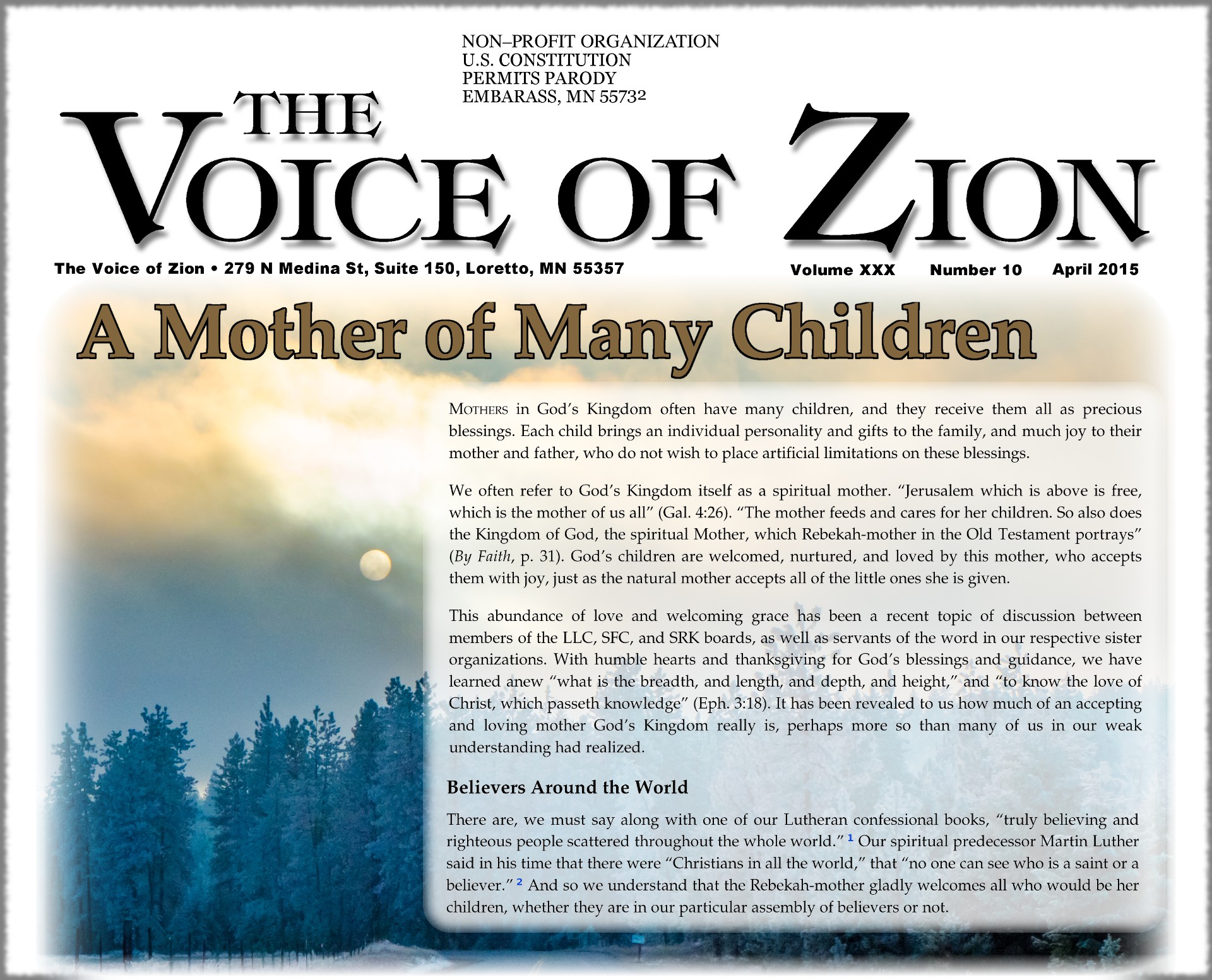

  1. “Ye also, as lively stones, are built up a spiritual house, an holy priesthood, to offer up spiritual sacrifices, acceptable to God by Jesus Christ” (1 Peter 2:5). 

  2. Suominen, Edwin A. An Examination of the Pearl (2012), §4.6.2 (“Forgiveness of Sins” / “The Sole Means of Grace”). Available at Amazon.com and for free online reading at ExaminationofthePearl.org

  3. OALC members are “spiritually dependent” on the proclamation of absolution, too. But the SRK/​LLC considers the preaching of forgiveness in the OALC to be just the empty words of “heretics,” without the Holy Spirit behind it. The person proclaiming the absolution needs to be the correct kind of Laestadian for things to work. That raises an interesting dilemma. One correspondent from the LLC says he’d had church friends come to him countless times with serious sins for absolution, and he preached it to them without actually believing himself. According to Conservative Laestadian doctrine, they are, to use a theological term, shit out of luck. 

  4. Tchappat, David. Breakout: How I Escaped From The Exclusive Brethren, New Holland Australia (2011), Amazon Kindle ed., loc. 3213. After being known as the Exclusive Brethren for many years, the group has recently started calling itself the Plymouth Brethren Christian Church

  5. Bachelard, Michael. Behind the Exclusive Brethren, Scribe Publications Pty Ltd (2008), p. 2. 

  6. Tchappat at loc. 3467. Same with my old group, except for 600 or so conversions in Africa over the past decade or so and a handful elsewhere that have stuck around. It’s plenty “exclusive,” too, at least in a spiritual sense. Outside of that one little flock–the correct one of a dozen schismatic branches of a 19th-century revival movement of Scandinavian Lutheranism–you cannot be saved. It’s not a doctrinal tenet that is discussed much in public. 

  7. Bachelard at p. 49. 

  8. Tchappat at loc. 105. 

  9. Tchappat at loc. 300-350, 842. The Brethren seem to go quite a ways beyond even the moral conservatism of Conservative Laestadianism, whose confession expectations have also diminished substantially since I was a kid. Brethren marriages must be pre-approved by their top leader, the “Elect Vessel”? No computers, except, says the documentary from A Current Affair, approved ones purchased from an official Brethren supplier? No domestic pets, including goldfish? The rules make my strict upbringing sound positively libertine. And some of what Tchappat says sounds just bizarre to me: “Cordless telephones and remote control-operated garage doors are also outlawed. Prestige vehicles such as BMWs and Mercedes Benz are not permitted and any vehicle red in colour is banned. Personalised number plates are not allowed and the ownership of a motorcycle is also not acceptable with farmers being the only exception.” Wow. 

  10. Tchappat at loc. 109. In my own former church, I heard a preacher say that giving up “this most precious gift of living faith” is the worst thing a person could possibly do–even worse than murder. It’s an outrageous statement, and not one that most Laestadian preachers would make–at this point, probably not even the one who originally made it. But it does accurately convey the importance Laestadians place on being “God’s Children.” And the punishment for murder is not an eternity of unspeakable torture. 

  11. Those still troubled by the Hell idea might take a look at my December 2013 blog posting on the subject, “Healing from Hell Horror.” 

  12. Tchappat at loc. 2681. 

  13. Bachelard at p. 56. 

  14. Tchappat at loc. 2129. 

  15. Tchappat at loc. 2929. 

  16. Tchappat at loc. 110. 

  17. Tchappat at loc. 2602, 3258. 

  18. reddit.com/r/exmuslim/​comments/2gzm42/​psa_for_exmuslims_considering_coming_out_to_their 

  19. Oppenheimer, Mark. Leaving Islam for Atheism, and Finding a Much-Needed Place Among Peers. New York Times, May 23, 2014. 

  20. Quran, Sura 3:80 (J.M. Rodwell trans., Ballantine Books, 1993). Liberal apologists for the supposed tolerance of Islam like to toss around another passage that states, “Let there be no compulsion in religion” (Sura 2:256). Regarding that, one ex-Muslim on reddit cites the passage I quote here and asks, “If there really was no compulsion in religion, then why does Allah not accept those who desire religions other than Islam? The Quran is one big contorted contradictory mess from which nothing consistent is ever going to emerge.” The same can of course be said about the Bible, Old and New Testaments alike. 

  21. “And the smoke of their torment ascendeth up for ever and ever: and they have no rest day nor night, who worship the beast and his image, and whosoever receiveth the mark of his name” (Rev. 14:11).