Showing posts with label Laestadianism – Personal. Show all posts

Friday, April 1, 2016

No Foolin’

The youth gets together his materials to build a bridge to the moon, or perchance a palace or temple on the earth, and at length the middle-aged man concludes to build a wood-shed with them.
—Henry David Thoreau, quoted in The Writing Life by Annie Dillard.

On the first day of April 2012, about two months after leaving the Laestadian Lutheran Church via the act of publishing a book critical of it, I posted on social media this parody image of a fake Voice of Zion article thoughtfully reviewing the book:

My first Laestadian-related April fool (click to enlarge)

Such a review was, of course, quite the opposite of what actually happened, which was the point of the parody piece. It quoted the conclusion of an actual article that had been published, for real and with refreshing candor, by the church’s sister organization in Finland: “There must be the ability to encounter facts with openness and honesty, even when the facts are not pleasing to us.” Switching from fact to April fool, my “article” went on to say:

This may raise doubts and concerns in the minds of God’s children: Can God’s Kingdom be the subject of legitimate criticism? Is it possible that certain teachings, even those that are being made in sermons and writings today, are simply not correct? These questions, once unthinkable in Zion, are being brought again and again to our attention by recent events.

Now we must confront the issues raised in a 530-page book by a former believer [me] who once wrote articles for this very paper [true]. Traditionally, our tendency would be to dismiss the book’s questions and criticisms by saying that the author just wanted to live a life of sin, or that he is distorting or even lying about what God’s Kingdom has taught. Another common response we have made to these challenges is that faith is childlike and not subject to any human reasoning.

Then the article plowed onward through a field of Bible quotes, just as you’d see in the real Voice of Zion. I selected them verbatim from the same King James Bible pages that Laestadian preachers consult for their articles. But my assortment of quotes told a very different story:

Scripture certainly encourages us to believe as a child (Matthew 18:3). But we should also remember the Apostle Paul’s admonition to “be not children in understanding: howbeit in malice be ye children, but in understanding be men” (1 Corinthians 14:20). Sometimes we need to “put away childish things” (1 Corinthians 13:11) and really understand what it is we claim to believe.

A second column of the “article” that appeared in the fake clipping provided some straight talk about this new book of mine that was giving the preachers such headaches. An unnamed preacher (also fake) being “interviewed” for the article in classic Voice of Zion fashion acknowledged that it was “undeniably true that the Gospel was not preached for several years after Laestadius and Raattamaa received the grace of repentance.” This implausibly candid preacher continued, “The book also correctly notes that Raattamaa favored Takkinen and criticized the followers of Heideman. These are matters of historical record that we must acknowledge somehow.”

Quite true, even if the person saying it was a fiction. Acknowledging the historical record is exactly what the church must do to be intellectually honest, but good luck ever seeing that happen. The real-life response was instead to retreat into a sheltered cocoon of denial and an outright repudiation of human reason in evaluating what the church teaches to be true. The same goes for “another difficult historical question raised in Suominen’s book,”

why our familiar preaching of the forgiveness of sins from believer to believer doesn’t seem to be found in any writings before Luther. The book states that there were “two centuries of writings” after Christ “that not only fail to explicitly mention absolution, but provide many teachings incompatible with it” (Section 5.1.2). It may seem like a far-fetched claim, but he provides several pages of discussion with plenty of references to back it up.

That I did. In response to this significant issue, too, crickets sounded forth in the fields of central Minnesota.

———

On first days of April since then, I published two more parody articles. In 2014, Social Media and the Believer did a dead ringer of an impression (if I do say so myself) of a Voice of Zion article soberly warning about the dangers of Facebook and mixing with unbelievers via this new medium of the Internet. It started pushing plausibility around halfway through:

One of the dangers with “friendship of the world” is the temptation to accept incorrect and sinful beliefs and lifestyles. Today’s society encourages an anything-goes attitude of “tolerance,” but God’s Word has always taught differently. The Old Covenant believers were instructed to let their light shine very clearly about the dead faiths of this world.

Then came a quote from Deuteronomy 13:6-9 about killing family members who tempt you into serving other gods (“Thou shalt not consent unto him, nor hearken unto him; neither shall thine eye pity him, neither shalt thou spare, neither shalt thou conceal him: But thou shalt surely kill him; thine hand shall be first upon him to put him to death”). According to the church, after all, God’s Word, is unchanging and eternal, and not subject to the whims of man’s desires. Somehow these nastier bits of the Old Testament get forgotten in favor of favorite passages warning that you’d better not be using birth control or hunting on a Sunday.

From the April 2015 parody, my last and favorite

April 1, 2015 was the occasion of my favorite of the parodies I’ve done, A Mother of Many Children. It was a heartfelt announcement of a surprising (alas, fictional) change in Conservative Laestadianism’s long-standing doctrine of exclusivity, drawing not just on scripture for support but also on the teachings of Luther himself:

There are, we must say along with one of our Lutheran confessional books, “truly believing and righteous people scattered throughout the whole world.” Our spiritual predecessor Martin Luther said in his time that there were “Christians in all the world,” that “no one can see who is a saint or a believer.”

These quotes and others in the article from Luther are all genuine, as with the Bible quotations. They leave no doubt about what Luther would have thought of the Laestadian Lutheran Church and its sister organizations claiming to be “God’s Kingdom,” the only place where actual Christians might be found. The “article” went on about the

danger of putting too much emphasis on God’s Kingdom as an organization, as an assembly of people, and making God Himself secondary to it. “I will not give my glory unto another” (Isaiah 48:11).

We can also look to the words of Luther in this: He wrote that anyone who “maintains that an external assembly or an outward unity makes a Church, sets forth arbitrarily what is merely his own opinion.” We must humbly agree with our brother in faith that there is not “one letter in the Holy Scriptures to show that such a purely external Church has been established by God.”

Many readers were saddened to know that it was just a parody and not a real article from the LLC. A few realized that only after reading through it and rejoicing that their church had finally come around to the loving, inclusive doctrine they personally believed.

I felt a little bad about causing disappointment for people, but hoped that it would do some overall good in the long term. After all, what possible answer could the preachers give to someone asking why this had to be an April fools joke and not a real article from the Voice of Zion? They would have to shrink their God down, along with the Bible and Luther’s teachings, to fit into their little doctrines.

———

There will be no April fool about the old church this year, or perhaps any in the future. I considered some ideas this past week and then decided it’s not worth the bother. I’m bored with it, and it’s bored with me.

This is just one weird little Protestant sect churning upriver against a flood of contrary facts, bearing its delusions of grandeur, its complicated set of mostly unwritten silly rules, and its steady fuel supply of new members popping into maternity wards and winding their way from day circle to Sunday School to confirmation class. There are many others like it with their own combinations of such features. The tiresome machinery of it all grinds inexorably on.

Rather than writing another parody piece, I dug through the nether reaches of my Facebook timeline to find one I’d posted in October 2012 as a Facebook status update. (I hadn’t yet started my blog then.) You can still see it and the 70 comments that ensued, here.

This dashed a few hopes, too, and got some heated discussion going. Those were the days before believers had been fully warned about not discussing faith matters online. A new wall was hastily constructed around Laestadian brains, and things have quieted down considerably ever since.

So, to conclude, here is a fake “opening statement” from my old church in one of the congregational meetings there were being held (really) in the wake of my book’s publication to address concerns and doubts.

———

We must begin by humbly acknowledging our own weakness and lack of understanding, not just as individuals, but as a battling congregation here in this sinful world. As the Apostle said, “We see through a glass, darkly” (1 Cor. 13:12). If such an important figure as Paul could acknowledge that he only “knew in part,” then we must do the same. We have been quick to cite Proverbs as saying, “The fear of the LORD is the beginning of knowledge,” but there’s a second part of the verse that we all ought to take to heart, where we are told that “fools despise wisdom and instruction” (1:7). Is any of us exempt from the need for wisdom and instruction?

The writer of Proverbs said much about wisdom. “The wisdom of the prudent is to understand his way: but the folly of fools is deceit” (14:8). There is simply no place for deceit in God’s Kingdom. After all, the Church is called “the Pillar and Ground of Truth” (1 Tim. 3:15). We must understand our way. A speaker brother recently quoted another verse from Proverbs, “There is a way which seemeth right unto a man, but the end thereof are the ways of death” (14:12). Yet we must also keep in mind what follows just a few verses later: “The simple believeth every word: but the prudent man looketh well to his going. A wise man feareth, and departeth from evil: but the fool rageth, and is confident” (14:15-16). Some of God’s children have recently decided they simply cannot go on just “believing every word.” We must respect this and learn from their courage.

If we are wrong, we must allow ourselves to be corrected. This applies to all of us. During the last heresy, it was said that the Bibles came off the shelves. We at the LLC have been reading God’s Word more diligently in recent days, too, and must admit that there have been important lessons there for us. For example, the believers of an earlier period in the Old Testament sacrificed thousands upon thousands of animals for sins, yet a later prophet, Micah, asked what he should bring with him when he comes before the LORD, when he bows himself “before the high God? Shall I come before him with burnt offerings, with calves of a year old? Will the Lord be pleased with thousands of rams, or with ten thousands of rivers of oil? Shall I give my firstborn for my transgression, the fruit of my body for the sin of my soul?” (Mic. 6:1-7). No, that was of no use. Instead, Micah concluded, “O man, what is good; and what doth the LORD require of thee, but to do justly, and to love mercy, and to walk humbly with thy God?” (6:8).

Let us do the same. Live in a just manner, love mercy, and walk humbly with God. How much sacrifice we have demanded of ourselves, and each other, when this is all that is required!

We sit before you chastened, knowing how much we have been shown to be wrong about in recent years. Our brothers in Finland have publicly apologized for “spiritual excesses” of the 1970s. We have seen crimes against children by believing men with positions of trust in God’s Kingdom made worse by cover-ups, denial, excuses, and poor behavior toward a courageous woman who attempted to see justice done and further abuse prevented. Here in America, we have advocated for women getting pregnant even at the cost of their lives when in Finland our sister organization is now calling for women to listen carefully to their doctor’s advice. We have concerned ourselves far too much with works– hundreds of confusing rules about dying hair when curling it is OK, about using birth control when a hysterectomy is OK, about watching animated cartoons when documentaries are OK. The words of Jesus are instructive to us, too: “Woe unto you, scribes and Pharisees, hypocrites! for ye pay tithe of mint and anise and cummin, and have omitted the weightier matters of the law, judgment, mercy, and faith: these ought ye to have done, and not to leave the other undone. Ye blind guides, which strain at a gnat, and swallow a camel” (Matt. 23:23-24).

Let us pass the microphone over to you now, the body of Christ. Let us discuss matters in true Christian freedom, not coercion, not intimidation. It is time for us all to learn from each other.

———

“Just kidding,” I finally added. “But for the sake of my loved ones still in the church, I wish I weren’t.” I still do. But life goes on. Those friends and loved ones know they have another option than trudging off to sit in those pews. Some of them have finally found the courage to exercise that option. And it may not be so bad anymore for those who haven’t. From what little I hear about the church nowadays, light and love have started shining through cracks in the wall of judgment and fear.

Inside those walls, and outside where billions of people like me are raising children and making friends and riding bikes and buying groceries, life goes on. 

Sunday, January 31, 2016

Community

[She] had the half thought that she would go and find the church phone book, but she realized that she wasn’t in the phone book anymore and neither was he and anyway there was no phone book for those who had left.
—Hanna Pylväinen, We Sinners
Sanctuary

Familiar faces, long unseen but not forgotten or forgetting, smile and nod toward me with friendly recognition. The extended hands are shaken with Hey, – ! fitting tidily in place with a remembered name where God’s Peace used to be. I respond to the polite questions about what I am up to these days with a deftness that improves as the evening progresses. All writings and publications go unmentioned.

They’re probably as nervous as I am, I remind myself at first. Soon I am not so nervous anymore and I think that perhaps they never were, either.

Standing beneath ceiling tiles I helped to glue up, on carpet I used to clean when my committee’s turn came, our brief conversations hop brightly across silent waters of unspoken things via lilypads of neutral topics. My eyes and those of a one-time brother or sister in faith lock and linger and take in the measure of the years as we talk of children growing up in our homes and moving on. Then another face slides into view and smiles, and I nod and wave my way to the next exchange of updates and memories.

These are the people of my first forty years, my friends and travel companions when I was on the way and the journey alongside them through a dark and sinful world. Now I am part of that world, an outsider, here as a visitor in a place that used to be mine, too.

It actually hurts that they are so friendly, that they remember, that they seem to mean it when they say it’s good to see me. It was good to see them, too, but it brought renewed awareness of a hole inside that will likely never quite be filled.

There’s not a God- or Jesus-shaped hole in my heart, but a people-shaped one. It’s them I miss, not some demanding, unpleasant, shape-shifting superhero characters1 who faded from my consciousness far quicker than the flesh-and-blood people who gathered there with me, week after week, in the name of the Father, and the Son, and the Holy Ghost, Amen.

I sing along with them, enjoying the music and our making of it but baffled that I’d ever believed the words I remember and see in the book held in my hands. Somewhere in those thin pages are the words Sing O people of the Lord, praises to the Lamb of God, and I am no longer one of those people. I will not be here next Sunday, or the one after that.

I’ve already done my time in these pews, listening to sermons with critical commentaries about them running through my head until one of my little kids would mercifully start to fuss and I’d have an excuse to get up for some air. Mine wasn’t much different from the experience of Father Michael Paul Gallagher, who listened to a Gospel reading at Mass while doubting (for good scholarly reasons!) that the red-letter words of the text ever had been actually spoken by Jesus. He found it “an alarming and lonely experience to be there with my community, and yet to feel cut off from the core of why we were gathered there.”2

Does it even matter to these people, I wonder, seeing them all warmly surrounded by parents and spouses and children and lifetime friends, whether it is true? Some of them do realize that it’s not, at least not all of it. But there they are, just the same.

A cozy cocoon [Flickr page]

Therapist Calvin Mercer observes that fundamentalists “tend to avoid new experiences by remaining isolated in their fundamentalist networks, thereby avoiding the various novel influences that flow into an emerging identity.”3 The ideal for the group is that “the fundamentalist Christian can live his or her life inside a protected cocoon constructed in a form consistent with fundamentalist ideology.”4

The sheltered community–God’s Kingdom, in Laestadian parlance–is paramount. Everything and everybody else is of “the world,” sinful, dangerous, and generally to be avoided.

The fundamentalist does not stand alone. The fundamentalist exists in and is supported by a social network that usually includes a religious community and, often, a biological family as well. The church or campus group that serves as the primary social group for the fundamentalist provides not only social interaction and support, but also ideological training.5

Perhaps nowhere else in American religion is this more harshly true than the Fundamentalist Church of Jesus Christ of Latter-Day Saints, an offshoot of Mormonism featuring polygamy and hard-line control of members under a strict morality code. Everything around you is of, and dictated by, the FLDS. It is your entire community, both physically and spiritually. When you leave the FLDS, you literally get out of town. And you certainly don’t go back for friendly visits like the one I had.

Brenda Nicholson told me that leaving the FLDS was the hardest thing she’s ever done. “I knew that once I walked away, it was over. My family, friends, community–everyone and everything that had been a part of my life would be gone. I knew the drill.” She had been well schooled in the protocol from the old-time Mormon prophet Brigham Young: “Leave apostates alone, severely!”

Now, she would “be looked upon as apostate. A traitor to God. And worse, I took my children with me and now I had ‘their innocent blood on my skirts.’” Even so, she said, “I knew I had to do it. My conscience wouldn’t permit me to stay. If nothing else, I had to leave to protect my children.”

I asked her how it felt leaving the community behind.

In many ways these last few years, since we left, have been very lonely. It’s like starting over alone in a strange world. I can’t say what the future may bring for sure, but it’s very doubtful I’ll ever be part of an organized religion again. I had enough of it. I know how to love, and I do so freely now. I have met some amazing people and gained friends within the educational community. It has changed my life for the better. It’s not the same as family, not quite, but hopefully someday I’ll have both.

She misses family and the feeling of belonging, but added, “I don’t miss the oppression and sadness.”

A woman I know who left my old Laestadian Lutheran church doesn’t miss that part, either. Nor does she seem to have even the nostalgia I sometimes get for the community. She’s only felt relief about leaving so far, she said.

The communities that I have found outside of the church fulfill something deep that has been missing in my life for a long time. It is me as an individual they embrace! Not my line of genealogy, not how many kids I have, not who I’m married to but me and who I am!

Her new friends, she said, “share my passions in life! My true passions!” She has chosen them, rather than merely having them handed to her as “friends by default.”

That night of my visit, I found myself lingering around the foyer of the church, soaking up the warmth and evident goodwill from people I hadn’t seen for years yet quickly felt at home talking with again. But this former sister in faith said she “scooted out as fast as I could” from one recent LLC event. “It’s been hard for me to get past the angst of how they view me, and the exclusivity of it all still really annoys the heck out of me! I still feel comfortable around my old friends, but I do feel that I can’t truly be myself without a few cross-eyed stares.”

Someone else I know, a brilliant amateur scholar of things biblical who studied his way out of faith but hasn’t made a clean break of it yet, considers himself “still fairly good friends with people from my former church community. Some of them know that I am no longer a believer, and several even know why.” A few of them he suspects “are even harboring serious doubts themselves.” He hasn’t resisted going to church, because his “wife is comfortable in a church community.” They are currently doing a bit of church shopping, not having found one where they both feel at home.

His wife knows that he is “not a believer,” he said. (We’re not talking about Laestadian “believers” here; my friend is from a majority black church hundreds of miles from the nearest LLC congregation.) Fortunately, though, she

is fine with it. She’s known for a little while (spouses are usually clued in). She has been very inquisitive and interested in why I no longer believe, and she understands intellectually–but she can’t get past the Pascal’s Wager mentality with regard to her own faith. I don’t push it. She hints that she respects my willingness to be “objective.” It has been such a relief! My mother-in-law knows too. And she doesn’t seem to care.

Hopefully they can find a church with songs my friend will find a little bit less creepy. “It’s all about ‘I am nothing . . . I am a wretch without Jesus,’” he complained to me. “‘My life is meaningless without your love, God.’ And all the songs that glorify the blood spillage on the cross. That stuff is psychologically crummy.” I’d thought about that a bit, too, as I belted out verse after verse along with my former brethren. And we never even got to the song with that part about being drunken with the bridegroom’s love.

———
Further reading: The Visit from January 2013, about another return visit I made a few years ago, equally pleasant; Round-Trip Trauma about the social pull that sometimes brings ex-members back, at least for a while; Section 4.2.3 of my book An Examination of the Pearl under the subheading “Separation from the World”; and a public Facebook posting by Brenda with a horrifying description of conditions in the crazy cult she left behind. I hasten to add that, despite its fundamentalism, restrictiveness, and authoritarian tendencies, the LLC is not a cult and certainly not in the same league as the FLDS.
Click on individual images to enlarge, or check out the photo page for the second one in my Flickr photostream. They are Copyright © 2014-15 Edwin A. Suominen. You may freely use the second one for non-commercial purposes, with attribution, under the Creative Commons Attribution-NonCommercial 3.0 Unported License.

Notes


  1. Remember, it’s a Trinity. The Fantastic Three? 

  2. Quoted in Ruth A. Tucker, Walking Away from Faith: Unraveling the Mystery of Belief and Unbelief (InterVarsity Press, 2002), p. 131. 

  3. Calvin Mercer, Slaves to Faith: A Therapist Looks Inside the Fundamentalist Mind (Praeger, 2009), p. 30. 

  4. Mercer at p. 152. 

  5. Mercer at p. 150. 


Tuesday, November 10, 2015

Frozen and the Chosen

It hit me as I was walking home–I could think anything! I could have any opinion on any subject, and it would be my own! No longer would I have to check against Scripture and other doctrine to make sure that my opinions were in line with God; I could decide my opinions with my own reason! . . . That moment was one of the most liberating, beautiful, and happy experiences of my life.
—Michael Amini in Generation Atheist, Dan Riley, editor (2012)
[T]he whores of the world wash their hands in the blood of creatures, but the daughters of Jerusalem do not wash themselves in the blood of the innocent Lamb, but with soap and with lye, and nevertheless their filthiness is visible.
—Lars Levi Laestadius, randomly selected passage from a random sermon (Palm Sunday 1854).
Kristoff Levi Laestadius, reindeer fan

Last week, I went with my wife and some of our kids to see the Disney on Ice figure-skating adaption of the musical movie Frozen. It was great fun to see Anna and Elsa zipping around the rink with Olaf, Kristoff, and Sven, who materialized as a rather large reindeer comprised of two skaters inside a furry brown costume. When Elsa went out on the ice under blue light for her big solo act, two little girls sitting behind us sang along at the top of their lungs: “Let it go, let it GO!”

A husband-and-wife pair of composers wrote Let it Go as “Elsa’s Badass Song,” specifically intended to be sung by Idina Menzel, “one of the most glorious voices of Broadway.” They succeeded brilliantly. The song is the highlight of the film and has sold over 10 million copies on its own.1

Lamplit Tree [Flickr page]

I first heard it while sitting in a theater with my family nearly two years ago. This was still a fairly novel experience after a lifetime of being told–and then allowing it to be told to my children–that seeing movies is a sin. Laestadianism and its oddities were still very much on my mind as I watched Anna make her cute wisecracks and accompany a socially-inept ice merchant and his furry best friend on a quest that included, among other delightful implausibilities, a visit with some witty and wise rock-rodents who dispensed relationship advice.

“So he’s a bit of a fixer-upper,” they sang about Kristoff while working on setting him up with Anna. Aren’t we all, I thought, musing about all the mental remodeling my wife and I were doing on ourselves and our older children, after the nonsense we’d all heard for years and years sitting alongside each other in a very different setting.

When Elsa finally broke out of her self-imposed shell, flung out her arms, tossed back her head, and proclaimed that she wasn’t going to hold back anymore, I felt like applauding.

Conceal, don’t feel, don’t let them know

Well, now they know!

Yes! You go, girl! I silently cheered, feeling a bit embarrassed about how emotional I was getting watching this movie. But there was a good reason for it. For a year, I’d had to “conceal, don’t feel, don’t let them know” what I’d learned from some diligent and sincere research about my childhood faith. Sharing that information with a few friends in the church got me hauled into a meeting with my local congregation’s preachers and board of trustees.

After a two-hour inquisition, having been told I was to retrieve the dozen or so copies of the book I’d given away, “I went home and told my wife, ‘You are about to witness the intellectual disintegration of your husband.’ Then the years of doubt, fear, and frustration–culminating in being muzzled into silence by a church far more interested in rebuke than reality–boiled over. I collapsed into my wife’s arms in tears, and went to bed for a fitful night.”2

Let it go, let it go

Can’t hold it back anymore

Let it go, let it go

Turn away and slam the door!

After some months, I just couldn’t hold it back anymore, either. My half-hearted promises to stay away from dangerous studies didn’t stick, of course, and I “learned and questioned more about church history, the Bible, and aspects of science that conflicted with important points of doctrine.” I also “lost the energy to continue swimming against the current of the church’s clannish, insular social scene,” which treated my family and me like we all had some dangerous and contagious disease once my doubts became known.

I was ready to “shake off the muzzle” and put into print what had “been swirling around my head and flagged in the pages of my library of books.” The result, An Examination of the Pearl, wound up being more than twice the size of the print-shop copy that had gotten the elders so bent out of shape.

Given the outraged reaction I encountered to a very limited, private distribution of the book, which consisted mostly of church statements and relatively restrained footnotes about those statements, I have no illusions that this published edition will be well received. As Ken Daniels noted about his own book, “whether I take a gentle or harsh approach, I am sure to elicit criticism. The very act of confronting deeply cherished religious convictions is unforgivable to some, regardless of my tactics.”3

Frost on Ponderosa [Flickr page]

I’m not the only one who has been moved by Let it Go as an anthem of liberation from fundamentalism. Blogger “Libby Anne” wrote about that in March 2014, after being shocked at how much her conservative evangelical mother obsessed over the movie. “How could they see Frozen and not realize that it was about self acceptance and freedom from others’ expectations–and moral standards?” she wondered.

When she first watched Let it Go on YouTube,

before seeing the movie in theaters, I completely choked up at the line “no right no wrong, no rules for me.” Tears started streaming down my cheeks. It was beautiful. I grew up in a conservative evangelicalism that I eventually found highly restrictive. As I began to extricate myself, my family and friends put me through a special kind of hell. But even through all of the pain and the tears, I entered into freedom when I left behind their rules, their expectations, their control. This song spoke to so many emotions. I’ve watched it again and again many times since that first time, and each time I’ve achieved some form of catharsis.

It’s now her personal theme song, she says.4 Another blogger, Maranda Russell, says she fell in love with the song as soon as she heard it:

At times in my life I felt like I had to hide my true self to get approval and love from friends, family and the church. I had to pretend to be a “good girl” who never questions anything and believes blindly what I am told. I still feel like many wish I would just shut up and believe what they tell me is true, but I just can’t do that anymore.5

I don’t care

What they’re going to say

Let the storm rage on,

The cold never bothered me anyway!

Maranda admits that “maybe I still care a little (after all I am still human), but I won’t let it rule me.” I did, too, about what I knew my “brothers and sisters in faith” were going to say, but I went ahead anyway. A storm would rage, friendships would be lost–most of those that I’d forged since childhood, it turned out, in a church that discouraged social contact with the outside world.

And the stakes were infinitely higher than what one friend called “social suicide”: Publishing the book against the wishes of the Laestadian Lutheran Church would inevitably be viewed as an act of apostasy, no matter how balanced I tried to be in presenting my findings. Eternal damnation loomed in my future.

To those who tell me my writing was courageous, I reply that it took less courage then what many of them have done–simply walking away. I needed to have my brethren push me out instead, simply for making the facts known, asking difficult questions about them, and refusing to accept the tired old insistence that the most important matter of one’s life “cannot be understood by reason.”

My introduction to the book quoted Clement of Alexandria from 18 centuries earlier: “If our faith is such that it is destroyed by force of argument, then let it be destroyed; for it will have been proved that we do not possess the truth.” Recalling the “faith” of a board member who said he won’t read anything critical about what he supposedly believes,” I asked if that was

really faith in anything other than the people around him who are repeating the old slogans? They, too, are ignoring the facts about their “faith,” making the whole thing a self-sustaining doctrinal bubble that quivers unsteadily in the air, vulnerable to being poked by the slightest intrusion of fact.6

Looking Back [Flickr page]

Now, nearly four years later, these words from Let it Go are exactly my experience:

It’s funny how some distance

Makes everything seem small

And the fears that once controlled me

Can’t get to me at all!

There is simply no fear anymore. And it’s not for any lack of knowledge about what this weird little sect thinks my eternal fate will be. Hell, I still listen to sermons sometimes to get to sleep, because the preachers’ somber, familiar, repetitive intonations send me drifting off faster than anything else. Sometimes I get several nights’ worth of use out of a single sermon, because I start the iPod at different points in the recording and am out within ten minutes.

One correspondent told me, “My old Laestadian world view is gone. If I talk to certain people or listen to sermons I can feel the world view there and experience it sometimes. I don’t think it’s ever coming back, though, and I am the better for it.”

Yes, my friend, you are. And, as Elsa sings out, fully embracing her unique identity and abilities, “one thought crystallizes like an icy blast”: You’re “never going back. The past is in the past!”

———
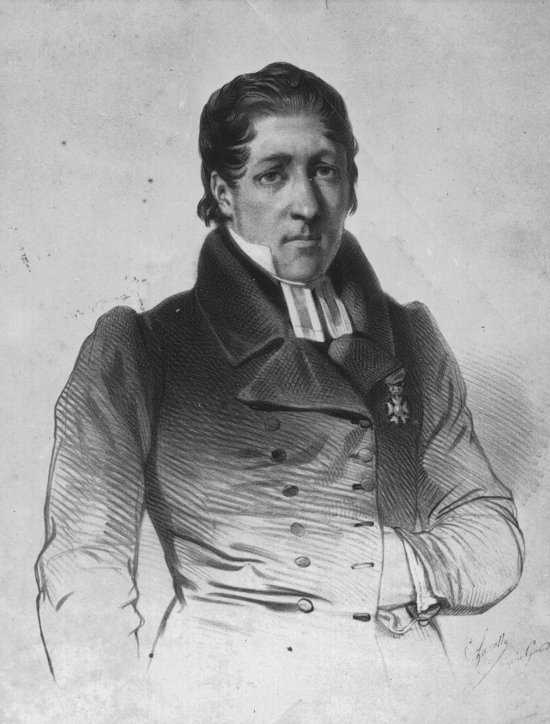
The picture of Lars Levi wearing Kristoff’s reindeer-hide coat was fair-use adapted from a Frozen wallpaper image and a classic portrait of Lars Levi Laestadius. Take a look online at Laestadius’s sermons and you’ll quickly see what I mean by the “People suck” paraphrase. He was not a happy man. The fictional Kristoff of Frozen seems to have had a more meaningful “conversion” experience with Anna than old Lars ever did.
The other photos are Copyright © 2013-15 Edwin A. Suominen. Click to enlarge, or check out my Flickr photostream. You may freely use them for non-commercial purposes, with attribution, under the Creative Commons Attribution-NonCommercial 3.0 Unported License.
See the online Dictionary of Christianese for an interesting discussion of the expression “frozen chosen.”

Notes


  1. Wikipedia, Let it Go

  2. An Examination of the Pearl, §1.2 (“Introduction–Disputation– The June 2010 Edition”). 

  3. §1.2 (“Introduction–Disputation–Alienation”), quoting Ken Daniels, Why I Believed: Reflections of a Former Missionary (self- published, 2010). 

  4. “Let It Gay? Subversive Messages from Disney’s Frozen,” Love, Joy, Feminism blog, March 4, 2014 

  5. “What the Disney ‘Frozen’ song ‘Let It Go’ means to me,” Maranda Russell blog (April 25, 2014). 

  6. §1.2, quoting from Clement’s Stromata, 6.10.80. William Wilson’s translation, freely available online, goes as follows: “But if the faith (for I cannot call it knowledge) which they possess be such as to be dissolved by plausible speech, let it be by all means dissolved, and let them confess that they will not retain the truth. For truth is immoveable; but false opinion dissolves.” 


Tuesday, September 22, 2015

The Forgiver

For we, like children frightened of the dark

Are sometimes frightened in the light–of things

No more to be feared than fears that in the dark

Distress a child, thinking they may come true.

—Lucretius, On the Nature of Things, c. 50 BC, tr. Ronald Melville.
Forbidden fruit: The new Receiver tries to do some giving.
Review: The Giver by Lois Lowry. Houghton Mifflin (1993). Movie adaptation produced by The Weinstein Co. (2014).

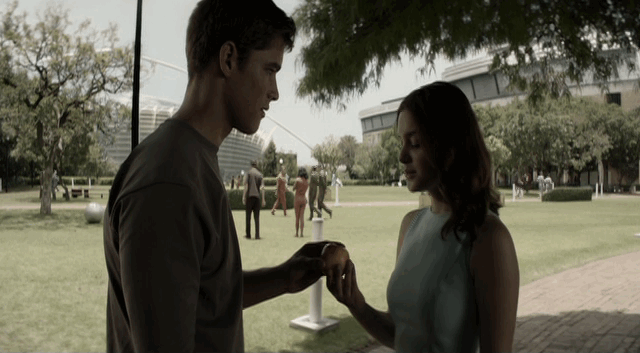
The other week, I watched The Giver on DVD with my wife and a few of my kids. It’s a 2014 film adaptation of Lois Lowry’s 1993 book about a future collectivist society that does away with all but a bland, utilitarian remnant of human emotion and ambition. “The community” has even eliminated history from the minds of its people, with one significant exception.

A single chosen individual, the “Receiver of Memory,” is designated to take care of recalling past civilizations and events. This exalted and burdened person is set apart with an exclusive collection of books and memories, which he keeps to himself except to cryptically advise the Elders in their decision-making.

Eventually, the Receiver takes on an apprentice, to whom he passes all that knowledge and memory. The selection of a new Receiver “is very, very rare,” as the community’s Chief Elder tells her community at the Ceremony of Twelve,1 where young people are being assigned their occupations with much fanfare, and without any say in the matter. “Our community has only one Receiver. It is he who trains his successor.”2

The story’s hero, Jonas, is named as that successor. “I thought you were The Receiver,” Jonas tells him during their first teaching session, “but you say that now I’m The Receiver. So I don’t know what to call you.” Call me The Giver, the old man says.3 And from him Jonas goes on to learn some amazing and troubling things. His life will never be the same again.

———

Around the end of 2010, one of my daughters had been assigned the book in school, and I wound up reading it myself. At the time, I was in the early stages of researching the doctrine and history of my old church. The things I was starting to learn would turn my own life upside-down and result in my first book, An Examination of the Pearl, about a year later.4

I was stunned by the parallels between Lowry’s sheltered, intellectually stunted community and the “Kingdom of God” in which I’d been struggling. After a lifetime as one of “God’s children,” I’d finally started to look at my odd little church in a clear-headed way. What I was seeing disturbed me a great deal, and so I put together a listing of church writings with footnotes stating some of my concerns. I had it printed and bound into a dozen softcover copies that I shared with a few friends in the church. Oops.

In September 2010, I was hauled before the church board of trustees and preachers for a stressful, coercive, and emotional meeting about my little copy-shop book. “Are you really believing?” I was asked. Beyond some concern about how I could dispute what “God’s Word” teaches regarding Adam and Eve and Noah’s Ark, there wasn’t much substantive discussion of what the book actually had to say. It was mostly about me for having said it.

Repent or Else

They told me the book was an expression of my doubts, which would have been best kept to myself or private conversations. It could be dangerous if it fell into the wrong hands, they said. It would leave the impression among outsiders that there are dif­ferences of opinion in “God’s Kingdom.” And it is certainly not something that believers should be reading. After over two hours of this, the meeting concluded with the understanding that I was to retrieve copies of the book.5

Just a few months after that experience, here I was reading about a closed community of myriad rules and “appropriate remorse” and public apologies, where uncomfortable history was extinguished from memory, where intractable rule-breakers were released to “Elsewhere.” And I was seeing a frightful near-future version of myself in Jonas, not some lofty hero but simply a wide-eyed seeker of truth–unable to tolerate cen­sorship and propelled by an irresist­ible call to look at reality, at long last, come what may.

Comparing Lowry’s all-controlling community with Christian funda­mentalism doesn’t seem to be a unive­rsal or even a com­mon interpretation of her book,6 but she would be happy to let me keep it as my own. “A book, to me, is almost sacrosanct: such an individual and private thing. The reader brings his or her own history and beliefs and concerns, and reads in solitude, creating each scene from his own imagination as he does.” And I was certainly interested to see her recall a “man who had, as an adult, fled the cult in which he had been raised” telling her “that his psychiatrist had recommended The Giver to him.”7

———

The first thing that jumped out at me was the rigid structure of rules that govern life both in Lowry’s dystopia and for the “believers” in the Laestadian Lutheran Church. Community members are careful to maintain “precision of language,”8 while believers do not swear, tell dirty jokes, or speak light-heartedly about faith matters. Each family unit of the community receives two children–no more–while believing parents are to accept as many children as they are “given”–no less. Community girls are instructed to keep their hair ribbons “neatly tied at all times”9 while believing girls are instructed not to wear earrings, make-up, or spaghetti straps.

Even a minor rule like the one against bragging (there is “never any comfortable way to mention or discuss one’s successes without breaking the rule against bragging, even if one didn’t mean to”) is best followed by steering clear of occasions where breaking it would be too easy.10 Thus believers have restrained themselves from playing violins in orchestras where they might get “puffed up” in their talents, even if they would just be one of many players helping to produce one of the few types of music to which they can listen in good conscience. Thus many an athletic Laestadian boy has walked home while his unbelieving sort-of friends go off to football practice. God’s glory must not be given to another, and the world cannot become too close.

And then there are those Stirrings, which begin for young Jonas with a dream about a girl his age. He describes it to his parents during a “sharing-of-feelings” rap session they are expected to do over dinner each day. (“Be free,” the board members would tell us during the many congregational meetings of my youth.) In the dream, he and the girl were in front of a tub in the House of the Old, where the elderly get cared for in their final days.11

“I wanted her to take off her clothes and get into the tub,” he explained quickly. “I wanted to bathe her. I had the sponge in my hand. But she wouldn’t. She kept laughing and saying no.”

His father asks Jonas about the strongest feeling he experienced during the dream.

“The wanting,” he said. “I knew that she wouldn’t. And I think I knew that she shouldn’t. But I wanted it so terribly. I could feel the wanting all through me.”12

His parents look at each other and Jonas is then told about the Stirrings.

He had heard the word before. He remembered that there was a reference to the Stirrings in the Book of Rules, though he didn’t remember what it said. And now and then the Speaker mentioned it. ATTENTION. A REMINDER THAT STIRRINGS MUST BE REPORTED IN ORDER FOR TREATMENT TO TAKE PLACE.13

In the dystopia of The Giver, the treatment is medication, taken every day to deaden a person’s natural sex drive until it finally disappears in old age. In Laestadianism, the treatment is the forgiveness of sins–dispensed in a sermon every Sunday and, if parents are following recommended procedure, in the words of absolution being preached to their children at bedtime every night.

Believe all sins forgiven in Jesus’ name and precious blood, the young innocents are told, night after night by parents or siblings. That proclamation offers redemptive relief for all sins, and does the job in most cases, certainly from sinful thoughts of providing erotic bathing assistance to the cute girl or boy next door. If one’s Stirrings have moved beyond mere fantasy to masturbation or–heaven forbid–to a little kissing and heavy petting behind the garage where the yard light don’t shine, guilt pangs may persist despite the generic assurance of forgiveness. The preachers recommend confession in such cases.

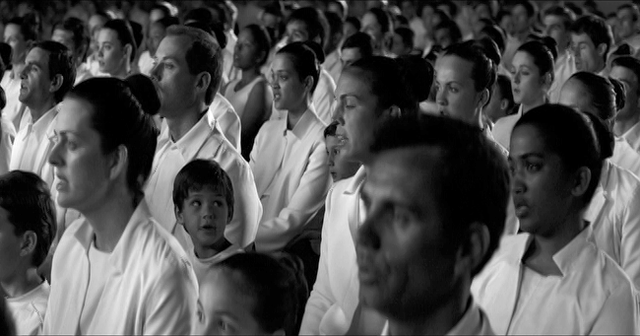
The assembled community: Looks a lot like church to me.

Confession was a big deal in Laestadianism during my childhood. Most sins beyond mere impure thoughts, doubts, etc. were considered to remain on the conscience until one had spoken of them “by name.” It was not an absolute requirement to confess, but was widely expected, at least for those infractions falling into a non-biblical category of “name sins,” a category that was often referred to but never very specifically defined.14 A 1978 article from the church newsletter pretty well encapsulates how things were back then:

It is never an easy matter to repent of sins for the flesh fights against the Spirit. But sin has a name, and those named sins will not go away without our speaking of them to a dear brother or sister. We are assured that we can freely go to a dear one and open our heart. But those sins that have affected the congregation of God are to be re­pented of before the con­gregation; otherwise we will not receive freedom.15

That last part about repentance before the congregation offers a hint of the public confessions that people often made after the Sunday morning service when I was a kid. In my congregation and at least some others in North America, members would head up to the front of the church after the ser­mon and ask the en­tire con­gregation for forgiveness of various sins.

During the congregational “caretaking” meetings that were a regular Saturday night event, where some issue or person(s) of concern would be discussed with much emotion, such repentances would go on and on.16 I’ll always remember one of them in particular, from a young father who dutifully walked up to the microphone and asked forgiveness of the congregation for “reading filthy literature.” Poor guy. It was probably just a paperback novel with a vague sex scene or two.

With all those memories in my head, you can see why I saw some Laestadian parallels in Jonas’s recollection of his friend Asher showing up late to class:

“When the class took their seats at the conclusion of the patriotic hymn, Asher remained standing to make his public apology as was required.”

“I apologize for inconveniencing my learning community.” Asher ran through the standard apology phrase rapidly, still catching his breath. The Instructor and class wait­ed patient­ly for his ex­planation. The students had all been grinning, because they had listened to Asher’s explanations so many times before.

“I left home at the correct time but when I was riding along near the hatchery, the crew was separating some salmon. I guess I just got distraught, watching them.

“I apologize to my classmates,” Asher concluded. He smoothed his rumpled tunic and sat down.

“We accept your apology, Asher.” The class recited the standard response in unison.17

“I’d like to ask forgiveness for, er, reading filthy literature,” the Laestadian Asher stammered, looking down at the floor. Believe all your sins forgiven in Jesus’ name and blood, replied the congregation with their standard response, in unison.

———

Back in those bad old days, there was another chilling parallel to The Giver. It was release from the community, the Laestadian form of which we called “binding.” Believers would be bound in their sins, and any requests they made to be forgiven would be denied unless it was decided that they were being specific and penitent enough about the issue at hand. Usually, there was some “false spirit” at the heart of the matter, which needed to be exorcised by being named in the confession.

This was a sad outcome of many “care­taking meet­ings” that were common­ly held to discuss the spiritual state of individual congregation members. Such a meeting was considered the third step in Jesus’ instructions regarding the rebuke of a brother who has caused offense (Matt. 18:15-16). Offense was taken not so much for individual actions against another member but as a result of the wayward one’s observed sins (e.g., acquiring a television) or erroneous doctrinal views.

In a 1971 newpaper article, the Finnish counterpart to my North American Laestadian church had set forth the binding procedure in no uncertain terms: “If the ones spoken to do not humble themselves to repentance, consider them pagans and publicans and refuse them membership in the association. The disobedient are not to be greeted with the greeting of God’s children.” My old church took “precisely the same stand in America” three years later.18

“For a contributing citizen to be released from the community was a final decision, a terrible punishment, an overwhelming statement of failure.”19 In The Giver, release was just to “Elsewhere.” Nobody but the Planning Committee knew exactly where the released person went.20 We readers, along with a wiser and sadder Jonas, come to realize that release actually involves death, not mere departure.

The horror and injustice of the community killing off its members–not just for disobedience, but for perceived unfitness at birth or just running out the clock on one’s old age–is what propels Jonas to take drastic action as the apprentice Receiver. Obviously, it would be a stretch to draw much of a parallel there, but it’s worth mentioning what a sad impact the Laestadian practice of binding did have on people.

Beyond the gate: Actually a good place to be. [Flickr page]

I personally witnessed it several times as a youth. It is quite unforgettable to see people ask the congregation for forgiveness at a meeting held concerning their spiritual affairs and receive only cold silence as a response. Sometimes they would sit gamely at their table at the front of the church while the meeting continued to the bitter end, often late into the night. And sometimes they would reach their breaking point and storm out of the building, ending the meeting of their own accord. I saw it go either way. Both outcomes were heartbreaking to the subjects as well as the congregation members who sincerely believed that the soul of their brother or sister hung in the balance that night.

There could be a good deal of secret resentment even when one had jumped through the hoops set before him. Grumbling behind the back of the church elders was the only possible relief. To approach them with concerns about their activities carried the very real danger of seeming unrepentant and becoming subject to yet another meeting. Instead, for a couple of years to come, the public face remained one of compliance and thankfulness for the opportunity of correction. In many cases the corrected one was probably so beaten down by the experience as to feel a Stockholm-syndrome sense of gratitude.21

The last case of binding I’ve heard of happened ten years ago, and that’s quite a late anomaly. The Finnish counterpart to my old church issued an apology of sorts in 2011 for “errors [that] were able to expand almost everywhere in our Christianity,” though it puts the blame on individuals rather than the supposed­ly inerrant community, er, Mother con­gregation.22 But the trauma and col­lective memory of it still lurks behind the rebukes taking place in every private board meeting with a wayward believer. There is usually no alternative but to accept what you are told and repent of your supposed sin if you want to continue being considered “heaven acceptable.”

———

One “morning, for the first time, Jonas did not take his pill. Something within him, something that had grown there through the memories, told him to throw the pill away.”23 He has gotten some of the forbidden knowledge into his head, and a bit of color has started seeping into his black-and-white world.

It hasn’t been an altogether pleasant transformation:

He found that he was often angry, now: irrationally angry at his groupmates, that they were satisfied with their lives which had none of the vibrance his own was taking on. And he was angry at himself, that he could not change that for them.

He tried. Without asking permission from The Giver, be­cause he feared–or knew–that it would be denied, he tried to give his new awareness to his friends.24

The reactions are mixed. Asher gets uneasy when Jonas tells him to look at some flowers very carefully, wondering if something is wrong. In the film adaptation, Fiona (the girl of Jonas’s bathtub dream) takes more readily to this scary new Jonas and his crazy ideas. “There is something wrong. Everything’s wrong. I quit,” Jonas tells her in response to the same question Asher had asked.25 He persuades her to quit taking her own stirring-stopper medication, too, and some difficult consequences ensue.

Ultimately, the Receiver of Memory cannot remain in the community. He knows too much. He feels too much. The community insists on keeping itself ignorant of what he has learned. It will not raise up its eyes from the safe grey sameness of doctrinal familiarity to look–really look–at the world he now sees all around.

“Listen to me, Jonas,” the old Giver tells a sobbing Jonas. “They can’t help it. They know nothing.”26 And then Jonas leaves the community of his birth and up­bring­ing, to a new and scary but joy­ous place–outside for the first time, inside never again, and the better for it.

———
The film (IMDb page) hasn’t been highly rated by critics or viewers. But I loved it, and not just because of the connection I felt with the story. The book is a Newberry Medal winner and has sold more than 10 million copies.
The three screenshots are from The Giver film, reproduced under “fair use” for purposes of review and commentary. The photo is Copyright © 2013 Edwin A. Suominen. Click to enlarge, or check out my Flickr photostream. You may freely use it for non-commercial purposes, with attribution, under the Creative Commons Attribution-NonCommercial 3.0 Unported License.

Notes


  1. “Ceremony of Advancement” in the film adaptation, since it has the kids being 16 years old, not 12, at the time their assignments are given (DVD playback at 06:50). 

  2. The Giver, p. 61. 

  3. p. 87. 

  4. Self-published January 2012, for Amazon Kindle, in print, and available for free reading at examinationofthepearl.org

  5. Adapted from An Examination of the Pearl, Section 1.2, “Disputation.” 

  6. Daniel D’Addario, “Lois Lowry: The dystopian fiction trend is ending,” Salon (July 10, 2014). salon.com/​2014/07/10/​lois_lowry_the_dystopian_fiction_trend_is_ending. Lowry: “People who are very conservative and feel they represent family values find that in this book. And ultraliberal people the same thing will hold true at the other end of spectrum. It happens also with theology, they’ll find it. I’ve had very conservative Baptist churches use the book as part of religious cur­riculum. Also ultra­conservative religious groups want it banned. It’s something that speaks to whomever wants to hear it. I have no control over that. I did not plan any specific political or theological interpretation, but people seem to find it.” 

  7. Lois Lowry, “Reflecting on 20 Years of The Giver,” Huffington Post (June 24, 2014). huffingtonpost.com/​lois-lowry/​the-giver-movie_b_5527063.html

  8. Once, before the midday meal at school, Jonas had said, “I’m starving.” Oops, that was a no-no. “Immediately he had been taken aside for a brief private lesson in language precision. He was not starving, it was pointed out. He was hungry. No one in the community was starving, had ever been starving, would ever be starving. To say ‘starving’ was to speak a lie. An unintentioned lie, of course. But the reason for precision of language was to ensure that un­intent­ional lies were never uttered. Did he understand that? they asked him. And he had” (pp. 70-71). 

  9. p. 23 

  10. p. 27. 

  11. Until being killed off, that is, in a nice little “release” ceremony that nobody seems to really recognize for what it is. 

  12. p. 36. 

  13. p. 37. 

  14. The following excerpt from An Examination of the Pearl, at the end of Section 4.6.3, provides some context about the Laestadian concept of “name sins”: It “is probably based on the ‘mortal sins’ that in Catholic theology must be confessed by name: ‘All mortal sins of which penitents after a diligent self-examination are conscious must be recounted by them in confession, even if they are most secret . . .’ (Catechism of the Catholic Church, para. 1456). But Luther downplayed and criticized the distinction between mortal and venial sins, criticizing theologians who ‘strive zealously and perniciously to drag the consciences of men, by teaching that venial sins are to be distinguished from mortal sins, and that according to their own fashion’ (Discussion of Confession, 89-90). Not all sins of either type ‘are to be confessed, but it should be known that after a man has used all diligence in confessing, he has yet confessed only the smaller part of his sins.’ Furthermore, he wrote, ‘we are so far from being able to know or confess all the mortal sins that even our good works are damnable and mortal, if God were to judge with strictness, and not receive them with forgiving mercy. If, therefore, all mortal sins are to be confessed, it can be done in a brief word, by saying at once, “Behold all that I am, my life, all that I do and say, is such that it is mortal and damnable”’” (p. 89). 

  15. Voice of Zion, October 1978. 

  16. These two paragraphs are adapted, with the quotation, from An Examination of the Pearl, Section 4.6.3, “Confession.” The psychological health of the current generation of Laestadians owes much to a greatly reduced emphasis on confession, and public confessions are now pretty much unheard of. 

  17. The Giver, pp. 3-4. 

  18. Päivämies No. 29, 1971, and then Voice of Zion, October 1974. These two paragraphs are adapted, with quotations, from An Examination of the Pearl, Section 4.6.4, “Rebuke.” 

  19. The Giver, p. 2. 

  20. p. 32. 

  21. These two paragraphs are also adapted from An Examination of the Pearl, Section 4.6.4. 

  22. See An Examination of the Pearl, Section 4.10.2 (“Rethinking the 1970s”). 

  23. The Giver, p. 129. 

  24. p. 99. 

  25. Film, DVD playback at 52:19. 

  26. p. 153. 


Monday, September 1, 2014

A Life Celebration: Mary Suominen

Mary M. Suominen (1928–) [Flickr page]

Trudi was unhappy with her husband. This had happened before, in Germany, with a young draftsman from Dresden who got her pregnant and reluctantly married her three months after their son was born. They were barely out of their teens and, as the boy’s father would put it in a sorrowful letter a decade later, too young to be grown ups. Trudi moved on in less than a year, leaving the baby with her parents.

She got a divorce and married a merchant who had ambitions of living in America. They made the crossing to Ellis Island on the Stuttgart, a new steamship that held a thousand passengers, four years after their wedding. Trudi’s little boy stayed behind with his grandparents, ignored by his father and unwanted by this other man in his mother’s life. He has his own story, about deserting the German army during WWII and being executed by a firing squad.

Now, two years later, Trudi was unhappy with this husband, too. She said he became demanding and abusive and sometimes hit her, and refused to even discuss her request for a divorce. When he finally filed for one some time later, he complained that she “willfully, continually and obstinately deserted” him. Whatever her reasons, that much was certainly true. On their sixth wedding anniversary, she packed up her things and left. She had found another man, again.

This one was a violinist who played in the concerts Trudi had been going to with her cousin Elsie, who had moved to New York from Germany a year earlier. The ladies had been enjoying some evenings out on the town, much to the annoyance of Trudi’s husband. They went anyway. Elsie’s husband played in the concerts alongside the violinist, and it was he who did the introductions.

What was it like, on the eve of the Great Depression in the winter of 1927, for the young German woman with a wandering eye and a son left on the other side of the Atlantic to meet this handsome dark-haired musician with Swiss immigrant parents, very prim and Catholic, and a studio for violin lessons? We cannot know, because they are both now gone and all we have are a few recollections Trudi left behind in the memory of the child she conceived with the violinist a few weeks before she packed those things and left to start a life with him.

With her mother Gertrude (Trudi), 1950 [Flickr page]

When the midwife came to Trudi and Bill’s apartment to help give birth to my mother in 1928, Bill the violinist had also become Bill the driver, because his violin students were dropping out. The timing is a bit fuzzy here; my mother was told she was conceived in the backseat of my grandfather’s taxicab. Was he already driving a cab when Trudi met him, or did that happen in the months to come? It makes for a good story, anyhow.

Mom also heard some good stories about a famous performer I will not name whom Bill chauffered around the city. This was another driving gig, better than just being a cabbie: Drop off the performer while he entertained one or another of the women who pawed at him in hordes, and discreetly pick him up later. There was a lot of the sort of thing going on that resulted in my mother, it seems.

Her childhood was quieter than all this. She spent most of it living with her parents–Trudi had finally found a man for the long haul, till death would they part–at her uncle’s house. Despite the stock market crash of 1929, Bill reopened his music studio and got active in the old orchestra. He also qualified for the New York Philharmonic, which led to the highlight of his career, a solo violin performance at Carnegie Hall. I grew up hearing him play that violin in his room at our house, an old man full of memories. He was my mother’s best friend.

With her dog, 80 years ago [Flickr page]
As a young lady [Flickr page]

Another story, about that: My mother was sixteen years old when she took a bus to the subway for a date rollerskating with a sailor she’d met once. She was terrified when she got on the subway, alone, and surprised that her parents hadn’t objected. Then panic, as she skated around the rink realizing that the sailor was never going to show up and thinking about the long ride she’d have to make, late at night, to get back home. Then a hand on her shoulder; it was her father. “No wonder they didn’t try to talk me out of it,” she said. Her father was keeping an eye on things. Her mother, too. “I looked at the side seats and saw my mother sitting there watching. Dad was a good skater. We did all the dances. After we left the rink, Dad stopped at a place where we had ice cream Sundaes.”

When Trudi lay dying of cancer just eight years later, she said to my mother, “People will still eat ice cream cones.” I think about that, and the grandmother I never had a chance to meet, when I eat one myself.

Wedding Day, 1946 [Flickr page]

My mother was not quite seventeen when she moved, grudgingly, with her parents to a little bungalow on a leaf-canopied dirt road in upstate New York. I remember it well from early visits to my grandfather: a screened-in front porch and one all-purpose room behind it, one bedroom, and a toilet in the basement, flushed with a bucket of water. Bill and Trudi slept in twin beds in the attic. It wasn’t much of a place for a teenage girl from the city. But a long arc of her life, and mine, would trace from a farmhouse down at the end of that rutted old road.

Trudi went to the farmhouse to buy a cooked chicken, and there she once again found herself eyeing a handsome, dark-haired young man. She wasn’t interested in wandering from her marriage to Bill–it was a happy one that had been in progress, officially now, for a dozen years. What she said when the young man’s mother introduced him as her son Ed, just back from the war, was this: “Now that is for my Mary.”

Mary and Ed were married eight months later, in the spring of 1946. She wouldn’t turn eighteen until summer. They would have four children; I was born last, decades later.

Art and Ambition

Exhibiting her art at a photo show [Flickr page]

My grandfather didn’t just play the violin and drive a cab and rescue Mom from being stood up on dates. He was also a camera bug, taking photos with his Kodak Brownie and developing the black-and-white images in a darkroom at home. His daughter spent a lot of time in that darkroom, with him and on her own, too. Bill had to lock up his photographic paper because she went through it too fast. It was made with silver, and not cheap.

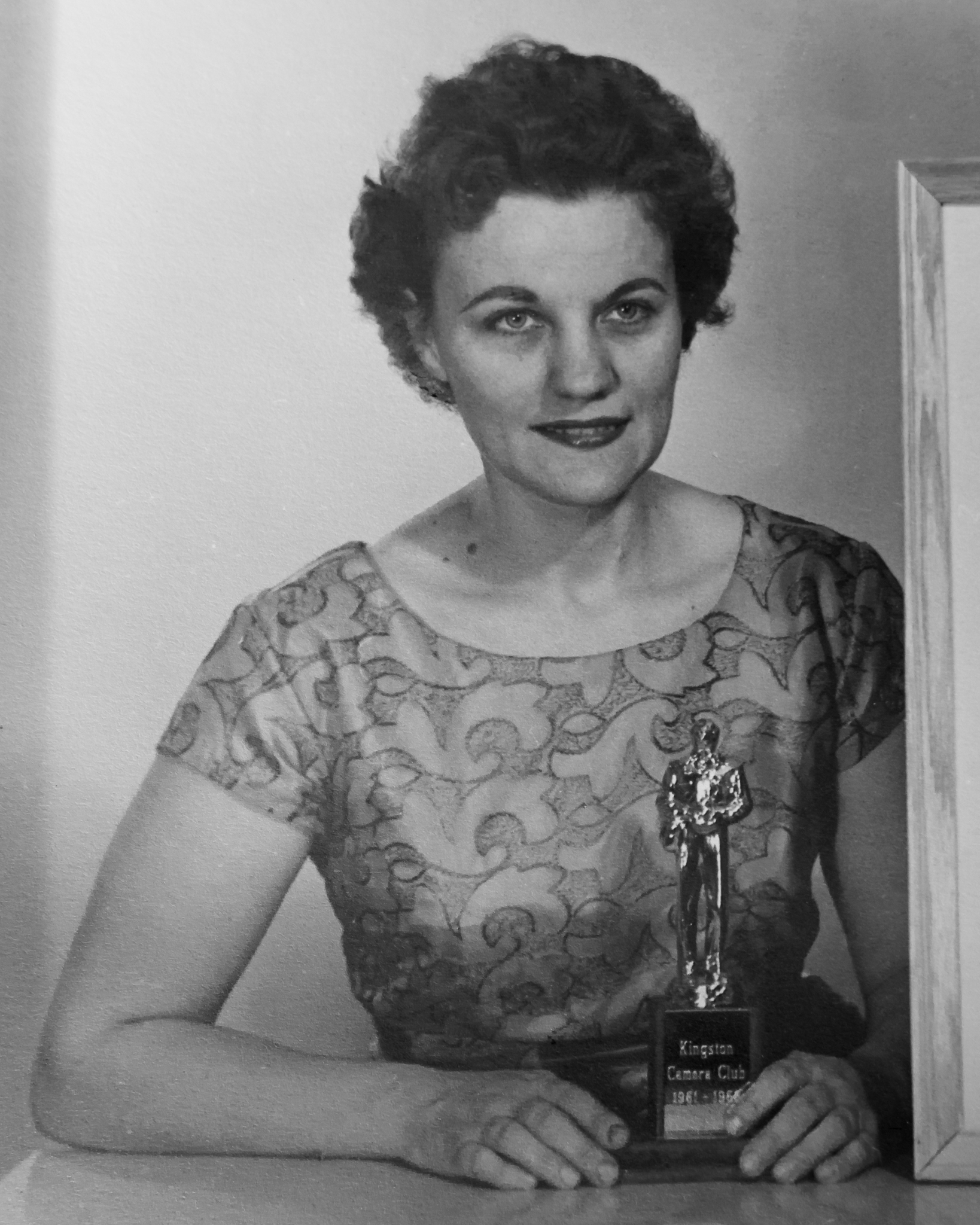
With one of her many photo awards in the 60s [Flickr page]

In her twenties, she published an article with some photos about being a young wife living in a trailer. Her portraits were getting noticed, and someone asked her to be a “following photographer” at a wedding. This was still a fairly new concept: Instead of the participants just sitting down for poses in a studio, the photographer would go to where the action was: the bride’s home, the church, the reception.

The gear for this undertaking, she recalls, “consisted of a heavy bulky press camera equipped with a large metal flashgun, film holders that each held two 4x5 black and white sheets of film, and No. 2 flashbulbs the size of regular lamp bulbs.” She lugged all that stuff into the man’s world of 1950s photography, returning with a few carefully framed exposures to develop herself in the darkroom.

It was exhausting she said, but fun. “Once my camera was in my hands, there wasn’t time to think beyond creating a love story through my lens.” The photo processing was time-consuming and added more responsibility. But she found it gratifying to see “the finished wedding album. It was a beautiful product of such personal nature to present to a happy client. So when another request came, I went ahead again.” And again, and again, building a business that she would run, with my father joining her as a partner, for the next fifteen years.

Giving a talk in the 70s [Flickr page]

Mom is a visual artist who made a career out of her gift for framing images in her mind and then expertly exposing them onto limited frames of film. But running Lakeside Studio called for a lot more than that.

She was an event fixer who took care of essential little details during all those weddings and receptions. That started with the very first wedding, when she calmed a crying mother of the bride and used some rubber bands to shorten a ringbearer’s shirtsleeves, fitting them under his jacket. Mom usually helped the brides with their wedding gowns. They were comfortable in such intimate settings with this woman as their photographer.

And she was a skilled technician who equipped herself with the best equipment available, who knew how to operate and care for it. When a smaller camera came on the market with a 2.25 inch format that would work with the exciting new color film, she bought two of them. There was always an extra of everything for backup; Mom didn’t like having dreams about catastrophic equipment failures on Friday nights. This was capital investment for a serious professional operation: The Hasselblad 500c single-lens reflex was the best you could get.

I remember the thunk and whine of that big shutter marking each careful shot in the studio as Mom leaned over the viewfinder and Dad stood off to the side, watching the people whose heads and arms and smiles he had just helped assemble into a perfect pose. He brought his own expertise to the partnership; one of his strengths was posing the subjects while keeping them happy to be there sitting on stools under the bright lights. “Did you know it takes more muscles to frown than to smile?” I heard him say a hundred times, and still don’t know if it’s true. But smile they did.

With one of her Hasselblads [Flickr page]

How many kids get to watch their parents work together as respected and mutually respecting partners, making a good living right there in the house? I’ll never forget the acrid smell of hot studio lights, the forest of shadows they cast on the walls, the thickness of their big black cords snaked along the carpet. The crisp rustling of wedding gowns as Dad sweet-talked their wearers into sitting up just a bit straighter, with their heads turned just so. The sound of Mom laughing with mothers of the brides.

They would wind up photographing almost 3,000 of those brides. One Saturday during their glory days, with each of them taking photos separately and some freelancers helping out as well, their tally was seven weddings. They would wave to each other from churches on opposite sides of the street. The local newspaper’s bridal section was pretty much given over to the work of Lakeside Studio.

Before any of that could happen, though, a young woman in the 1950s needed to believe in herself as an artist and entrepreneur, to assert that she was not just another pretty housewife tidying up the kitchen until her husband got home. When she went to City Hall, the clerk grinned at her and asked, “You want a photographer’s license?” She paid the fee and took the paperwork from him, and he said, “I give you six months.” She did see him again, while photographing his own family members’ weddings.

When she and Dad finally sold Lakeside Studio and moved to Arizona, her second act was to manage a portrait studio. There she photographed Ronald Reagan, Dolly Parton, countless high school seniors, food, and a Rembrandt she found unimpressive. Sometimes I would ride my bike to the studio to see her after school, and then, when I could drive and wanted to use the car, to give her a ride home. She had samples of her work hanging on the studio walls, and my favorite–for some reason–was a blown-up shot of Dolly in a glimmering white outfit that must have been spray-painted on for her concert.

Story and Spirit

With Dad, sometime in the 1980s [Flickr page]

Mom viewed the wedding album as a story that became a work of visual art. Her aim was to capture “all the beauty and love of the moment” for the bride and groom, especially the bride. She loved a good story, and she knew how to tell them in words as well.

An example of that is her 1999 book Twice to Freedom about Dad’s experience as a prisoner of war in WWII. (He met and fell in love with the daughter of a German immigrant less than six months after escaping from German captivity. These parents of mine were an interesting pair.) Dad would occasionally get to telling his war stories and we would sit quietly and listen, not wanting to interrupt what was a rare and fickle thing.

Mom was always fascinated by the history of the war and wanted to record Dad’s part in it, but he never shared anything about it with her except these verbal stories. When she found some notes he was writing, she typed them out and put them back. He continued writing, and she continued typing, adding a narrative of her own with photos and historical references. They never talked about the book until boxes of its first printing had piled up in the house (it sold out) and he finally read one. He sent her a signed card in the mail: “Wonderful. Fantastic.”

In the 50s [Flickr page]

Dad could be trying at times. I think Trudi would have put him in his place and kept him there. There was plenty of love between him and Mom and me, though. As a privileged late arrival to the family, I was fortunate to have a wonderful and supportive father who drove me across town to buy electronic parts and radio equipment and stood on the house roof helping me string up antenna wire. He was in his late forties when I was born, and I told him he needed to last a while. He did, for another 35 years.

There was something else about my father that arrived late into the family, an unseen entity that followed slowly behind from that farmhouse where Trudi first spotted him. It was at turns a force of joy and beauty and fear and pain, forming me and shaping me, giving me the view I would hold of the world for the first forty years of my life. It was the Apostolic Lutheranism of Dad’s Finnish parents, a demanding and fervent faith they brought across the Atlantic and practiced with a few thousand others having their own origins in the land of Lars Levi Laestadius. A handful of them lived in Ulster Park and they held services in homes. There was sin and forgiveness in abundance, and much wailing about people’s transitions from one to the other.

After twenty years of marriage to a moderate Catholic, Dad returned to the exclusivist Protestant religion of his youth. Contention sparked into flame about things like their teenage daughter’s earrings and the television in the living room. With no change on her part, Mom was one of the worldly now. She entered a period of soul-searching, questioning the clergy at various churches where she did her weddings, spreading their pamphlets out on her bed. Finally she asked God to point the way, and the answer she thought she heard had her convert, enthusiastically, to Dad’s Laestadianism. The television went away.

It’s not my place to summarize my mother’s current beliefs, half a lifetime later. Frankly, I don’t know or care what they are. What I do know is that she made quite a splash in the little pond of American Laestadianism (Heideman branch), just as she did with photography in upstate New York.

There were front-page articles in the Greetings of Peace with this eloquent former Catholic woman (what an exotic combination!) writing about the sense of peace and joy she felt at finding God’s Children. There were long letters back and forth with prominent ministers during a time of schism in the early 1970s. And there was a song–a beautiful one I sang many times along with hundreds of others in church, before a committee somewhere changed the tune and lyrics and ruined it all–about her heart longing for Christian love. She wrote it in the car on the way back from services one evening, full of feeling: “God’s children here blessed from above / Here in the flock on God’s Holy Mount / I find peace when washed in the fount.” And just listen to the biblical poetry here:

No ear has heard nor an eye has seen

The endless joy of which I dream

To Paradise leads the narrow way

Keep me in Faith, God, to thee I pray.

She’s written a lot of private musings that express this same faith in God, even as some people in the old church scratch their heads and wonder about whatever happened to Mary, who married an unbeliever after Ed died and is now living with another one. Like this stanza from a poem “Our Senior Years”:

Moonlit nights and sunlit days

Shining fields golden grained

All of God’s wonderful ways

The joy of life retained.

In another poem, “Life,” she writes about standing “on the threshold of eternity,” turning around to lift her eyes to “the light from Heaven above.” Her words tell of faith and praise and a patient hope. This is from “I Want to Walk the Narrow Way”:

In the quiet all through the night

With many thoughts running free

I’m thanking God for all

The blessing that he gave to me.

She isn’t all just sentimentality and flowers, though. I smile at the memory of a story she liked to tell about a gathering of their little congregation of Apostolic Lutherans. One of the elders was admonishing her to humble herself and repent of some sin, or more likely, a false spirit that was being blamed as the “root” of many sins. At the time, false spirits were running rampant across Laestadian Christianity–Heideman branch, non-Torola–and the discerning elders of the Ulster Park congregation had spotted their share. This gentleman was enamored with the sound of his own voice (I heard it plenty myself), and his rebukes were going on and on. Finally, Mom said, “If you’ll shut up, maybe I’ll repent.”

Repentance, perhaps, but humbling herself? She might not have been so good at that part.

Love and Loss

With Joe, a late-in-life love story [Flickr page]

Mom and Dad made it 57 years together. She couldn’t stand to be alone after Dad’s death, and Match.com had itself a new customer. She came across the listing for a man whose wife had died three days before Dad. Off they went–talking on the phone, meeting at a restaurant for lunch. “It was so comfortable with Joe,” she writes. “We held hands and shed tears for our lost spouses. This led to many more ‘dates’ and we knew it was right for both of us. We couldn’t stay apart.”

She married Joe in 2005. I was still so firmly stuck in my old church’s judgmental views that I didn’t attend their wedding, because she was in the Laestadian faith and he wasn’t. One should not be unequally yoked with unbelievers and all that. I wish I hadn’t been so damn righteous. Unlike me, some of her family and friends who remained in the church behaved decently about it: They were there, and they have my admiration for it.

I met Joe after the wedding on a visit down to Arizona. We went out to a buffet for dinner, and when Mom got up for some dessert, he looked at me with his big bushy eyebrows raised. “Well?” he asked. Did I approve, finally? I stuck out my hand. “Joe,” I said, “I give you my mother’s hand in marriage.”

They were a couple of doting old lovebirds, Joe and Mom. “It’s our new beginning,” she wrote in another poem, “when these vows are said. Wedding bells are ringing, but it’s my heart instead.” They had a wonderful marriage, both of them respecting the memory of their first spouses and loving each other just the same. And then she found him dead one day, the way of all flesh, and she grieved over another husband outlived.

He brought to me joy each day

His sweetness and tender love

It was happiness in every way

A gift from God above.

Their five years together was much too short.

With Jack, still smiling for the camera [Flickr page]

Now Mom is with another companion, Jack, a smart and interesting man. Her memory is fading and his sharp mind helps keep things on track. They sit in his trailer with their two dogs and watch their remaining days go by. She is coasting to the quiet finish of a long life well lived.

I sat beside her a couple of months ago as she leafed through an album I’d made for her of my own favorite photos. The call of the camera seems to have continued a bit in me, just as a hobby. She commented on composition and lighting, pointing to this and that, saying how pleased she was that I’d taken up photography. I looked at this remarkable woman, at her wispy hair and that big nose she left me with, and my eyes welled up with proud and fond and grieving tears.

You’re amazing, Mom, and I love you.

———
Click on individual images to enlarge. Most of my photography on this blog is Creative Commons licensed, but the ones for this posting are All Rights Reserved. You can visit and link to the Flickr page for any of them (see the hyperlink next to each caption) or browse the full album, but no further distribution, please.
A technical note about these images: I reproduced all but the bottom one (the photo of Mom and Jack I took myself) from prints in Mom’s various albums using my Panasonic Lumix DMC-LX7 camera in full sunlight, doing hours of post-processing work with Adobe Lightroom. The most time-consuming part of the processing was removing speckles and scratches using Lightroom’s spot removal tool. There was also some sharpening, noise reduction, radial and gradient filtering to emphasize subjects, and considerable tone mapping. With the faded color photos, I also did color adjustments, mostly to overcome the reddish hues that creep into those old prints over the decades. It was a labor of love; an accomplished photographer deserves to have her life story told with some decent photographs as well as words.