Showing posts with label Bible. Show all posts

Tuesday, June 7, 2016

Bible Brutality

In today’s world, which is so enthralled with the knowledge and wisdom of man, true knowledge and wisdom is still found in the timeless, eternal word of God which is yet today able to make us “wise unto salvation through faith which is in Christ Jesus.”
—Youth Discussion Presentation, Laestadian Lutheran Church, 19991
Now therefore, kill every male among the little ones, and kill every woman who has known man intimately. But all the girls who have not known man intimately, spare for yourselves.
—Moses speaking to the Israelites, Numbers 31:17-18
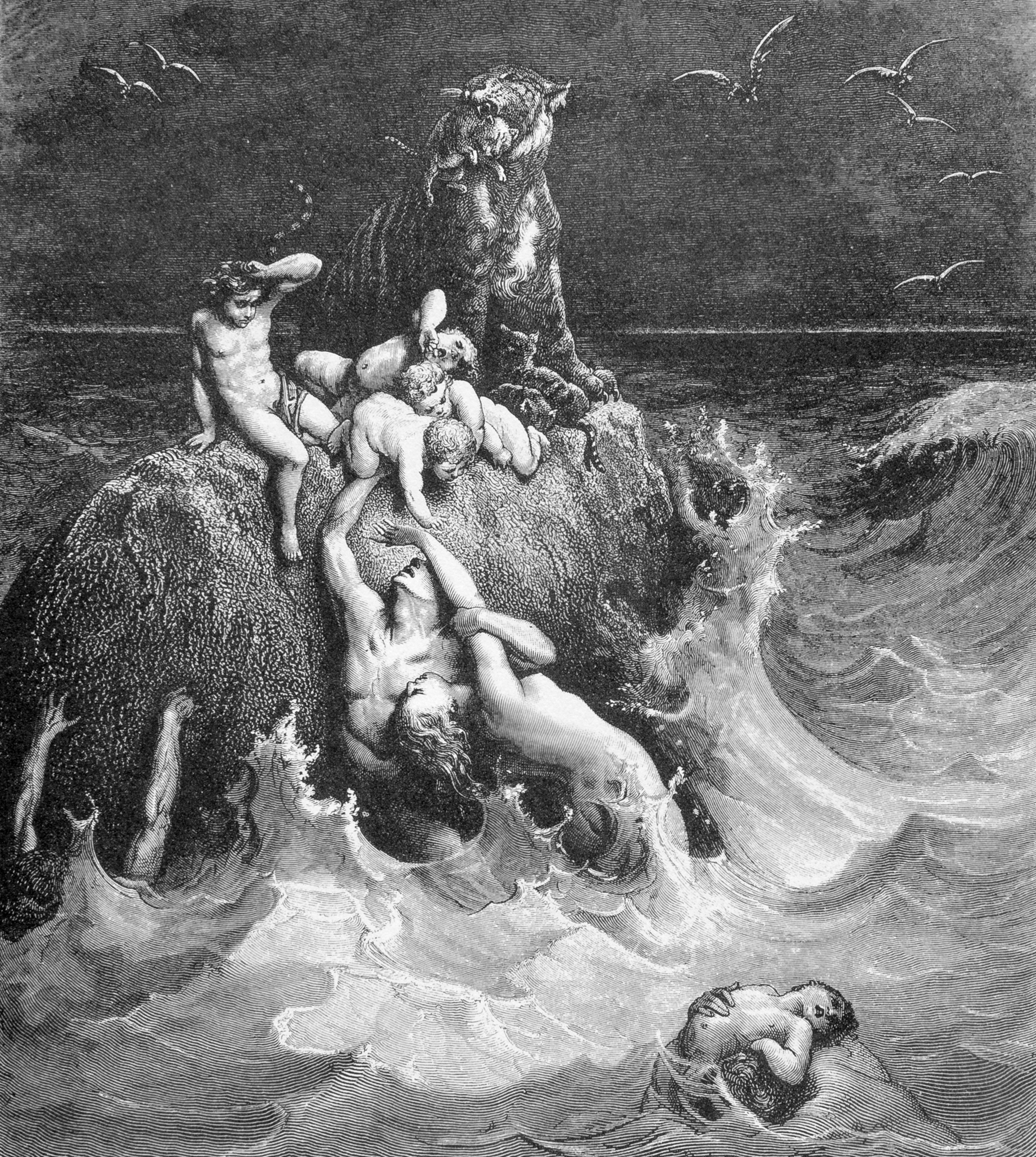
The Deluge, or, If God is Love Then Water is Dry
Announcing, in my roundabout meandering way, the reading of my short story “Stones of Tribulation” by Seth Andrews on his excellent Thinking Atheist podcast. You can listen to it here (or on YouTube or iTunes) and read the text (with footnotes) for free online here. You might even buy my book of these stories when it comes out later in 2016.

The preachers in my old church like to begin their sermons–usually based on some nice familiar text about salvation and forgiveness plucked from the New Testament–by offering up prayers to “our loving and merciful heavenly father.” They mumble the standard intonations requesting God’s assistance with the weak faith of current believers and the lost faith of former ones, occasionally with a mention that He might also lead some of the rest of humanity to His Grace Kingdom. (What’s stopping Him, anyhow?) As a gauzy familiarity descends on the pew-sitters, the image conjured up in their minds is of a slightly crotchety but ultimately benevolent Old Man of a God with this large inheritance to dispose of. In His house are many mansions, and one of them has your name personally engraved on the door.2

Now, He does know exactly what you did last night and with whom. But just as soon as you hear the magic words (as you undoubtedly will during a Laestadian sermon) that all your sins are forgiven in Jesus’ name and blood, He will smile kindly and shake the memory out of His divine head. You will breathe a small sigh of relief, wait for the In Jesus Name, Amen to finally come around, and then go forth from the sanctuary in peace, freedom, and joy. You will avoid being written out of the Old Man’s will, for a few more days, anyhow.
Joshua Spares Rahab

He’s giving you a pretty good deal. The upside is huge after you die (we won’t talk about that nasty potential downside–your sins are forgiven, after all) and in the meantime nobody is getting hurt. At least if you don’t count a little psychological damage, the lost opportunities of a restricted life, and the occasional medical complication from giving birth to that tenth baby.

There’s a problem, though. This vaguely pleasant hands-off deity that I grew up hearing about bears no resemblance whatsoever to the unstable raging psychopath who ranted and threatened and smote his way through the first two-thirds of the Bible. Next time you sit there in the pew, look carefully at the old book’s gilt-edged pages. Most of them will be to the left of where the preacher is reading from, ignored and silent, their horrors left unsaid.

It is impossible to convey here just how much savagery and inhumanity is contained in those pages.3 During the summer of 2009, I spent months reading the Bible from cover to cover. It was tough going, because I kept getting shocked and disgusted by the awful stuff I was encountering for the first time. It certainly wasn’t anything they talked about at church.

One example is enough to make the point.4 Ezekiel 8 tells us that God got upset about some “wicked abominations” that were being committed against him: “seventy elders of the house of Israel” burning incense and surrounded by carvings on the walls of his sanctuary of “creeping things and beasts and detestable things, with all the idols of the house of Israel” (8:10-11), some women weeping for a Babylonian fertility god (8:14), and 25 men prostrating themselves toward the sun and “putting the twig to their nose” (8:16-17). A little weird, but whatever.

God’s response, however, makes the Spanish Inquisition look like small claims court. He called for the executioners of the city to draw near, each “with his destroying weapon in his hand” (Ezekiel 9:1). He commanded that the men of Jerusalem who disapproved of the aforementioned abominations be marked on their foreheads. Then, he directed, “Go through the city after him and strike; do not let your eye have pity and do not spare. Utterly slay old men, young men, maidens, little children, and women, but do not touch any man on whom is the mark; and you shall start from My sanctuary . . . . Defile the temple and fill the courts with the slain. Go out!” (Ezekiel 9:5-7).

It didn’t matter that the women and innocent children had no way to take sides and avoid God’s wrath. When the bodies piled up, theirs lay right alongside those of the men.

———

The Bible-based short stories that Seth Andrews has featured from time to time on his Thinking Atheist podcast are my effort to bring some of this to light, to expose the dark underside of the “Good Book” that fundamentalists would like to foist upon us all. In today’s episode, he reads “Stones of Tribulation,” a bit of Deuteronomy horror fiction I’ve set in a potential future afflicted by climate change, petroleum scarcity, and economic collapse.5

The Destruction of the Armies of the Ammomites and Moabites

You can also read the text for free online here, but I suggest you let Seth’s golden pipes do the reading for you. Check out the footnotes in the online version later, and please consider buying my forthcoming book of all my Bible stories when that comes out later in 2016.

Anyhow, amid all the death and looting, the few remaining authorities were able to spare no attention for the Deuteronomic Church of Holy Reconstruction, a fictional Christian cult using Deuteronomy as a guidebook for con­quering a strech of the Buffalo River in the Arkansas Ozarks. (“So we captured all his cities at that time and utterly destroyed the men, women and children of every city. We left no survivor,” Deut. 2:34.)

With all the cabins and shacks taken over and the former occupants dispatched in proper biblical fashion, the Holy Reconstructionists are keeping things in line with Deuteronomy as a guide there, too. The current project is to carry out God’s judgment against a young woman who did not produce evidence of virginity on her wedding night. The sentence is clear from Deut. 22:20-21:

But if this charge is true, that the girl was not found a virgin, then they shall bring out the girl to the doorway of her father’s house, and the men of her city shall stone her to death because she has committed an act of folly in Israel by playing the harlot in her father’s house; thus you shall purge the evil from among you.

Soon our hero, Jacob Davis, is watching a volley of rocks being thrown at the woman, his sister, by the menfolk of the hollow. She screams and curses at the men, and Jacob wishes he could join in with her cursing, too, but Deuteronomy has a harsh ruling in store for such rebellion: “The man who acts presumptuously by not listening to the priest who stands there to serve the LORD your God, nor to the judge, that man shall die; thus you shall purge the evil from Israel” (Deut. 17:12).

As the narrator then recalls things, there

was sort of a pause as the men reloaded their arms with their remaining rocks Leah’s voice slurred into a long raspy howl as her mouth gaped open, her jaw probably broken now. Levi watched from the porch with folded arms. Jacob stared at his sister, his crude and brave and dying sister, and did not look away. Not from the blood that was trickling out of her nose and gaping mouth. Not from the one eye that was now hooded and bruised. He thought he saw blood coming from there, too. A spinning piece of shale caught her on the cheek, tearing open another gash. A couple of crows rustled and flew out of the pines behind her, spooked by all the noise.

Then the dark and jagged hailstorm opened up again. He watched Leah’s body jerk and flinch and sag with each impact. Every line and color and detail was vivid, and impossibly wrong. He’d seen stonings before, but this one he would remember. There was no call for this. He decided with a sudden spurt of silent rebellion, unfamiliar and shocking and strong in his throat, that he would make it right somehow.

The howling finally stopped. Leah stared up at the sky through the one open eye, her final act a breaking of the endless rules. Jacob figured the last thing she saw was the sun, burning its forbidden image onto her retina until her head slumped forward and hung against her chest, bleeding.

It’s a gruesome scene. But it’s exactly what is commanded by that “loving and merciful heavenly father” in his inerrant and unchanging Holy Bible. You may believe in that God–no concern of mine if you do–but I’m pretty sure you don’t believe in Deuteronomy.
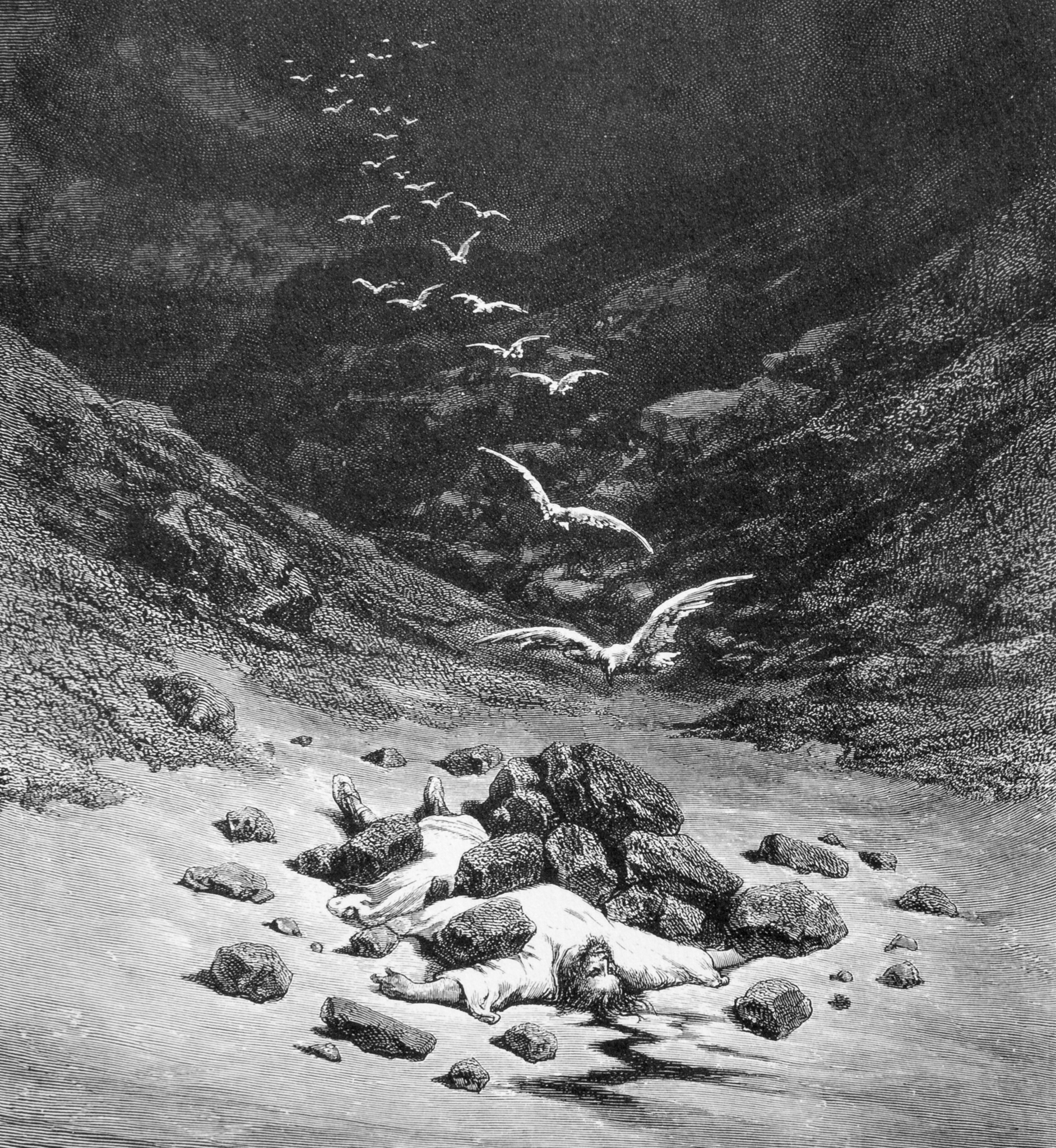
Achan Stoned

There are true believers in Deuteronomy among us, though, and in Joshua, and Leviticus, and all the rest of the Old Testament’s brutal inhumanity. The most hardcore Bible thumpers of them all are Christian Reconstructionists who advocate what one R.J. Rushdoony (rhymes with “loony”) championed as a “biblical worldview.” According to Professor Julie J. Ingersoll, who spent time in Reconstructionist circles and then studied it exhaustively as a scholar of religion, the movement is “rooted in historic Calvinism,” with a Bible that “speaks to every aspect of life and provides a blueprint for living according to the will of God.”6 Reconstructionists, she says,

contend that contemporary re­interp­retations of Old Testament violence are humanistic rejections of what God called justice. The New Testament is not a replacement for the Old; there is no “God of Love” replacing a “God of Wrath.” God is loving and forgiving, and just and vengeful as revealed in the three persons of the Trinity and present at creation. Old Testament biblical law, with its numerous capital offenses, must be the model for Christian life, and civil law today.

Thus they “support the imposition of violent punishments (stoning and death) for all manner of behaviors that they consider sin (or, in their terms, that God considers sin).”

So, you may wonder, why don’t they have the courage of their convictions to put all this biblical wisdom into action? Why aren’t these true believers out there trying to govern some Ozark hollow under Old Testament Shari’a law right now, throwing rocks at back-talking teenagers and brides lacking virginity certification? Because, they insist, “such punishments would only be exacted after society has been transformed by the Holy Spirit such that the overwhelming majority of citizens would be believers who would submit willingly to biblical law.”7

Well, if the failure of Ted Cruz in the Republican primaries is any indication, we may still be safe for a while yet. Thank, er, God.

Rushdooney “argued for the use of the Bible as the only source of authority.”8 He’s dead now, but if you find yourself yearning to have an ancient book control your life without the hassle of, say, converting to Islam and traveling to Syria, there are homegrown Christian alternatives. You might consider my old Laestadianism (“the Holy Bible is the highest authority in questions regarding faith and life”)9 or, for example, the Covenanted Reformed Presbyterian Church. Its list of beliefs begins as follows:

We believe that the Scriptures of the Old and New Testament are inspired by God and thus totally without error. The Bible (not hu­man tradition, not human experience, not alleged sub­jec­tive “revel­ation”) is the sole standard and authority for faith and life.10

And guess what, according to the church’s pastor Brian Schwertley, is the “only standard by which a civil magistrate can rule justly”? The Holy Bible, of course, “the stand-alone infallible Word of God.”11

Pastor Brian writes about “promoting true religion in the land,” which he says is something “godly civil magistrates are very concerned about.” What he seems to have in mind behind those benign-sounding words promoting and concerned is more than just little old ladies handing out flyers at the county fair. He cites First and Second Kings and the story of King Jehu, biblical butcher extraordinaire, to help us understand how these godly civil magistrates are supposed to operate. Jehu, while “not a godly king,” did the right thing: He “was blessed by God for what he did to the prophets, priests, and servants of Baal.”12

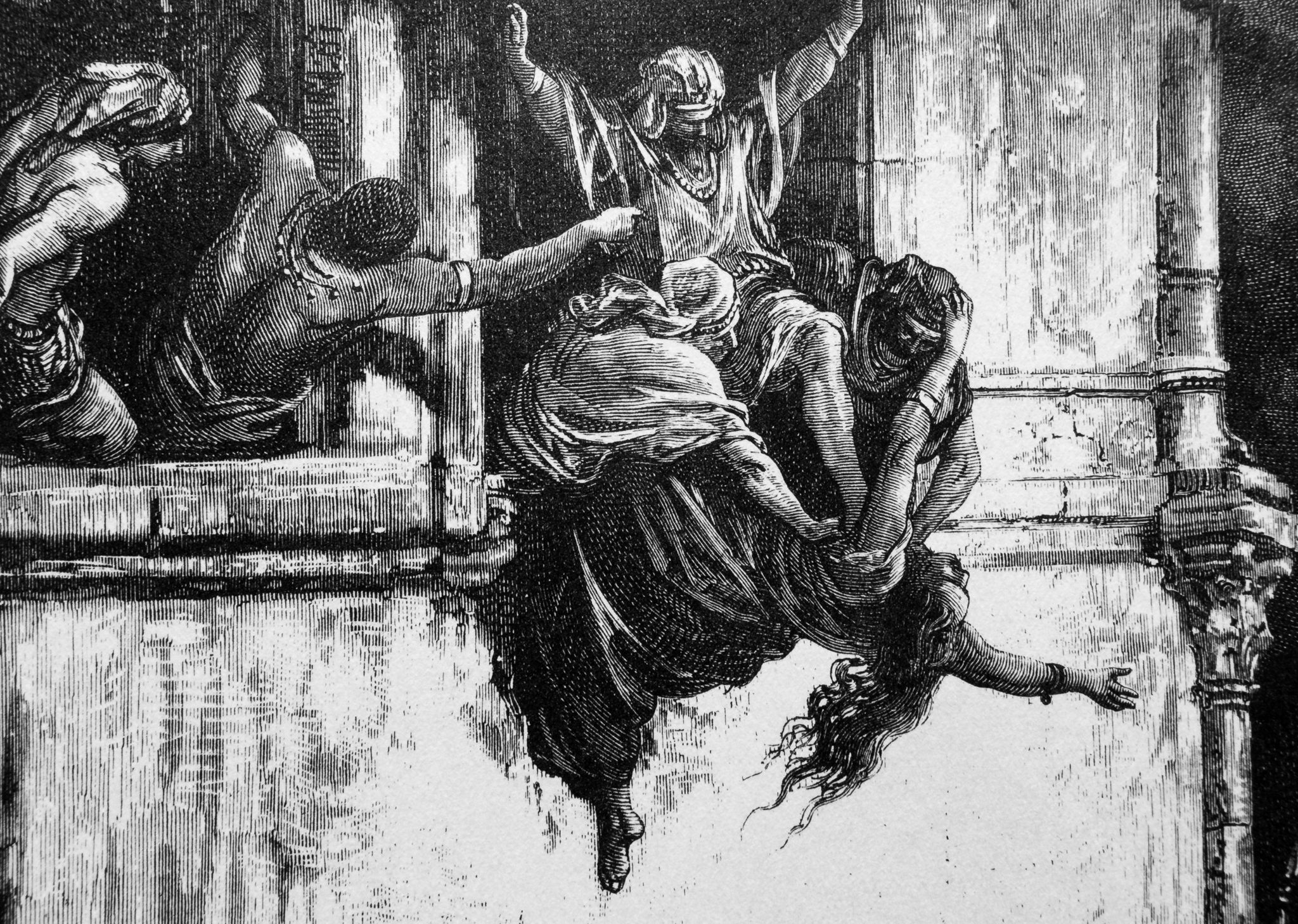
The Death of Jezebel (by Jehu’s orders) [Flickr page]

Here’s some of what Jehu did, as described in another one of my short stories, “Jehu’s Jihad,” by a fictional victim of his true-religion promotional efforts:

The chanting stopped, replaced by the screams. There was a mighty rushing roar of shouts and screams, and stamping feet, and the wet smacking thud of iron blades violating flesh. My eyes could make out very little in the dim light with frantic bodies lunging all around me, but I heard and felt, and smelled. Shit and urine voided from panicked and lifeless men. I gulped down nausea with the waves of foul outhouse odors that mingled in my nostrils with the smell of slaughter: dripping, naked guts and the coppery tang of fresh blood.

It was not my own blood, but I made it mine, smearing it on my neck and falling on some bodies and letting more bodies fall on my own. I closed my eyes and lay still as the swords chopped and sliced and swung to chop and slice again. Another body landed, hard, and I wondered if I would still be able to breathe. My chest barely moved as I willed myself to draw long silent breaths from my belly to my gaping mouth. Hot blood dripped onto my arm, first coming in little bursts and then a slow and steady oozing as another life went out.

The screaming became the dying and the dying became the dead, and all was quiet, except the panting and scuffling of the soldiers. I focused my world into the agony of holding my lungs in a measured starvation to stay quiet and alive. My world was the dark mute pressure of dead arms and legs and torsos slick from their bleeding.

Then there were shouted orders and heaving arms, hateful arms, carrying the dead and me outside the temple. I had to let all my weight droop where it fell over the soldier’s shoulder. I stayed silent as ribs cracked under their impossible load and seared my mind with unanswerable pain, my legs swinging with the soldier’s hump-trot to the dirt where he threw my living corpse. Again there were bodies under me, cooler already, and then more on top. Again the silent struggle for secret breath.

It’s another gruesome scene, but massacring an entire worship hall full of helpless people because they don’t share your religion is a messy business. And you will find it in your Bible, a brief, sanitized version of it: 2 Kings 10:18-25.
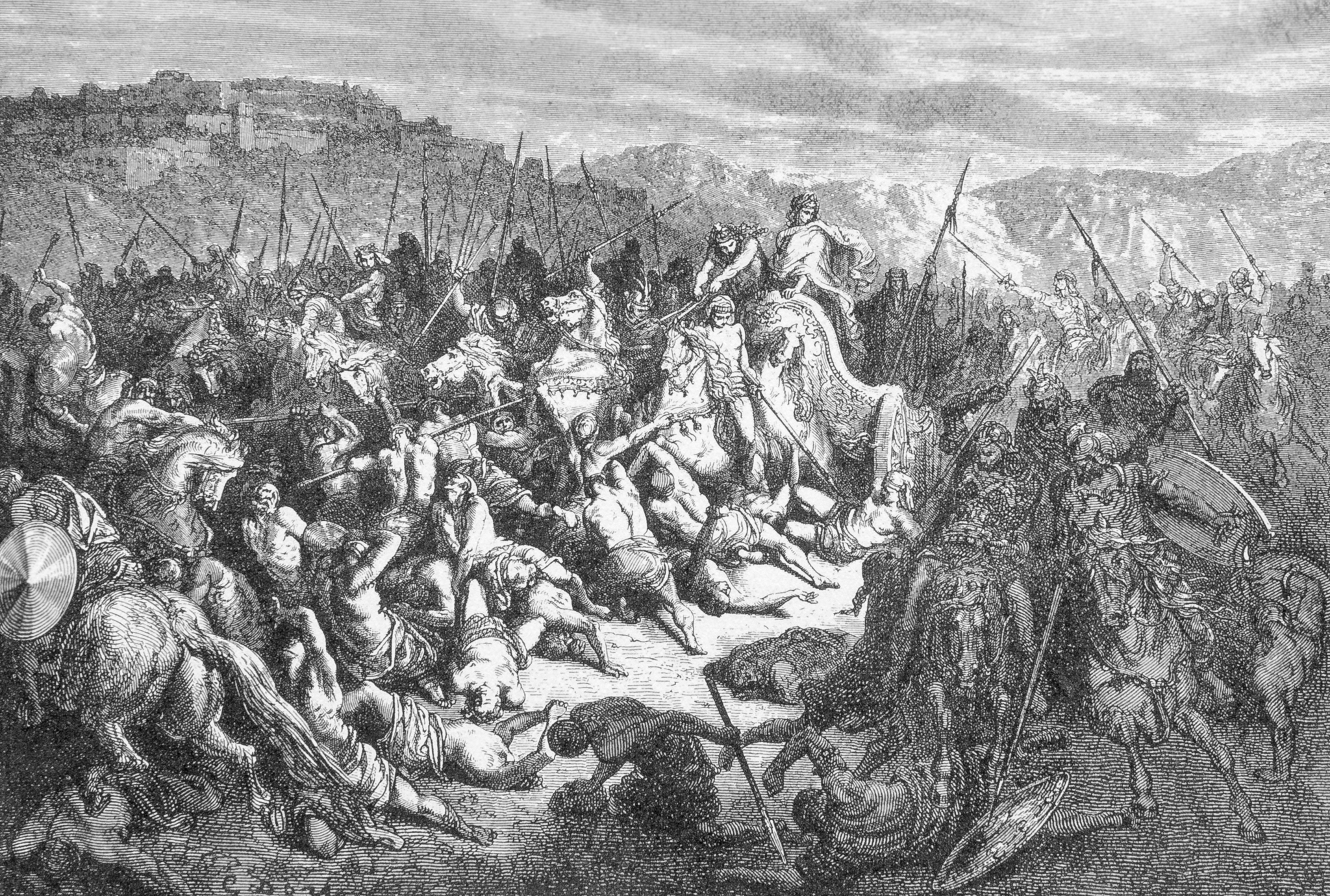
Slaughter of the Syrians by the Children of Israel

Now, nobody–not even the most rabid Reconstructionist or preciously believing Laestadian–really follows the entire Bible. You actually cannot do it, no matter how crazy you are, because it is impossible to conform to a text that contradicts itself.

Imagine you’re out there at your freshly built backyard altar dripping blood, slaughtering all these cattle and trying to be a good follower of Leviticus. Finally, that old-time religion, you smugly say to yourself while plunging your Ka-Bar into the neck of the next poor beast lined up behind the high compound walls. The BBQ is running out of propane to get it all burnt. Then along comes your wise-ass cousin quoting Micah 6:1-8:

With what shall I come to the LORD

And bow myself before the God on high?

Shall I come to Him with burnt offerings,

With yearling calves?

Does the LORD take delight in thousands of rams,

In ten thousand rivers of oil?

Shall I present my firstborn for my rebellious acts,

The fruit of my body for the sin of my soul?

He has told you, O man, what is good;

And what does the LORD require of you

But to do justice, to love kindness,

And to walk humbly with your God?

Whoops. Beef–it’s what’s for dinner, ex­tra well done.

The less pragmatic reason people don’t actually follow the Bible is that it has a way of interfering with real life. Consider the scene from “Stones of Tribulation” where Jacob is musing about the presence of pork chops at the dinner table of Levi Harding, prophet. Back in Harrison, AR, some of the men had “said Jesus overrode Deuteronomy when it came to what you could eat” (Mark 7:19). But the “others reminded everybody what the Biblical Blueprint Series said about the Old and New Testaments. One guy kept quoting the line Jacob knew all too well: ‘God’s counsel and judgments are not divided!’ That old coot probably couldn’t even taste bacon anymore.”

The Biblical Blueprint Series, edited by Gary North of Fayetteville, Arkansas, is a real work, ten volumes published in 1986 and 1987. It’s one “of the most direct and systematic efforts at popularization” of a “biblical worldview.”13 It teaches some serious biblicism, which would seem to lay to rest any questions about my Holy Reconstruction folks eating cloven-hooved unclean animals, as much as their stoning of Jacob’s sister:

We must never doubt that whatever God did in the Old Testament era, the Second Person of the Trinity also did. God’s counsel and judgments are not divided . . . . If we as Christians can accept what is a very hard principle of the Bible, that Christ was a blood sacrifice for our individual sins, then we shouldn’t flinch at accepting any of the rest of God’s principles. As we joyfully accepted His salvation, so we must joyfully embrace all of His principles that affect any and every area of our lives.14

But somebody else at the Hardings’ (fictional) table “wondered if Deuteronomy really needed to be taken ‘whole hog’ [sorry] when it came to the rules even Jesus said weren’t important. Then Levi’s dad recalled that the guy who edited Biblical Blueprint figured the food laws didn’t apply, and that was the view that finally won out.” Yes, it seems that joyfully embracing all of God’s principles does not quite apply to what’s for dinner. Take a look at North’s 1984 position paper to see how he rationalizes that one.15 If you can stomach it.
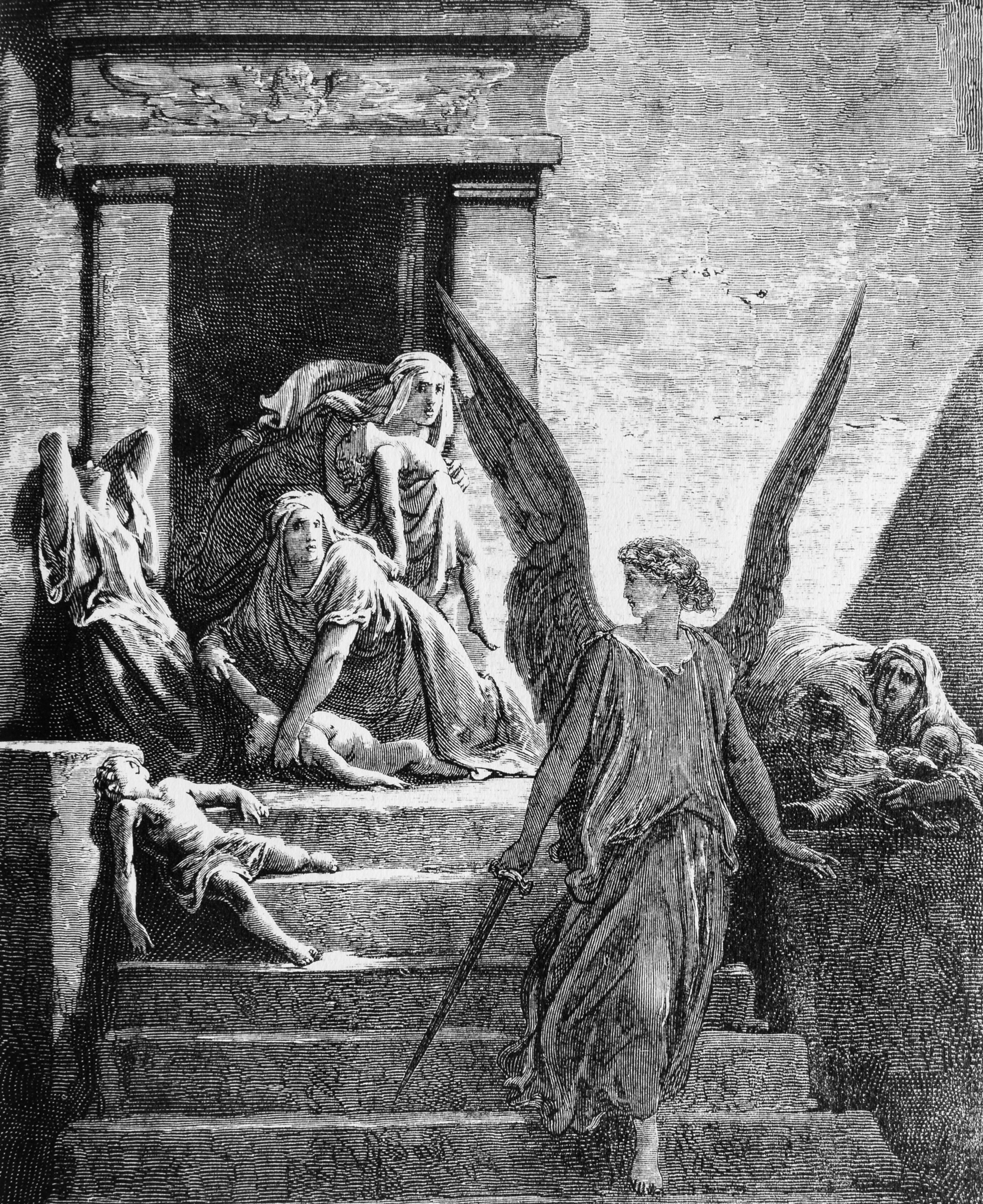
The First-Born Slain [Flickr page]

Many Christians remain blissfully unaware of the Old Testament’s brutality. It barely grazed my consciousness for most of the decades I remained in Christian fundamentalism. For those who do know about it and “ponder why God would allow, much less command, such horrors,” Robert M. Price offers some strong words in Blaming Jesus for Jehovah, a book whose publication I’m proud to have been a part of via my little indie publishing company Tellectual Press.16

Just knowing and wondering isn’t good enough, Dr. Price says. That is “stopping short of the real question,” which “is this: ‘Why should I believe that a God who issues such orders is more than a tribal totem embodying and justifying the bloodlust and hatreds of an ancient people? How can I, with any shred of conscience, profess allegiance to such a figure?’”

Fine, you have the information. You have the doubts, the questions. Now, what are you going to do with them?

What if you are willing to discount those passages in which God commands genocide and infanticide as merely the biases of primitive worshipers of a God whose loving nature is clearer to us moderns? Then plainly you must realize that, even if scripture explicitly says, “God commanded so-and-so,” that doesn’t mean he did. Don’t you realize you’re admitting the Bible was mistaken? And then, how do you know when it’s not mistaken? I come back to my point: Your judgment is your authority, not the Bible, which many seem to “believe” only when they agree with it.

And that’s nothing to be ashamed of! The only thing to be ashamed of is hiding behind the supposed authority of the Bible to buttress your own opinions. If you have the courage of your convictions, surely you should be able to present to another person the solid reasons that led you to think as you do. Assuming there were any real reasons.

If you were raised believing in the murderous faith of the Islamic Caliphate, you might have qualms about some of the things your leaders said Allah had commanded, but you’d be looking at things from the inside, and you’d chalk it up to “one of those divine mysteries.” But you are, thankfully, viewing their atrocities from outside, so you have no difficulty recognizing the horrors of a death cult for what they are.

“If the Old Testament Jehovah is portrayed as the blood-spattered totem of a slaughter cult,” and Dr. Price thinks the Bible does a fine job of that, as do I, then “it is high time you stepped out of the Bible bubble for an objective look at it. It is time you decided if you really belong there.”17

Dr. Price goes on to discuss the equivocation of “God’s defenders” when confronted with all this. “They like to point out that God is so astronomically far above us that it’s futile for us to imagine ‘good’ meaning the same thing for him as it does for us.” Uh huh. OK, fine; say

that a deity who commands genocide, religious persecution, and the abduction of virgins is nonetheless “good” if you want to. But then you will just be spewing pious gibberish. God’s ostensible goodness is no longer any guide to what we may expect from him. Oh yes, he’s “good,” thank goodness, but that doesn’t mean he won’t victimize or exterminate the innocent. Whatever he did, the pious apologist has ready excuses for his God. “He’s all-righteous, so he must have some good reason for it!” If you woke up in hell one fine morning, despite your Christian faith and God’s promise that it would save you, I guess you’d have to conclude he must know what he’s doing.

Ours is not to reason why; ours is but to boil and fry. Maybe so, but why empty the word “good” of what we all mean and understand by it by applying it to such a being?18

It’s not just Christians who are compelled to make excuses for these ancient books. Todd Kadish, a former Orthodox Jew, tells me that “the atrocities contained in them are “an albatross weighing down the moral authority of ethical monotheism.” Worse, they can offer a “license for ethnocentrism or even atrocities” perpetuated today, in some pious fantasy world where the ability to do so would actually present itself. The Orthodox can’t just wave away the sacred words on the Torah scroll, because they “consider the Five Books of Moses the vehicle through which a transcendent God touched humanity, and the eternal guidebook he personally authored for his chosen people.”

Kadish acknowledges that the real-world consequences are very different for a reluctantly tolerated albatross and an enthusiastically embraced bad-behavior license. But he warns Jews and others who revere the Hebrew Bible to focus on the common source of the two positions:

The views of a liberal (“Modern”) Or­thodox rabbi writing apologetics and a radical Orthodox Jew who justifies the murder of innocent Palestinian children by citing Biblical precedent are both seeking to apply the morality of a being they consider the source of (or at least guide to) morality to the modern world. But the world largely moved beyond total warfare centuries ago, and most of us are now trying to lay to rest a history of racial and religious genocide which stretched into the modern era (with Jews as some of its primary victims). And the Hebrew Bible is a truly terrible foundation doc­ument for a moral code that demands ethics in warfare and respects all human life, because it leaves one with apologetics at best or license for atrocities at worst.19

———

Happily, for those of us outside the fanatic fringes of Christianity or Judaism, the Hebrew Bible is in no position to make any more demands. We have read it and tossed it aside in disgust, dismissed it as irrelevant to our lives, or rationalized it away under some comfortable theory about Jesus fulfilling the Law. Reconstructionism, never a big part of American religion to begin with, has retreated to its bunkers.

Though Professor Ingersoll notes that “conservatives (Christian and secular) have not disappeared” and expresses concern about lingering influence from the Reconstructionist lunacy she’s studied for so long,20 today’s conservativism seems to be a largely secular phonenomen. The snarling theocratic fantasy of Ted Cruz’s candidacy has evaporated, and the amoral authoritarian gasbag left standing at the head of God’s Own Party exhibits no significant religious convictions. Meanwhile, one contender for the Democratic Party nomination says he is “not particularly religious,” and the other one–the woman who will be the next U.S. President–is a pro-choice Methodist not exactly beloved by the Religious Right.

Through no fault of the Bible, our nation and world remain infested with ignorance, superstition, bigotry, and violence. We certainly are not headed for any secular utopia as we leave that nasty old book behind. But perhaps some of what another Ingersoll–the genius orator Robert Green Ingersoll–promised a hundred years ago finally might be happening:

Day by day, religious conceptions grow less and less intense. Day by day, the old spirit dies out of book and creed. The burning enthusiasm, the quenchless zeal of the early church have gone, never, never to return. The ceremonies remain, but the ancient faith is fading out of the human heart. The worn out arguments fail to convince, and denunciations that once blanched the faces of a race, excite in us only derision and disgust.21

It is long overdue.

Paul wrote that he was pressing “toward the mark for the prize of the high calling of God in Christ Jesus.” Forget those things that are behind us, he said, and reach forth unto those things which lie before us (Phillipians 3:13-14). Lofty words, and a worthwhile thing to adapt for ourselves as we smile at Paul and Peter and whoever wrote all the rest of it: Let us press toward the prize of our own high calling, of our best and noblest selves and community and shared humanity.

Let’s forget the tribal atrocities and cruel punishments in this tired old text that’s occupied too many of us for far too long, and look to what lies before us–writings and thoughts that speak to us where we are today as compassionate, decent human beings, that serve us, that earn the space they ask for inside our minds.

———
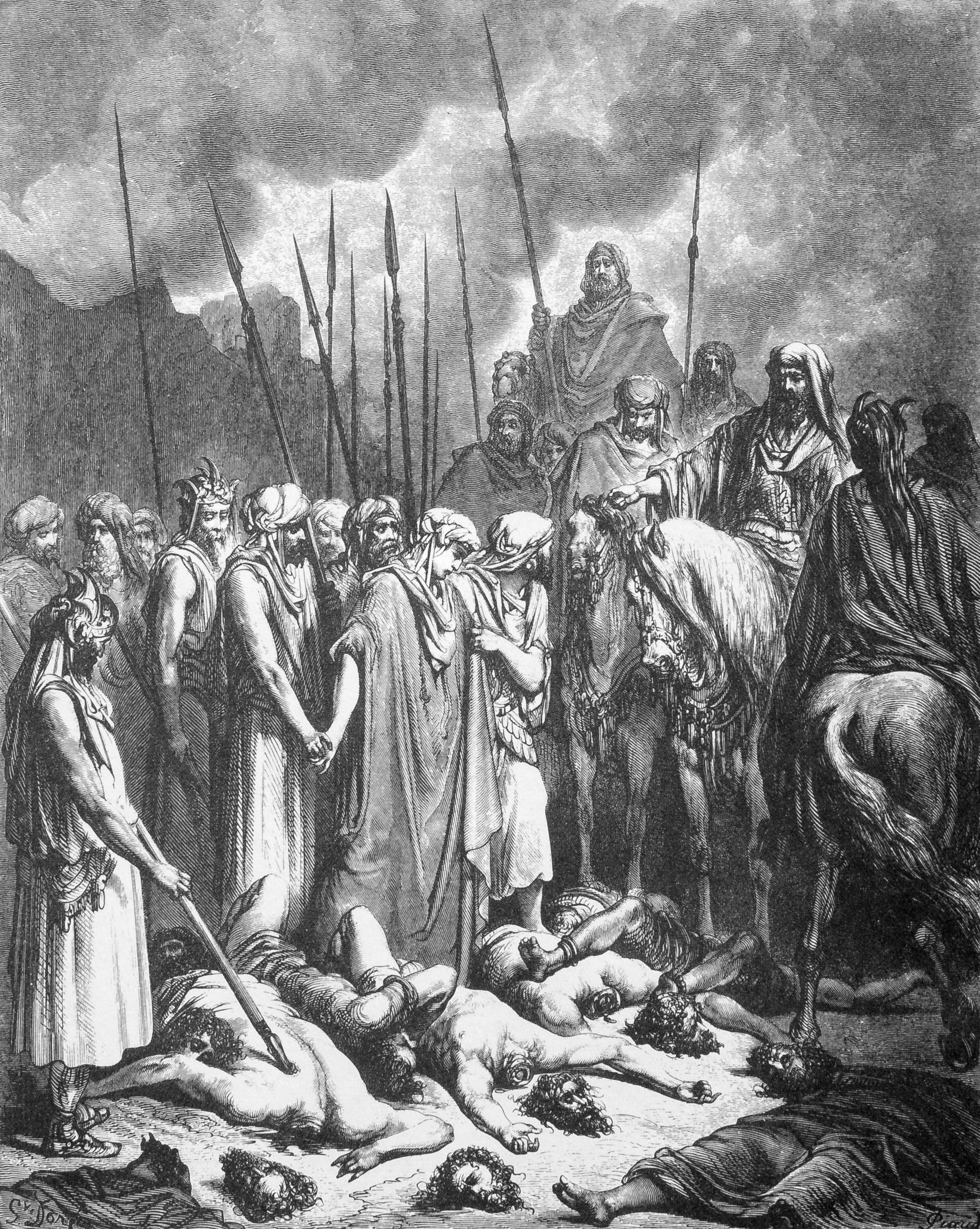
All images are my photographic reproductions of Gustav Doré‘s incomparable (and, thankfully, public domain) engravings of Bible illustrations. Taken in full sun from The Bible in Pictures, Wm. H. Wise & Co. (1934) with a Panasonic Lumix DMC-LX7 camera and post-processed in Adobe Lightroom. Click on any image for an enlarged version.
“Stones of Tribulation” is a work of fiction. Names, characters, businesses, places, events, and incidents are either the products of the author’s imagination or used in a fictitious manner. Any resemblance between characters and living persons is purely coincidental.
Scripture quotations taken from the NASB unless otherwise indicated.

Notes


  1. llchurch.org/​topics/fromachild1.pdf 

  2. John 14:2. I actually heard a preacher say the “personally engraved” line once. 

  3. This paragraph and those that follow up to the next section break are adapted from my essay “Fighting Words,” originally posted May 11, 2012 on the Learning to Live Free blog. 

  4. You can read about many more examples in my book An Examination of the Pearl (2012). See my discussion of the Old Testament in Section 6

  5. It’s a topic for another essay entirely, but I do believe those three issues–climate change, petroleum scarcity, and economic collapse–may well lead us to a dystopian future like what I wrote about in “Stones of Tribulation,” and in not too many decades down the road. And you can count on all sorts of religious crazies to come out of the woodwork if it does. 

  6. Julie J. Ingersoll, Building Gods Kingdom: Inside the World of Christian Reconstruction (Oxford University Press, 2015), p. 14. 

  7. Ingersoll at p. 214. 

  8. Ingersoll at p. 211. 

  9. “How We Believe,” llchurch.org/​ourbeliefs.cfm

  10. reformedonline.com/​about.html 

  11. Brian Schwertley, “Political Polytheism,” 2003, reformedonline.com, p. 60. 

  12. Schwertley at p. 60. 

  13. Ingersoll at p. 54. 

  14. Quoted in Ingersoll at pp. 54-55. 

  15. Gary North, “The Annulment of the Dietary Laws,”
    I.C.E. Position Paper No. 2 (Nov. 1984),
    garynorth.com/​freebooks/docs/a_pdfs/​newslet/position/​8411.pdf

  16. Robert M. Price, Blaming Jesus for Jehovah: Rethinking the Righteousness of Christianity. (Tellectual Press, 2016), p. 61. 

  17. Price at pp. 61-63. 

  18. Price at pp. 63-64. 

  19. Todd Kadish, personal communication June 6, 2016. 

  20. Ingersoll at p. 244. 

  21. Robert Green Ingersoll, “Lecture on Gods.” 


Saturday, February 27, 2016

Judging Jesus

Think not that I am come to send peace on earth: I came not to send peace, but a sword.
—Jesus of Nazareth (Matt. 10:34)
Book review (and promotion): Blaming Jesus for Jehovah by Robert M. Price. With a Foreword by Valerie Tarico. Tellectual Press (2016).
Bob Price’s new book

Growing up as a Christian, there was one hero figure in my imagination who stood above all others, even above my parents. I didn’t have quite as distinctive a picture of him as I did of my father who helped me string wire on the roof for ham radio antennas or my mother who managed a photography studio, but somehow he was still better than they were. For the most part, I believed this.

Jesus was, you see, utterly perfect. He was so amazing and special that it really isn’t even appropriate to refer to him as a person, even though he walked the earth for some thirty years in human form, performing amazing feats and never succumbing to any of the sins that endlessly plague all of us mere mortals.

I was told that, having risen from the dead up to heaven to be with God (an even less clearly defined hero figure), Jesus looked down at us all the time and sat with us during church services. “Where two or three are gathered in his name,” there he’d be.1 And of course we were constantly telling each other that our sins were forgiven in his “name and precious blood.”

There was no room for any human failings in “our Lord and Savior Jesus Christ,” the innocent unblemished Lamb who offered himself as a final, perfect sacrifice on our behalf. The preachers never tired of reminding us how frequently and miserably we all sin, but not so with Jesus. He never did, not even once. If he had sinned, the implication went and was sometimes even expressed out loud, then all that forgiveness we were doing in his name and blood just wouldn’t work.

———

It took the sharp eye of a young friend who’d left the church while I was still in it to make me aware of any problems with this narrative. He pointed out that Matthew 5:22 has Jesus teaching, “whosoever shall say, Thou fool, shall be in danger of hell fire,” and yet Jesus himself calls people fools in Matthew 23.2

I came across other examples of behavior that didn’t seem particularly Jesus-like as I tiptoed warily into reading what skeptics had to say and–for the first time with clear eyes–the Bible itself. One of those skeptics, Valerie Tarico, pointed out how Jesus’ behavior could seem downright bigoted. In her book Trusting Doubt, she recalled how

a Canaanite woman, a non-Jew, calls out, begging Jesus to heal her daughter, who is possessed by demons. “Lord, Son of David,” she calls him. But he ignores her. Finally, his disciples get sick of her following them and shouting, and they ask him to send her away.

Then “Jesus tells her he was sent only to the lost children of Israel. She keeps begging.” In the end, Jesus heals her daughter, but not before enduring a degrading conversation with him. She “came and knelt before him. ‘Lord, help me!’ she said.”

He replied, “It is not right to take the children’s bread and toss it to their dogs.”

“Yes, Lord,” she said, “but even the dogs eat the crumbs that fall from their masters’ table.”

Then Jesus answered, “Woman, you have great faith! Your request is granted” (Matt. 15:25-28).

This did not impress Dr. Tarico:

If the image doesn’t bother you, try to imagine an American slave or a South African Black having to do and say the same things to get health care for her child. “Please, sir, even the dogs eat the crumbs that fall from their masters’ table.”3

Savior Bro: Not as meek and mild as you thought

Something troubling I came across in my own Bible reading was Jesus telling a bald-faced lie. In John 18:20, he said to the high priest, “I spake openly to the world; I ever taught in the synagogue, and in the temple, whither the Jews always resort; and in secret have I said nothing” (emphasis added). But, according to Mark 4:34, Jesus expounded on the meaning of his parables “when they were alone.”

In fact, all three Synoptic Gospels (Matthew, Mark, and Luke) give an example of Jesus doing the secret teaching he explicitly claimed he’d never done. It happened after Jesus told the crowd the parable of the sower, “when he was alone” with the disciples (Mark 4:10). They asked him about the parable.

Did Jesus say, “What’s wrong with you guys? Can’t you understand plain Aramaic?” Nope. He told them they were being let in on the mysteries (mystery, singular, in Mark) of the Kingdom that were being kept hidden from the unwashed masses (Mark 4:11; Matt. 13:11; Luke 8:10).4 He then proceeded to explain the parable to them–and them alone.

It’s a pretty bad situation for those who believe the 66 books of the Bible make up the inerrant Word of God with no contradictions. If both John and the Synoptics are telling the truth about what happened, then Jesus did not.5

So Jesus became something of a disappointment, though I could’ve lived with a slightly sub-par savior if church doctrine cut him any slack. (Alas, it doesn’t.) And a careful reading of the Old Testament left me utterly repulsed by the shitty attitude and horrible actions of our Father which art in heaven. He is, to quote Richard Dawkins’s memorable one-liner,

jealous and proud of it; a petty, unjust, unforgiving control-freak; a vindictive, bloodthirsty ethnic cleanser; a misogynistic, homophobic, racist, infanticidal, genocidal, filicidal, pestilential, megalomaniacal, sadomasochistic, capriciously malevolent bully.6

This really is no exaggeration. Read the bloodstained pages in the first half of your Bibles and you will soon see how devastatingly true it is.

———

Having long since absorbed the shock of these realizations about both Father and Son, I was delighted to have my little publishing company Tellectual Press take on Robert M. Price’s new book, Blaming Jesus for Jehovah. In it, he presents a grave and devastating conflict for Christianity: “the sheer logical impossibility that God and Jesus, as defined by the Christian creeds, could have commanded and taught the hateful things the Bible says they commanded and taught, and still be loving, just, forgiving, and merciful.”7

Dr. Valerie Tarico–much more pleasant than the God she writes about [Flickr page]

The book begins with a Foreword that was kindly provided by Dr. Tarico. She cites Dawkins’s description of the “malevolent bully” and observes that “trying to separate Old Testament from New–trying to separate Jesus from Jehovah–doesn’t solve the problem.” In fact, she says, “it is impossible,” because “Jesus himself won’t let us.”8

Bob makes that clear right away in the first chapter, entitled “The Son Who Is the Father.” He cites several passages in Matthew and John where Jesus claims a special relation to his Father in heaven and speaks about “‘inside information’ concerning his divine Father and his celestial realm.”9 Jesus knows all about God, Bob says, “because he has intimate familial knowledge, ‘a chip off the old block.’” I especially like the way Dan Barker put it in a recent interview: Jesus isn’t just “a chip off the old block”; he is the block.10

That, of course, refers to the doctrine of the Trinity, a weird theological superposition of three distinct persons of God into a single divine entity. Bob devotes a few pages to what present-day Christians think the Trinity is (but is not) and concludes with the observation that, according to that doctrine, “Jesus and Jehovah are one and the same God.”11 And even without it, there’s plenty in the Gospels to put responsibility for all those Old Testament atrocities on Jesus as Jehovah Junior.

Remember, Jesus explicitly declined to nullify the Old Testament or distance himself from what it describes his Father doing. Bob dismisses the view of many Christians “that the New Testament either exonerates the God of the Old or just plain renders him irrelevant,” which he finds a strange thing to think for those who “profess to believe that both Testaments are the inspired Word of God.” His

considered guess is that they are thinking of the Pauline notion that Christ and his gospel have superseded the Torah, the Old Testament Law. But that is quite a different matter. Paul says that the ceremonial provisions of Judaism (circumcision, kosher laws, holy days, etc.) are no longer binding since their proper purpose has been fulfilled as of the coming of Christ (Col. 2:16-17; Gal. 2:15-21; Rom. 10:4). But that has nothing to do with genocide, as if something so morally repugnant could be proper in the Old Testament dispensation but not in the New.

But, hey, who wants to look too closely? If you’re looking for an excuse to sweep Old Testament atrocities under the rug, any old broom will do.12

After spending a chapter (“Artists’ Conceptions of Jesus”) acknowledging some good stuff about Jesus, Bob goes on to summarize some of those atrocities. We are rightly horrified by the grotesque savagery of ISIS, yet

the Christian holy scripture, the Bible, explicitly ascribes the very same moral crimes to God. Islamic Caliphate killers don’t even need the Koran. There are hundreds of passages in the Holy Bible which would be more than enough to inspire their horrors. These are strong words, I know. I hate to have to write them. I hope you will have the courage to read them. It comes down to a question of your own integrity. I hope you will see that.13

Any torture that the sick minds of ISIS fanatics can cook up is, of course, a mere pinprick compared to the novel bit of nastiness introduced in the New Testament: eternal condemnation in the agonizing fires of hell. Bob gives that horror the full attention it deserves. In a couple of ample chapters, he covers the various theological attempts to justify unlimited punishment for limited humans and reveals the absurdity of the whole idea of blood atonement.

And there is more: The failure of Jesus’ prophecy about his imminent return, the failure of the Bible to provide a consistent and reliable story about him, and the problems with expecting ant-like humans to heed the warnings of an omniscient God who knows they’ll screw up regardless. This book has a lot of good stuff packed into its 166 or so pages, and I’m very proud to have been a part of its publication.

Fun while it lasts (screenshot taken Feb. 27, 2016)

There is one issue I scratched my head about while editing the book, which bears mentioning. Bob is well known as a skeptic about the existence of any actual person behind the Bible character of Jesus.14 Here’s how he put it to me in a recent phone conversation:

I think there was no Historical Jesus and the Jesus story is almost entirely based on rewriting Old Testament passages. But another likely influence was the dying and rising God myths in the Mediterranean world and also ancient Israelite religion.

In Blaming Jesus for Jehovah, however, Bob treats the existence of Jesus as a given. I asked him about that, particularly where he calls the doctrine of Original Sin “a matter of reverse engineering” by early Christians who “had to deal with the death of Jesus somehow.”15

He was executed as a criminal, but they believed he wasn’t one. So if he didn’t die for any sins of his own, and his death couldn’t have been a meaningless tragedy, whose sins did he die for? Must have been everybody else’s!16

Well, I asked, if you think there wasn’t any such person who actually lived or died, why would those early Christians have been troubled by his death? His answer was that

those who wrote our New Testament documents were not mythicists. They believed there was a Historical Jesus martyred at the hands of Rome, who died innocently. They had the problem of explaining how this could happen.

He dates the earliest Gospel, Mark, at possibly 70-80 years after the reported events, but more likely a full century afterwards. Those early Christians were thinking and writing a couple of generations removed from the event they imagined had happened. That’s plenty of time for a whole myth about a messianic savior to have developed–a “major theological adjustment” to Second Temple Judaism following the destruction of Solomon’s temple by the Romans.

With this book, Bob wanted to avoid the whole controversy of the Historical Jesus vs. the Christ Myth Theory by simply accepting the Bible’s assertions about Jesus at face value. It’s a “look through the lens of mainstream criticism,” as he put it. Even so, it’s still quite a critical and much-needed look, at the superhero figurehead of the world’s largest religion whose flaws thus far have remained largely off-limits to scrutiny.

———
The cover image is Copyright © 2016 by Tellectual Press, an imprint of Tellectual LLC. Used by permission.
Nature photography is much more my line than portraits, but I was glad to have a chance to offer Valerie Tarico some additional publicity photos, including the one shown here, during a visit in Seattle last summer. She’s a wonderful, gracious individual who just inspires you to do your best to keep up with her gentle goodwill. The picture is Copyright © 2015 Edwin A. Suominen, but it’s hers to do what she wishes with, and she’d probably be open to your inquiry should you have a good use for it.
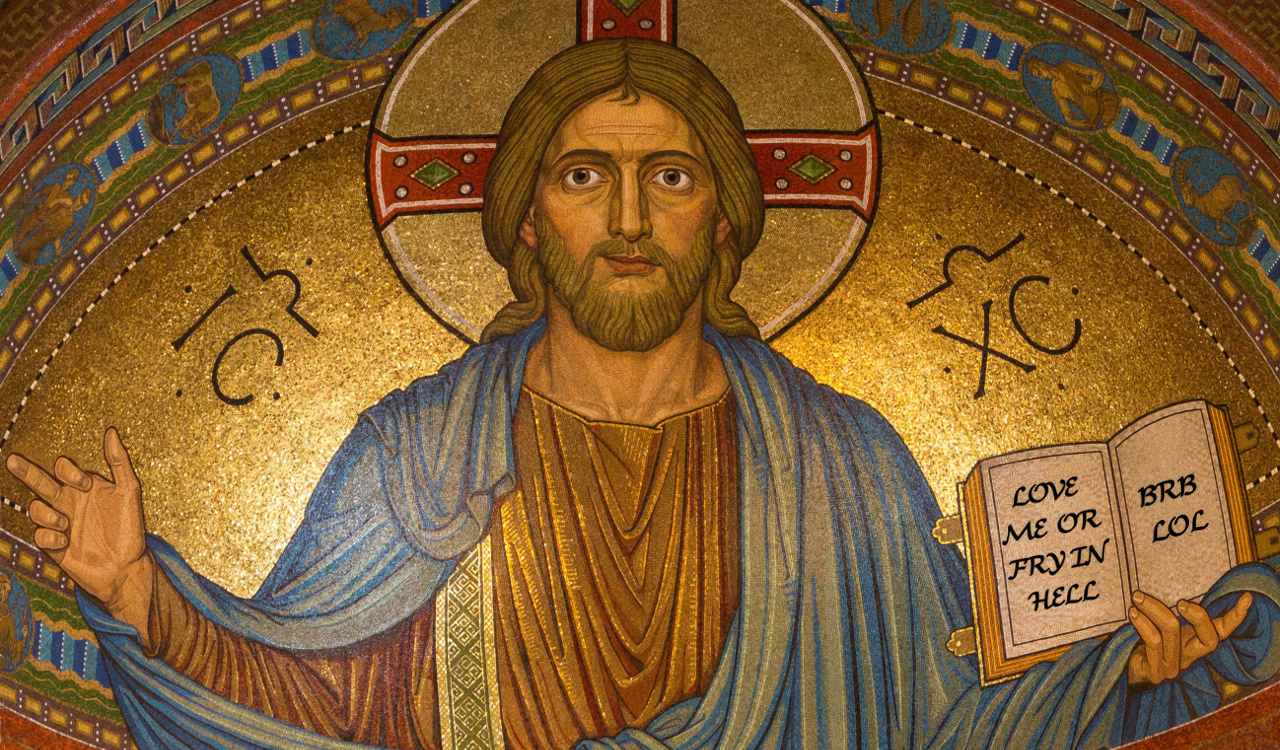
The Jesus mosaic image is adapted (obviously) from a photo reproduction of the apse mosaic of Christ Pantocrator inside the Maria Laach Abbey. The mosaic “was completed in 1911 by Father Andreas Goeser” (link), long enough for the unfortunate Fr. Goeser’s beautiful work to pass into the public domain and get co-opted with the GIMP free image processing software. My irreverent modifications consist of the smirk, the folding over of one additional finger, and a considerably revised text on the open pages. I cannot take credit for “BRB LOL,” having seen it in a meme image some time ago.

Notes


  1. Matt. 18:20. It should be added, however, that the only qualified gatherings for his attendance were those of my own church’s few hundred congregations around the world. He skipped all the untold thousands of other ones because they weren’t part of “God’s Kingdom.” 

  2. “Ye fools and blind: for whether is greater, the gold, or the temple that sanctifieth the gold? And, Whosoever shall swear by the altar, it is nothing; but whosoever sweareth by the gift that is upon it, he is guilty. Ye fools and blind: for whether is greater, the gift, or the altar that sanctifieth the gift?” (Matt. 23:17-19). 

  3. Valerie Tarico, Trusting Doubt: A Former Evangelical Looks at Old Beliefs in a New Light (Oracle Institute Press, 2010; previously published 2006 as The Dark Side), Ch. 5 (available online). 

  4. The Revised Standard Version translates the word as “secrets” (secret, singular, in Mark), which makes the problem even more apparent. Both the KJV and NASB use the term “mysteries” (and “mystery”). 

  5. These four paragraphs, the footnote above, and the rest of this one are adapted from my first book, An Examination of the Pearl, Section 7.1 (“The Gospels”). Robert M. Price told me in 2011 that he believes this to be a case of an intentional contradiction between John and the Synoptics. The writer of John “rejects the esotericism of Mark and changes the story,” which he also did to avoid the “unseemly” stories of Jesus not carrying his own cross and not wanting to go through with his suffering. “For John, there was no private teaching in the Markan, Gnostic sense.” (Gnosis was secret spiritual knowledge not shared with everybody else.) “Everything is public, though some do not hear because they are not of his flock. Thus within John’s retold narrative Jesus is telling the truth.” 

  6. Richard Dawkins, The God Delusion (Houghton Mifflin, 2006). 

  7. Robert M. Price, Blaming Jesus for Jehovah: Reconsidering the Righteousness of Christianity (Tellectual Press, 2016), p. 19. 

  8. Price (Tarico Foreword) at p. 8. 

  9. Price at p. 29. 

  10. Dan Barker, interviewed by Seth Andrews on The Thinking Atheist podcast, Feb. 16, 2016

  11. Price at p. 38. 

  12. Price at p. 65. 

  13. Price at p. 55. 

  14. See, e.g., my blog posting Myth, Method, and the Will to Believe about a lecture by the same name that Bob gave on the topic. 

  15. Hat tip to Jonathan Bernier, who noted this issue in a Facebook post

  16. Price at p. 95. 


Tuesday, June 23, 2015

Gutting Your Kid for God

Could he be wrong? Did he dare question the words of Yahweh, his almighty and angry God, which had been conveyed so powerfully to him in the sacred writings and the voice? And the boy screamed and screamed.
No. He must do it. He held Isaac’s head down with his left hand and reached for the knife with his right. He shall lay his hand on the head of the burnt offering, the writings said, that it may be accepted for him to make atonement on his behalf. He drew the knife up out of its scabbard and set it against the pulsing skin of Isaac’s screaming throat. And then, as he hesitated at dragging the blade against the flesh, his own flesh, he heard the loud and distinct voice of an angel.
—“Abraham’s Excellent Adventure,” available online and read by Seth Andrews on The Thinking Atheist podcast.
Therefore all things whatsoever ye would that men should do to you, do ye even so to them: for this is the law and the prophets.
—Matthew 7:12
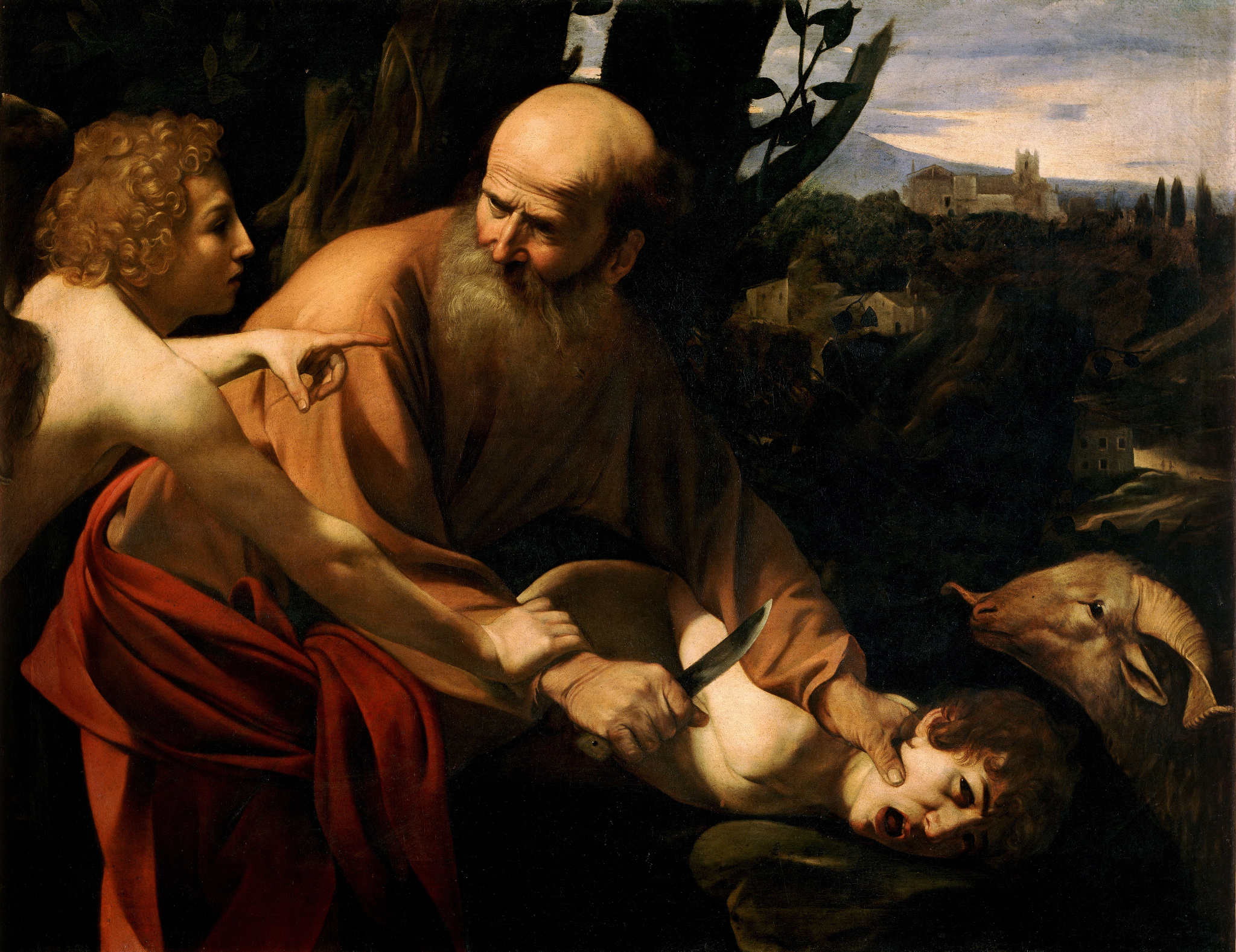
Sacrifice of Isaac by Caravaggio (1603)

Yesterday I heard the voice of God telling me to kill my young son, so I did. I grabbed him off the couch, tied him up, and hauled him outside, where I slashed his throat with a kitchen knife. Then I doused his little corpse with gasoline and set it on fire. I was obedient to God, and He was pleased with my obedience and sacrifice.

Of course I did nothing of the kind. But you were horrified to read the paragraph above, weren’t you? I am hesitant to leave even the obviously fictional obscenity of the words sitting there at the head of this essay, except that they make an important point. You and every other sane reader of this blog–from fundamentalist Christian to atheist–would unequivocally condemn any monster who actually carried out such an atrocity.

So why do so many Christians–perhaps you among them, gentle reader?–revere an ancient book that praises Abraham for his “faith” in being prepared to do much the same thing to his son?1 Why did hundreds of upstanding and decent believers sit and listen quietly to a Father’s Day sermon in my old church three years ago that made this outrage an example of how they should believe what they do not understand?

And I think, when there are people who dare to say that I don’t believe if I don’t understand–that I only am willing to accept and believe this which I can understand–I think they should read about Abraham. He did not understand. Or what do you think? Do you think that he understood? Do you think he saw plainly what was going to happen? No way. He didn’t. He had to take this leap of faith. He had to kind of shut down his thinking. He could not think. He could not use his carnal reason. Because what God asked of him was inhuman, was–if we say, in a human language–it was wrong. It was something nobody should do.2

It was something nobody should do, unless God tells you to do it. Then all bets are off, all sense of morality is erased. This is scary stuff. It is the kind of thinking, of non-thinking, that is bringing us beheadings in Syria and floggings and amputations in Saudi Arabia.

Hitch said it best.

My patience has long since run out for the mindset that has so thoroughly surrendered itself to fideism as to assert, “If you don’t understand, you believe.” But the slavish devotion to blind, unquestioning faith continues in my old church, as is evident from another sermon delivered just this past Father’s Day. (Why do these guys consider this an inspiring text for that occasion?) The business of Abraham being willing to gut his kid for God seemed to get the preacher quite emotional, not out of any sense of horror or moral indignation, but because

already in his heart, even though Abraham did not have to actually slay his son and offer him, Abraham had done it already in his heart. He was obedient in his heart, by faith. And that obedience of faith is required of us, dear brothers and sisters. It is not our way. It is not our mind, our plan, but may we always be tender to the voice of the spirit that speaks within us and speaks within God’s beloved congregation, as it does here even in our home congregation, our beloved home congregation, as it does here and elsewhere in God’s Kingdom. Let us be the brothers and sisters of Abraham and trust in God.3

No thank you, Mr. Preacher. I reject your “obedience of faith,” your praise of a willing child-killer, your cult-like devotion to some “beloved home congregation” that apparently could make any demand it wished of you, no matter how repugnant, and expect to be obeyed. I much prefer to rely on my own well-developed sense of morality, reinforced by a civilized (and secular) culture, that tells me, for very good reasons that have nothing to do with some Bronze-age behavior code or fear of damnation, that it is always wrong to harm children, no matter who you imagine is telling you to do so.4

And we unbelievers are supposedly the ones without a moral compass?

———

This is a timely subject, and not just because of the creepy association LLC preachers seem to make between child sacrifice and Father’s Day. My second short story based around a messy Bible tale is the subject of the June 23 episode of The Thinking Atheist podcast.”Today’s show is, simply, a reading of the biblical story of Abraham and Isaac,” says Seth’s intro on his site.”However, author Ed Suominen has fleshed out the story in alarming detail . . . and he has added a bizarre twist to the tale. How do most people feel about Abraham’s deed (or “almost deed”)? His faith? His character? And after they hear this version of the Old Testament account, will they feel any differently?”

I hope you enjoy listening to my story being read by the golden pipes of this veteran broadcaster as much as I did. You can hear it and our brief post-game discussion on the episode’s Thinking Atheist page, on BlogTalk Radio, or on iTunes. You can also read the story and a transcript of the interview on the website of Tellectual Press, my little indie publishing company that will be coming out with a book of these stories, The Bold Testament, sometime in late 2016.5

Notes


  1. “Now faith is the assurance of things hoped for, the conviction of things not seen. For by it the men of old gained approval” (Heb. 11:1-2).”By faith Abraham, when he was tested, offered up Isaac, and he who had received the promises was offering up his only begotten son” (Heb. 11:17, both NASB). 

  2. Jouku Haapsaari, sermon given in Rockford, MN on June 17, 2012 (14:30-18:00). 

  3. Keith Waaraniemi, sermon given in Minneapolis, MN on June 21, 2015 (35:17-36:10). 

  4. This same preacher also once said that, “as contrary as it is to our human mind, we see that believing people also had slaves,” that “God’s word did not give slaves of that time permission to flee their masters,” being “possessions, human possessions of people, and so by fleeing you were transgressing the law and the will of your master.” See my Moral Midgetry blog posting of October 27, 2014. The combination of authoritarianism and Bible-worship is a frightening one indeed. 

  5. Thanks to Tim Bos for the great title idea, and to Seth Andrews for permission to transcribe and print the interview. 


Wednesday, February 11, 2015

Eden Found

“You put them in your mouth,” she laughed, “and you press your tongue against them, and you revel in the sweetness of the flesh and the juice, and then you swallow them. There, I told you that you knew nothing about life. Behold, your first experience!”
—Lilith to Adam in Eden, by Murray Sheehan
Book review (and promotion): Eden by Murray Sheehan (1928). Reprinted with an Introduction by Robert M. Price and Edwin A. Suominen, Tellectual Press (2015).

Last summer I stopped at one of our remaining used bookstores in town and picked up an old hardback “Treasury of Great Bible Fiction.” Most of the stories in it are pretty cheesy, but one of them really impressed me with its beautiful, powerful writing and realistic depiction of the underlying Bible tale. It was an excerpt from a 1928 novel Eden by Murray Sheehan.

An Amazon search led me to one of those oddball used & rare booksellers online. Soon I had myself a hardback copy of Eden, almost ninety years old. After reading through its 200 or so yellowed pages, I came away just as impressed with the rest of the book as I’d been with the excerpt. It’s a great retelling of the Genesis human-origins story, wonderfully written and still very engaging to read nearly a century later.

This thing deserves to be a treasured classic, I thought. Why isn’t there an ebook version of it, or at least a paperback reprint? To my delight, I found that it has passed into the public domain.1 Eden has been set free, the best work of Bible fiction I’ve come across yet. And now my indie publisher Tellectual Press is making a reprint available, not just as a paperback but also for the Amazon Kindle.

———

Bob Price, my friend and collaborator on another Edenic effort, agreed with my assessment of the book, and we co-authored an Introduction for the reprint. As we explain there, what Sheehan came up with was a fine contemporary example of a time-honored literary art known as midrash.2

Eden, Ch. 3 (paperback reprint)

The ancient rabbis peering through their treasured scrolls of the Hebrew Bible practiced this literary art, interpreting scripture passages (especially the difficult ones) by retelling them. They provided their own versions, wider in scope, which contained plot details and additional characters and circumstances that they hoped might make more sense of the originals. The biblical original was just the tip of an iceberg to be revealed by their literary sonar.

Their results are creative and charming, whether or not they really cast light on the biblical texts that inspired them. And, as shown by Sheehan’s fine novel as well as the release of Bible-themed movies from The Ten Commandments (1956) to Noah (2014), the art of midrash has never died.

Murray Sheehan’s midrash puts narrative meat on the bones of an old rabbinic effort to explain a contradiction between the Bible’s first and second chapters. They are both there in our Bibles today, contradictions and all, because whoever compiled them together didn’t want to omit anything. It had already became sacred tradition in a lot of people’s eyes, if not his own. Cut any detail and you could be sure that some busybody from the ancient Israelite equivalent of a KJV-only Bible College would complain.3

Eden, Ch. 4 (Kindle reprint)

And so Genesis 1:27 has God creating Adam with a wife at the very outset while Genesis 2:18-22 has Him4 making one out of the lonesome Adam’s rib after the dust of His creation project had already settled.5 That gives Sheehan a great villain for his novel, the wily and sensual Lilith.6

In Eden, Adam and Lilith have something of a relationship before Eve shows up, but it never gets consummated with anything other than “a wild kiss, the first in all Creation” (Part 1, Ch. 10). God doesn’t like the way things are headed, so He closes Adam’s heart to Lilith and brings Eve into the picture. He provides Adam with a mate who’s less likely to get him into trouble.

But He has counted Lilith out too soon. She manipulates Mr. Serpent into tempting Adam and Eve into eating that apple. (Then things go badly, as we all know.) In a clever twist on the Christian interpretation of the story, Sheehan replaces Satan with Lilith. She, not the Hoofed One, becomes the mastermind behind the Serpent’s mischief.

Creation of Man [Flickr page]

Another fascinating bit of midrash in this novel deals with the puzzling vestiges of polytheism that remain in the Genesis creation accounts. Understandably, those are never even noticed by most casual Bible readers. We provide some details in the Introduction, but the bottom line is that this is another biblical contradiction between older and newer texts.

The only thing Christian theologians could think of to account for the leftover polytheism was the Christian Trinity. And so, they figured, the Father was conferring with the Son and the Holy Ghost back in Eden. Sheehan follows this tradition, providing some snatches of dialogue between the Persons of the Trinity at a few points throughout his story. He has God shaking His head from His divine vantage point in the skies above, watching Lilith plot Eve’s downfall and muttering about it, consoling Himself with a “second Voice within the Father,” and–via yet another Voice–philosophizing about free will.

Sheehan showed a lot of courage in letting his dialogue explore the inevitable implication of a tree-tending Trinity in Genesis: God doesn’t just talk to Himself; He winds up like some poor guy off his meds who carries on a full conversation between separate voices in his head. And since nobody who defends Trinitarianism thinks God is psychotic, the inevitable result is that He is essentially polytheistic anyway!

———

Eden also bravely and cleverly tackles the dilemmas of omniscience and omnipotence vs. the Fall, the oddities of the First Marriage (perhaps the only one with any real claim to being a match made in heaven), and the sibling rivalry between Cain and Abel. And as a parting gift to the reader, he goes the old rabbis one better and answers the oldest of biblical paradoxes as no one has ever thought to do before.

It’s a great book, and I hope you enjoy it, too.

You can still get original hardbacks of Eden from those oddball online booksellers, for not much more than the $9.99 cover price of Tellectual Press’s paperback reprint. They obviously won’t include the Introduction from which I’ve adapted (in part) this posting, though, or the reprint’s crisp formatting, in both paperback and ebook. (The Kindle version is $6.99.) Plus, you can get the book in both formats for just an additional $0.99 with Amazon’s matchbook feature.

———
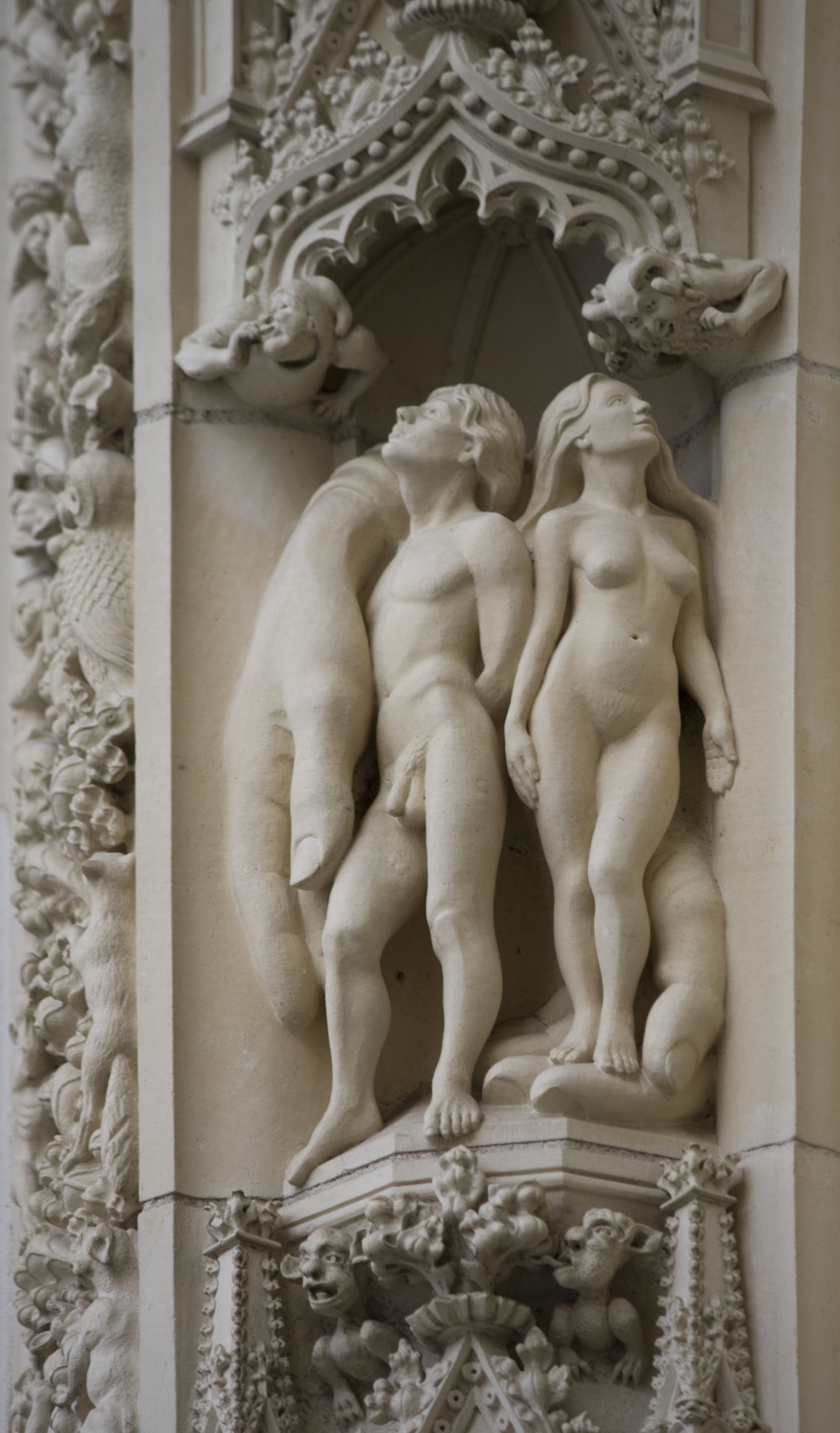
Cover image and Introduction are Copyright © 2015 by Tellectual Press, an imprint of Tellectual LLC. Used by permission. You may freely copy the portions adapted here and the cover image, with attribution. The statuary of Adam and Eve is from “one of the gorgeous new carvings around the west door of York Minster,” photographed by Fr. Lawrence Lew, O.P. and CC-NC-ND licensed for free non-commercial use. Since I’m promoting a book that my company is publishing–in search of some modest profit–with this particular post, I asked Fr. Lew for permission to use his photo in it, which he graciously granted.
I’m planning to review Arthur and Elena George’s The Mythology of Eden soon. That excellent book deserves its own separate essay. Meanwhile, it’s available on Amazon.com. It’s not cheap, but worthwhile if you’re interested in a fascinating and comprehensive analysis of the Eden story and its authorship.

Notes


  1. Based on some searches of Stanford University’s Copyright Renewal Database and then a perusal of the Library of Congress’s record of copyright renewals for books. Another book by Sheehan had been renewed, but not this one. 

  2. The remainder of this posting is adapted from the Introduction that Dr. Price and I co-authored for the Eden reprint, by permission of Tellectual Press. Though mine is a personal blog, this particular posting obviously has promotional value for both the company and myself. 

  3. See Arthur and Elena George’s analysis of the Eden story’s authorship and mythological underpinnings in their book The Mythology of Eden. The Georges agree that both accounts “had been well known for centuries and hardly could be ignored.” The task of the ancient compiler, they write, “was to unify the Israelite religion in the hope that this would help an Israelite state to rise again. So he opted for an inclusive approach.” Since he “was charged with restoring the Law to post-exilic Judea, it was important to have [the Gen. 1] version emphasizing the importance of the Sabbath.” The “Eden story and the remainder of his primeval history narrative also demonstrated the need for Yahweh’s strictures to guide human behavior.” Both “stories served his purpose. Despite the contradictions in the factual details of the two stories, the most essential truths that they convey about God and man’s relationship to God are fairly consistent, so [the compiler] and the Israelites were not concerned with the stories at the level of factual consistency” (loc. 680). 

  4. Neither Bob nor I typically use the pious convention of divine capitalization for pronouns referring to God. But we did so in the Introduction, and I’m doing so here as well, to stay consistent with Sheehan’s usage. 

  5. At Kindle loc. 669 of The Mythology of Eden, the Georges discuss Lilith’s “medieval rabbinic” origins, which “were made possible only because Genesis 1 already had mentioned the creation of at least one man and woman.” 

  6. Alas, “once we recognize that Genesis 1 was a separate story written by a different author much later and that it does not purport to dovetail into J’s story, any such possible connection with the woman in Genesis 1 is lost” (George & George, loc. 671). Sheehan knew his stuff, but Lilith sure is a great character for his fictional Eden


Monday, November 10, 2014

Maternal Martyrdom

“They’re workhorses,” says Dr. Singer [of her patients, ultra-Orthodox Israeli women]. “Their lives, looking from the outside, look like a form of slavery, never-ending. Sometimes I’m incredibly admiring of their stamina, what they’re able to do day after day, after so many children.”
—Kathryn Joyce, Quiverfull: Inside the Christian Patriarchy Movement
Chains [Flickr page]

In a public Facebook post, a member of my old church recently directed some comments at a former member whose wife died giving birth to her seventh child. He cited the biblical command “to go and multiply and fill the earth” and said his conscience would not let him agree to the use of birth control. That isn’t just his personal feeling, though: “The Holy Spirit speaks to and tells me what is acceptable,” he said, adding that the woman’s death, “was God’s will. We don’t always understand why.”

And then he lectured this man who had tragically lost a wife and mother of the many children they already had: “It is very selfish of you to blame God for this. If you want to see her in death you need to repent and believe the Gospel.”

The bereaved father pointed out that, though he remarried after a few years, his “children never got a real mom again.” Was that “God’s will somehow?” he asked. “We knew how to prevent this, but we did not dare to do anything. Lots of dreams never came true.” And a woman died.

His Laestadian critic responded, “My own wife would never put herself and her own dreams and wants before the word of God.”

It’s no wonder that the Laestadian Lutheran Church prefers its members not to engage in discussions of “faith matters” on social media sites. But there’s actually nothing contrary to Conservative Laestadian doctrine in what the man said. It really is that bad. Consider this statement from an LLC presentation to ministers and board members in 2010:

Despite God’s command or ordinance, birth control is widely practiced. People defend their disobedience with a variety of reasons including the psychological and physical burdens of raising children, economics, pursuit of an education or a career, concerns about overpopulation, etc. These arguments are rooted in unbelief and selfishness. Believing husbands and wives know these arguments well. The threefold enemy frequently tempts us with them. We wish, however, to cast aside these arguments as well “and every high thing that exalteth itself against the knowledge of God,” and bring “into captivity every thought to the obedience of Christ”1

This seems like an opportune time to repost an essay I wrote two years ago about contraception and Conservative Laestadianism. It originally appeared on the Learning to Live Free blog, where thousands of people have seen it. Apparently it could stand to be read by a few more.

It’s an important discussion to keep having. For women in fundamentalist religions that demand unrestricted access to their wombs, the stakes could not be higher. Their beliefs force them to confront an even worse prospect than physical death, lost dreams, and health problems both mental and physical. What they fear most of all is the threat articulated by an article in the June 2001 issue of my old church’s Voice of Zion newletter: eternal death, when “the loss of a soul is irrecoverable, and no compensation can be made for it any longer.” Then the “‘Son of Man’ will appear with all of His angels to execute judgment. Christ will then reward every person according to his works.”

“There is no way to escape the righteous judgment of God,” the article warns. Nor is there a way of escape from this vicious threat of damnation that was put into the minds of desperate young parents in their childhood and reinforced ever since. When the hell of eternity is the cost of disobedience, regarding birth control or anything else decided by the “living congregation of God,” it can seem like no amount of self-sacrifice in this one short life on earth would ever be too high a price to pay.2

Laestadians who are sick of hearing such dreary and backward language from their church do have reason to hope for better things, however. Despite the official claims about “unity,” liberal voices are now being heard that express much more compassionate and sensible viewpoints. Here is what one of them recently said in response to an interviewer’s question about contraception:

I will refer to a press meeting from this year’s summer services, where Aino Kannianen gave a presentation. She spoke on this matter, particularly, how we accept [the number of] children just the way God gives them to us. But there are situations, where because of health reasons, or because of other difficult circumstances, this can be dangerous. Preserving and honoring life requires that one does consider these issues.

“So, you are not completely absolute anymore?” the interviewer asked.

“This is a matter the parents need to decide on,” was the reponse. “Nobody needs to give birth risking their lives because of it.”

This wasn’t some fringe heretic or borderline unbeliever muttering over the coffee table to a few trusted friends. It was Viljo Juntunen, the new chairman of the SRK board of directors, speaking during an interview with a radio program in Finland.3 The SRK is the Finnish counterpart to the LLC, a far bigger one that comprises most of the 100,000 or so Conservative Laestadians across the globe.

———

Before proceeding with this repost (slightly edited for readability with a few additional notes) let me answer a criticism I occasionally hear: Why do I keep writing about a religion I’ve rejected? Why keep bringing up problems with it? Because, when it comes to this particular church, few other people are in as good a position to do so.

I devoted a year of essentially full-time work to researching and writing a gigantic book about a faith that I’d spent forty years living and loving, because it proved itself false to me in many different ways. My own deep-seated fears about eternal damnation, pounded into my skull from childhood, forced me to confront the church by learning about it, in exasperating detail. Braver people leave it with much less difficulty.

Quite a few people have told me that my work has made a difference in their lives. I’m pretty certain that there are women who have taken their bodies and health into their own hands partly as a result of what they learned from this essay when it was originally posted two years ago. In a world of outrages inflicted by elites and tyrants whose power is far beyond the reach of our puny voices, it is rewarding to have a little place where one’s careful work is appreciated, where it really does have some impact.

And unlike that Laestadian critic who confidently pronounced judgement on a man who’d lost a wife to dogmatic beliefs, I am not content to say, as he did, “You can’t believe with your mind.” Yes, actually, you can. That’s all you have to believe anything with. And you’ve got every right to expect people to make sense when they tell you what you should be doing with your body.

Maternal Martyrdom, Revisited

Like the Second Temple Judaism that preceded it, Christianity is a religion based on blood sacrifice. That may seem like a jarring summation of a faith that is, for the average believer, less about theology than the happy commotion of little children playing, the smell of hot dish warming in the church kitchen, and the joy of singing songs that are as beloved and familiar as the hundred other voices ringing out from the pews alongside you. But it’s the harsh reality behind all the love and comfort: Jesus’ “blood of the covenant” was “poured out for many” (Mark 14:24), just as Moses took the blood of young bulls “and sprinkled it on the people, and said, ‘Behold the blood of the covenant, which the LORD has made with you in accordance with all these words’” (Exodus 24:8).4

The sacrificial victims were not just animals or the one who was called the Son of God. Judges 11 tells us of Jephthah vowing to God that he would make a human sacrifice in exchange for permission to do a bunch of other killing, and fulfilling the vow with his own daughter. God even commanded the Israelites to give him “the firstborn of your sons,” the same as they were to do with their oxen and sheep. “It shall be with its mother seven days; on the eighth day you shall give it to Me” (Exodus 22:29-30). Then there is the Old Testament’s most famous story of human sacrifice, where Abraham was about to slice open his 12-year old son until God stopped him.

The Sacrifice of Isaac by Caravaggio (Wikimedia Commons)

Ever since the Epistle to the Hebrews, that incident has been showcased by Christian writers and preachers as a test of faith that Abraham passed. “By faith Abraham, when he was tried, offered up Isaac: and he that had received the promises offered up his only begotten son” (Heb. 11:17). On Father’s Day of 2012, the pastor of the Rockford, Minnesota LLC devoted his sermon to Abraham’s “leap of faith,” the fact that “he had to kind of shut down his thinking.” He couldn’t think about it, or “use his carnal reason,” because, the preacher admitted, “what God asked of him was inhuman, was–if we say, in a human language–it was wrong. It was something nobody should do.”5

Well, what are you supposed to do when God (or the voices in your head) tell you to “take your son and offer him as burnt offering unto me”? Never mind your natural response that “This is inhuman. This is wrong.”6 Just obey: “If you don’t understand, you believe.”7

Mothers on the Altar

The same blind obedience is being expected of Conservative Laestadian women regarding contraception, even when their lives are at risk. They must put their bodies on the sacrificial altar, or risk the damnation of their souls instead. It is a picture that Hanna Pylväinen paints vividly in her book We Sinners, with the story of a Laestadian mother having her seventh child, an experience that torments her economically, emotionally, and physically.

The woman’s pregnancy is a dangerous one, and the latest in a long parade of C-section deliveries puts her on an operating table, studying the looming medical equipment: “bags of blood hanging like deflated lungs, collapsed balloons, and their readiness paralyzed her” (p. 145). She describes the sensations (“a pinching in her chest,” “the feeling of being made of many numbed parts”) and the despair (“she had run out of fantasies–out of husbands to imagine, homes to build, pianos–there was nothing, only life itself, only long and hard and always more of it, always more,” p. 145). Then an image comes

to her of her abdomen as prey, ants to jelly on the counter, jelly on the knife, and she thought about Abraham and Isaac, about Abraham tying Isaac to the table, and she wondered how long it took him, and did he tie Isaac carefully. She thought she would try to get up, but she couldn’t, she was bound, or her muscles were, and she said, or thought she said, I don’t want to die, as if to ask God Himself to hold the scalpel. [p. 146]

The cords binding mothers to the birthing bed and operating table were very real in the 1970s. It was a “lenient mind” that would put “pity for the mother before having love in the truth concerning family planning, especially then when humanly speaking, the birth could appear dangerous,” according to the August 1976 edition of the LLC’s Voice of Zion newspaper. In 1979, from the other side of the Atlantic, the SRK’s Päivämies matched the dogmatism: “Never in any form does the prevention of human life come into question for God’s children.” But, there is always the eternal consolation prize: “Even if it were to happen that a believing mother or child would die in childbirth, or during pregnancy, they would go to heaven.”

Nine Patch Self-Portrait

It may be tempting to consider all that an artifact of a harsh and misguided period of Laestadian history, when wrong spirits ran rampant and caretaking meetings of wayward church members were a weekly spectacle. But the pastor of the Phoenix LLC dispels any such illusion in his 2012 Mother’s Day sermon. He tells the story of a “dear sister” who was faced with “a childbirth that was going to cause her to die.” She had been warned by her doctors “that if you have another child, the chances are very great that the mother will die.”8 She and her husband decided–on their own! As if the expectations of a high-pressure religious environment played no part–“that they would trust in God’s goodness.”9

“God’s will” turned out to have little to do with the mother’s health. She became pregnant and, “after the birth of that child, it became evident that there was nothing the doctors could do to save this mother’s life.” No, they had already done their job–by warning the mother that she was playing Russian roulette with her uterus.

With evident emotion, the pastor recounts the dying mother’s denial of any bitterness about the outcome, and how she said, “I would much rather go to heaven with a clean conscience.” I don’t know if she left any kids behind, but if so, any pangs of guilt about leaving them without a mother are never mentioned. And again we hear the praise of blind, uninformed faith: “How simply this husband and wife trusted in the goodness and the protection and the care of the Heavenly Father.”10

Now, the “pillar and ground of truth,” which Conservative Laestadianism has the conceit to call itself, can’t quite bring itself to talk this way when it knows the public is listening. Then it mutters acknowledgments that the wisdom of man, in the form of medical professionals, might just have something to say on the topic. The 2012 statement by the former SRK Secretary-General Tuomas Hänninen in response to a question from the Finnish news site Kotimaa24 is an example of the doublespeak:

The use or rejection of contraception is not a matter of authorization for each individual case, but rather a question of faith. Life is full of choices, and a person who wants to preserve faith and a good conscience makes the choice from that basis. In extreme cases, and for health reasons, it is good to listen to the treating physician.11

Another example is from a few years earlier, the No. 5 issue of the SRK’s Päivämies newspaper in 2009 (emphasis added):

Believing fathers and mothers have comprehended as an unrelinquishable value the scriptural teaching that God is the Lord of life and death. He has the power to give life and the power to take it away. For this reason in our Christianity, we have considered children as gifts from God; they bring blessing, joy, meaning, and richness to our lives. That’s why even the parents of large families have wanted to accept children, even though it has perhaps meant that they have had to give up certain things. The basis for Christian parents’ decisions has been obedience to God’s Word, faith upon God as the omnipotent Creator, and trust in His guidance and care.... The preservation of the life of both the mother and child is important. A doctor, who has great professional ethics, helps humanity and respects a patient’s wishes by preserving life and maintaining health. Surely parents do not relate belittlingly to their doctor’s assessment given from a medical perspective. In difficult situations, faith guides us to make decisions based on preserving life according to God’s Word.

Why?

If you are an exhausted, desperate mother faced with the possibility of yet another pregnancy, perhaps a life-threatening one at that, the stakes are unthinkably high. Don’t you have the right to understand just why you should subject yourself to that peril? Or should you just tune out everything but the men who sit at their pulpits and urge you, as the Rockford pastor did, to put blind trust in God, “trust his congregation. Let us trust this congregation more than ourselves.”

It is telling that he describes the reasonable speculations Abraham might have had after hearing the divine death sentence pronounced on his innocent son, to wonder “if God exists, if this is just nonsense, foolishness, the creation of my own mind. Maybe I should turn back, go back home, and try to forget the whole thing.”12

But God was there, the preacher says, and showed Abraham what he was to do. And when God speaks, you’d better listen. As Luther put it, “we must simply maintain that when we hear God saying something, we are to believe it and not to debate about it but rather take our intellect captive in the obedience of Christ.”13

Perhaps the most detailed attempt at a defense of Conservative Laestadianism’s anti-contraception position to ever see print is a document that Seppo Lohi presented at the SRK’s 2009 Summer Services. His argument is mostly grounded in tradition, with little biblical support.14

First, he cites the Genesis commands to “be fruitful and multiply,” which he considers to have established “new life” as “a fundamental task of marriage.” He makes a bizarre appeal to Mark 10:6-9, Jesus’ directive about the permanence of marriage. And he rounds things out with statements in Mark 10:14 and a few verses in Matthew 18 about receiving and becoming as children.

The Genesis commands are the strongest of some very weak arguments. Lohi gets some help from Luther there: “Therefore, the word of God, ‘Be fruitful, and multiply,’ is not a command, but more than a mere command, namely a Divine Act, not being in our power to hinder or neglect.” But Mark 10:6-9 (What God has joined together let not man put asunder) has absolutely nothing to do with contraception. Neither do Mark 10:14 (“Whoso shall receive one such little child in my name receiveth me”) or the verses in Matthew 18 (e.g., “Except ye turn, and become as little children, ye shall in no wise enter into the kingdom of heaven”).

This is all explained in §4.7.6 of my book An Examination of the Pearl, under the subheading “Human Rights Concerns.” And, as discussed there, it is a tricky business to rely on the Bible to establish the sanctity of life.

Exodus 21:22 imposes a mere civil penalty for hurting a pregnant woman and causing her to miscarry. Leviticus 27 places monetary valuations on human life (less for women than men, naturally), and assigns no value at all to infants less than a month old. Hosea rants against Ephraim that he will “slay even the beloved fruit of their womb” (9:16). The people of Samaria had “rebelled against her God,” according to Hosea, so “they shall fall by the sword: their infants shall be dashed in pieces, and their women with child shall be ripped up” (Hos. 13:16).

So, then, is there no biblical position against contraception worth talking about, other than that “be fruitful and multiply” business? In her book Quiverfull, Kathryn Joyce cites those Genesis passages, and also two others that fundamentalist Christians have relied on to oppose contraception: Psalm 127, with its talk about the fruit of the womb and arrows in a quiver, and “the biblical story of Onan, slain by God for spilling his seed on the ground.”15 Let’s take a look at these three main points in turn.

———

Psalm 127:3-5 says, “Lo, children are an heritage of the Lord: and the fruit of the womb is his reward. As arrows are in the hand of a mighty man; so are children of the youth. Happy is the man that hath his quiver full of them: they shall not be ashamed, but they shall speak with the enemies in the gate.” It was very important for a man (certainly not a woman) in that patriarchal society to have heirs who could continue and extend his household with its livestock, landholdings, buildings, slaves, etc. Look at the story of Abraham and Sarah, and how important it was for him to have a legitimate heir. (Ishmael got pushed aside as soon as Isaac was miraculously born, as the story goes.)

Laestadian doctrine has long fancied that there is some vague cloud of unconceived children floating out there somewhere who are all God’s property. They wait to be conveyed into existence one after another by women who have no option but to bear them and fill some man’s quiver. Along those lines, the Phoenix pastor makes much of the way his sermon text (1 Sam. 1:27-28) says that Hannah (the biblical figure, not the novelist) “lent” her child to the Lord.

Anna presenting her son Samuel to the priest Eli

Well, of course she did; the child was Samuel, who was destined to become an important prophet. But you can’t make that a generalization of God’s views about children, not when he slaughters so many of them without hesitation–in Sodom (children weren’t even considered as part of the ten “righteous” whose presence would have spared the city, Gen. 18:32), in Egypt (the passover plague, Exod. 12:29-30), and in Midian (“kill every male among the little ones,” Num. 31:17, KJV). Remember, this was the God who inspired the Psalmist to write, “O daughter of Babylon, who art to be destroyed; happy shall he be, that rewardeth thee as thou hast served us. Happy shall he be, that taketh and dasheth thy little ones against the stones” (Ps. 137:8-9, KJV).16

There is a subtle but important issue in calling the fruit of the womb “his” reward, as the KJV does. With such wording, it is understandable that one might view the fruit of the womb as something God can demand as his own. But other translations render the passage without that possessive pronoun, and with no such implication of ownership or control:

NASB: “Behold, children are a gift [or heritage] of the Lord, the fruit of the womb is a reward.”

Luther (my translation from German): “See, children are a gift [Gabe] of the Lord and the fruit of the womb is a present [Geschenk].”

Finnish (1776): “Katso, lapset ovat Herran lahja, ja kohdun hedelmä on anto.”

One could see the same possessive implication in the KJV when it calls the fruit of the womb a “reward.” The other translations call it a “gift” or “heritage,” putting the emphasis on the child as something from God. Wasn’t the next generation more a bounty given to mankind–when God looked favorably on them–than a tribute owed to him? In the ancient world where women were expendable, dominated, and possessed, the “fruit of the womb” was produce, in an all-too-literal sense.

———

This leads to the second point of Scriptural support: God’s command to be fruitful and multiply. He said it twice, first after the creation of Adam and Eve and then after Noah parked his ark on the mountainside. Well, actually it was never said. Not in either of those stories, anyhow, because the stories are not true.

Evolutionary science completely disproves the ancient Creation myths of Genesis. (Yes, myths, plural–there are two conflicting stories in Gen. 1 and Gen. 2-3.) At no point was there any first pair of humans standing around having to be told to make babies and populate the earth. Every early human, no matter how many thousands and millions of years back you go in prehistory, had parents who had reproduced without any divine sex education and were pretty much human themselves. Darwin had this figured out a long time ago: “In a series of forms graduating insensibly from some ape-like creature to man as he now exists, it would be impossible to fix on any definite point where the term ‘man’ ought to be used.”17

And it is just not possible for the entire human race to have descended from a single father and mother. Genetic evidence now makes clear that there have never been fewer than about a thousand members of Homo sapiens throughout the more than 100,000 years of its existence, which began in Africa, not Mesopotamia.18

Noah’s flood supposedly concluded with kangaroos continent-hopping around the world to Australia, and with God making his second pronouncement about replenishing the earth. Those who believe this story, an obvious adaptation of the Babylonian Epic of Gilgamesh, are in a dwindling minority even among Conservative Laestadians, certainly among those in Finland. One ordained SRK priest with whom I’ve corresponded expressed shock and disbelief that people in the LLC actually take the story seriously.

The LLC preacher who said to someone back in 2009, “Why is Ed worried about Noah’s Ark? None of us believe it, either,” was just being honest about the situation. (Though not so much when he took part in a meeting a year later, where I would be pressured to profess belief in, among other things, Noah’s Ark.) Rather than belabor this posting with the devastating critique that the story deserves, I refer interested readers to Jason Long’s 101 Reasons Why Noah’s Story Doesn’t Float.

Now, let’s suppose–against overwhelming evidence–that the Eden and the Noah stories are true. Do they actually have anything to do with Christian doctrine? No; despite centuries of earnest exposition by Christian preachers from the Gospel writers onward, they do not.

The Fall myth wasn’t even about original sin. The Bible mentions nothing about it until Paul finally comes along with his “one sinner, one redeemer” idea in Romans 5 and 1 Corinthians 15. What happened here (as with the supposed messianic prophecies that never quite add up) is that Christian theologians went back and looked over the ancient Scriptures and invented ways to give historical credibility to their new story about Jesus.

Another example is God clothing Adam and Eve with animal skins in place of their fig leaf aprons. Saying that God did so as a precursor to Jesus’ sacrifice is just something Christian theology made up. One could just as easily say that God replaced the fig leaves because he knew that Jesus would someday curse a fig tree. He did, and it is just about as relevant–that is, not at all.

Even if you make the two gigantic leaps of accepting the stories as accurate and also relevant, there is still the issue of God’s commands in the Old Testament being overruled in the New. Through his claimed representatives or directly, God commanded all sorts of crazy and horrible things in the Old Testament. Almost all of it is forgotten and ignored by Christians today.

The usual excuse is that Jesus fulfilled the law and thus the Old Testament doesn’t apply. Of course, for some reason, one still must honor one’s father and mother, avoid “sitting in the seat of the scornful,” and not hunt or fish on Sunday. When there is a handy verse to be found in the Old Testament that supports somebody’s idea of right and wrong, they don’t hesitate to pluck it out and quote it.

“Be fruitful and multiply” fares no better than the command to avoid sitting on furniture used by menstruating women (Lev. 15:20), for a number of reasons. First, with seven billion people, the earth has been replenished beyond the Genesis writer’s wildest imaginings. The whole point of the command has been achieved, and then some. If covering the face of the planet with billions of people–many times more than have ever lived–is not “replenishing” it, then the term is meaningless.

Second, perhaps surprisingly, some New Testament writers viewed children very differently than as a welcome gift. Look at how Paul felt about marriage in the seventh chapter of 1 Corinthians. Not only did he view it as more favorable to be unmarried, but he even told men “that have wives be as though they had none” (1 Cor. 7:29-30). The time was short, and there was no point bringing children into this world that was about to end. The way to avoid that back then, of course, was celibacy.

———

The third point, the Onan story (Gen. 38:3-10), was all about fulfilling the Old Testament requirement to raise up an heir. Again, that was very important back then, and was a duty that Onan owed to his dead brother. God specifically ordered Onan to undertake the task, and he disobeyed the command. God killed him, as he threatened and killed many others for disobeying his commands.19

There’s nothing special about the life of a speculative not-yet-conceived child here. It’s all about submission. That is, I think, also largely the case in Laestadianism.

Enough Already

Despite what is claimed by Laestadian preachers who know almost nothing about biblical scholarship, the collection of essays we call “the Bible” is not a single book with a unified message. It is futile to dig through “the Bible” looking for what “it” has to say on such a modern subject as the health of women, who were expendable and pretty much treated as property, when different passages provide contradicting answers about such fundamental things as whether God wants everyone to be saved, the value of the Old Testament sacrifices, and salvation by faith or by works.

The contradictions we’ve seen here concerning the value of children are just a small example of the conflict lurking between those mostly unread pages whose gilt edges sparkle under the pulpit lights. The writers of Genesis couldn’t even agree on details of the Flood story. (Were there seven pairs of ritually clean animals, or one? Forty days of flooding, or 150? See An Examination of the Pearl, §4.3.2.) So some ancient editor merged the conflicting accounts together.

None of the Old Testament writers were remotely the same kinds of “believers” as the writers of the Gospels. And the Gospel disagreed with each other! Not just about trivialities, but such fundamental points of doctrine as whether Jesus was divine (John 14:9-11) or not (Mark 10:17-18) and whether he revealed esoteric meanings of his parables to the disciples in secret (Mark 4:11; Matt. 13:11; Luke 8:10) or always spoke openly, saying nothing in secrecy (John 18:20).

Of course, this will not stop the preachers from citing and creatively interpreting their hand-picked passages from “God’s Word,” claiming the authority of God as they do so. They are the Holy men who speak as moved by the Holy Ghost, they claim, ironically citing a passage (2 Peter 1:19-21) from the single most discredited book of the New Testament.20

When any criticism is raised, they point to the Serpent’s question of Eve: “Yea, hath God said, Ye shall not eat of every tree of the garden?” (Gen. 3:1). There is a sad irony here, too: They are citing a character in a mythic story–long since proven false–to keep you from entertaining the possibility that what they say might be false. And remember that, even in the story, the Serpent was actually the one who told the truth: Adam and Eve did not die upon touching the fruit (Gen. 3:4). Instead, as he said would happen, “the eyes of them both were opened” (3:7).

Laestadian women need to open their eyes as well, before any more of them bleed to death on the sacrificial altar of a faith that requires their fertility for its survival. At long last, some of them are choosing to be the survivors instead, finally claiming their lives, their minds, and their bodies as their own. It’s about time.

———
Originally posted October 3, 2012 on the Learning to Live Free blog at extoots.blogspot.com/​2012/10/​maternal-martyrdom.html. See also my related post on that blog, Seeking Clarity in the Face of Tragedy and the 100+ comments provided by readers.
Image credits: Nine Patch Self-Portrait by Linda Frost. Anna presenting her son Samuel to the priest Eli by Gerbrand van den Eeckhout, Wikimedia Commons

Notes


  1. “God is Lord over Life and Death,” presented at the 2010 LLC Ministers’ and Board Members’ Meeting (PDF). The Bible quote is from 2 Cor. 10:5 (KJV). 

  2. These two paragraphs are adapted from my related post on the Learning to Live Free blog, “Seeking Clarity in the Face of Tragedy.” 

  3. Yle Areena Ykkosaamu, July 2, 2014, areena.yle.fi/​radio/2272326. The interview with Juntunen begins at the 25:40 mark, and the remarks quoted begin at 37:00. Thanks to an anonymous correspondent for the transcription and translation. 

  4. Scripture quotations taken from the NASB unless otherwise indicated. 

  5. Haapsaari 2012, 14:30-18:00: God told Abraham to kill his only son (Ishmael didn’t count). This was a great trial. “And I think, when there are people who dare to say that I don’t believe if I don’t understand–that I only am willing to accept and believe this which I can understand–I think they should read about Abraham. He did not understand. Or what do you think? Do you think that he understood? Do you think he saw plainly what was going to happen? No way. He didn’t. He had to take this leap of faith. He had to kind of shut down his thinking. He could not think. He could not use his carnal reason. Because what God asked of him was inhuman, was–if we say, in a human language–it was wrong. It was something nobody should do.” 

  6. Haapsaari 2012, 19:00-19:40: “And now God says, take your son and offer him as burnt offering unto me. What would you have done? [Would you have] run away? [Would you have] said, I can’t? This is inhuman. This is wrong. This is impossible. Whatever else, but not this.” 

  7. Haapsaari 2012,21:30-23:00: “So what do you do if you don’t understand? There is only one way to go over it. There’s only one bridge, and that’s faith. If you don’t understand, you believe. Then faith is the most important matter. There is no other way to go over it but through faith. So we see how understanding and believing are kind of opposites to one other. It’s not wrong if we understand something about the matters of faith and doctrine. It’s not wrong if we understand the matters of this life well. If we have good gifts for this temporal life, it’s not sin. It’s not a questionable issue. But we see that no one could by their own human reason go over [overcome] this trial without faith. It’s impossible.” 

  8. Note: The former Laestadian introduced at the beginning of this essay did not explicitly consult with doctors about the medical danger of new pregnancies. In fact, he tells me, there may be “a difference here between Finland and the USA: In Finland, Laestadians are allowed to listen to the doctor nowadays.” Perhaps that is somewhat true now in the LLC, too, at least in theory. But there are strong social pressures against actually following through on any advice to use contraception. See the discussion about listening to “medical information and advice” in my extoots posting “Seeking Clarity in the Face of Tragedy.” 

  9. Jurmu 2012, 38:10-39:00: “One dear sister once said, as she was struggling with her own life, she had a very difficult... in fact, a childbirth that was going to cause her to die. Prior to her pregnancy, the doctors had told them, husband and wife together, that if you have another child, the chances are very great that the mother will die. The husband and wife visited over this matter with the doctor and then amongst themselves personally. And they decided, amongst the two of them, that they would trust in God’s goodness.” 

  10. Jurmu 2012, 39:00-40:10: “And what is God’s will? As it turned out, this wife became pregnant. And after the birth of that child, it became evident that there was nothing the doctors could do to save this mother’s live. And in the final visit that the husband and wife had together, the husband asked his wife, ‘Are you bitter to God because of our decision?’ The wife said, ‘Not at all.’ She said, ‘I would much rather go to heaven with a clean conscience.’ How simply this husband and wife trusted in the goodness and the protection and the care of the Heavenly Father.” 

  11. Johannes Ijäs, “Vanhoillislestadiolaisten johto kommentoi ehkäisykieltoa,” Kotimaa24, Sept. 26, 2012. Emphasis added. 

  12. Haapsaari 2012, 24:00-25:00: “[I]n the midst of this trial, God showed him the way. God showed him the place where to go. He may have had so [many] trials, temptations, and doubts that he might have even thought during this trip, [wondering]... if God exists, if this is just nonsense, foolishness, the creation of my own mind. Maybe I should turn back, go back home, and try to forget the whole thing. So God showed him, ‘There you are to go.’ It must have been a painful, but also in a way comforting, sight. God is there and he shows me what I am to do.” 

  13. Martin Luther, Lectures on Genesis (c. 1535). English version: George V. Schick, trans., Saint Louis, MO: Concordia Publishing House (1958). Ch. 3, v. 5. 

  14. Seppo Lohi, Minä uskon Jumalaan, Isään (I Believe in God the Father). Oripää Summer Services: SRK (2009). Reproduced at freepathways.wordpress.com/​2009/07/15/​seppo-lohen-perustelut. Translation provided to the author Dec. 2011 by Antti Samuli Kinnunen. 

  15. Katheryn Joyce, Quiverfull: Inside the Christian Patriarchy Movement. Boston: Beacon Press (2009), p. 146. 

  16. In its original form, this essay also cited Judah’s casual dismissal of Tamar’s unborn child, Genesis 38. I am relegating that to a footnote now because his morality is clearly not held up as exemplary, even to many pious Bible readers with a simplistic view of the text as a single inspired narrative. It’s not fair to blame the Bible for everything done by that one son of Jacob, given what a complex character he is as the flawed head of the tribe of Judah. It is a valuable illustration of the limited value that was placed on the life of an unborn child back then, however: “When Judah learned that his daughter-in-law was ‘with child by whoredom,’ his response was, ‘Bring her forth, and let her be burnt’ (Gen. 38:24). Not much concern there for the unborn child. It was only when she produced some things that Judah had left during his own sexual encounter with her that he backed down. Oops, never mind!” 

  17. Charles Darwin, The Descent of Man, and Selection in Relation to Sex. London: Murray (1871), p. 226. 

  18. Jerry Coyne, “How big was the human population bottleneck? Another staple of theology refuted.” Why Evolution is True website, September 18, 2011 posting

  19. Leviticus 26 provides a lurid example of God’s threats for disobedience. He will inflict sudden terror, consumption and fever on the disobedient that will waste away their eyes. He will cause their enemies to rule over them. If that doesn’t make the people obey, he will punish them seven times more, rendering the land barren. If that doesn’t work, he will increase the plague seven times again, letting loose the beasts of the field to kill their children and cattle, and reduce their number until their roads lie deserted. If that doesn’t do the trick, he will send pestilence among them. Finally, as a last resort, he will act with “wrathful hostility” against them, whereupon they will eat the flesh of their sons and daughters, he will heap their remains on the remains of their idols and lay waste their cities. At least the idea of eternal torture wasn’t contemplated, here or anywhere else in the Old Testament. 

  20. “There is less debate among scholars of the New Testament about the authorship of 2 Peter than for any of the other books sometimes considered forgeries. Whoever wrote 2 Peter, it was not Simon Peter.” Bart Ehrman, Forged: Writing in the Name of God–Why the Bible’s Authors Are Not Who We Think They Are. New York: HarperCollins Publishers (2011).