Showing posts with label Lucretius. Show all posts

Wednesday, December 14, 2016

Requiem for the Republic

A hungry people neither listens to reason nor is mollified by fair treatment or swayed by any appeals.
—Seneca (c. 5 BC–65 AD), On the Shortness of Life.1
Dark Clouds Ahead.

The clock relentlessly marked out its hours, circling round from each day’s jarring dawn to the slow darkness of another evening, then to the hours of unconscious respite and fitful dreaming amid this long bleak nightmare. For about a month after I crawled into bed at 8:00 PM on November 8 and finally got up in shock late the next morning, the dark hand was pressing down, more days than not.

It wasn’t made much easier for knowing how many others share my despair about the unfolding collapse of our country. Certainly not for realizing that millions of others are cheering on each manipulative and bullying tweet, each outrageous Cabinet pick, each new degradation of the Office of President already being inflicted by the malignant egotist2 and con man they elected to it.

Do many of his supporters even realize how much they’ve been played? “So far,” observes Susan Page at USA Today, “Trump’s choices–including top jobs for a trio of veterans of Goldman Sachs, a firm he blasted at campaign rallies–haven’t reflected the populist impulses that fueled his appeal to some white working-class voters or his vow to ‘drain the swamp’ in Washington of donors and other insiders.”3 Imagine that. You’d almost think the man who lied about never settling out of court and then settled the fraud cases against his scam “university” for $25 million shortly after the election might not be 100% sincere.4

His new Cabinet swims around in a brand new swamp–the best swamp, a terrific swamp–of record-breaking personal wealth, with a total net worth just shy of $14.5 billion.5 His recent pick for Secretary of State, despite pulling down double-digit millions as Exxon CEO since 2012, is a small fish having a mere $150 million to his name.6 One can see why Trump excused the poor guy’s relative poverty: With “some of the most deep and long-standing ties to the Russian political and business elite of any American,”7 Tillerson will be amply prepared to cozy up to the ex-KGB thug who awarded him the “Order of Friendship” in 2013 and just helped his boss get elected President.8

The proposed Secretary of Labor (Would you like fries with that?) has touted the benefits of automation over humans who take vacations, show up late, slip and fall, and sue for discrimination, and opposes a raise in the federal minimum wage, currently at $7.25 per hour.9 He wrote a piece in Forbes this May opining that most fast-food store managers making more than $23,660 per year “recognize that in exchange for the opportunity, prestige and financial benefits that come with a salaried position and a performance-based bonus, they’re expected to have an increased sense of ownership and stay until the job gets done, to run the business like they own it.”10 Inspiring stuff for the former $30/hr factory workers hooting it up at Trump rallies in Cleveland and Grand Rapids. Men, go get yourselves some of that opportunity and prestige overseeing the fry vat until closing–with no overtime, mind you–down at the local Carl’s Jr.!

The “narcissist abuses people,” writes the self-confessed narcissist Sam Vaknin. “He misleads them into believing that they mean something to him, that they are special and dear to him, and that he cares about them. When they discover that it was all a sham and a charade, they are devastated.”11

———

There is some consolation about this mess, oddly enough, in contemplating the long arc of history. We’ve been here before, many times. Contrary to Lincoln’s lofty words at Gettysburg, government “of the people, by the people, for the people” never seems to last.12 What a left-wing set of pissed-off populists giveth to the people in righteous anger, a right-wing set of pissed-off populists eventually taketh away with some new strongman who will provide leadership and set everything straight. We just can’t seem to have nice things like democracy and equality for long. Homo sapiens has been dividing itself “into make-believe groups, arranged in a hierarchy” ever since agriculture allowed the accumulation and hoarding of wealth around 10,000 years ago, with the upper levels enjoying “privileges and power, while the lower ones suffered from discrimination and oppression.”13

That was certainly true around 2700 years ago, when the Prophet Amos berated the elites of Israel (considering his voice to be that of God, naturally) who imposed “heavy rent on the poor” and exacted “a tribute of grain from them.” They were rich absentee owners of “houses of well-hewn stone” and vineyards whose wine they didn’t bother to drink themselves. I know the score, God (i.e., Amos) warned these good-for-nothing scumbags who “distress the righteous and accept bribes,” and “turn aside the poor” (Amos 5:11-12, NASB). It’s doubtful anything ever came of such divine threats. And when it came to government by the people, forget it; other than an occasional rebuke and punishment, e.g., David for the Bathsheba incident, the history of the ancient Israelites is littered with kings doing pretty much whatever they wanted, usually in God’s name.

Some six hundred years later and about a thousand miles to the west, Lucretius recalled the populist uprising that overthrew the last Roman king in 509 BC and began the Roman Republic:14

Therefore the kings were killed, and in the dust

The ancient majesty of thrones and sceptres proud

Lay overthrown. The sovereign head’s great crown

Bloodstained beneath the rabble’s trampling feet,

All honour lost, bewailed its high estate.

For men do eagerly tread underfoot

What they have feared too much in former time.15

Lucretius recalled this bit of history with some critique of the aforementioned rabble, saying that things then “fell back to utter dregs and turmoil / As every man sought power for himself.” But law and order won out; “some men taught them to appoint magistrates / With rights established and the rule of law.”16

Alas, he wrote these lines in the final decades of the Republic’s 482-year lifespan. It had been a good long run; except during limited periods of military emergency, ordinary citizens did have some say in who was chosen to run their government.17 The elites and those who ingratiated themselves to them managed to get much more of a say, of course. Yet even such corrupt and occasionally interrupted democracies are exceptions to history’s rule of dictators and despots.

The revered and ancient Republic that began with men who had “eagerly tread underfoot” the crown of Tarquin the Proud finally ended with some of their descendants in the Senate granting Octavian the title of Augustus, “the illustrious one.” This title “symbolized a stamp of authority over humanity–and in fact nature–that went beyond any constitutional definition of his status.”18 Octavian was Julius Caesar’s grand-nephew and adopted son and the “Caesar Augustus” mentioned in Luke 2:1. Neither he nor the Emperors who followed answered to voters or even really senators. And during the next 500 years that the Empire continued–longer for the Eastern half that would eventually split off–Rome gradually diminished and lost even the limited, mostly illusory pseudo-democracy that remained in the Senate.

Around 50-60 AD, a century or so after Lucretius, the Roman philosopher Seneca lamented how rare simplicity and innocence were as human qualities. This after having tutored Augustus’ fourth successor Nero–a decidedly unsavory populist authoritarian. It was hypocritical, since he’d made “himself the teacher of a tyrant,”19 and profited from Nero’s crimes.20 But Seneca’s observations and sorrow about humanity are still worth recalling. You “scarcely ever find loyalty except when it is expedient,” he wrote, yet there is an abundance of “successful crimes” and “all the things equally hateful that men gain and lose through lust.” Ambition, he observed, sets no “limits to itself.” When you consider all this, it “drives the mind into a darkness whose shadows overwhelm it, as though those virtues were overturned which it is not possible to hope for and not useful to possess.”21 I’ve come to know those shadows well these past several weeks.

“Magdalenian Woman,” buried around 15,000 years ago in what is now Dordogne, France22

A particularly nasty populist takeover of democracy that hits closer to home for me is the transition from the Weimar Republic to the “Thousand-Year Reich.” Following a thirteen-year struggle for power, Hitler’s Nazi Germany wound up lasting just twelve years, a brief but incredibly destructive time. This one is personal. My mother’s half-brother was shot by the Nazis for refusing to serve in their army.23 My father saw the living skeletons of their victims and the smoke of their crematoria when he made a detour into a concentration camp during his escape from the Stalag IIb POW camp.24

It’s still a bit early to entirely equate our new President-Elect to Hitler. I’m not sure Trump is even a racist, and I actually find him quite sensible when it comes to the threat of Islam.25 Though he seems to like the strong-arm style of the hollow-eyed assassin in the Kremlin and the way Rodrigo Duterte is gunning down his fellow Filipinos,26 he hasn’t yet had anyone killed. But he is a thin-skinned narcissistic demagogue who lies constantly and dangerously, holding himself out as the one leader for the challenge of our times, and that’s bad enough.

The really clear and disturbing parallels are between the current political climate vs. the Weimar Republic in which Hitler began his long quest for power, and the fist-pumping “Lock her up!” crowds in their stupid red baseball caps vs. das Volk cheering at Hitler’s rallies. “We share Hitler’s planet and several of his preoccupations,” observes Timothy Snyder in his book recounting “The Holocaust as History and Warning,” as its subtitle goes. We “have changed less than we think. We like our living space, we fantasize about destroying governments, we denigrate science, we dream of catastrophe.”27

It’s important to acknowledge an uncomfortable reality here, one that I will expand on in an upcoming essay. As 77,000 voters in Wisconsin, Michigan, and Pennsylvania made abundantly clear last month, life is not going well for millions of angry fellow citizens, despite our government’s warmed-over official stats touting an “economic recovery” that’s every bit as fake as the news Trump supporters have been passing around on Facebook. “Today we live in a world of predatory bankers, predatory educators, even predatory health care providers, all of them out for themselves.”28

The Democrats are complicit in this. The husband of the woman those Rust Belt voters so shockingly rejected is the one who

deregulated derivatives, deregulated telecom, and put our country’s only strong banking laws in the grave. He’s the one who rammed the North American Free Trade Agreement (NAFTA) through Congress and who taught the world that the way you respond to a recession is by paying off the federal deficit. Mass incarceration and the repeal of welfare, two of Clinton’s other major achievements, are the pillars of the disciplinary state that has made life so miserable for Americans in the lower reaches of society. He would have put a huge dent in Social Security, too, had the Monica Lewinsky sex scandal not stopped him.29

The next Democrat in the Oval Office followed this up with bailouts of the big banks, a hands-off policy for white-collar criminals at those banks, the TPP (yet another odious trade deal), a near-freeze of anti-trust enforcement, greatly expanded Orwellian mass surveillance, and an insanely complex healthcare law “with its exchanges, its individual and employer mandates, its Cadillac tax, its subsidies to individuals and to the insurance industry, and its thousands of other moving parts, sluicing funding this way and that.”30 I must confess that I nearly burned my ballot in 2012 rather than cast a vote to re-elect Barack Obama.

The problem is that–for abundant reasons I will explain in that next essay with all the usual footnotes–there are no ready solutions to the predicament so many of our countrymen find themselves in. And when that happens, so long as people have a vote and even more so after they finally acquiesce in giving it up, the likely outcomes are grim.

The “aging, increasingly brittle, effectively bankrupt, but still immensely powerful global empire of the United States of America” is leaving a lot of its citizens behind.31 Most of them have little interest in transgender bathrooms, the immense privilege they enjoy over, say, disabled lesbians of color, and the virtues of those peace-loving Muslims they are lectured about every time some guy with a beard slaughters people while shouting Allahu Akbar.

There is plenty of “cheerleading from government officials,” plenty of “reassurances from dignified and clueless economists” and “reams of doctored statistics gobbled down whole by the watchdogs-turned-lapdogs of the media and spewed forth undigested onto the evening news.”32 But people pay more attention to the monthly $1300 insurance premiums for their shitty high-deductible health plan and the poverty and degradation of working for eight bucks an hour at a fast food joint after getting laid off at the now-shuttered factory.

No amount of official propaganda can convince them the the economy is recovering, because for them, it’s not. Except for “a few privileged sectors, times are hard and getting harder; here in the US, more and more people are slipping into the bleak category of the long-term unemployed, and a great many of those who can still find employment work at part-time positions for sweatshop wages with no benefits at all.”33

Abandoned house in Stevens County, WA

In 1920, Germany was experiencing an “explosive mixture of economic misery, social instability and collective trauma” that a black-haired populist demagogue could use as well as a yellow-haired one can in much the same environment today. He did so, better “than any of his rivals on the nationalist far right,” to rise up out of anonymity.34 “Hardly a week passed” during that year “without a meeting or a rally,” with audience sizes reaching 3,000 by the end of the year.35 He (still referring to the black-haired guy) was skilled at working the crowd, a master of the

“language of the post-war little guy,” peppering his speeches not only with the coarse phrases of a former military man, but also with irony and sarcasm. He was good at responding to hecklers so he mostly kept the laughter on his side. Moreover, Hitler’s speeches clearly touched a nerve. Like no one else, he was able to express what his audience thought and felt: he exploited their fears, prejudices and resentments, but also their hopes and desires.36

Sound familiar? Make Germany Great Again! would not be an unreasonable translation of his campaign message. Hitler’s “speeches typically began with a look back at ‘wonderful, flourishing Germany before the war,’ in which ‘orderliness, cleanliness and precision’ had ruled” (Law and order!) and “civil servants had gone about their work ‘honestly and dutifully’” (Drain the swamp!).37

Here was “‘someone seduced by himself,’ someone who was so inseparable from his words ‘that a measure of authenticity flowed over the audience even when he was telling obvious lies.’”38 Believe me, folks . . . In a 1927 speech, after a couple of low-key years following the Beer Hall Putsch and his nine months spent in Landsberg Prison for it,

Hitler used vulgar comparisons, tailor-made to the intellectual capacities of his listeners, and he did not shy away from even the cheapest allusions . . . His words and opinions were simply hurled out with dictatorial certainty as if they were unquestionable principles and facts. All this manifests itself in his language as well, which is like something merely expulsed.39

There were a few good years in the 1920s, but Germany’s economy started really heading downhill with the Great Depression in 1929. Hitler finally had the unemployment and popular anger he needed. Many German “farmers were ‘extraordinarily bitter and prepared to commit all sorts of violent acts,’” noted a police observer to a March 1929 rally, “adding that some saw the National Socialists as their ‘rescuers.’”40

On October 28, 1929, the U.S. stock market dropped almost twelve percent. The next day, it went down nearly another twelve percent. Within a few years, in Germany, an

apocalyptic mood of hopelessness began to take hold, even among those segments of the populace that were not primarily affected by the Depression. Faith in democratic institutions and democratic political parties dissolved, and anti-parliamentary sentiment, already rife in the Weimar Republic, was given a huge boost. Those in power appeared to have no solutions to the crisis, and the more helpless they seemed to be, the greater the demand became for a “strong man,” a political messiah who would lead Germany out of economic misery and point the way towards renewed national greatness.

“More than any other German politician,” the black-haired populist “presented himself as the answer to these hopes for salvation.”41 The yellow-haired one has said, “I alone can fix it.”

The narcissist, writes Vaknin, “needs and requires an audience to applaud, approve, affirm, recoil, admire, adore, fear, or even detest him.”42 Next stop on Trump’s post-election “Thank You Tour” is tomorrow in Hershey, PA.

Photo tweeted Dec. 9 by the President-Elect. Somebody please tell him he won the damn election.

Notes


  1. In On the Shortness of Life, trans. C.D.N. Costa. (Penguin Publishing Group). 

  2. “Having been exposed for what he is–a deceitful, treacherous, malignant egotist–the narcissist’s old tricks now fail him. People are on their guard, their gullibility reduced. The narcissist being the rigid, precariously balanced, and fragile structure that he is can’t change. He reverts to old forms, re-adopts hoary habits, and succumbs to erstwhile temptations. He is made a mockery by his accentuated denial of reality, by his obdurate refusal to grow up, remaining an eternal, malformed child in the sagging body of a decaying man” (Sam Vaknin, Malignant Self-love: Narcissism Revisited, Narcissus Publications, 2015, p. 267).

    See my recent essay The Trump Tragedy for a discussion of Trump’s narcissism and the important caveat that this is a layman’s opinion based on some pretty obvious character flaws and creepiness exhibited almost daily by Donald Trump and not any kind of psychological diagnosis. 

  3. “Trump’s Cabinet dubbed ‘Goldman, generals, and gazillionaires,” Dec. 12, 2016 

  4. Rosalind S. Helderman, “Trump agrees to $25 million settlement in Trump University fraud cases,” Washington Post, Nov. 18, 2016

  5. E.J. Dionne Jr., “Trump can’t wait to sell out his base,” Washington Post, Dec. 11, 2016

  6. Wikipedia, Rex Tillerson. At least, unlike Trump’s pick to head the Environmental Protection Agency, Tillerson doesn’t deny climate change: “At ExxonMobil, we share the view that the risks of climate change are serious and warrant thoughtful action. Addressing these risks requires broad-based, practical solutions around the world. Importantly, as a result of the Paris agreement, both developed and developing countries are now working together to mitigate greenhouse gas emissions, while recognizing differing national responsibilities, capacities and circumstances. In our industry, the best hope for the future is to enable and encourage long-term investments in both proven and new technologies, while supporting effective policies” (Speech given October 19, 2016). 

  7. Josh Rogin, “Inside Rex Tillerson’s long romance with Russia,” Washington Post, Dec. 13, 2016

  8. Adam Entous, Ellen Nakashima and Greg Miller, “Secret CIA assessment says Russia was trying to help Trump win White House,” Washington Post, Dec. 9, 2016. The Russian involvement became pretty obvious even before the election–especially when a Wikileaks dump from the Podesta emails got released after an announcement about the dump appeared on the Russian propaganda news site RT

  9. Kate Taylor, “Fast-food CEO says he’s investing in machines because the government is making it difficult to afford employees,” Business Insider, Mar. 16, 2016

  10. Andy Puzder, “The Harsh Reality of Regulating Overtime Pay,” Forbes, May 18, 2016

  11. Vaknin at p. 69. 

  12. Yuval Noah Harari, Sapiens: A Brief History of Humankind (HarperCollins, 2015), p. 133. 

  13. The Gettysburg Address, delivered by Abraham Lincoln Nov. 19, 1863, following a period of division in America that is starting to seem comparable to what we’re experiencing now. 

  14. Wikipedia, Lucius Tarquinius Superbus

  15. On the Nature of the Universe, Ronald Melville, trans. (Oxford University Press), Book V, lines 1135-40. 

  16. Book V, lines 1141-44. 

  17. Naturally, “citizens” excluded women (at least when it came to voting and holding office) and slaves. Except for the past century, and in much of the world still, half the population has been arbitrarily excluded from full citizenship. I’ll grudgingly acknowledge this about Trump: He doesn’t seem to be much concerned about whether his cabinet appointees have penises or not. 

  18. Wikipedia, Augustus

  19. Cassius Dio, Book LXI 33.9, quoted in Wikipedia, Seneca the Younger

  20. “The art critic Robert Hughes labelled Seneca ‘a hypocrite almost without equal in the ancient world’” (Elizabeth Kolbert, “Such a Stoic: How Seneca became Ancient Rome’s philosopher-fixer,” New Yorker, Feb. 2, 2015). 

  21. “On Tranquillity of Mind,” in On the Shortness of Life, trans. C.D.N. Costa. (Penguin Publishing Group). At the beginning of the work, Seneca admitted, “I am not really free of the vices which I feared and hated.” 

  22. “Magdalenian Woman” is the earliest known Homo sapiens skeleton. Photo taken with my iPhone at the Field Museum, Chicago. According to the display label, the “skeleton and the rock shelter in France where she was found to indicate burial. A grave was created and the body was positioned.” 

  23. In Memoriam: Kurt Stein

  24. The Germans had orders to shoot POW escapees on sight, so my father pretended to be bringing his companions into the concentration camp and then escaped from it as well. 

  25. See Why I am an Islamophobe, my most widely read essay. 

  26. Felipe Villamor, “Rodrigo Duterte Says Donald Trump Endorses His Violent Antidrug Campaign,” New York Times, Dec. 3, 2016 

  27. Timothy Snyder, Black Earth: The Holocaust as History and Warning (Crown/​Archetype 2015), Kindle loc. 6044. 

  28. Thomas Frank, Listen, Liberal: Or, What Ever Happened to the Party of the People? (Henry Holt and Co., March 2016), p. 13. 

  29. Frank at p. 70. 

  30. Frank at p. 146. 

  31. John Michael Greer, Decline and Fall: The End of Empire and the Future of Democracy in 21st Century America (New Society Publishers, 2014), p. 76. 

  32. John Michael Greer, Dark Age America: Climate Change, Cultural Collapse, and the Hard Future Ahead (New Society Publishers, July 2016), loc. 3325. 

  33. Greer, Dark Age America, p. 3327. 

  34. Volker Ullrich, Hitler: Ascent, 1889-1939 (Knopf Doubleday, 2016), Kindle loc. 2196. 

  35. Ullrich at loc. 2239. 

  36. Ullrich at loc. 2283. 

  37. Ullrich at loc. 2329. 

  38. Ullrich at loc. 2298. 

  39. Police observer of March 9, 192 speech at Munich. Quoted in Ullrich at loc. 4663. 

  40. Ullrich at loc. 5082. 

  41. Ullrich at 5172. 

  42. Vaknin at p. 90. 


Friday, July 29, 2016

Galaxy Gazing

I think that the dying pray at the last not “please,” but “thank you,” as a guest thanks his host at the door. Falling from airplanes the people are crying thank you, thank you, all down the air; and the cold carriages draw up for them on the rocks. Divinity is not playful. The universe was not made in jest but in solemn incomprehensible earnest. By a power that is unfathomably secret, and holy, and fleet. There is nothing to be done about it, but ignore it, or see.
—Annie Dillard, Pilgrim at Tinker Creek1
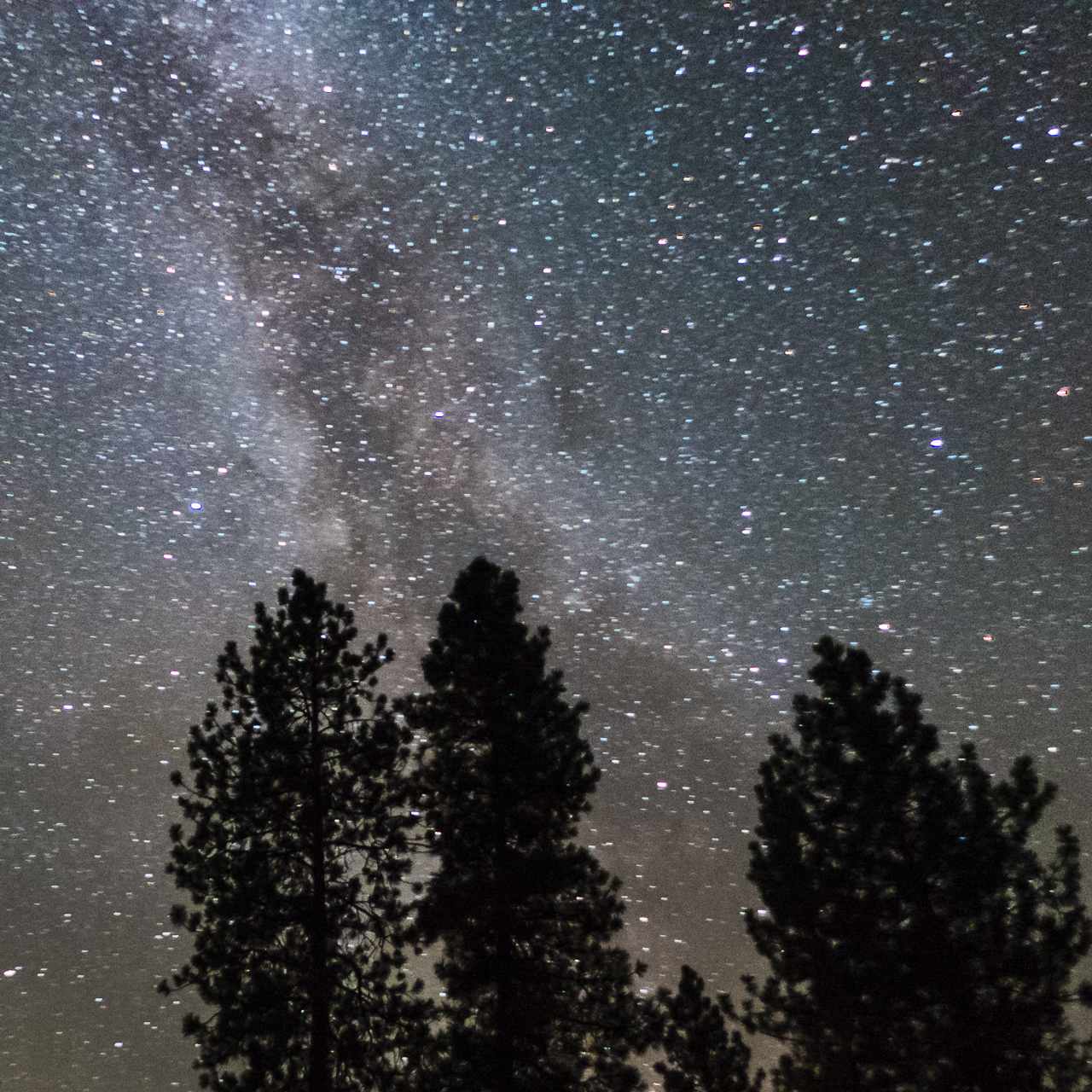
The Milky Way from my driveway

Tonight, with clear weather and no moon around, I am up late to look at a dark sky with the first decent pair of binoculars I’ve ever owned. The vaguely textured white blur of the Milky Way that my eyes have long admired, unmagnified, now resolve through the 10x binoculars into clusters of countless stars with crisscrossing fuzzy ribbons of black woven in between.

I pan the circular field of view slowly along our galaxy’s long overhead arc, immersed in the depth I sense above me from my two eyes merging a single image. There’s a satisfying tangible connection between the fine motions of my arms and the slow sweeping past of this collection of a hundred billion stars in our little corner of the universe.

A dim smudge near Cassiopeia teases my eyes’ limits of sensitivity and resolution. I think it’s M52, a globular cluster a few thousand light-years away. It was first identified by Charles Messier in 1774. The photons I’m collecting in my binoculars tonight from its 193 or so stars were more than 90% of the way here when Messier peered through his telescope. In the meantime, a nation rose through a rebellion and then quashed one of its own; enslaved, freed, and still long oppressed a large fraction of its citizens; conquered its native peoples and then rescued others from conquest in two world wars.

The smudges are clusters of countless stars.2

These photons had already emerged from their nuclear furnaces by the time some settlements along the river Tiber formed the first humble beginnings of the Roman empire.3 Their journey may even have been halfway underway by then; we’re not sure exactly how far away M52 is from us.4

It’s been a little more than two thousand years ago since a citizen of that empire, a gifted poet and philosopher, stood next to some pool or pond beneath the night sky. The skies anywhere in Europe were darker than they are now, even at my place out in the country. I imagine Titus Lucretius Caras (c. 99-55 B.C.) looking at an image of the blazing array of stars overhead, seeing their “images,” which, he muses, must “be able to run through space incalculable / In a moment of time.”5

The pointpoints and patterns of the stars are mirrored in the still water before him, “not turned round intact, but flung straight back / In reverse,” with the features thus shown “in reverse.”6 He moves slightly to one side along the water’s edge and notices how one particularly bright star near the horizon comes abruptly into view from behind the tree. Its direct image and its reflection both wink on instantly–at exactly the same time, as far as he can tell.7

A smooth surface of water is exposed

To a clear sky at night, at once the stars

And constellations of the firmament

Shining serene make answer in the water.

Yet he knows that the “images” raining down from the sky take a longer route when they make the extra trip to the water and back than when they go directly into his eye.

Now do you see how in an instant the image

Falls from the edge of heaven

to the edge of earth?

Wherefore again and yet again I say

How marvellously swift the motion is

Of the bodies which strike our eyes

and make us see.8

Those image-bearing bodies are “marvelously swift” indeed. They move 186,000 miles–more than 23 earth diameters–through the vacuum of space every second. Yet the immense vault of our universe is so incomprehensibly vast that it’s taken most of the span of human civilization for them to reach us, from a relatively nearby neighbor within just our own galaxy (there are at least a hundred billion others).9

My kind of nightlife

Silent and impassive to all the twitches and ripples in the microscopic biofilm of one ordinary planet, in the hundreds of years since Messier noticed this odd feature among the stars–in the thousands filled with death and wars and tears of joy and sorrow since Lucretius did his ancient poolside musings–the photons from its clustered stars continued their long journey outward. Only now do they finally land on my retinas to collapse wave functions and trigger individual rod-shaped cells to launch neurotransmitters down neighboring filaments of cell-strings along my optic nerves.

In my brain, a little smudge registers. Something’s really up there.

The stars in M52 will keep launching their photons all my life, as they have for 35 million years now. They’ll get lost in the sea of light that covers and warms the daylight half of earth, fall through clear skies over the other half in darkness, and remain ignored almost always, as the earth swings around its own little star a few dozen more times until my eyes no longer see anything at all.

And yet, despite my absence, the earth will stay in its orbit and the photons will stream on.

Notes


  1. Does it surprise you to see such ringing words of spirituality as the epigraph to an atheist’s essay? Such prose retains its profound beauty regardless of one’s disagreements with its message. And even with no God in the picture, I am still happy to call whatever was behind the Big Bang, or the quantum fluctuation that unleashed the Big Bang, or whatever was behind that, a “power that is unfathomably secret,” even holy, filling me with a sort of reverence as I gave upwards at night. 

  2. There’s also some light pollution near the horizon, even out here, miles from the nearest city. I’ve tried to de-emphasize it with reduced yellow and green luminance. 

  3. en.wikipedia.org/​wiki/Ancient_Rome 

  4. Because “this cluster is in the plane of the Milky Way,” our available “methods of determining distance are too uncertain,” some yielding estimates “as small as 3,000 light years, while others are as large as 7,000” (Ethan Siegel, “Messier Monday: A Star Cluster on the Bubble, M52,” ScienceBlogs

  5. Lucretius, Book IV, line 191. From On the Nature of the Universe, Ronald Melville, trans. (Oxford University Press). 

  6. Book IV, lines 295-99. 

  7. It’s not exactly the same time, of course, something I remain well aware of as an electrical engineer with a radio background. Indeed, engineers rely on the known and limited speed of light to do antenna design with all of its resonant and carefully spaced conductive elements. Quarter-wavelength spacings abound. 

  8. Book IV, lines 210-17. 

  9. “How Many Stars Are There In the Universe?”, European Space Agency. I’ve seen another dim smudge out there in the night sky from the nearest of those other galaxies, Andromeda. Its photons took millions of years to reach me instead of thousands. 


Monday, June 23, 2014

Lucretius on Love

A bundle of myrrh is my well-beloved unto me; he shall lie all night betwixt my breasts.
—Song of Songs
Photo credit: Rosie English

It has been at least 2200 years since the Song of Songs celebrated the raw sensuous beauty and passion of sex. That book probably holds the record as the one least referenced in Lutheran church services. Just try to imagine the preacher wearing his Sunday suit and sitting stiffly behind his pulpit, reading, “Awake, O north wind; and come, thou south; blow upon my garden, that the spices thereof may flow out. Let my beloved come into his garden, and eat his pleasant fruits” (4:16). Or this (7:6):

How fair and how pleasant art thou, O love, for delights!

This thy stature is like to a palm tree,

and thy breasts to clusters of grapes.

I said, I will go up to the palm tree,

I will take hold of the boughs thereof:

Now also thy breasts shall be as clusters of the vine,

and the smell of thy nose like apples;

and the roof of thy mouth like the best wine for my beloved,

that goeth down sweetly,

causing the lips of those that are asleep to speak.

Given how much Christianity has wielded the Bible (the same one in which the Song of Songs appears, oddly, like a bikini on an Amish grandmother) to supress human sexuality, it is worthwhile to stop and reconsider what a normal and natural part of life sex really is. We are all of us the warm wet products of some sexual union decades ago, between two participants who each were the products of an earlier one. It goes all the way back to the grunted cave couplings of prehistoric hominids on furs by firelight, and beyond.

Bud Burst  [Flickr page]

Over its centuries of dominance, the church has sown in our society a minefield of hair-trigger offense that separate us from acceptance and expression of the very act that formed us. In the outermost reaches of fundamentalism, it is sinful for a young person to even linger on thoughts about how this primal drive might at last be satisfied. The explosions of offense get louder if the poor sinner traverses further into the minefield: sex without children in mind, masturbation, sex before marriage, sex with someone of your own gender.

To that we can add a further boundary, sex outside marriage. It is one that most of society, myself included, still considers a valid taboo. Frankly, cheating is just a deceptive act of selfishness. But even extramarital sex has been a nuanced topic: What if, for example, all parties are consenting? I personally can’t imagine such an arrangement, but who am I to judge? In the early 1500s, someone more radical than myself about the idea suggested this course of discussion for a sexually dissatisfied wife:

Look, my dear husband, you are unable to fulfill your conjugal duty toward me; you have cheated me out of my maidenhood and even imperiled my honor and my soul’s salvation; in the sight of God there is no real marriage between us. Grant me the privilege of contracting a secret marriage with your brother or closest relative, and you retain the title of husband so that your property will not fall to strangers. Consent to being betrayed voluntarily by me, as you have betrayed me without my consent.

The writer was Martin Luther.

Any proper Lutherans shocked by this or the Song of Songs, those who consider gay marriage to be a sure sign that the End of Times is upon us at last, may not be aware of just how much sex has been going on throughout human existence, and how varied it has been. I could mention the exploits of Enkidu in The Epic of Gilgamesh some four thousand years ago, or the incest and prostitution in Genesis, or the misogynist pornography of Ezekiel 23. Perhaps in future essays I will. But for this one, I want to turn to one writer from antiquity with a remarkably free mind: Lucretius.

He came from a time and place where it was “taken for granted that male sexual desire may be for either a younger male or a female.” So says Ronald Melville in a footnote to this passage Lucretius wrote sometime in the first century B.C., in the secular masterpiece On the Nature of Things:

Thus, therefore, he, who feels the fiery dart

Of strong desire transfix his amorous heart,

Whether some beauteous boy’s alluring face,

Or lovelier maid, with unresisting grace,

From her each part the winged arrow sends,

From whence he first was struck he thither tends;

Restless he roams, impatient to be freed,

And eager to inject the sprightly seed;

For fierce desire does all his mind employ,

And ardent love assures approaching joy.

Pretty candid stuff, for both the ancient philosopher poet as well as the bold translator of these lines and the ones that follow, John Dryden [1631-1700]. I am awed and inspired by what I’ve been discovering in Lucretius, and am happy to finally be thinking for myself about issues where the proper opinions were once prepackaged for me. But I’m certainly glad we’ve moved past some of the things he and his culture accepted, like “Beautious boy,” or, considering the difference in age and power that he likely had in mind, “lovelier maid.” Yuck.

Book IV of On the Nature of Things has a lot more sordid stuff in it, and we’ll see a bit more of that in a minute. It was so scandalous to the prim eyes of Oxford University Press in 1913 that their edition of The Poems of John Dryden omitted his translation of the entire fourth book, offering only the curt footnote, “It is impossible to reprint this piece.”1

Come Hither  [Flickr page]

After acknowledging nature’s raw power, Lucretius advises his (presumably male) readers to find sexual outlets that don’t lead to infatuation and commitment.

But strive those pleasing phantoms to remove,

And shun the aërial images of love,

That feed the flame: when one molests thy mind,

Discharge thy loins on all the leaky kind;2

For that’s a wiser way, than to restrain

Within thy swelling nerves that hoard of pain.

Sex without love, how convenient—for the man. As Melville translates him, “by avoiding love you need not miss / The fruits that Venus offers, but instead / You may take the goods without the penalty.” Women readers may be forgiven for dismissing Lucretius immediately as just another jerk of a man. Some things never change.

But they might wish to hear him out just a bit longer. Lucretius goes on to describe, in graphic detail that will make even modern readers blush a bit, the grasping passion of lovesick sex. He means it as a warning to his fellow commitment-phobic, privileged freemen of ancient Rome. But to me it’s the good part, ironically a fine tribute to the best moments we can hope to attain from a dedicated love match, something two life partners can look back on with smiles even when the candle burns lower.

So I leave you, now, to read some steamy stuff from antiquity. As you do so (and admit it, you will), keep in mind just how remarkable it is: Penned a hundred years before Christ, a thousand years before the long shadow of the Dark Ages, 1800 years before prim and starched Victorian England! And during most of the intervening centuries between when Lucretius scratched his Latin onto some scroll now disintegrated into the atoms he taught of, these sensuous lines were preserved, copy by painstaking copy at the hand of monks whose cloistered lives were as far from this experience as one might imagine. Officially and publicly, at least.

When love its utmost vigour does employ,

Even then ‘tis but a restless wandering joy;

Nor knows the lover in that wild excess,

With hands or eyes,

what first he would possess;

But strains at all, and,

fastening where he strains,

Too closely presses with his frantic pains;

With biting kisses hurts the twining fair,

Which shows his joys imperfect, insincere:

For, stung with inward rage,

he flings around,

And strives to avenge the smart

on that which gave the wound.

But love those eager bitings does restrain,

And mingling pleasure mollifies the pain.

For ardent hope still flatters anxious grief,

And sends him to his foe to seek relief:

Which yet the nature of the thing denies;

For love, and love alone of all our joys,

By full possession does but fan the fire;

The more we still enjoy,

the more we still desire.

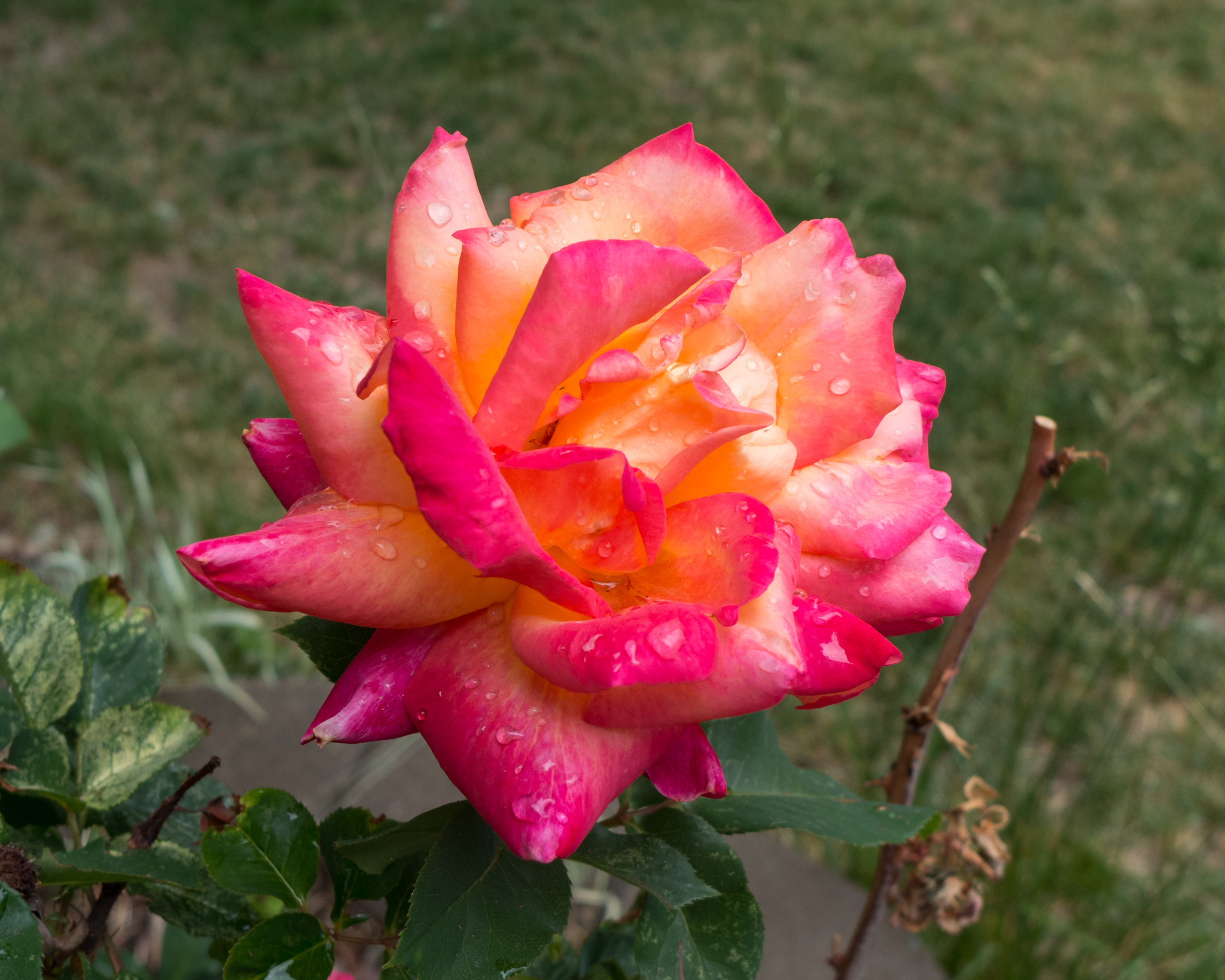
Rose  [Flickr page]

Nature for meat and drink provides a space,

And, when received,

they fill their certain place;

Hence thirst and hunger may be satisfied,

But this repletion is to love denied:

Form, feature, colour, whatsoe’er delight

Provokes the lover’s endless appetite,

These fill no space,

nor can we thence remove

With lips, or hands,

or all our instruments of love:

In our deluded grasp we nothing find,

But thin aërial shapes,

that fleet before the mind.

As he, who in a dream with drought is cursed,

And finds no real drink to quench his thirst,

Runs to imagined lakes his heat to steep,

And vainly swills and labours in his sleep;

So love with phantoms cheats our longing eyes,

Which hourly seeing never satisfies:

Our hands pull nothing

from the parts they strain,

But wander o’er the lovely limbs in vain.

Nor when the youthful pair more closely join,

When hands in hands they lock,

and thighs in thighs they twine,

Just in the raging foam of full desire,

When both press on, both murmur,

both expire,

They gripe, they squeeze,

their humid tongues they dart,

As each would force their way

to the other’s heart:

In vain; they only cruise about the coast;

For bodies cannot pierce,

nor be in bodies lost,

As sure they strive to be,

when both engage

In that tumultuous momentary rage;

So tangled in the nets of love they lie,

Till man dissolves in that excess of joy.

Then, when the gathered bag has burst its way,

And ebbing tides the slackened nerves betray,

A pause ensues; and nature nods awhile,

Till with recruited rage new spirits boil;

And then the same vain violence returns,

With flames renewed the erected furnace burns…3

———
Thanks to Rosie English for permission to use her outstanding photograph, “Evening Swimmerettes” of two beachgoers. The other photos are my own: Click on individual ones to enlarge, or check out my most “interesting” photos on Flickr. All are Copyright © 2013-14 Edwin A. Suominen. You may freely use them (not Rosie’s, at least not without her permission) for non-commercial purposes, with attribution, under the Creative Commons Attribution-NonCommercial 3.0 Unported License.

Notes


  1. See bartleby.com/204/187.html 

  2. Dryden’s phrase “leaky kind” Ronald Melville translates as “other bodies,” i.e., those of the promiscuous: “Reject, and turn the mind away, and throw / The pent-up fluid into other bodies, / And let it go, not with one single love / Straitjacketed, not storing in your heart / The certainty of endless cares and pain.” 

  3. John Dryden, trans., “The Latter Part of the Fourth Book of Lucretius Concerning the Nature of Love.” In John Dryden: The Complete Poetical Works (Annotated), N. John McArthur, ed. 


Thursday, March 6, 2014

Invocation to Venus

[A]s a poet, a maker of metaphors, Lucretius could do something very strange, something that appears to violate his conviction that the gods are deaf to human petitions. On the Nature of Things opens with a prayer to Venus. … The hymn pours forth, full of wonder and gratitude, glowing with light. It is as if the ecstatic poet actually beheld the goddess of love, the sky clearing at her radiant presence, the awakening earth showering her with flowers. She is the embodiment of desire, and her return, on the fresh gusts of the west wind, fills all living things with pleasure and passionate sexual longing.
—Stephen Greenblatt, The Swerve: How the World Became Modern. W.W. Norton & Company (2011).
This posting is the first of several I have planned about the remarkable On the Nature of Things by Lucretius.
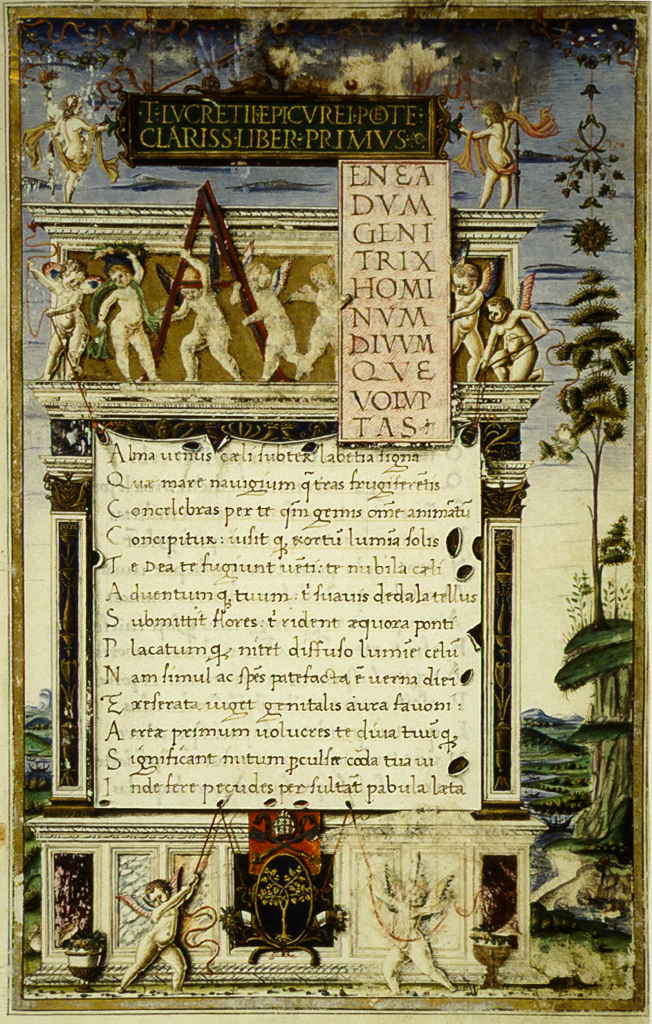
First page of a 1483 manuscript copy  [Flickr page]

There is a priceless work of ancient literature that rests, now safely copied beyond risk of annihilation, within the world’s digital book databases, web servers, bookstores, and libraries. A few manuscripts from the middle ages survive, along with copies made painstakingly by hand, then printed widely once Gutenberg’s invention came into use.

On the Nature of Things is a poem of 7,400 lines written two thousand years ago by a freethinking Roman named Lucretius. It “yokes together moments of intense lyrical beauty, philosophical meditations on religion, pleasure, and death, and complex theories of the physical world, the evolution of human societies, the perils and joys of sex, and the nature of disease.”1 It’s a wonder that it survived the dark ages, escaping the fiery fate of so many other manuscripts that did not conform to the iron-fisted piety of the almighty medieval Church.

And conform it certainly did not. Throughout his remarkable poem, Lucretius denies any divine influence or even interest in the affairs of humans. The universe was not made by the gods, and does not need their help to run its random course. We are all fortunate arrangements of atoms formed into living beings who exist only briefly, and just this once. We have no souls that outlast our bodies, so our pursuit is the happiness and pleasure that these brief lives of ours can offer. When the end comes, it is final, and we must accept it graciously.

Lucretius was very much a materialist. A person “can call the earth ‘Mother of the Gods,’” he allowed, “on this condition— / that he refuses to pollute his mind / With the foul poison of religion.”2 He did not deny the existence of the old gods, just their influence on our world or any interest in it. “By their very nature,” they sat aloof, enjoying “perfect peace” and “immortal life,”

Far separate, far removed from our affairs.
For free from every sorrow, every danger,
Strong in their own powers, needing naught from us,
They are not won by gifts nor touched by anger.3

Whether out of poetic license, some lingering respect for the old traditions, or as a way of easing the pious into his starkly materialist worldview, Lucretius begins his monumental celebration of humanism by addressing one of those gods whose superstitious worship he disdains.4 The “Invocation to Venus” is a beautiful and erotic paean to the goddess of love, a celebration of how the “universe, in its ceaseless process of generation and destruction and regeneration, is inherently sexual.”5

Now, for a few minutes, try to forget that you are an occupant of a frantic, attention-limited society twenty centuries after Lucretius scratched out his lines with quill pen on papyrus or parchment. You are browsing a blog with bills to pay and laundry to fold, and that sort of fast reading does not lend itself to the appreciation of thoughts formed in a more deliberate age.

But please do try. Savor the lines below, which have been so artfully translated—from manuscript copies several times removed from the long-lost originals—by an Englishman, John Dryden, three centuries ago. The words are stunning in their glorious sensuality and power, and are a bit daring for stiff-necked readers even today.

And enjoy the pictures interspersed, too. They are samples of my own long-running visual paean to nature, expressing the same ancient appreciation with modern tools.

———

Delight of humankind, and gods above,

Parent of Rome, propitious Queen of Love!

Whose vital power, Air, Earth, and Sea supplies,

And breeds what e’er is born

beneath the rolling Skies;

For every kind, by thy prolific might,

Springs, and beholds the regions of the light.

Lake Mist Aglow  [Flickr page]

Thee, Goddess, thee the clouds and tempests fear,

And at thy pleasing presence disappear;

For thee the Land in fragrant Flowers is drest;

For thee the Ocean smiles,

and smooths her wavy breast,

And Heav’n itself with more serene

and purer light is blest.

Molokai Shoreline from the Sea  [Flickr page]

For, when the rising Spring adorns the Mead,

And a new Scene of Nature stands displayed,

When teeming Buds, and cheerful greens appear,

And Western gales unlock the lazy year;

The joyous Birds thy welcome first express,

Whose native Songs thy genial fire confess;

Then savage beasts bound o’er their slighted food,

Struck with thy darts, and tempt the raging flood.

Raindrops on Oregon Grape  [Flickr page]

All nature is thy Gift; Earth, Air, and Sea;

Of all that breathes, the various progeny,

Stung with delight, is goaded on by thee.

Purple and Gold  [Flickr page]

O‘er barren Mountains, o’er the flowery Plain,

The leafy forest, and the liquid main,

Extends thy uncontrolled and boundless reign;

Through all the living Regions dost thou move,

And scatterest, where thou goest,

the kindly seeds of Love.

Molokai from the Kamehameha Highway  [Flickr page]

To thee Mankind their soft repose must owe,

For thou alone that blessing canst bestow;

Because the brutal business of the War

Is managed by thy dreadful Servant’s care;6

Who oft retires from fighting fields, to prove

The pleasing pains of thy eternal Love;

And panting on thy breast supinely lies,

While with thy heavenly form

he feeds his famished eyes;

Sucks in with open lips thy balmy breath,

By turns restored to life,

and plunged in pleasing death.

Molokai Pali  [Flickr page]

There while thy curling limbs about him move,

Involved and fettered in the links of Love,

When wishing all, he nothing can deny,

Thy Charms in that auspicious moment try;

With winning eloquence our peace implore,

And quiet to the weary World restore.

Flaming Firs  [Flickr page]
Invocation to Venus quoted from lines 1-27, 43-58 of John Dryden’s 1685 translation, with modern spelling and removal of some archaic contractions (e.g., “fettered” instead of “fetter’d”), as with the version consulted in N. John McArthur, ed. John Dryden, The Complete Poetical Works, N. John McArthur and Lexicos Publishing (2012).
The photography is my own modern contribution to this ancient appreciation of the natural world. Click on individual images to enlarge, or check out my most “interesting” photos on Flickr. All are Copyright © 2013-14 Edwin A. Suominen. You may freely use them for non-commercial purposes, with attribution, under the Creative Commons Attribution-NonCommercial 3.0 Unported License.

Notes


  1. Stephen Greenblatt, The Swerve: How the World Became Modern. W. W. Norton & Company (2011), Ch. 8. 

  2. Book II, 658-660. Ronald Melville, trans. On the Nature of the Universe, Oxford World’s Classics. Oxford University Press (1997). 

  3. Book I, lines 646-51. Melville trans. 

  4. For a more nuanced view, see George Depue Hadzsits, “The Lucretian Invocation of Venus.” Classical Philology, Vol. 2, No. 2 (Apr., 1907), pp. 187-192. Available for free online courtesy of the University of Chicago Press. According to Hadzsits, the “Lucretian invocation of Venus, as a typical Epicurean prayer, must be interpreted in the light of Epicurean theory and practice—a prayer, then, with a deep, complex, religious significance to the sincere Epicurean himself, a prayer that included an emotional attachment to older traditions, to established customs and beliefs, and also an enlightened intellectual, Epicurean interpretation of such religious material.” He finds it “utterly unthinkable that in the Venus invocation Lucretius has been untrue to himself,” with a mere “conventional literary ornament” as a hypocritical pious preamble to his “literary monument to fearless honesty.” 

  5. Greenblatt, p. 45. 

  6. The servant was Mars. Melville provides this footnote to the line in his translation: “Venus restraining the warlike impulse of her husband Mars was a frequent subject of ancient as of modern painting (see especially Botticelli’s Venus and Mars). Their union was sometimes allegorized as bringing about harmony: they also look back to the two cosmic principles of ‘Love’ and ‘Strife’ of the fifth-century BC Greek poet Empedocles, who was one of Lucretius’ major models.” 

Sunday, June 23, 2013

The Atom (and God)

Book Review: God and the Atom. Victor J. Stenger. Amherst, NY: Prometheus Books (2013).
We’re into books with blue
covers around here.

Dr. Stenger was kind enough to look over a book I co-authored with our mutual friend Robert M. Price, and he wound up writing a nice blurb for it. So, full disclosure: I owe him one, and admire his work. Though my reviewing the work of this accomplished particle physicist and prolific author is a bit like a sign painter sizing up the brush strokes on the Mona Lisa, I will say right up front that I like this book, too.

God and the Atom is not overbearing on either of its headline topics. It is more about atoms than God, really, and I would readily recommend it to my Christian friends who are interested in science. Stenger expresses his atheistic views clearly and without apology in other works such as God: The Failed Hypothesis and Quantum Gods. But in this particular book, atheism is an undercurrent, almost something to be taken for granted as he takes the reader on a tour through the history of thought about elementary particles and the material substance of everything around us.

Stenger’s story begins with the Greek philosophers Leucippus and Democritus. As he points out, these guys had some amazingly accurate ideas about particle physics. They correctly understood that vision, hearing, smell, and touch are all the result of interactions between various parts of our bodies and particles in, or emanating from, objects of the outside world (pp. 25-26). He provides some illuminating quotes from Lucretius that talk about the chance movements of atoms, the material nature of our bodies and everything else. I’m in no position to judge one way or another, but Stenger seems to be an able curator of ancient thought on his chosen topic, showcasing (on p. 39) amazing passages like this one (reformatted here):

Thus clearly there are particles

of wind you cannot spy

That sweep the ocean and the land

and clouds up in the sky.

While discussing these ancients, Stenger makes the atheism connection by noting how their view is based on everything being material, all the way down. No intervention by any deities was considered necessary or even useful, it seems. And, he notes, their views about human mortality is clearly not one involving any afterlife. Here is the first stanza of a passage from Lucretius that Stenger particularly enjoys, quoted on p. 36 of his book:

So when our mortal frame shall be disjoin’d

The lifeless lump uncoupled from the mind,

From sense of grief and pain we shall be free;

We shall not feel, because we will not be.

In The Tell-Tale Brain, the neuroscientist V.S. Ramachandran notes that our conscious selves emerge “from the mindless agitations of atoms and molecules” in our brains. Those brains are made up of a hundred billion neurons, he says, each making “from one thousand to ten thousand contacts with other neurons.” This knowledge of ourselves, much of it gained within living memory of the current generation of scientists, is staggering. And, more than 2,000 years after Lucretius wrote them, the barren wisdom of his words stands: We shall not feel, because we will not be.

If it ain’t tabbed or highlighted, it ain’t been read. Not with a book this informative.

Stenger artfully continues his history lesson forward through the centuries, presenting scientific and historical facts with his subdued atheistic theme holding things together. It doesn’t seem at all preachy or overbearing. Even when I was a Christian, the science and history probably would have kept me engaged without the book’s low-key atheism turning me off too much. The way Stenger patiently shows (not just says) how little God figures into our scientific understanding is a refreshing change of pace, and may be more powerful an approach for the godless than the explicit reverse evangelism of books like Hitchens’s God is Not Great or Dawkins’s The God Delusion.

I did much of my reading of the book on a beautiful sunny day, sitting out on the deck. After taking in one of the many profound little nuggets in Stenger’s well-crafted text, I would pause to look up at the big trees that surround my home. The “universe is not fine-tuned for us; we are fine-tuned to the universe” (p. 146), the words would ring out in my mind, as I noted the height of those trees, evolved to strain upwards above their green rivals in a greedy quest for photons to feed the long-captive chloroplasts in their needles. Stenger has explained what those are, too: massless, dimensionless particles of light that act like waves, not individually, but when moving together in beams (pp. 154-55), in countless, unfathomable numbers.

All that structure, all those organic compounds are formed from tiny clumps of proton and neutron (which themselves are made of quarks that can never be isolated), surrounded by statistical clouds of negative charge—dimensionless particles that can’t be pinned down to a single point, which we call electrons (p. 151). The carbon atoms in those trees have six electrons, not individual little balls whizzing around but probabilities of position layered into two shells. And those atoms are almost always fused with other atoms, and other shells.

Frost on pine needles: It’s all atoms.  [Flickr page]

Stenger explains what’s behind all this: quantum indeterminacy and the Pauli exclusion principle. Without that principle keeping them from overcrowding orbitals, “the electrons in every atom would settle down to the ground state and we would have no complex chemical structures” (p. 164). Not the pine needles, not the crooked-dumbbell shaped water molecules that stream into them and provide raw material for photosynthesis, not the rods and cones in my eyes that alternate from Stenger’s words to the greenery.

It’s exhilarating to have even a dim comprehension of all this hidden splendor beneath the beauty that stands before me, and within me. What about God, the unseen force to whom I’ve given credit (and blame!) for all of this during most of my life thus far? Nowhere to be found, apparently. “In today’s science,” Stenger writes as he draws to a conclusion, “we find no evidence for any ingredient in nature other than matter. If some other immaterial substance exists, such as what is usually referred to as spirit, it has no effect on our senses or instruments that we can verify scientifically” (p. 263).

Stenger, 78 years old and apparently very comfortable in his own material and mortal skin of atomic particles, seems quite unperturbed by this godless universe he describes so well. He shrugs his shoulders about the appeal to theism, the very human need to find some agency behind it all. Bah humbug, Stenger says to any search for spirit or qi or, of course, God. In “what sense can we say immaterial objects exist if they have no measurable effects on the material objects we do observe?” (p. 264).

God and the Atom goes on for a few more pages from that jarring question, but there is no metaphysical soft landing to comfort those who, like me, cannot quite seem to embrace an existence based solely on nothing more than four fundamental particles. That is the only part of the book that seemed uneven to me. It isn’t necessarily a shortcoming of Stenger’s writing, but of this reader’s emotional yearning for something more than what writer and reader alike have concluded, intellectually, just isn’t there. I look up from the trees—my exultation in understanding their evolution and the wondrous bits of physics that Stenger writes about turning to a pang of sadness as I look to the empty sky—and say with the writer of Isaiah 45:15, “Verily thou art a God that hidest thyself, O God of Israel, the Saviour.”

———
See the Prometheus website for more information. Get the book from Amazon.com in hardcover or for the Kindle, or for the Barnes & Noble Nook.