Showing posts with label Laestadianism – Doctrine. Show all posts

Wednesday, April 1, 2015

A Mother of Many Children

Jerusalem, God’s Zion, came down from heav’n above.
She’s our beloved mother, whom we, her children, love.
It’s here that God is dwelling, in spirit here is found;
of truth it is the pillar, and is it’s very ground.
Songs and Hymns of Zion No. 188, v. 1.
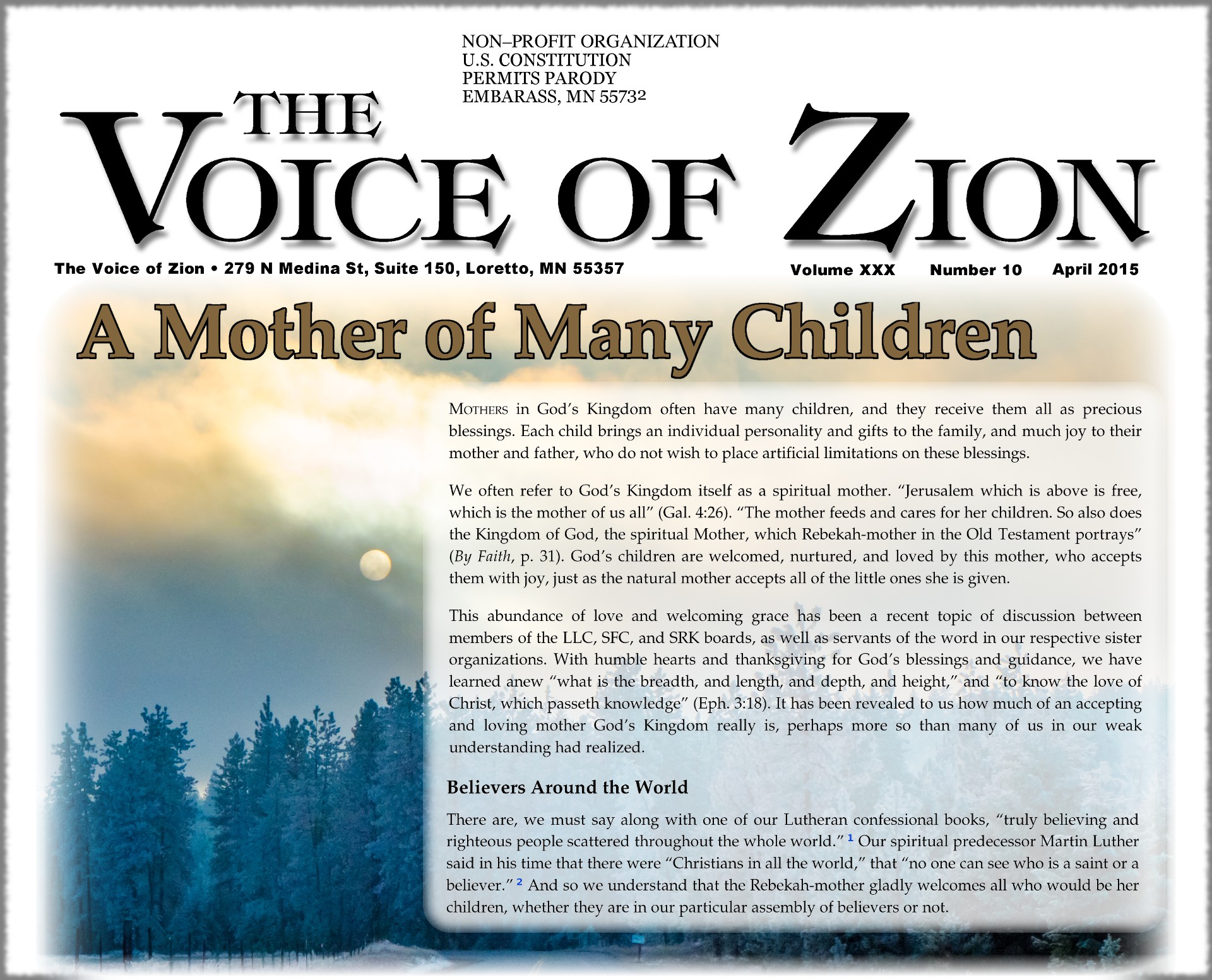
In this as-yet-unpublished newsletter article, my old fundamentalist church announces a surprising change in its long-standing doctrine of exclusivity. Be sure to read my comments that follow the article at the bottom of this posting. [Suomeksi]

MOTHERS in God’s Kingdom often have many children, and they receive them all as precious blessings. Each child brings an individual personality and gifts to the family, and much joy to their mother and father, who do not wish to place artificial limitations on these blessings.

We often refer to God’s Kingdom itself as a spiritual mother. “Jerusalem which is above is free, which is the mother of us all” (Gal. 4:26). “The mother feeds and cares for her children. So also does the Kingdom of God, the spiritual Mother, which Rebekah-mother in the Old Testament portrays” (By Faith, p. 31). God’s children are welcomed, nurtured, and loved by this mother, who accepts them with joy, just as the natural mother accepts all of the little ones she is given.

This abundance of love and welcoming grace has been a recent topic of discussion between members of the LLC, SFC, and SRK boards, as well as servants of the word in our respective sister organizations. With humble hearts and thanksgiving for God’s blessings and guidance, we have learned anew “what is the breadth, and length, and depth, and height,” and “to know the love of Christ, which passeth knowledge” (Eph. 3:18). It has been revealed to us how much of an accepting and loving mother God’s Kingdom really is, perhaps more so than many of us in our weak understanding had realized.

Believers Around the World

There are, we must say along with one of our Lutheran confessional books, “truly believing and righteous people scattered throughout the whole world.”1 Our spiritual predecessor Martin Luther said in his time that there were “Christians in all the world,” that “no one can see who is a saint or a believer.”2 And so we understand that the Rebekah-mother gladly welcomes all who would be her children, whether they are in our particular assembly of believers or not.

God’s Kingdom is precious to us, “our beloved mother, whom we, her children, love” (SHZ 188). Here we find comfort and the forgiveness of our sins. But there is a danger of putting too much emphasis on God’s Kingdom as an organization, as an assembly of people, and making God Himself secondary to it. “I will not give my glory unto another” (Isaiah 48:11).

We can also look to the words of Luther in this: He wrote that anyone who “maintains that an external assembly or an outward unity makes a Church, sets forth arbitrarily what is merely his own opinion.” We must humbly agree with our brother in faith that there is not “one letter in the Holy Scriptures to show that such a purely external Church has been established by God.”3

During our concluding meeting at the SRK offices in Oulu, we received much loving instruction from God’s Word and a spirit of unity. With tears of joy, one brother read simple instructions from the Bible about how we can know where the Spirit of God is: “Hereby know ye the Spirit of God: Every spirit that confesseth that Jesus Christ is come in the flesh is of God” (1 John 4:2). Every spirit, he repeated, and went on to read how we can know who God’s children are: “Whosoever shall confess that Jesus is the Son of God, God dwelleth in him, and he in God” (1 John 4:15).

Another brother recalled that the Apostle Paul considered the Gentiles as equals in God’s eyes. He noted that this was a significant new revelation for the Old Covenant believers of that time, too. But there is no difference between the Jew and the Greek, Paul wrote, “for the same Lord over all is rich unto all that call upon him. For whosoever shall call upon the name of the Lord shall be saved” (Rom. 10:12-13).

A question arose about the preaching of the Gospel in the verses that follow: How can other people “call on him in whom they have not believed? And how shall they believe in him of whom they have not heard? And how shall they hear without a preacher?” Luther wrote that whoever hears the Gospel and believes on it, and is baptized, is called and saved. And, he added, “the Gospel is nothing else than the preaching of Christ.”4

We cannot allow our traditions about the Gospel and forgiveness to take away from God’s Word. “And if any man shall take away from the words of the book of this prophecy, God shall take away his part out of the book of life, and out of the holy city, and from the things which are written in this book” (Rev. 22:19). This portion says that whoever calls upon His name shall be saved and then simply points out that people cannot call on someone they haven’t yet heard of.

There were many around Paul who had no knowledge about Jesus. We certainly cannot say the same today of the many millions of people who faithfully read the same Bibles we have and praise God’s name in their own churches.

God’s Ways Are Beyond Human Comprehension

The mind of man rebels against such inclusiveness. Who are these strangers we are to consider as possible fellow-travelers on the way that leads to heaven? How do they get their sins forgiven? But these questions arise from our sin-corrupt flesh.

It is important to remember that God’s grace is not limited by the limitations of our carnal reasoning. “Now unto him that is able to do exceeding abundantly above all that we ask or think, according to the power that worketh in us, unto him be glory in the church by Christ Jesus throughout all ages, world without end” (Eph. 3:20).

Random, marginally relevant nature scene [Flickr page]

Apostle Paul reminds us, “Now there are diversities of gifts, but the same Spirit. And there are differences of administrations, but the same Lord. And there are diversities of operations, but it is the same God which worketh all in all” (1 Cor. 12:4). We have seen many sorrowful incidents in our own history since the time of Laestadius where “the weightier matters of the law, judgment, mercy, and faith” (Mat. 23:23) have been forgotten over minor issues and personality differences, leading to needless strife and divisions. There “should be no schism in the body; but that the members should have the same care one for another” (1 Cor. 12:25).

Our brother Juhani Raattamaa, whose portrait hangs alongside Luther and Laestadius in some of our church buildings, honored the Apostle’s message during a spiritual storm that took place in our Zion about a hundred years ago. He continued to show love for a prominent servant of the word who had been rejected over obscure matters few of us can even recall anymore and who was forced to journey in faith with a group called the Esikoinen, or “Firstborn.” After the death of this “beloved brother and fellow laborer,” Raattamaa remembered him “with sorrow and joy, even though his body is resting in the bosom of his Fatherland, but his glorified soul is rejoicing in the Paradise of God.”5

The question about how these other believers get their sins forgiven is easy to answer in the case of our Esikoinen brethren; they preach it in the name and blood of Jesus just as we do. There are thousands of them in the United States and Finland receiving this message with joy every Sunday. That forgiveness, Raattamaa said, has been given “to the flock in living faith which is scattered around the whole world of all peoples and tongues. The sermon of repentance and forgiveness of sins is established with them.”6

Have we been like John when he forbade a stranger from casting out devils in Jesus’ name, just because the man did not walk with the disciples? The Lord of Life did not commend John for doing that. Rather, he said, “Forbid him not: for he that is not against us is for us” (Luke 9:50).

God’s Kingdom is not some entity located in Minnesota or Oulu, just as it was “not bound to Rome” in Luther’s day. Rather, it is “as wide as the world, the assembly of those of one faith, a spiritual and not a bodily thing, for that which one believes is not bodily or visible.”7

Boundless Grace

Paul said that God wants all men to be saved and that they would come to the knowledge of the truth. Therefore it is not the will of God that anyone be lost. He has not prepared hell for men, but for the devil and his angels.8 The Lord, Peter writes, is “not willing that any should perish, but that all should come to repentance” (2 Pet. 3:9).

With our weak understanding, can we say that God has not been able to achieve His will except when it comes to our small Zion? “For my thoughts are not your thoughts, neither are your ways my ways, saith the LORD. For as the heavens are higher than the earth, so are my ways higher than your ways, and my thoughts than your thoughts” (Isaiah 55:8).

Jesus told His disciples, “Fear not, little flock; for it is your Father’s good pleasure to give you the kingdom” (Luke 12:32). Certainly they were a small group when He spoke those words, for the same reason that Paul wrote about those who had not heard. God’s promises of the Old Covenant had only just been fulfilled in the few decades since Jesus’ birth. In our time, two thousand years later, the world is filled with people who are happy to take on the name of a Christian. We should not hasten to pass judgment on their faith. “Judge not, and ye shall not be judged: condemn not, and ye shall not be condemned: forgive, and ye shall be forgiven” (Luke 6:37).

Our Lord and Savior Jesus Christ was sent for the sins of the whole world, not just for ours. “For God so loved the world, that he gave his only begotten Son, that whosoever believeth in him should not perish, but have everlasting life. For God sent not his Son into the world to condemn the world; but that the world through him might be saved” (John 3:16). It is grace of grace to be in God’s Kingdom. “Our faith is the greatest of gifts we could own / Through Christ we are given the hope of a crown” (SHZ 403). But now, in His time, God is revealing unto us that we should not be too quick to say that others are not among His own as well. “God is nigh unto all them that call upon him, to all that call upon him in truth” (Psalm 145:18-20).

———

Important disclaimer and commentary:

It is April 1, and that date for this “article” is no coincidence; none of this was actually written by any church official or for any church newsletter. (The epigraph is indeed a verse from a song in the church songbook, by Anna Tulkki.) It is “as-yet unpublished,” and always will be, because it’s a parody I wrote in honor of the holiday. There have been recent discussions between representatives of the LLC, SFC, and SRK, but I seriously doubt that univeralism or even acceptance of “worldly” Christians was on the agenda.

I can still write like a believer, but I’m not a Laestadian or even a Christian anymore. (Nor am I really convinced at this point that there’s a God behind our astounding yet scientifically explainable mess of a universe, though that’s another topic entirely.) But I know plenty of people who used to be Laestadians, and a few who are still sitting in the pews while enduring their own painful private silences of doubt and cognitive dissonance. Many of those who have left are still Christians of one type or another who get to hear their faith dismissed as worthless and irrelevant by their former brothers and sisters.

This was written for all of them. May our beloved old church evolve toward the kind of compassionate and realistic position this essay describes (alas, still only as parody) within our lifetimes or at least those of our children.

And I wrote it for those readers who are still Laestadians, too. You know who you are: Better clear your browser history before anyone else finds out! I hope you’ve found something to ponder here. Every one of these quotes and cites is real, and relevant. Think about how much you are marginalizing your Savior and the omnipotent creator of the universe (in your beliefs, at least) by making him unable or unwilling to save all but 0.002% of the world’s population. Some further reading along those lines: “God’s Kingdom,” “Sailing in a Sea of Humanity,” and “The Christmas Program.”

Because the Bible is so full of contradictions, either one of two opposite viewpoints often can be selected and amplified via the Laestadian-style quote-bombing I tried to illustrate above. There is certainly another more orthodox essay that could be written about God’s wrath and how he plans to exercise his infinite power to torture almost all of his created humanity for not being Laestadians. But it would be a less honest and compelling one, I think, and certainly more depressing to read.

———
Click on images for full-size versions, as usual. Here is the link to download the full-size 1920x1553 version of the top one, which I created using The GIMP free image processing software and years of looking at way too many real Voice of Zion issues that had arrived in the mail.
Many thanks to an anonymous correspondent for supplying a translation into Finnish, which was completed in a matter of hours, and for correcting one of my Bible references in the process. There are some amazing people out there!

Notes


  1. Philipp Melanchthon, The Apology of the Augsburg Confession, in Concordia: The Lutheran Confessions, Paul T. McCain, ed. (2005), p. 146. Melanchthon, Luther’s co-worker in the Reformation, wrote the Apology to defend The Augsburg Confession that they had published a year earlier. Luther was involved with the writing of the Apology and approved of it. In a 1533 letter, he urged Leipzig Christians to adhere to both works (McCain at p. 70). 

  2. Martin Luther, The Papacy at Rome. In Works of Martin Luther (“Philadelphia Edition”), pp. 361, 391. 

  3. The Papacy at Rome, pp. 350, 355. 

  4. Martin Luther, The Epistles of St. Peter and St. Jude Preached and Explained, “The Second Epistle General of St. Peter,” Ch. 1. 

  5. Juhani Raattamaa, 1892 letter following the death of John Takkinen. From The Streams of Life, Carl Kulla, ed. (1985), p. 393. 

  6. Juhani Raattamaa, sermon given 1894. From The Streams of Life at p. 181. 

  7. The Papacy at Rome, p. 361. 

  8. These three sentences are actually a quote from Journey of Fiery Trials (1961) by Lauri Taskila, a Laestadian preacher, which have ample support in the Bible, e.g., 1 Timothy 2:1-6; 2 Peter 3:1. But in the real world outside of an April 1 parody, Taskila went on with an unsurprising Laestadian qualifier: “Of course, it is the will of many men to die blessed, but the world is dear and its vanishing course is pleasing where slavishness and scorn of men keep them from repentance” (pp. 58-59). Apparently the threat of infinite, eternal torture is not incentive enough for all those uppity folks. 


Thursday, January 15, 2015

God’s Kingdom

There are not many spirits by which we have access to the Father through Jesus Christ. There is only one, the Holy Spirit, which is of God. Neither are there many kingdoms, as the world would believe. There is only one kingdom that has the foundation of the faith and doctrine of the prophets and the apostles with Jesus Christ the chief cornerstone.
The Voice of Zion, September 1979
But what people find difficult to accept is the Church of Christ that emerged in the Philippines.
Pasugo (God’s Message), August 2014
The Kingdom of God–about 0.002% of the world’s population (click to enlarge)

One fascinating aspect of my old church is its claim to be “God’s Kingdom,” the one little flock of true believers that exists anywhere on earth. Almighty God, who wants everybody saved, has for some reason stashed his keys of reconciliation in a place where almost nobody would know to look.1 But, the story goes, he is going to damn almost everybody for not finding them.

The (Finnish) True Church

You see, after getting Christianity spread across the planet over the course of two thousand years, God has chosen those 100,000 or so Finns and descendants of Finns who were lucky enough to have been “born into a Christian home,” plus maybe another thousand converts, as his “grace children.” They comprise about 0.002% of the world’s population. Everybody else–other kinds of Laestadians (there are several), other kinds of Lutherans, all those generic Christians in their innumerable “dead faiths”–God is unwilling or unable to help.2

It’s quite a story, breathtaking in its audacity. Yet it’s so deeply ingrained into Conservative Laestadian doctrine that it’s hardly ever spelled out in sermons.3 When a preacher laments the loved ones who have given up this precious gift of living faith or forsaken the fellowship of God’s Children or left the Kingdom, everybody knows what he’s talking about. Those poor misguided saps are no longer members of the Laestadian Lutheran Church, and they’d better not die in that condition. It doesn’t matter if they still profess the basics of Christianity, perhaps more sincerely then ever, or became (spoken in hushed tones) one of those people who don’t even believe in God. They’re spiritually dead just the same, and headed for hellfire if physical death completes the equation to yield eternal death.

Just that one orange dot.

“God’s Kingdom has an address” is one old saying I heard in sermons and discussions from time to time. But the church doesn’t go out of its way to inform the outside world about just how detailed the directions are. “The kingdom of God is to be found on earth according to the teachings of Jesus,” says its How We Believe web page. “It is a kingdom of grace on earth and a kingdom of glory in heaven. The kingdom of God is one-minded in faith, doctrine, and love.” Another page, The Kingdom of Heaven, gives a few hints of something a bit more specific: “In this world God’s kingdom is hidden beneath the flaws and faults of believing people ... What we can offer you is God’s forgiveness in Jesus Christ.”

That’s a nice enough offer, but it omits the unpleasant yet absolutely essential detail that no other offer will do, from anyone else and that you will fry in hell forever if you don’t take them up on it. It’s like a doctor knowing that a certain 70-person clinic down a side road somewhere near the Maltby Cafe off Highway 522 has the only batch of experimental chemo in the entire Seattle Metro area that can cure your rare and imminently fatal form of cancer. Imagine her just telling you to head north from Olympia looking for a good oncology center, mentioning some obscure one nobody’s ever heard of that’s a two-hour drive away, and then hanging up.4

Why not just come out with the bracing truth and “call a spade a spade,” as one LLC preacher is fond of saying? If you believe that your clinic has this indispensable medication, that your church is the only way people can avoid the horrors of hellfire, it seems that you would want to convey the absolute urgency of the situation. “Don’t go anywhere else, you hear? This is the place!” I asked an LLC elder about it some years ago: Why wasn’t the church website clearer about who will be saved and who will not? He replied, “Well, we don’t want to scare people off.”5

Perhaps vagueness is considered desirable for PR purposes, but the exclusivity doctrine is certainly something that members are expected to believe. The LLC’s paper “Unity of Faith and Understanding” makes that very clear, at least to those who know the intended meanings of “house of God” and “saving faith”:

It is no small matter when an individual or group, either secretly or openly, begins to believe that the house of God is not necessarily “the pillar and ground of truth” in all matters of soul and conscience or that there is more than one saving faith.6

So I will provide the public with some clarity about one of my old church’s key doctrines where it declines to do so: All of the billions of mentally competent individuals over the age of accountability who now occupy this planet other than Conservative Laestadians are headed for an eternity of unthinkable torture. “Preciously believing” ones, that is, not those fence-sitting “New Age” believers or party animals with grievous hidden sin on their consciences. And, unless the world finally ends after two thousand years of failed expectations, that same horrible fate will be shared by almost all of the billion or so of the world’s children as they reach the age of accountability without any clue about how to be saved.7

Are you on board with this? Head back to church or visit llchurch.org if you have felt the call of God’s Kingdom. But first you might want to consider the other groups that each claim they are the only true church. Why should just one of them automatically be given the benefit of the doubt, after all?

The (Filipino) True Church

I was in Hawaii on a Sunday morning last month, and visited an Iglesia ni Cristo church I’d spotted while sightseeing the day before. The name means “The Church of Christ” in Tagalog. It was a group I’d written about in An Examination of the Pearl, and I just had to see for myself what its services were like. My wife slept in.

Iglesia ni Cristo church on Kauai, Hawaii

A surprised but polite usher escorted me to a seat near the back of their small sanctuary. The congregation was strictly divided between men and women on opposite sides of a central aisle. I sat down and flipped through the songbook as the congregation halfheartedly accompanied an organ and a choir of white-robed Filipino women.

It was interesting to see how similar the messages in the songs were to what I grew up singing. One of them told of “The kingdom, so glorious and blest,” into which, the singer was to recall aloud, “Motivated by faith, I gladly entered” and where “now I do receive / The care for my once-troubled soul.” It is “Within His kingdom”, the song said, where the “great mercy and grace” of the Father is found, along with “His teachings, great beyond compare.” Another song began, “This lonely land is not my true home,” expressing the same yearning for eternity as a beloved old Song of Zion I heard in warm little sanctuaries for nearly 40 years: My home is not here where I journey, ah, no, it is far, far away.8

Those sanctuaries were and still are filled with Finns whose ancestors (in my case, two Finnish grandparents) had left an earthly homeland on the other side of the Atlantic. And in the rough wooden interior of this little church in Hawaii, I sat amidst people whose ancestral origins lay across a different ocean, the Pacific. I was the only white person in the building, looking at the backs of about 150 dark-haired heads, plus the blond-dyed hair of a guy right in front of me who must have been the local rebel.

Actually, I suspect there were a few more rebels with me in those back rows, young guys who reluctantly dragged themselves to their mandatory Sunday morning church attendance. The one to my left was furiously bouncing his knee and shifting position the whole time. And I’m pretty sure I heard some audible snickering behind me at a few points during the preacher’s fervent oratory.

As an outsider, I certainly found it amusing, though I was far too polite to give any indication of that. Imagine stuff like “We cannot neglect our offering to almighty God!” shouted sing-song fashion over a jabbing pointed finger, by a guy with black helmet hair, a thick Asian accent, and a voice that bordered dangerously close to a squeak. Despite all his efforts, to which some people in the rows ahead of me responded with evident or at least well-acted emotion, I walked out of the place without the slightest pang of fear or interest in hearing more of his preaching.

You would have, too, whether you are religious or not. You simply do not take this group’s claims seriously. You may never even have heard of it before now. But it teaches that you are going to hell, and it has about five million members.

Sound Familiar?

The Iglesia ni Cristo began in the Philippines by the inspiration of one Felix Manalo in 1914, after reaching “a pivotal point in his personal religious odyssey.” He “embarked on a programme of evening evangelism,” which yielded about 100 converts within the first year.9

They think you are wrong, and there are a lot of them.

Fairly early in the group’s history, some members emigrated to America and, with guidance from the leadership back home, established congregations at their new locations.10 As with Laestadianism, though, the American adherents still represent only a fraction of the total worldwide membership. And neither movement has attracted substantial interest outside its original ethnic group; most everybody is a descendant of immigrants from the old country. If what I saw in Hawaii was any indication, God’s chosen people in the U.S. are almost all Filipino.11

Today, Manalo figures prominently in the church’s history, and his grandson Eduardo is now its leader, the “Executive Minister.” But the church considers itself “of God and of Christ,” and says Manalo is only “God’s instrument in preaching the gospel of salvation in these last days.” He was, after all, “the first one to proclaim about the Church of Christ” in the Philippines where most of the church’s members are still found today.12

The story is not too different in structure from Laestadian lore about Lars Levi receiving the Gospel from one member of an obscure group of “Readers” and then unleashing it from his pulpit in Karesuando. And the spiritual successors of Laestadius also disclaim him as any kind of an object of worship, though the ones in the OALC sure devote a lot of their service to reverent mentions of his name and readings of his written sermons.

Complete unity! Except they aren’t Laestadians.

Naturally, one true church means just one true doctrine: “Unity in the Church is quite significant, because our unity includes God and Christ. It is wrong to destroy this unity.”13 Again there is a striking familiarity between these words from the Philippines and the ones coming from the LLC. They really want everybody on board with the party line, and there is only one party line.

Choose Wisely

The Iglesia ni Cristo makes the same exclusivity claim as each schismatic branch of Laestadianism does for itself. (Obviously, only one of them can be correct about it, at most.) If you are not a member of the Church, “you will not be saved on the Day of Judgment.”14 And what they mean by “the Church” is very specific: “The prevailing belief that all churches belong to God is false. Christ founded only one Church–the church of Christ.”15 Man receives “redemption and the forgiveness of sins” only through this Church. “In God’s scheme of salvation, Christ and the Church of Christ are inseparable”16

The Church of Christ

That quoted material is from Iglesia ni Cristo’s materials, but it could just as well have come from the SRK/​LLC, OALC, IALC, or FALC. If they could be persuaded to come out and actually say it publicly, that is.

I have been in contact with people who have left all of those branches of Laestadianism as well as the Church of Christ (Boston Movement), the “Churches of Christ,” “the Truth” aka the 2x2s or “church without a name,” and More Than Conquerors Faith Church of Birmingham, Alabama. Indeed, for most of the seven groups listed besides my own former SRK/​LLC Laestadianism, my conversations and correspondence have been with more than ex-member from each group. They all spoke and wrote to me about their experiences in a church where everybody in all the others is considered damned to hell, including the sincere believers I grew up with.17

The nerve of them, I thought about the churches these people had left. Then we smiled together about how firmly that same outrageous and indefensible idea had remained implanted in each of our brains, before that other ex-exclusivist ever had the slightest clue about my old church or I ever did about theirs. And our respective former churches still go on with their self-absorbed preaching, condemning each other and everybody else without knowing or caring to know.

———
The two graphic art images depict the number of Conservative Laestadians proportional to everyone else on the planet. Created with The Gimp, a free and powerful piece of graphics software. The Iglesia ni Cristo church pictured is the one I visited in Kauai, Hawaii. I took the photo of it from the passenger window as my wife and I drove by sightseeing later. These three images are Copyright © 2014 Edwin A. Suominen; you may freely copy and use them for non-commercial purposes, with attribution, under the Creative Commons Attribution-NonCommercial 3.0 Unported License.
Indeed, I hope you will, particularly that first one showing all those dots representing the world population as 50,000 groups of the same size as the SRK/​LLC. “God’s children” are just one orange dot in the upper left corner. Click on the image above or here to download the full-resolution 1311px by 929px version (only 129 KB), or just forward the link.
Photos of textual material are from a copy of Pasugo (August 2014) that I saw and requested after the service, and then photographed in highly cropped, low-resolution form for “fair use” illustration of this essay. The issue was subtitled God’s Message, so what used to be two magazines may have now merged into one. The official website of Iglesia ni Cristo, if you’re curious or perhaps want to see if 5,000,000 or so Filipinos might be right about the perilous state of your eternal soul, is incmedia.org.

Notes


  1. “God our Saviour ... will have all men to be saved, and to come unto the knowledge of the truth” (1 Tim. 2:3-4); “The Lord is not slack concerning his promise, as some men count slackness; but is longsuffering to us-ward, not willing that any should perish, but that all should come to repentance” (2 Pet. 3:9). 

  2. If God really wants everybody to be saved, he must be quite unhappy about a world where so few actually are. He seems unable to do anything about the situation, yet he’s supposedly omnipotent, which means nothing can stand in his way (Mark 10:25-27). This show-stopper of a theological problem I discuss in one of my most popular postings, The New Testament Disproving Itself

  3. The results can be embarrassing for the church when one of its preachers does stray into discussing the awful specifics. In a sermon given at the LLC’s 2010 Winter Services, for example, one of them started talking about the “kind of reaction we sometimes hear today when we speak about God’s Kingdom.” Things got a little too candid when he went on, “‘You really think this is the only place where forgiveness is found? Do you really think that you are the only group that is traveling to heaven, the only group of believers? Do you really believe that?’ And of course, to the rational mind it does seem like an awfully simple way to believe, doesn’t it? When we look around us in this world and we see the people and the churches and the deeds that people do and all of these outward things, certainly we can understand that to the carnal mind our faith is so foolish. That’s what Paul found too, when he preached. He said we preach Jesus Christ and him crucified, and to the Jews it’s a stumbling block, and to the Greeks it’s foolishness.” Paul was talking about Christianity itself, not some group’s sectarian claims of exclusivity; I wonder what he would have thought about his church becoming so absurdly limited in scope as to be practically invisible. 

  4. The size of my hypothetical clinic is proportional to the 0.002% figure, given the Seattle metro area’s population of 3.6 million people. And the Seattle Laestadian Lutheran Church is down that road off Highway 522, in case you were wondering. However, instead of 70 people there are about 200-300 “who have been called by the grace of God to be partakers of the hope of eternal life” and “individually have been given grace to believe the forgiveness of our own sins in Jesus’ name and blood.” 

  5. This soft-pedaling to outsiders contradicts the idea that God’s holy law, “our schoolmaster to bring us unto Christ” as Gal. 3:24 puts it, is being preached in all its harshness to unbelievers to prod us into repentance. See An Examination of the Pearl, §4.5.1

  6. Speaker’s and Elder’s Meeting presentation, 2007 LLC Summer Services, llchurch.org/​topics/unityfaith1.pdf

  7. Adapted from An Examination of the Pearl, §4.2.1

  8. From “A Song of my Home I am Singing,” Songs and Hymns of Zion No. 576, v. 2. 

  9. Robert R. Reed, “The Iglesia ni Cristo, 1914-2000. From obscure Philippine faith to global belief system.” Bijdragen tot de Taal-, Land- en Volkenkunde, The Philippines Historical and Social studies. Vol. 157, No. 3, pp. 561-608. 

  10. Reed at pp. 583-85. 

  11. “Iglesia is not better known, despite its numbers, because the majority of Iglesia’s members are Filipino. Virtually the only exceptions are a few non-Filipinos who have married into Iglesia families” (Catholic Answers, catholic.com/​tracts/iglesia-ni-cristo). 

  12. Manual for New Members, Part 4: “How you should obey the teachings you received,” under “About God’s Last Messenger,” From unofficial copy reproduced online at incworld.faithweb.com/​info.htm

  13. Manual for New Members, Part 4, under “About unity.” 

  14. Manual for New Members, Part 4, under “About being registered.” The Iglesia ni Cristo goes so far as to have a “registry on earth” that corresponds to “the registry in heaven (the Book of Life),” which really just makes official what Conservative Laestadianism believes about membership status in its organization. The closest thing it has to an earthly “Book of Life” is the little paperback church phone book that comes out every year. I have to admit I was a bit sad to see an edition of it without my wife and me listed for the first time. 

  15. Manual for New Members, Part 4, under “About the true religion.” 

  16. Pasugo (the church’s monthly newsletter): January 1997; September 1988. 

  17. I have varying degrees of certainty about how much these different groups hold to the belief that they are the only place where salvation may be found. I’ve read quite a bit about the Churches of Christ, for example, and exclusivity has been a commonly made claim among them, even in writing at times. On the other hand, all that I know about the More than Conquerors group making that claim comes from a person who left it. But all of my correspondents from the groups listed seemed sure that the exclusivity idea was commonly understood among their brethren when they were among them. And of course there are other groups not discussed in this essay with the same view, or at least a general belief that nobody else is quite as saved as they are. 


Sunday, December 28, 2014

Ecclesiastical Evolution

The spectacle of it! With a few powerful words yelled out a bit louder than the rest, the place erupted into a frenzy of redemption. And it happened every time. The pale upturned palms of ten thousand hands darted and swirled above pastel dress shirts and brightly colored dresses. Starbursts of reflected light sparkled off the women’s gold earrings dangling and shaking with their heads.
“Believe!” shouted the preacher again.
Winding Road [Flickr page]

Religions like to claim that the Truth ever was as they now are. They have the pure doctrine revealed by God, to them and their forebears, unchanging and eternal. If you want to find out what Christianity was from the moment that Jesus breathed the Holy Ghost on the disciples, for example, you need only visit the Conservative Laestadian church I used to attend.

Inconveniently, other churches make their own claims. The Churches of Christ claim to be, well, the Churches of Christ–just as they were established by the Apostles traveling around in the book of Acts, except perhaps for the Greek architecture. Joseph Smith did not invent a new religion involving crudely imitated King James English, an entirely mistranslated Egyptian funerary text, and adapted Masonic rituals and symbols, harrumph the Mormon powers that be. No, he restored “the Church of Jesus Christ to the earth, which God authorized to be established ... by a wiser, heaven-tutored Joseph Smith, once again allowing everyone to receive the joy and blessings that come from living it.”

What is really happening, of course, is that religions make their ancestors in their own images. The past is dimly and selectively visualized through a screen imposed by the present. Whatever is being practiced today–strict confession of sins or more relaxed general absolution, instrumental music or just singing a capella, magic underwear, whatever–is absolutely what happened all along with the true believers of yore.1

But it isn’t.

Lurching through Laestadianism

There are many cases of ecclesiastical evolution in my old church, none of which its elders are eager to acknowledge. Some examples that come to mind: Nobody stands in the pews rejoicing about grace anymore, false spirits are nowhere to be found, sinners have largely dispensed with confession and all its mental hang-ups, and a lot of entertainment video is being watched on private little screens. But those are peripheral things I personally observed during my decades of membership. A larger issue, and one that few believers know about (I certainly didn’t, until researching it), is that the church’s main theme of proclaiming sins forgiven has slowly evolved into existence over the entire span of Christian history.

The Laestadian Lutheran church centers its doctrine and practice around a ritual of absolution that the Bible declines to illustrate with a single solid example, even in Saul’s conversion or the case where it would seem most instructive–Peter’s denial of Christ.2 The whole thing revolves around the preaching of “the gospel” (the term being narrowly construed for doctrinal purposes), a proclamation that one’s sins are forgiven in Jesus’ name and blood, which was never actually used in any of the Gospels!3

Church history is also a problem for this group’s idea of itself as a special group of believers who have passed along the keys of absolution in an unbroken chain from Jesus and the disciples. There’s just no historical evidence for that. Rather, it is clear that there was a slow evolution of Christian thought, over many painful centuries, about the nature of sin and to what extent it might be forgiven.

My research and discussion of this topic is the one part of An Examination of the Pearl that I dare to consider original. Writing my conclusions about it also marked the end of my belief in the doctrines of Conservative Laestadianism. This is important stuff if you’re a Laestadian of any type, so let me summarize what I wrote about it in §5.1.2 with the next few paragraphs.

Arriving at Absolution

The earliest Christian writers never thought to mention what became such an important aspect of Catholic (and, I might add, Conservative Laestadian) doctrine and practice, the absolution of sins by the proclamation of another human being. And the fact that they wrote about other means by which sins could be forgiven makes their silence about absolution all the more problematic.

At first, sins could only be forgiven once, and only once, through the spiritual washing of baptism. Then the idea of a second chance materialized, but that was all you’d get. This “two strikes and you’re out” arrangement evolved into a harsh system of cruel penalties that dished out misery and humiliation to anyone who dared confess to committing sin.

It wasn’t until the fifth century that the bishops started sharing the keys with ordinary priests and limits of grace finally disappeared. Even then, it seems that there was little attention paid to absolution into the early middle ages, at least when it came to the practice of everyday Christians.

All in all, there was a tortuously slow expansion of those Christians who were authorized to use the keys. At first the authority was neither claimed by nor given to anyone at all. Then the bishops appeared, keys in hand. Then the priests to whom they hesitantly delegated their authority got copies, and later monks did, too, within the walls of their closed communities. And finally, when Luther’s system appeared, laymen got their chance to employ the keys, in theory if not so apparently in actual practice.4

As if all that weren’t bad enough, it turns out that Laestadianism began without its 19th-century founders using the supposedly indispensable keys to let themselves into the Kingdom.5 Things had hummed along with visions and revelations for a good nine years before one of those guys, Juhani Raattamaa, finally stumbled on the idea of comforting a desperate woman by preaching that her sins were forgiven via his proclamation that it was so. He was struck by how well it seemed to work and, upon returning home, found support for what he’d done in Luther’s writings.6 And on that pebble of forgotten Lutheran practice was built an entire church.

No wonder church elders don’t like people to read or think too much about their own history.

A Return to Ecstacy?

Knowing how much my former religion has evolved while simultaneously claiming never to do so, I got to thinking about what that church might look like in the future. It certainly will be very different than it is now.

I wouldn’t be surprised to see all but a devoted core group surrender the idea that contraception is a sin. That core group, of course, will then be the source for new members, most all of whom are supplied via procreation. Laestadianism attracts hardly any converts in its long-standing population centers of Finland and North America. Babies are the key–lots and lots of babies.

But there are two places where Laestadianism is attracting converts, hundreds of them: Togo and Ghana. What would a West African Laestadian Lutheran Church look like in the year 2044, as the (further evolved) movement celebrates the Bicentennial of Laestadius’s awakening in the presence of Milla Clementsdotter aka “Lapp Mary”?

Perhaps things will go full circle, in a sense. The services of African Laestadians might wind up a lot like those of the spiritually awakened Sámi 200 years earlier, with fervent preaching and ecstatic outbursts.

My latest short story “Africa 2044” is a brief musing about how that might appear as seen through the eyes of Koffi, a lukewarm believer who is thinking too much while translating a sermon. It’s available via this link or under the “Fiction” sidebar to the right.

Notes


  1. In a  2014 sermon, an LLC preacher acknowledged that things really aren’t so unchanging and eternal after all, about one issue at least. I found his candor about that refreshing as well as the fact that he didn’t just skip over an inconvenient verse (Titus 2:3) during his line-by-line exposition of the text. The Spirit today guides believers to abstain from alcohol, he said, but fermentation was a method of preservation and “there was some wine consumed in biblical times by believers. And what we don’t know, necessarily, is the alchohol content and then also whatever customs of the times were acceptable to believers. ‘But not given to much,’ he does say, so certainly not drunkards” (15:30). 

  2. Regarding conversion by absolution, see An Examination of the Pearl, §4.2.5. Regarding absolution as the sole means of grace, see §4.6.2. Regarding the oft-cited example of the “Keys to the Kingdom” passages in Mark 7:6-7 and Matthew 15:7-9, see §7.1. Regarding Saul’s conversion, see §7.2

  3. As I wrote in §4.3.3, the “story of Nathan rebuking David of his sin and then pronouncing that he was forgiven of it (2 Sam. 12) strikes me as the only plausible example in the Bible of the Laestadian-style absolution being employed.” But “one must recognize that there was not even a remote mention of Jesus during the encounter. Imagine the noise that Christian apologists would have made of such a thing if it were there, seeing how they scour the Old Testament for the vaguest of statements that might be considered messianic prophecies! No, it was the time of the ‘Old Covenant,’ when the forgiveness of sins supposedly was facilitated through animal sacrifices.” 

  4. This paragraph and the three preceding ones are adapted and condensed from §5.1.2. If there is one part of An Examination of the Pearl that I really would like Laestadians to read, it’s that. 

  5. “This belated realization by Raattamaa, the timing of his ‘discovery of the keys’ and Laestadius’ initial misgivings to it, and the lack of first-hand accounts of the keys being used in conversion before the discovery makes it seem that the early awakenings did not involve the proclamation of the forgiveness of sins from a believer to a penitent one. But that is completely contrary to the Conservative Laestadian doctrine that such a personal proclamation is the only way for one to receive forgiveness of his sins, including the ‘greatest sin’ of unbelief.... It seems like a vexing problem indeed for a church to teach that its doctrine never changes and yet have its founders entering into ‘living faith’ without the benefit of the very proclamation of the forgiveness of sins that is one of its distinguishing characteristics and central doctrines” (§4.1.4). 

  6. The support is indeed there. Luther invented the idea of absolution from one ordinary believer to another (§5.4.3). It just took about 1500 years from the time Jesus conveyed the Keys of the Kingdom to Peter or the disciples, depending on which Gospel passage you read. 


Monday, November 10, 2014

Maternal Martyrdom

“They’re workhorses,” says Dr. Singer [of her patients, ultra-Orthodox Israeli women]. “Their lives, looking from the outside, look like a form of slavery, never-ending. Sometimes I’m incredibly admiring of their stamina, what they’re able to do day after day, after so many children.”
—Kathryn Joyce, Quiverfull: Inside the Christian Patriarchy Movement
Chains [Flickr page]

In a public Facebook post, a member of my old church recently directed some comments at a former member whose wife died giving birth to her seventh child. He cited the biblical command “to go and multiply and fill the earth” and said his conscience would not let him agree to the use of birth control. That isn’t just his personal feeling, though: “The Holy Spirit speaks to and tells me what is acceptable,” he said, adding that the woman’s death, “was God’s will. We don’t always understand why.”

And then he lectured this man who had tragically lost a wife and mother of the many children they already had: “It is very selfish of you to blame God for this. If you want to see her in death you need to repent and believe the Gospel.”

The bereaved father pointed out that, though he remarried after a few years, his “children never got a real mom again.” Was that “God’s will somehow?” he asked. “We knew how to prevent this, but we did not dare to do anything. Lots of dreams never came true.” And a woman died.

His Laestadian critic responded, “My own wife would never put herself and her own dreams and wants before the word of God.”

It’s no wonder that the Laestadian Lutheran Church prefers its members not to engage in discussions of “faith matters” on social media sites. But there’s actually nothing contrary to Conservative Laestadian doctrine in what the man said. It really is that bad. Consider this statement from an LLC presentation to ministers and board members in 2010:

Despite God’s command or ordinance, birth control is widely practiced. People defend their disobedience with a variety of reasons including the psychological and physical burdens of raising children, economics, pursuit of an education or a career, concerns about overpopulation, etc. These arguments are rooted in unbelief and selfishness. Believing husbands and wives know these arguments well. The threefold enemy frequently tempts us with them. We wish, however, to cast aside these arguments as well “and every high thing that exalteth itself against the knowledge of God,” and bring “into captivity every thought to the obedience of Christ”1

This seems like an opportune time to repost an essay I wrote two years ago about contraception and Conservative Laestadianism. It originally appeared on the Learning to Live Free blog, where thousands of people have seen it. Apparently it could stand to be read by a few more.

It’s an important discussion to keep having. For women in fundamentalist religions that demand unrestricted access to their wombs, the stakes could not be higher. Their beliefs force them to confront an even worse prospect than physical death, lost dreams, and health problems both mental and physical. What they fear most of all is the threat articulated by an article in the June 2001 issue of my old church’s Voice of Zion newletter: eternal death, when “the loss of a soul is irrecoverable, and no compensation can be made for it any longer.” Then the “‘Son of Man’ will appear with all of His angels to execute judgment. Christ will then reward every person according to his works.”

“There is no way to escape the righteous judgment of God,” the article warns. Nor is there a way of escape from this vicious threat of damnation that was put into the minds of desperate young parents in their childhood and reinforced ever since. When the hell of eternity is the cost of disobedience, regarding birth control or anything else decided by the “living congregation of God,” it can seem like no amount of self-sacrifice in this one short life on earth would ever be too high a price to pay.2

Laestadians who are sick of hearing such dreary and backward language from their church do have reason to hope for better things, however. Despite the official claims about “unity,” liberal voices are now being heard that express much more compassionate and sensible viewpoints. Here is what one of them recently said in response to an interviewer’s question about contraception:

I will refer to a press meeting from this year’s summer services, where Aino Kannianen gave a presentation. She spoke on this matter, particularly, how we accept [the number of] children just the way God gives them to us. But there are situations, where because of health reasons, or because of other difficult circumstances, this can be dangerous. Preserving and honoring life requires that one does consider these issues.

“So, you are not completely absolute anymore?” the interviewer asked.

“This is a matter the parents need to decide on,” was the reponse. “Nobody needs to give birth risking their lives because of it.”

This wasn’t some fringe heretic or borderline unbeliever muttering over the coffee table to a few trusted friends. It was Viljo Juntunen, the new chairman of the SRK board of directors, speaking during an interview with a radio program in Finland.3 The SRK is the Finnish counterpart to the LLC, a far bigger one that comprises most of the 100,000 or so Conservative Laestadians across the globe.

———

Before proceeding with this repost (slightly edited for readability with a few additional notes) let me answer a criticism I occasionally hear: Why do I keep writing about a religion I’ve rejected? Why keep bringing up problems with it? Because, when it comes to this particular church, few other people are in as good a position to do so.

I devoted a year of essentially full-time work to researching and writing a gigantic book about a faith that I’d spent forty years living and loving, because it proved itself false to me in many different ways. My own deep-seated fears about eternal damnation, pounded into my skull from childhood, forced me to confront the church by learning about it, in exasperating detail. Braver people leave it with much less difficulty.

Quite a few people have told me that my work has made a difference in their lives. I’m pretty certain that there are women who have taken their bodies and health into their own hands partly as a result of what they learned from this essay when it was originally posted two years ago. In a world of outrages inflicted by elites and tyrants whose power is far beyond the reach of our puny voices, it is rewarding to have a little place where one’s careful work is appreciated, where it really does have some impact.

And unlike that Laestadian critic who confidently pronounced judgement on a man who’d lost a wife to dogmatic beliefs, I am not content to say, as he did, “You can’t believe with your mind.” Yes, actually, you can. That’s all you have to believe anything with. And you’ve got every right to expect people to make sense when they tell you what you should be doing with your body.

Maternal Martyrdom, Revisited

Like the Second Temple Judaism that preceded it, Christianity is a religion based on blood sacrifice. That may seem like a jarring summation of a faith that is, for the average believer, less about theology than the happy commotion of little children playing, the smell of hot dish warming in the church kitchen, and the joy of singing songs that are as beloved and familiar as the hundred other voices ringing out from the pews alongside you. But it’s the harsh reality behind all the love and comfort: Jesus’ “blood of the covenant” was “poured out for many” (Mark 14:24), just as Moses took the blood of young bulls “and sprinkled it on the people, and said, ‘Behold the blood of the covenant, which the LORD has made with you in accordance with all these words’” (Exodus 24:8).4

The sacrificial victims were not just animals or the one who was called the Son of God. Judges 11 tells us of Jephthah vowing to God that he would make a human sacrifice in exchange for permission to do a bunch of other killing, and fulfilling the vow with his own daughter. God even commanded the Israelites to give him “the firstborn of your sons,” the same as they were to do with their oxen and sheep. “It shall be with its mother seven days; on the eighth day you shall give it to Me” (Exodus 22:29-30). Then there is the Old Testament’s most famous story of human sacrifice, where Abraham was about to slice open his 12-year old son until God stopped him.

The Sacrifice of Isaac by Caravaggio (Wikimedia Commons)

Ever since the Epistle to the Hebrews, that incident has been showcased by Christian writers and preachers as a test of faith that Abraham passed. “By faith Abraham, when he was tried, offered up Isaac: and he that had received the promises offered up his only begotten son” (Heb. 11:17). On Father’s Day of 2012, the pastor of the Rockford, Minnesota LLC devoted his sermon to Abraham’s “leap of faith,” the fact that “he had to kind of shut down his thinking.” He couldn’t think about it, or “use his carnal reason,” because, the preacher admitted, “what God asked of him was inhuman, was–if we say, in a human language–it was wrong. It was something nobody should do.”5

Well, what are you supposed to do when God (or the voices in your head) tell you to “take your son and offer him as burnt offering unto me”? Never mind your natural response that “This is inhuman. This is wrong.”6 Just obey: “If you don’t understand, you believe.”7

Mothers on the Altar

The same blind obedience is being expected of Conservative Laestadian women regarding contraception, even when their lives are at risk. They must put their bodies on the sacrificial altar, or risk the damnation of their souls instead. It is a picture that Hanna Pylväinen paints vividly in her book We Sinners, with the story of a Laestadian mother having her seventh child, an experience that torments her economically, emotionally, and physically.

The woman’s pregnancy is a dangerous one, and the latest in a long parade of C-section deliveries puts her on an operating table, studying the looming medical equipment: “bags of blood hanging like deflated lungs, collapsed balloons, and their readiness paralyzed her” (p. 145). She describes the sensations (“a pinching in her chest,” “the feeling of being made of many numbed parts”) and the despair (“she had run out of fantasies–out of husbands to imagine, homes to build, pianos–there was nothing, only life itself, only long and hard and always more of it, always more,” p. 145). Then an image comes

to her of her abdomen as prey, ants to jelly on the counter, jelly on the knife, and she thought about Abraham and Isaac, about Abraham tying Isaac to the table, and she wondered how long it took him, and did he tie Isaac carefully. She thought she would try to get up, but she couldn’t, she was bound, or her muscles were, and she said, or thought she said, I don’t want to die, as if to ask God Himself to hold the scalpel. [p. 146]

The cords binding mothers to the birthing bed and operating table were very real in the 1970s. It was a “lenient mind” that would put “pity for the mother before having love in the truth concerning family planning, especially then when humanly speaking, the birth could appear dangerous,” according to the August 1976 edition of the LLC’s Voice of Zion newspaper. In 1979, from the other side of the Atlantic, the SRK’s Päivämies matched the dogmatism: “Never in any form does the prevention of human life come into question for God’s children.” But, there is always the eternal consolation prize: “Even if it were to happen that a believing mother or child would die in childbirth, or during pregnancy, they would go to heaven.”

Nine Patch Self-Portrait

It may be tempting to consider all that an artifact of a harsh and misguided period of Laestadian history, when wrong spirits ran rampant and caretaking meetings of wayward church members were a weekly spectacle. But the pastor of the Phoenix LLC dispels any such illusion in his 2012 Mother’s Day sermon. He tells the story of a “dear sister” who was faced with “a childbirth that was going to cause her to die.” She had been warned by her doctors “that if you have another child, the chances are very great that the mother will die.”8 She and her husband decided–on their own! As if the expectations of a high-pressure religious environment played no part–“that they would trust in God’s goodness.”9

“God’s will” turned out to have little to do with the mother’s health. She became pregnant and, “after the birth of that child, it became evident that there was nothing the doctors could do to save this mother’s life.” No, they had already done their job–by warning the mother that she was playing Russian roulette with her uterus.

With evident emotion, the pastor recounts the dying mother’s denial of any bitterness about the outcome, and how she said, “I would much rather go to heaven with a clean conscience.” I don’t know if she left any kids behind, but if so, any pangs of guilt about leaving them without a mother are never mentioned. And again we hear the praise of blind, uninformed faith: “How simply this husband and wife trusted in the goodness and the protection and the care of the Heavenly Father.”10

Now, the “pillar and ground of truth,” which Conservative Laestadianism has the conceit to call itself, can’t quite bring itself to talk this way when it knows the public is listening. Then it mutters acknowledgments that the wisdom of man, in the form of medical professionals, might just have something to say on the topic. The 2012 statement by the former SRK Secretary-General Tuomas Hänninen in response to a question from the Finnish news site Kotimaa24 is an example of the doublespeak:

The use or rejection of contraception is not a matter of authorization for each individual case, but rather a question of faith. Life is full of choices, and a person who wants to preserve faith and a good conscience makes the choice from that basis. In extreme cases, and for health reasons, it is good to listen to the treating physician.11

Another example is from a few years earlier, the No. 5 issue of the SRK’s Päivämies newspaper in 2009 (emphasis added):

Believing fathers and mothers have comprehended as an unrelinquishable value the scriptural teaching that God is the Lord of life and death. He has the power to give life and the power to take it away. For this reason in our Christianity, we have considered children as gifts from God; they bring blessing, joy, meaning, and richness to our lives. That’s why even the parents of large families have wanted to accept children, even though it has perhaps meant that they have had to give up certain things. The basis for Christian parents’ decisions has been obedience to God’s Word, faith upon God as the omnipotent Creator, and trust in His guidance and care.... The preservation of the life of both the mother and child is important. A doctor, who has great professional ethics, helps humanity and respects a patient’s wishes by preserving life and maintaining health. Surely parents do not relate belittlingly to their doctor’s assessment given from a medical perspective. In difficult situations, faith guides us to make decisions based on preserving life according to God’s Word.

Why?

If you are an exhausted, desperate mother faced with the possibility of yet another pregnancy, perhaps a life-threatening one at that, the stakes are unthinkably high. Don’t you have the right to understand just why you should subject yourself to that peril? Or should you just tune out everything but the men who sit at their pulpits and urge you, as the Rockford pastor did, to put blind trust in God, “trust his congregation. Let us trust this congregation more than ourselves.”

It is telling that he describes the reasonable speculations Abraham might have had after hearing the divine death sentence pronounced on his innocent son, to wonder “if God exists, if this is just nonsense, foolishness, the creation of my own mind. Maybe I should turn back, go back home, and try to forget the whole thing.”12

But God was there, the preacher says, and showed Abraham what he was to do. And when God speaks, you’d better listen. As Luther put it, “we must simply maintain that when we hear God saying something, we are to believe it and not to debate about it but rather take our intellect captive in the obedience of Christ.”13

Perhaps the most detailed attempt at a defense of Conservative Laestadianism’s anti-contraception position to ever see print is a document that Seppo Lohi presented at the SRK’s 2009 Summer Services. His argument is mostly grounded in tradition, with little biblical support.14

First, he cites the Genesis commands to “be fruitful and multiply,” which he considers to have established “new life” as “a fundamental task of marriage.” He makes a bizarre appeal to Mark 10:6-9, Jesus’ directive about the permanence of marriage. And he rounds things out with statements in Mark 10:14 and a few verses in Matthew 18 about receiving and becoming as children.

The Genesis commands are the strongest of some very weak arguments. Lohi gets some help from Luther there: “Therefore, the word of God, ‘Be fruitful, and multiply,’ is not a command, but more than a mere command, namely a Divine Act, not being in our power to hinder or neglect.” But Mark 10:6-9 (What God has joined together let not man put asunder) has absolutely nothing to do with contraception. Neither do Mark 10:14 (“Whoso shall receive one such little child in my name receiveth me”) or the verses in Matthew 18 (e.g., “Except ye turn, and become as little children, ye shall in no wise enter into the kingdom of heaven”).

This is all explained in §4.7.6 of my book An Examination of the Pearl, under the subheading “Human Rights Concerns.” And, as discussed there, it is a tricky business to rely on the Bible to establish the sanctity of life.

Exodus 21:22 imposes a mere civil penalty for hurting a pregnant woman and causing her to miscarry. Leviticus 27 places monetary valuations on human life (less for women than men, naturally), and assigns no value at all to infants less than a month old. Hosea rants against Ephraim that he will “slay even the beloved fruit of their womb” (9:16). The people of Samaria had “rebelled against her God,” according to Hosea, so “they shall fall by the sword: their infants shall be dashed in pieces, and their women with child shall be ripped up” (Hos. 13:16).

So, then, is there no biblical position against contraception worth talking about, other than that “be fruitful and multiply” business? In her book Quiverfull, Kathryn Joyce cites those Genesis passages, and also two others that fundamentalist Christians have relied on to oppose contraception: Psalm 127, with its talk about the fruit of the womb and arrows in a quiver, and “the biblical story of Onan, slain by God for spilling his seed on the ground.”15 Let’s take a look at these three main points in turn.

———

Psalm 127:3-5 says, “Lo, children are an heritage of the Lord: and the fruit of the womb is his reward. As arrows are in the hand of a mighty man; so are children of the youth. Happy is the man that hath his quiver full of them: they shall not be ashamed, but they shall speak with the enemies in the gate.” It was very important for a man (certainly not a woman) in that patriarchal society to have heirs who could continue and extend his household with its livestock, landholdings, buildings, slaves, etc. Look at the story of Abraham and Sarah, and how important it was for him to have a legitimate heir. (Ishmael got pushed aside as soon as Isaac was miraculously born, as the story goes.)

Laestadian doctrine has long fancied that there is some vague cloud of unconceived children floating out there somewhere who are all God’s property. They wait to be conveyed into existence one after another by women who have no option but to bear them and fill some man’s quiver. Along those lines, the Phoenix pastor makes much of the way his sermon text (1 Sam. 1:27-28) says that Hannah (the biblical figure, not the novelist) “lent” her child to the Lord.

Anna presenting her son Samuel to the priest Eli

Well, of course she did; the child was Samuel, who was destined to become an important prophet. But you can’t make that a generalization of God’s views about children, not when he slaughters so many of them without hesitation–in Sodom (children weren’t even considered as part of the ten “righteous” whose presence would have spared the city, Gen. 18:32), in Egypt (the passover plague, Exod. 12:29-30), and in Midian (“kill every male among the little ones,” Num. 31:17, KJV). Remember, this was the God who inspired the Psalmist to write, “O daughter of Babylon, who art to be destroyed; happy shall he be, that rewardeth thee as thou hast served us. Happy shall he be, that taketh and dasheth thy little ones against the stones” (Ps. 137:8-9, KJV).16

There is a subtle but important issue in calling the fruit of the womb “his” reward, as the KJV does. With such wording, it is understandable that one might view the fruit of the womb as something God can demand as his own. But other translations render the passage without that possessive pronoun, and with no such implication of ownership or control:

NASB: “Behold, children are a gift [or heritage] of the Lord, the fruit of the womb is a reward.”

Luther (my translation from German): “See, children are a gift [Gabe] of the Lord and the fruit of the womb is a present [Geschenk].”

Finnish (1776): “Katso, lapset ovat Herran lahja, ja kohdun hedelmä on anto.”

One could see the same possessive implication in the KJV when it calls the fruit of the womb a “reward.” The other translations call it a “gift” or “heritage,” putting the emphasis on the child as something from God. Wasn’t the next generation more a bounty given to mankind–when God looked favorably on them–than a tribute owed to him? In the ancient world where women were expendable, dominated, and possessed, the “fruit of the womb” was produce, in an all-too-literal sense.

———

This leads to the second point of Scriptural support: God’s command to be fruitful and multiply. He said it twice, first after the creation of Adam and Eve and then after Noah parked his ark on the mountainside. Well, actually it was never said. Not in either of those stories, anyhow, because the stories are not true.

Evolutionary science completely disproves the ancient Creation myths of Genesis. (Yes, myths, plural–there are two conflicting stories in Gen. 1 and Gen. 2-3.) At no point was there any first pair of humans standing around having to be told to make babies and populate the earth. Every early human, no matter how many thousands and millions of years back you go in prehistory, had parents who had reproduced without any divine sex education and were pretty much human themselves. Darwin had this figured out a long time ago: “In a series of forms graduating insensibly from some ape-like creature to man as he now exists, it would be impossible to fix on any definite point where the term ‘man’ ought to be used.”17

And it is just not possible for the entire human race to have descended from a single father and mother. Genetic evidence now makes clear that there have never been fewer than about a thousand members of Homo sapiens throughout the more than 100,000 years of its existence, which began in Africa, not Mesopotamia.18

Noah’s flood supposedly concluded with kangaroos continent-hopping around the world to Australia, and with God making his second pronouncement about replenishing the earth. Those who believe this story, an obvious adaptation of the Babylonian Epic of Gilgamesh, are in a dwindling minority even among Conservative Laestadians, certainly among those in Finland. One ordained SRK priest with whom I’ve corresponded expressed shock and disbelief that people in the LLC actually take the story seriously.

The LLC preacher who said to someone back in 2009, “Why is Ed worried about Noah’s Ark? None of us believe it, either,” was just being honest about the situation. (Though not so much when he took part in a meeting a year later, where I would be pressured to profess belief in, among other things, Noah’s Ark.) Rather than belabor this posting with the devastating critique that the story deserves, I refer interested readers to Jason Long’s 101 Reasons Why Noah’s Story Doesn’t Float.

Now, let’s suppose–against overwhelming evidence–that the Eden and the Noah stories are true. Do they actually have anything to do with Christian doctrine? No; despite centuries of earnest exposition by Christian preachers from the Gospel writers onward, they do not.

The Fall myth wasn’t even about original sin. The Bible mentions nothing about it until Paul finally comes along with his “one sinner, one redeemer” idea in Romans 5 and 1 Corinthians 15. What happened here (as with the supposed messianic prophecies that never quite add up) is that Christian theologians went back and looked over the ancient Scriptures and invented ways to give historical credibility to their new story about Jesus.

Another example is God clothing Adam and Eve with animal skins in place of their fig leaf aprons. Saying that God did so as a precursor to Jesus’ sacrifice is just something Christian theology made up. One could just as easily say that God replaced the fig leaves because he knew that Jesus would someday curse a fig tree. He did, and it is just about as relevant–that is, not at all.

Even if you make the two gigantic leaps of accepting the stories as accurate and also relevant, there is still the issue of God’s commands in the Old Testament being overruled in the New. Through his claimed representatives or directly, God commanded all sorts of crazy and horrible things in the Old Testament. Almost all of it is forgotten and ignored by Christians today.

The usual excuse is that Jesus fulfilled the law and thus the Old Testament doesn’t apply. Of course, for some reason, one still must honor one’s father and mother, avoid “sitting in the seat of the scornful,” and not hunt or fish on Sunday. When there is a handy verse to be found in the Old Testament that supports somebody’s idea of right and wrong, they don’t hesitate to pluck it out and quote it.

“Be fruitful and multiply” fares no better than the command to avoid sitting on furniture used by menstruating women (Lev. 15:20), for a number of reasons. First, with seven billion people, the earth has been replenished beyond the Genesis writer’s wildest imaginings. The whole point of the command has been achieved, and then some. If covering the face of the planet with billions of people–many times more than have ever lived–is not “replenishing” it, then the term is meaningless.

Second, perhaps surprisingly, some New Testament writers viewed children very differently than as a welcome gift. Look at how Paul felt about marriage in the seventh chapter of 1 Corinthians. Not only did he view it as more favorable to be unmarried, but he even told men “that have wives be as though they had none” (1 Cor. 7:29-30). The time was short, and there was no point bringing children into this world that was about to end. The way to avoid that back then, of course, was celibacy.

———

The third point, the Onan story (Gen. 38:3-10), was all about fulfilling the Old Testament requirement to raise up an heir. Again, that was very important back then, and was a duty that Onan owed to his dead brother. God specifically ordered Onan to undertake the task, and he disobeyed the command. God killed him, as he threatened and killed many others for disobeying his commands.19

There’s nothing special about the life of a speculative not-yet-conceived child here. It’s all about submission. That is, I think, also largely the case in Laestadianism.

Enough Already

Despite what is claimed by Laestadian preachers who know almost nothing about biblical scholarship, the collection of essays we call “the Bible” is not a single book with a unified message. It is futile to dig through “the Bible” looking for what “it” has to say on such a modern subject as the health of women, who were expendable and pretty much treated as property, when different passages provide contradicting answers about such fundamental things as whether God wants everyone to be saved, the value of the Old Testament sacrifices, and salvation by faith or by works.

The contradictions we’ve seen here concerning the value of children are just a small example of the conflict lurking between those mostly unread pages whose gilt edges sparkle under the pulpit lights. The writers of Genesis couldn’t even agree on details of the Flood story. (Were there seven pairs of ritually clean animals, or one? Forty days of flooding, or 150? See An Examination of the Pearl, §4.3.2.) So some ancient editor merged the conflicting accounts together.

None of the Old Testament writers were remotely the same kinds of “believers” as the writers of the Gospels. And the Gospel disagreed with each other! Not just about trivialities, but such fundamental points of doctrine as whether Jesus was divine (John 14:9-11) or not (Mark 10:17-18) and whether he revealed esoteric meanings of his parables to the disciples in secret (Mark 4:11; Matt. 13:11; Luke 8:10) or always spoke openly, saying nothing in secrecy (John 18:20).

Of course, this will not stop the preachers from citing and creatively interpreting their hand-picked passages from “God’s Word,” claiming the authority of God as they do so. They are the Holy men who speak as moved by the Holy Ghost, they claim, ironically citing a passage (2 Peter 1:19-21) from the single most discredited book of the New Testament.20

When any criticism is raised, they point to the Serpent’s question of Eve: “Yea, hath God said, Ye shall not eat of every tree of the garden?” (Gen. 3:1). There is a sad irony here, too: They are citing a character in a mythic story–long since proven false–to keep you from entertaining the possibility that what they say might be false. And remember that, even in the story, the Serpent was actually the one who told the truth: Adam and Eve did not die upon touching the fruit (Gen. 3:4). Instead, as he said would happen, “the eyes of them both were opened” (3:7).

Laestadian women need to open their eyes as well, before any more of them bleed to death on the sacrificial altar of a faith that requires their fertility for its survival. At long last, some of them are choosing to be the survivors instead, finally claiming their lives, their minds, and their bodies as their own. It’s about time.

———
Originally posted October 3, 2012 on the Learning to Live Free blog at extoots.blogspot.com/​2012/10/​maternal-martyrdom.html. See also my related post on that blog, Seeking Clarity in the Face of Tragedy and the 100+ comments provided by readers.
Image credits: Nine Patch Self-Portrait by Linda Frost. Anna presenting her son Samuel to the priest Eli by Gerbrand van den Eeckhout, Wikimedia Commons

Notes


  1. “God is Lord over Life and Death,” presented at the 2010 LLC Ministers’ and Board Members’ Meeting (PDF). The Bible quote is from 2 Cor. 10:5 (KJV). 

  2. These two paragraphs are adapted from my related post on the Learning to Live Free blog, “Seeking Clarity in the Face of Tragedy.” 

  3. Yle Areena Ykkosaamu, July 2, 2014, areena.yle.fi/​radio/2272326. The interview with Juntunen begins at the 25:40 mark, and the remarks quoted begin at 37:00. Thanks to an anonymous correspondent for the transcription and translation. 

  4. Scripture quotations taken from the NASB unless otherwise indicated. 

  5. Haapsaari 2012, 14:30-18:00: God told Abraham to kill his only son (Ishmael didn’t count). This was a great trial. “And I think, when there are people who dare to say that I don’t believe if I don’t understand–that I only am willing to accept and believe this which I can understand–I think they should read about Abraham. He did not understand. Or what do you think? Do you think that he understood? Do you think he saw plainly what was going to happen? No way. He didn’t. He had to take this leap of faith. He had to kind of shut down his thinking. He could not think. He could not use his carnal reason. Because what God asked of him was inhuman, was–if we say, in a human language–it was wrong. It was something nobody should do.” 

  6. Haapsaari 2012, 19:00-19:40: “And now God says, take your son and offer him as burnt offering unto me. What would you have done? [Would you have] run away? [Would you have] said, I can’t? This is inhuman. This is wrong. This is impossible. Whatever else, but not this.” 

  7. Haapsaari 2012,21:30-23:00: “So what do you do if you don’t understand? There is only one way to go over it. There’s only one bridge, and that’s faith. If you don’t understand, you believe. Then faith is the most important matter. There is no other way to go over it but through faith. So we see how understanding and believing are kind of opposites to one other. It’s not wrong if we understand something about the matters of faith and doctrine. It’s not wrong if we understand the matters of this life well. If we have good gifts for this temporal life, it’s not sin. It’s not a questionable issue. But we see that no one could by their own human reason go over [overcome] this trial without faith. It’s impossible.” 

  8. Note: The former Laestadian introduced at the beginning of this essay did not explicitly consult with doctors about the medical danger of new pregnancies. In fact, he tells me, there may be “a difference here between Finland and the USA: In Finland, Laestadians are allowed to listen to the doctor nowadays.” Perhaps that is somewhat true now in the LLC, too, at least in theory. But there are strong social pressures against actually following through on any advice to use contraception. See the discussion about listening to “medical information and advice” in my extoots posting “Seeking Clarity in the Face of Tragedy.” 

  9. Jurmu 2012, 38:10-39:00: “One dear sister once said, as she was struggling with her own life, she had a very difficult... in fact, a childbirth that was going to cause her to die. Prior to her pregnancy, the doctors had told them, husband and wife together, that if you have another child, the chances are very great that the mother will die. The husband and wife visited over this matter with the doctor and then amongst themselves personally. And they decided, amongst the two of them, that they would trust in God’s goodness.” 

  10. Jurmu 2012, 39:00-40:10: “And what is God’s will? As it turned out, this wife became pregnant. And after the birth of that child, it became evident that there was nothing the doctors could do to save this mother’s live. And in the final visit that the husband and wife had together, the husband asked his wife, ‘Are you bitter to God because of our decision?’ The wife said, ‘Not at all.’ She said, ‘I would much rather go to heaven with a clean conscience.’ How simply this husband and wife trusted in the goodness and the protection and the care of the Heavenly Father.” 

  11. Johannes Ijäs, “Vanhoillislestadiolaisten johto kommentoi ehkäisykieltoa,” Kotimaa24, Sept. 26, 2012. Emphasis added. 

  12. Haapsaari 2012, 24:00-25:00: “[I]n the midst of this trial, God showed him the way. God showed him the place where to go. He may have had so [many] trials, temptations, and doubts that he might have even thought during this trip, [wondering]... if God exists, if this is just nonsense, foolishness, the creation of my own mind. Maybe I should turn back, go back home, and try to forget the whole thing. So God showed him, ‘There you are to go.’ It must have been a painful, but also in a way comforting, sight. God is there and he shows me what I am to do.” 

  13. Martin Luther, Lectures on Genesis (c. 1535). English version: George V. Schick, trans., Saint Louis, MO: Concordia Publishing House (1958). Ch. 3, v. 5. 

  14. Seppo Lohi, Minä uskon Jumalaan, Isään (I Believe in God the Father). Oripää Summer Services: SRK (2009). Reproduced at freepathways.wordpress.com/​2009/07/15/​seppo-lohen-perustelut. Translation provided to the author Dec. 2011 by Antti Samuli Kinnunen. 

  15. Katheryn Joyce, Quiverfull: Inside the Christian Patriarchy Movement. Boston: Beacon Press (2009), p. 146. 

  16. In its original form, this essay also cited Judah’s casual dismissal of Tamar’s unborn child, Genesis 38. I am relegating that to a footnote now because his morality is clearly not held up as exemplary, even to many pious Bible readers with a simplistic view of the text as a single inspired narrative. It’s not fair to blame the Bible for everything done by that one son of Jacob, given what a complex character he is as the flawed head of the tribe of Judah. It is a valuable illustration of the limited value that was placed on the life of an unborn child back then, however: “When Judah learned that his daughter-in-law was ‘with child by whoredom,’ his response was, ‘Bring her forth, and let her be burnt’ (Gen. 38:24). Not much concern there for the unborn child. It was only when she produced some things that Judah had left during his own sexual encounter with her that he backed down. Oops, never mind!” 

  17. Charles Darwin, The Descent of Man, and Selection in Relation to Sex. London: Murray (1871), p. 226. 

  18. Jerry Coyne, “How big was the human population bottleneck? Another staple of theology refuted.” Why Evolution is True website, September 18, 2011 posting

  19. Leviticus 26 provides a lurid example of God’s threats for disobedience. He will inflict sudden terror, consumption and fever on the disobedient that will waste away their eyes. He will cause their enemies to rule over them. If that doesn’t make the people obey, he will punish them seven times more, rendering the land barren. If that doesn’t work, he will increase the plague seven times again, letting loose the beasts of the field to kill their children and cattle, and reduce their number until their roads lie deserted. If that doesn’t do the trick, he will send pestilence among them. Finally, as a last resort, he will act with “wrathful hostility” against them, whereupon they will eat the flesh of their sons and daughters, he will heap their remains on the remains of their idols and lay waste their cities. At least the idea of eternal torture wasn’t contemplated, here or anywhere else in the Old Testament. 

  20. “There is less debate among scholars of the New Testament about the authorship of 2 Peter than for any of the other books sometimes considered forgeries. Whoever wrote 2 Peter, it was not Simon Peter.” Bart Ehrman, Forged: Writing in the Name of God–Why the Bible’s Authors Are Not Who We Think They Are. New York: HarperCollins Publishers (2011).