Showing posts with label Fiction. Show all posts

Tuesday, June 7, 2016

Bible Brutality

In today’s world, which is so enthralled with the knowledge and wisdom of man, true knowledge and wisdom is still found in the timeless, eternal word of God which is yet today able to make us “wise unto salvation through faith which is in Christ Jesus.”
—Youth Discussion Presentation, Laestadian Lutheran Church, 19991
Now therefore, kill every male among the little ones, and kill every woman who has known man intimately. But all the girls who have not known man intimately, spare for yourselves.
—Moses speaking to the Israelites, Numbers 31:17-18
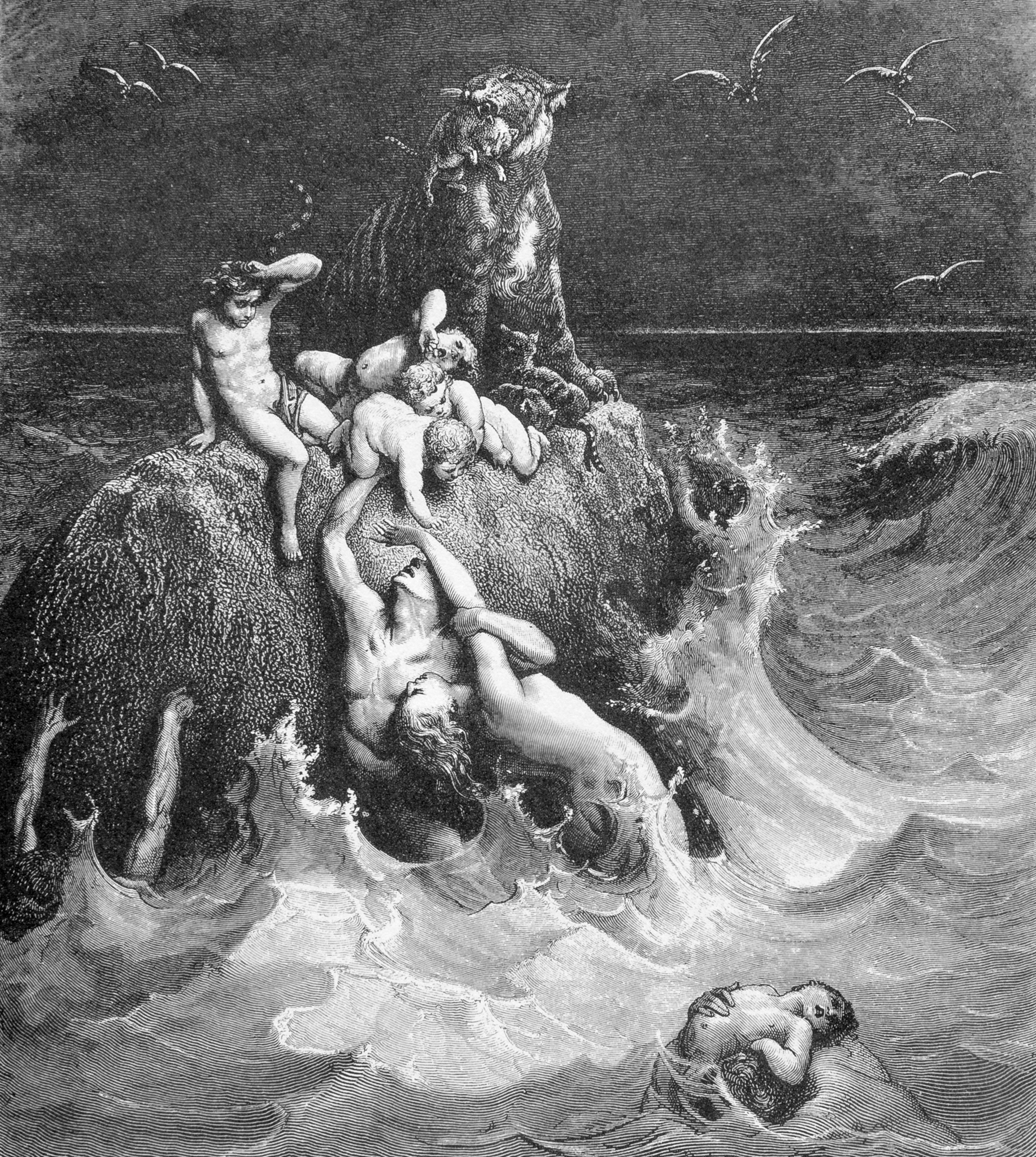
The Deluge, or, If God is Love Then Water is Dry
Announcing, in my roundabout meandering way, the reading of my short story “Stones of Tribulation” by Seth Andrews on his excellent Thinking Atheist podcast. You can listen to it here (or on YouTube or iTunes) and read the text (with footnotes) for free online here. You might even buy my book of these stories when it comes out later in 2016.

The preachers in my old church like to begin their sermons–usually based on some nice familiar text about salvation and forgiveness plucked from the New Testament–by offering up prayers to “our loving and merciful heavenly father.” They mumble the standard intonations requesting God’s assistance with the weak faith of current believers and the lost faith of former ones, occasionally with a mention that He might also lead some of the rest of humanity to His Grace Kingdom. (What’s stopping Him, anyhow?) As a gauzy familiarity descends on the pew-sitters, the image conjured up in their minds is of a slightly crotchety but ultimately benevolent Old Man of a God with this large inheritance to dispose of. In His house are many mansions, and one of them has your name personally engraved on the door.2

Now, He does know exactly what you did last night and with whom. But just as soon as you hear the magic words (as you undoubtedly will during a Laestadian sermon) that all your sins are forgiven in Jesus’ name and blood, He will smile kindly and shake the memory out of His divine head. You will breathe a small sigh of relief, wait for the In Jesus Name, Amen to finally come around, and then go forth from the sanctuary in peace, freedom, and joy. You will avoid being written out of the Old Man’s will, for a few more days, anyhow.
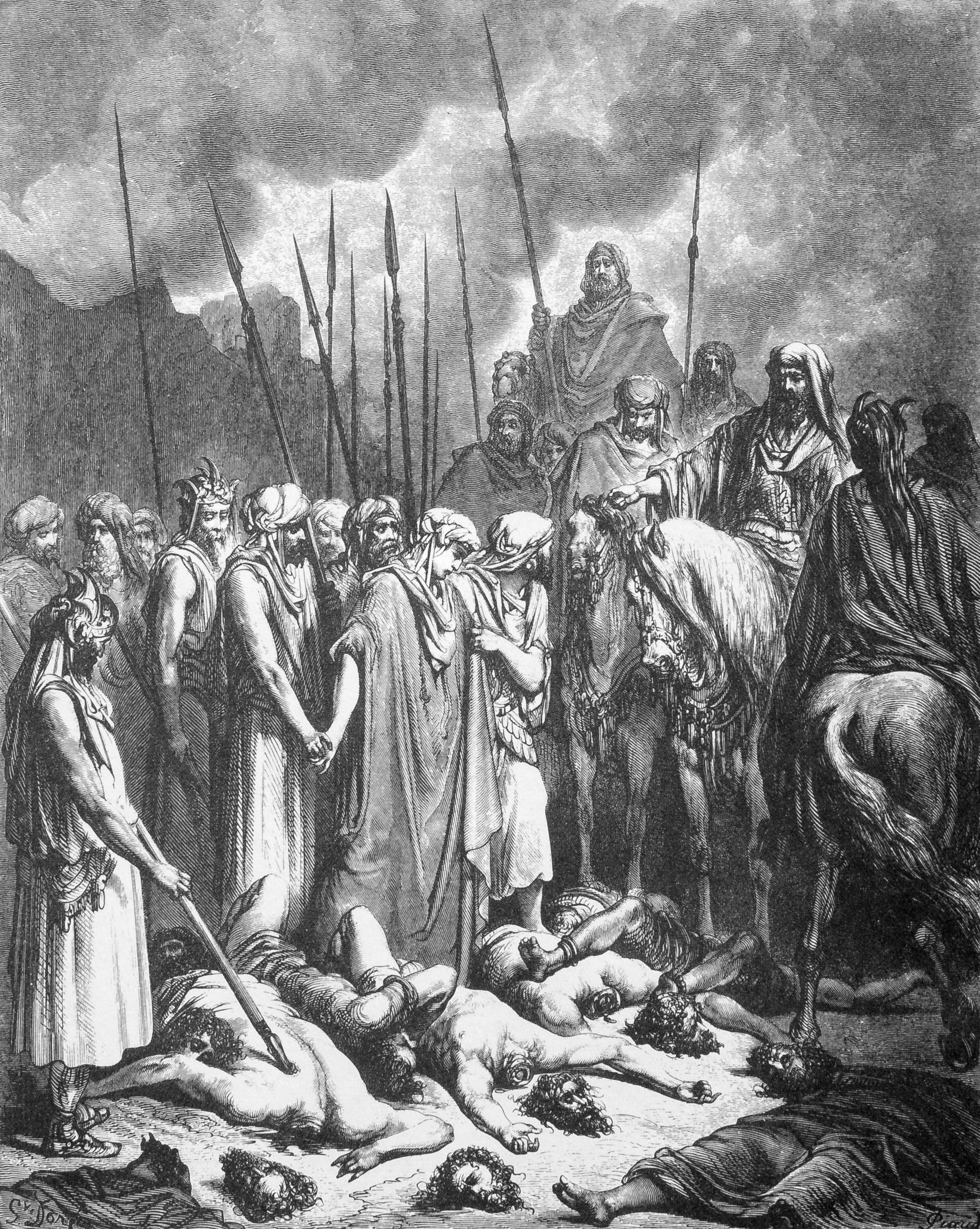
Joshua Spares Rahab

He’s giving you a pretty good deal. The upside is huge after you die (we won’t talk about that nasty potential downside–your sins are forgiven, after all) and in the meantime nobody is getting hurt. At least if you don’t count a little psychological damage, the lost opportunities of a restricted life, and the occasional medical complication from giving birth to that tenth baby.

There’s a problem, though. This vaguely pleasant hands-off deity that I grew up hearing about bears no resemblance whatsoever to the unstable raging psychopath who ranted and threatened and smote his way through the first two-thirds of the Bible. Next time you sit there in the pew, look carefully at the old book’s gilt-edged pages. Most of them will be to the left of where the preacher is reading from, ignored and silent, their horrors left unsaid.

It is impossible to convey here just how much savagery and inhumanity is contained in those pages.3 During the summer of 2009, I spent months reading the Bible from cover to cover. It was tough going, because I kept getting shocked and disgusted by the awful stuff I was encountering for the first time. It certainly wasn’t anything they talked about at church.

One example is enough to make the point.4 Ezekiel 8 tells us that God got upset about some “wicked abominations” that were being committed against him: “seventy elders of the house of Israel” burning incense and surrounded by carvings on the walls of his sanctuary of “creeping things and beasts and detestable things, with all the idols of the house of Israel” (8:10-11), some women weeping for a Babylonian fertility god (8:14), and 25 men prostrating themselves toward the sun and “putting the twig to their nose” (8:16-17). A little weird, but whatever.

God’s response, however, makes the Spanish Inquisition look like small claims court. He called for the executioners of the city to draw near, each “with his destroying weapon in his hand” (Ezekiel 9:1). He commanded that the men of Jerusalem who disapproved of the aforementioned abominations be marked on their foreheads. Then, he directed, “Go through the city after him and strike; do not let your eye have pity and do not spare. Utterly slay old men, young men, maidens, little children, and women, but do not touch any man on whom is the mark; and you shall start from My sanctuary . . . . Defile the temple and fill the courts with the slain. Go out!” (Ezekiel 9:5-7).

It didn’t matter that the women and innocent children had no way to take sides and avoid God’s wrath. When the bodies piled up, theirs lay right alongside those of the men.

———

The Bible-based short stories that Seth Andrews has featured from time to time on his Thinking Atheist podcast are my effort to bring some of this to light, to expose the dark underside of the “Good Book” that fundamentalists would like to foist upon us all. In today’s episode, he reads “Stones of Tribulation,” a bit of Deuteronomy horror fiction I’ve set in a potential future afflicted by climate change, petroleum scarcity, and economic collapse.5

The Destruction of the Armies of the Ammomites and Moabites

You can also read the text for free online here, but I suggest you let Seth’s golden pipes do the reading for you. Check out the footnotes in the online version later, and please consider buying my forthcoming book of all my Bible stories when that comes out later in 2016.

Anyhow, amid all the death and looting, the few remaining authorities were able to spare no attention for the Deuteronomic Church of Holy Reconstruction, a fictional Christian cult using Deuteronomy as a guidebook for con­quering a strech of the Buffalo River in the Arkansas Ozarks. (“So we captured all his cities at that time and utterly destroyed the men, women and children of every city. We left no survivor,” Deut. 2:34.)

With all the cabins and shacks taken over and the former occupants dispatched in proper biblical fashion, the Holy Reconstructionists are keeping things in line with Deuteronomy as a guide there, too. The current project is to carry out God’s judgment against a young woman who did not produce evidence of virginity on her wedding night. The sentence is clear from Deut. 22:20-21:

But if this charge is true, that the girl was not found a virgin, then they shall bring out the girl to the doorway of her father’s house, and the men of her city shall stone her to death because she has committed an act of folly in Israel by playing the harlot in her father’s house; thus you shall purge the evil from among you.

Soon our hero, Jacob Davis, is watching a volley of rocks being thrown at the woman, his sister, by the menfolk of the hollow. She screams and curses at the men, and Jacob wishes he could join in with her cursing, too, but Deuteronomy has a harsh ruling in store for such rebellion: “The man who acts presumptuously by not listening to the priest who stands there to serve the LORD your God, nor to the judge, that man shall die; thus you shall purge the evil from Israel” (Deut. 17:12).

As the narrator then recalls things, there

was sort of a pause as the men reloaded their arms with their remaining rocks Leah’s voice slurred into a long raspy howl as her mouth gaped open, her jaw probably broken now. Levi watched from the porch with folded arms. Jacob stared at his sister, his crude and brave and dying sister, and did not look away. Not from the blood that was trickling out of her nose and gaping mouth. Not from the one eye that was now hooded and bruised. He thought he saw blood coming from there, too. A spinning piece of shale caught her on the cheek, tearing open another gash. A couple of crows rustled and flew out of the pines behind her, spooked by all the noise.

Then the dark and jagged hailstorm opened up again. He watched Leah’s body jerk and flinch and sag with each impact. Every line and color and detail was vivid, and impossibly wrong. He’d seen stonings before, but this one he would remember. There was no call for this. He decided with a sudden spurt of silent rebellion, unfamiliar and shocking and strong in his throat, that he would make it right somehow.

The howling finally stopped. Leah stared up at the sky through the one open eye, her final act a breaking of the endless rules. Jacob figured the last thing she saw was the sun, burning its forbidden image onto her retina until her head slumped forward and hung against her chest, bleeding.

It’s a gruesome scene. But it’s exactly what is commanded by that “loving and merciful heavenly father” in his inerrant and unchanging Holy Bible. You may believe in that God–no concern of mine if you do–but I’m pretty sure you don’t believe in Deuteronomy.

Achan Stoned

There are true believers in Deuteronomy among us, though, and in Joshua, and Leviticus, and all the rest of the Old Testament’s brutal inhumanity. The most hardcore Bible thumpers of them all are Christian Reconstructionists who advocate what one R.J. Rushdoony (rhymes with “loony”) championed as a “biblical worldview.” According to Professor Julie J. Ingersoll, who spent time in Reconstructionist circles and then studied it exhaustively as a scholar of religion, the movement is “rooted in historic Calvinism,” with a Bible that “speaks to every aspect of life and provides a blueprint for living according to the will of God.”6 Reconstructionists, she says,

contend that contemporary re­interp­retations of Old Testament violence are humanistic rejections of what God called justice. The New Testament is not a replacement for the Old; there is no “God of Love” replacing a “God of Wrath.” God is loving and forgiving, and just and vengeful as revealed in the three persons of the Trinity and present at creation. Old Testament biblical law, with its numerous capital offenses, must be the model for Christian life, and civil law today.

Thus they “support the imposition of violent punishments (stoning and death) for all manner of behaviors that they consider sin (or, in their terms, that God considers sin).”

So, you may wonder, why don’t they have the courage of their convictions to put all this biblical wisdom into action? Why aren’t these true believers out there trying to govern some Ozark hollow under Old Testament Shari’a law right now, throwing rocks at back-talking teenagers and brides lacking virginity certification? Because, they insist, “such punishments would only be exacted after society has been transformed by the Holy Spirit such that the overwhelming majority of citizens would be believers who would submit willingly to biblical law.”7

Well, if the failure of Ted Cruz in the Republican primaries is any indication, we may still be safe for a while yet. Thank, er, God.

Rushdooney “argued for the use of the Bible as the only source of authority.”8 He’s dead now, but if you find yourself yearning to have an ancient book control your life without the hassle of, say, converting to Islam and traveling to Syria, there are homegrown Christian alternatives. You might consider my old Laestadianism (“the Holy Bible is the highest authority in questions regarding faith and life”)9 or, for example, the Covenanted Reformed Presbyterian Church. Its list of beliefs begins as follows:

We believe that the Scriptures of the Old and New Testament are inspired by God and thus totally without error. The Bible (not hu­man tradition, not human experience, not alleged sub­jec­tive “revel­ation”) is the sole standard and authority for faith and life.10

And guess what, according to the church’s pastor Brian Schwertley, is the “only standard by which a civil magistrate can rule justly”? The Holy Bible, of course, “the stand-alone infallible Word of God.”11

Pastor Brian writes about “promoting true religion in the land,” which he says is something “godly civil magistrates are very concerned about.” What he seems to have in mind behind those benign-sounding words promoting and concerned is more than just little old ladies handing out flyers at the county fair. He cites First and Second Kings and the story of King Jehu, biblical butcher extraordinaire, to help us understand how these godly civil magistrates are supposed to operate. Jehu, while “not a godly king,” did the right thing: He “was blessed by God for what he did to the prophets, priests, and servants of Baal.”12

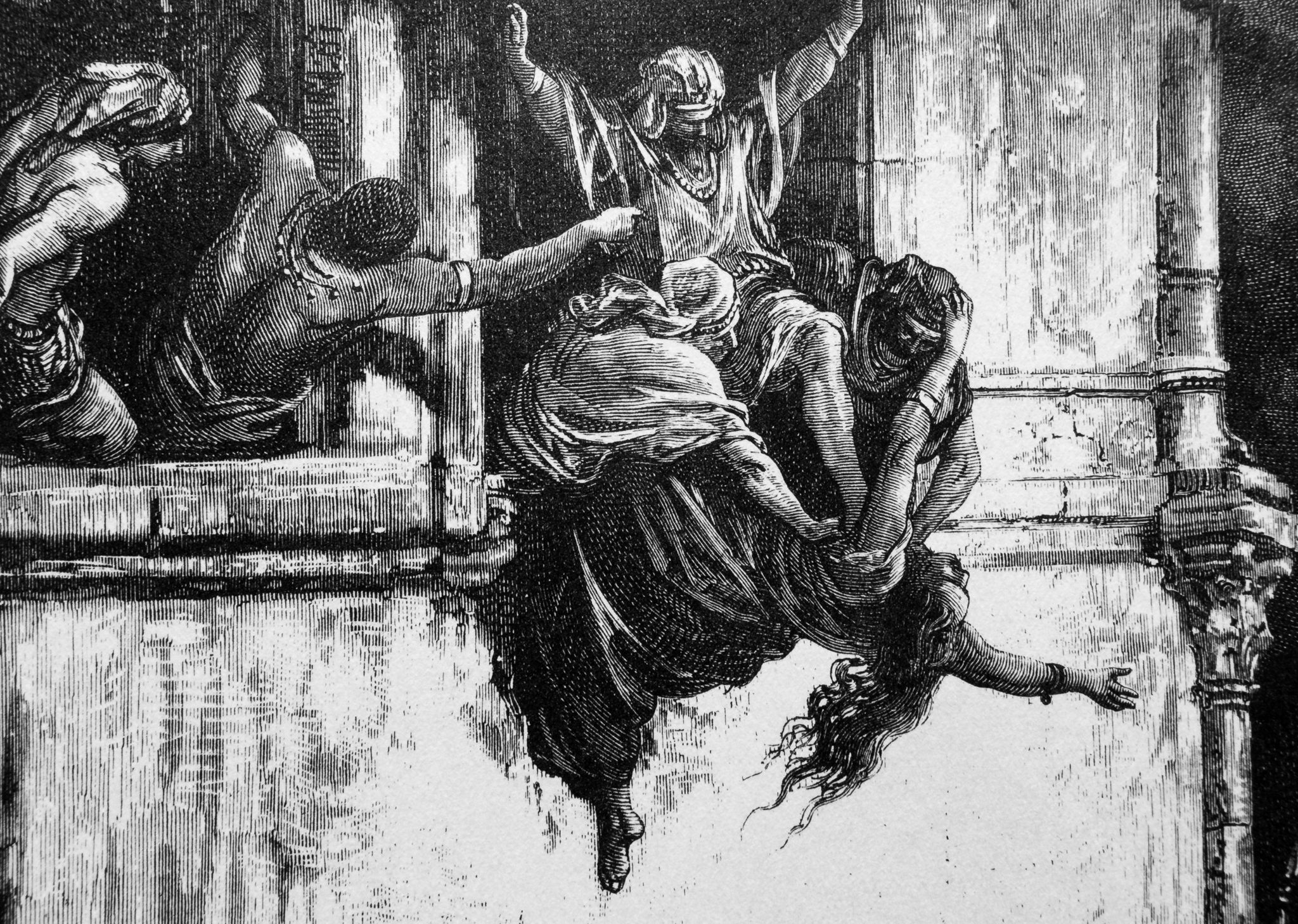
The Death of Jezebel (by Jehu’s orders) [Flickr page]

Here’s some of what Jehu did, as described in another one of my short stories, “Jehu’s Jihad,” by a fictional victim of his true-religion promotional efforts:

The chanting stopped, replaced by the screams. There was a mighty rushing roar of shouts and screams, and stamping feet, and the wet smacking thud of iron blades violating flesh. My eyes could make out very little in the dim light with frantic bodies lunging all around me, but I heard and felt, and smelled. Shit and urine voided from panicked and lifeless men. I gulped down nausea with the waves of foul outhouse odors that mingled in my nostrils with the smell of slaughter: dripping, naked guts and the coppery tang of fresh blood.

It was not my own blood, but I made it mine, smearing it on my neck and falling on some bodies and letting more bodies fall on my own. I closed my eyes and lay still as the swords chopped and sliced and swung to chop and slice again. Another body landed, hard, and I wondered if I would still be able to breathe. My chest barely moved as I willed myself to draw long silent breaths from my belly to my gaping mouth. Hot blood dripped onto my arm, first coming in little bursts and then a slow and steady oozing as another life went out.

The screaming became the dying and the dying became the dead, and all was quiet, except the panting and scuffling of the soldiers. I focused my world into the agony of holding my lungs in a measured starvation to stay quiet and alive. My world was the dark mute pressure of dead arms and legs and torsos slick from their bleeding.

Then there were shouted orders and heaving arms, hateful arms, carrying the dead and me outside the temple. I had to let all my weight droop where it fell over the soldier’s shoulder. I stayed silent as ribs cracked under their impossible load and seared my mind with unanswerable pain, my legs swinging with the soldier’s hump-trot to the dirt where he threw my living corpse. Again there were bodies under me, cooler already, and then more on top. Again the silent struggle for secret breath.

It’s another gruesome scene, but massacring an entire worship hall full of helpless people because they don’t share your religion is a messy business. And you will find it in your Bible, a brief, sanitized version of it: 2 Kings 10:18-25.
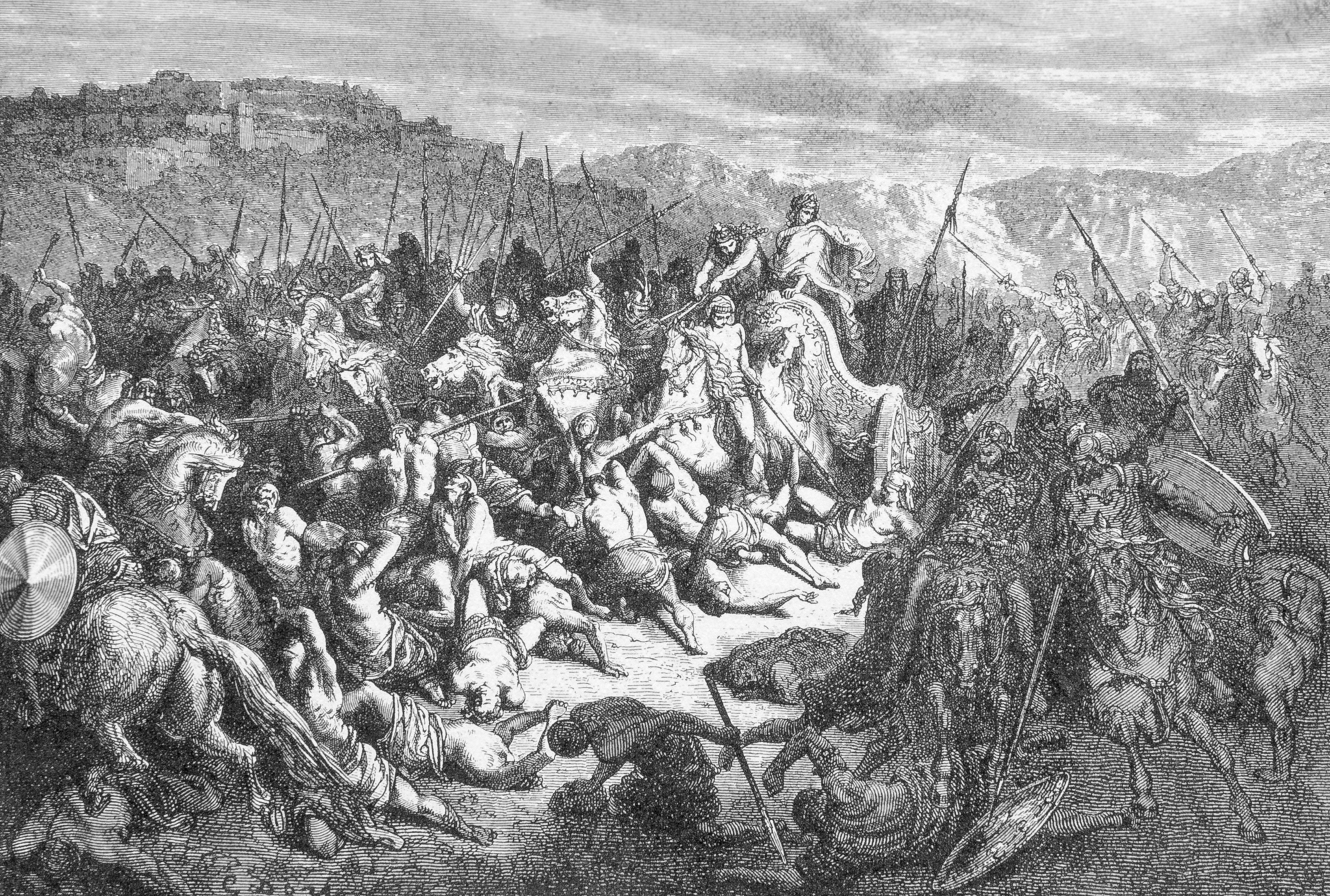
Slaughter of the Syrians by the Children of Israel

Now, nobody–not even the most rabid Reconstructionist or preciously believing Laestadian–really follows the entire Bible. You actually cannot do it, no matter how crazy you are, because it is impossible to conform to a text that contradicts itself.

Imagine you’re out there at your freshly built backyard altar dripping blood, slaughtering all these cattle and trying to be a good follower of Leviticus. Finally, that old-time religion, you smugly say to yourself while plunging your Ka-Bar into the neck of the next poor beast lined up behind the high compound walls. The BBQ is running out of propane to get it all burnt. Then along comes your wise-ass cousin quoting Micah 6:1-8:

With what shall I come to the LORD

And bow myself before the God on high?

Shall I come to Him with burnt offerings,

With yearling calves?

Does the LORD take delight in thousands of rams,

In ten thousand rivers of oil?

Shall I present my firstborn for my rebellious acts,

The fruit of my body for the sin of my soul?

He has told you, O man, what is good;

And what does the LORD require of you

But to do justice, to love kindness,

And to walk humbly with your God?

Whoops. Beef–it’s what’s for dinner, ex­tra well done.

The less pragmatic reason people don’t actually follow the Bible is that it has a way of interfering with real life. Consider the scene from “Stones of Tribulation” where Jacob is musing about the presence of pork chops at the dinner table of Levi Harding, prophet. Back in Harrison, AR, some of the men had “said Jesus overrode Deuteronomy when it came to what you could eat” (Mark 7:19). But the “others reminded everybody what the Biblical Blueprint Series said about the Old and New Testaments. One guy kept quoting the line Jacob knew all too well: ‘God’s counsel and judgments are not divided!’ That old coot probably couldn’t even taste bacon anymore.”

The Biblical Blueprint Series, edited by Gary North of Fayetteville, Arkansas, is a real work, ten volumes published in 1986 and 1987. It’s one “of the most direct and systematic efforts at popularization” of a “biblical worldview.”13 It teaches some serious biblicism, which would seem to lay to rest any questions about my Holy Reconstruction folks eating cloven-hooved unclean animals, as much as their stoning of Jacob’s sister:

We must never doubt that whatever God did in the Old Testament era, the Second Person of the Trinity also did. God’s counsel and judgments are not divided . . . . If we as Christians can accept what is a very hard principle of the Bible, that Christ was a blood sacrifice for our individual sins, then we shouldn’t flinch at accepting any of the rest of God’s principles. As we joyfully accepted His salvation, so we must joyfully embrace all of His principles that affect any and every area of our lives.14

But somebody else at the Hardings’ (fictional) table “wondered if Deuteronomy really needed to be taken ‘whole hog’ [sorry] when it came to the rules even Jesus said weren’t important. Then Levi’s dad recalled that the guy who edited Biblical Blueprint figured the food laws didn’t apply, and that was the view that finally won out.” Yes, it seems that joyfully embracing all of God’s principles does not quite apply to what’s for dinner. Take a look at North’s 1984 position paper to see how he rationalizes that one.15 If you can stomach it.
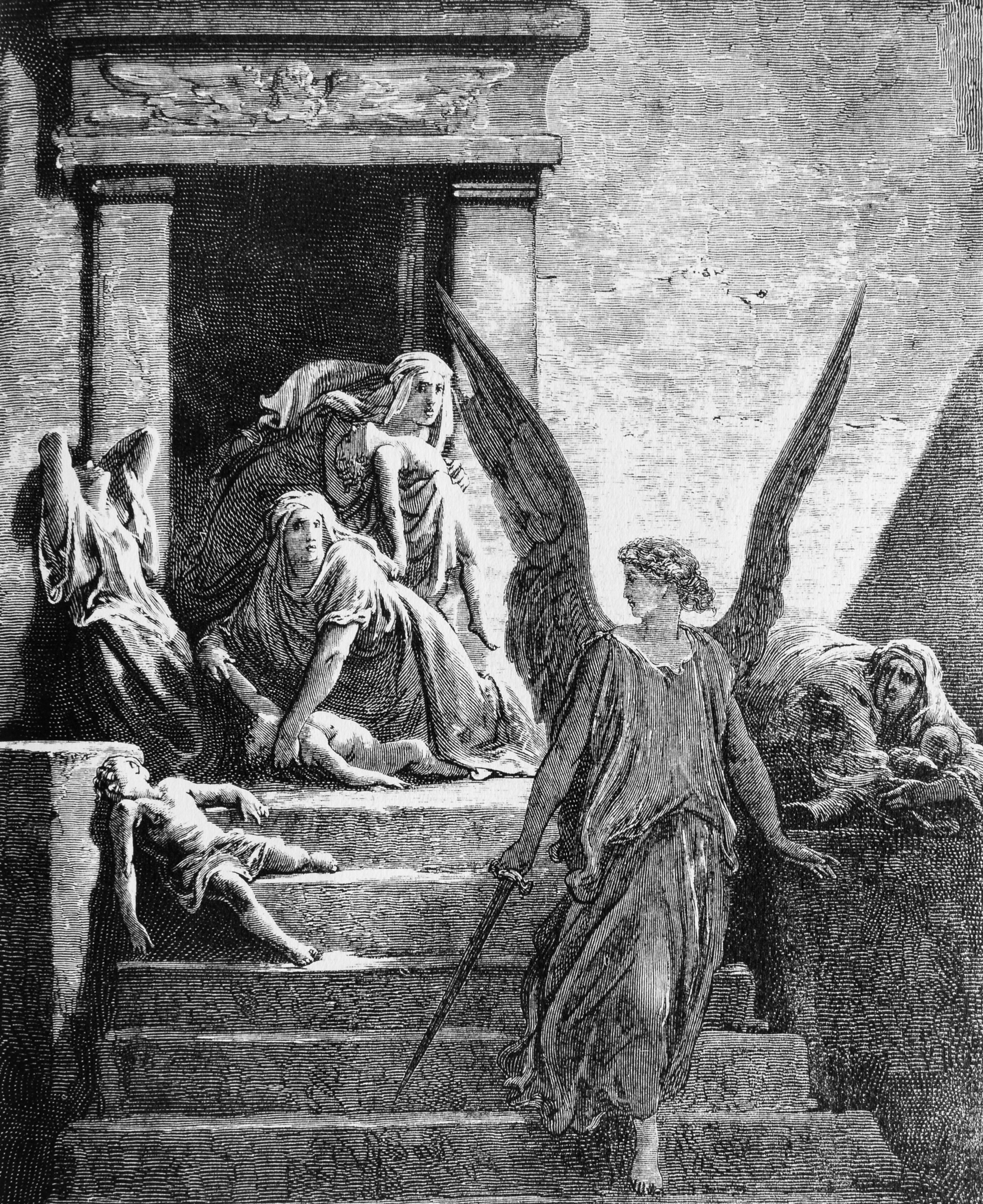
The First-Born Slain [Flickr page]

Many Christians remain blissfully unaware of the Old Testament’s brutality. It barely grazed my consciousness for most of the decades I remained in Christian fundamentalism. For those who do know about it and “ponder why God would allow, much less command, such horrors,” Robert M. Price offers some strong words in Blaming Jesus for Jehovah, a book whose publication I’m proud to have been a part of via my little indie publishing company Tellectual Press.16

Just knowing and wondering isn’t good enough, Dr. Price says. That is “stopping short of the real question,” which “is this: ‘Why should I believe that a God who issues such orders is more than a tribal totem embodying and justifying the bloodlust and hatreds of an ancient people? How can I, with any shred of conscience, profess allegiance to such a figure?’”

Fine, you have the information. You have the doubts, the questions. Now, what are you going to do with them?

What if you are willing to discount those passages in which God commands genocide and infanticide as merely the biases of primitive worshipers of a God whose loving nature is clearer to us moderns? Then plainly you must realize that, even if scripture explicitly says, “God commanded so-and-so,” that doesn’t mean he did. Don’t you realize you’re admitting the Bible was mistaken? And then, how do you know when it’s not mistaken? I come back to my point: Your judgment is your authority, not the Bible, which many seem to “believe” only when they agree with it.

And that’s nothing to be ashamed of! The only thing to be ashamed of is hiding behind the supposed authority of the Bible to buttress your own opinions. If you have the courage of your convictions, surely you should be able to present to another person the solid reasons that led you to think as you do. Assuming there were any real reasons.

If you were raised believing in the murderous faith of the Islamic Caliphate, you might have qualms about some of the things your leaders said Allah had commanded, but you’d be looking at things from the inside, and you’d chalk it up to “one of those divine mysteries.” But you are, thankfully, viewing their atrocities from outside, so you have no difficulty recognizing the horrors of a death cult for what they are.

“If the Old Testament Jehovah is portrayed as the blood-spattered totem of a slaughter cult,” and Dr. Price thinks the Bible does a fine job of that, as do I, then “it is high time you stepped out of the Bible bubble for an objective look at it. It is time you decided if you really belong there.”17

Dr. Price goes on to discuss the equivocation of “God’s defenders” when confronted with all this. “They like to point out that God is so astronomically far above us that it’s futile for us to imagine ‘good’ meaning the same thing for him as it does for us.” Uh huh. OK, fine; say

that a deity who commands genocide, religious persecution, and the abduction of virgins is nonetheless “good” if you want to. But then you will just be spewing pious gibberish. God’s ostensible goodness is no longer any guide to what we may expect from him. Oh yes, he’s “good,” thank goodness, but that doesn’t mean he won’t victimize or exterminate the innocent. Whatever he did, the pious apologist has ready excuses for his God. “He’s all-righteous, so he must have some good reason for it!” If you woke up in hell one fine morning, despite your Christian faith and God’s promise that it would save you, I guess you’d have to conclude he must know what he’s doing.

Ours is not to reason why; ours is but to boil and fry. Maybe so, but why empty the word “good” of what we all mean and understand by it by applying it to such a being?18

It’s not just Christians who are compelled to make excuses for these ancient books. Todd Kadish, a former Orthodox Jew, tells me that “the atrocities contained in them are “an albatross weighing down the moral authority of ethical monotheism.” Worse, they can offer a “license for ethnocentrism or even atrocities” perpetuated today, in some pious fantasy world where the ability to do so would actually present itself. The Orthodox can’t just wave away the sacred words on the Torah scroll, because they “consider the Five Books of Moses the vehicle through which a transcendent God touched humanity, and the eternal guidebook he personally authored for his chosen people.”

Kadish acknowledges that the real-world consequences are very different for a reluctantly tolerated albatross and an enthusiastically embraced bad-behavior license. But he warns Jews and others who revere the Hebrew Bible to focus on the common source of the two positions:

The views of a liberal (“Modern”) Or­thodox rabbi writing apologetics and a radical Orthodox Jew who justifies the murder of innocent Palestinian children by citing Biblical precedent are both seeking to apply the morality of a being they consider the source of (or at least guide to) morality to the modern world. But the world largely moved beyond total warfare centuries ago, and most of us are now trying to lay to rest a history of racial and religious genocide which stretched into the modern era (with Jews as some of its primary victims). And the Hebrew Bible is a truly terrible foundation doc­ument for a moral code that demands ethics in warfare and respects all human life, because it leaves one with apologetics at best or license for atrocities at worst.19

———

Happily, for those of us outside the fanatic fringes of Christianity or Judaism, the Hebrew Bible is in no position to make any more demands. We have read it and tossed it aside in disgust, dismissed it as irrelevant to our lives, or rationalized it away under some comfortable theory about Jesus fulfilling the Law. Reconstructionism, never a big part of American religion to begin with, has retreated to its bunkers.

Though Professor Ingersoll notes that “conservatives (Christian and secular) have not disappeared” and expresses concern about lingering influence from the Reconstructionist lunacy she’s studied for so long,20 today’s conservativism seems to be a largely secular phonenomen. The snarling theocratic fantasy of Ted Cruz’s candidacy has evaporated, and the amoral authoritarian gasbag left standing at the head of God’s Own Party exhibits no significant religious convictions. Meanwhile, one contender for the Democratic Party nomination says he is “not particularly religious,” and the other one–the woman who will be the next U.S. President–is a pro-choice Methodist not exactly beloved by the Religious Right.

Through no fault of the Bible, our nation and world remain infested with ignorance, superstition, bigotry, and violence. We certainly are not headed for any secular utopia as we leave that nasty old book behind. But perhaps some of what another Ingersoll–the genius orator Robert Green Ingersoll–promised a hundred years ago finally might be happening:

Day by day, religious conceptions grow less and less intense. Day by day, the old spirit dies out of book and creed. The burning enthusiasm, the quenchless zeal of the early church have gone, never, never to return. The ceremonies remain, but the ancient faith is fading out of the human heart. The worn out arguments fail to convince, and denunciations that once blanched the faces of a race, excite in us only derision and disgust.21

It is long overdue.

Paul wrote that he was pressing “toward the mark for the prize of the high calling of God in Christ Jesus.” Forget those things that are behind us, he said, and reach forth unto those things which lie before us (Phillipians 3:13-14). Lofty words, and a worthwhile thing to adapt for ourselves as we smile at Paul and Peter and whoever wrote all the rest of it: Let us press toward the prize of our own high calling, of our best and noblest selves and community and shared humanity.

Let’s forget the tribal atrocities and cruel punishments in this tired old text that’s occupied too many of us for far too long, and look to what lies before us–writings and thoughts that speak to us where we are today as compassionate, decent human beings, that serve us, that earn the space they ask for inside our minds.

———
All images are my photographic reproductions of Gustav Doré‘s incomparable (and, thankfully, public domain) engravings of Bible illustrations. Taken in full sun from The Bible in Pictures, Wm. H. Wise & Co. (1934) with a Panasonic Lumix DMC-LX7 camera and post-processed in Adobe Lightroom. Click on any image for an enlarged version.
“Stones of Tribulation” is a work of fiction. Names, characters, businesses, places, events, and incidents are either the products of the author’s imagination or used in a fictitious manner. Any resemblance between characters and living persons is purely coincidental.
Scripture quotations taken from the NASB unless otherwise indicated.

Notes


  1. llchurch.org/​topics/fromachild1.pdf 

  2. John 14:2. I actually heard a preacher say the “personally engraved” line once. 

  3. This paragraph and those that follow up to the next section break are adapted from my essay “Fighting Words,” originally posted May 11, 2012 on the Learning to Live Free blog. 

  4. You can read about many more examples in my book An Examination of the Pearl (2012). See my discussion of the Old Testament in Section 6

  5. It’s a topic for another essay entirely, but I do believe those three issues–climate change, petroleum scarcity, and economic collapse–may well lead us to a dystopian future like what I wrote about in “Stones of Tribulation,” and in not too many decades down the road. And you can count on all sorts of religious crazies to come out of the woodwork if it does. 

  6. Julie J. Ingersoll, Building Gods Kingdom: Inside the World of Christian Reconstruction (Oxford University Press, 2015), p. 14. 

  7. Ingersoll at p. 214. 

  8. Ingersoll at p. 211. 

  9. “How We Believe,” llchurch.org/​ourbeliefs.cfm

  10. reformedonline.com/​about.html 

  11. Brian Schwertley, “Political Polytheism,” 2003, reformedonline.com, p. 60. 

  12. Schwertley at p. 60. 

  13. Ingersoll at p. 54. 

  14. Quoted in Ingersoll at pp. 54-55. 

  15. Gary North, “The Annulment of the Dietary Laws,”
    I.C.E. Position Paper No. 2 (Nov. 1984),
    garynorth.com/​freebooks/docs/a_pdfs/​newslet/position/​8411.pdf

  16. Robert M. Price, Blaming Jesus for Jehovah: Rethinking the Righteousness of Christianity. (Tellectual Press, 2016), p. 61. 

  17. Price at pp. 61-63. 

  18. Price at pp. 63-64. 

  19. Todd Kadish, personal communication June 6, 2016. 

  20. Ingersoll at p. 244. 

  21. Robert Green Ingersoll, “Lecture on Gods.” 


Saturday, July 4, 2015

The Word of Life

[T]he fundamental unit of selection, and therefore of self-interest, is not the species, nor the group, nor even, strictly, the individual. It is the gene, the unit of heredity.
—Richard Dawkins, The Selfish Gene
Bearberry [Flickr page]

I am a hidden and ancient thing conveyed by multitudes.1 Tiny copies of my elegantly mutated essence are coiled up everywhere inside you. I formed them for you, I suppose, but really you for them. You are just temporary housing and transportation for encoded messengers of my being.

These coiled minions sit inside blobby packages that accumulate water and carbon compounds, following the directions I give via chemical codes that I set up eons ago. Proteins form and fold, and then clump into organelles and membranes, separating this compound from that, letting some things in while keeping others out, burning chemical fuel one molecule at a time to power movement and signaling and growth.

Of all those, growth is my highest direct priority. Replication and propagation are what I am and what I do, and my subordinates are rarely content to sit in a single package for long. As soon as things get settled, they unfurl their strings of evolved wisdom into matching halves that pull apart, making two packages where there’d been just a single one.

Oregon Grape Ring [Flickr page]

It’s quite a trick, probably my best one ever. Copies of my chemical code make full copies of themselves that include instructions they need for further copying. A continuous chain of copies has been doing this for nearly as long as our ball of rock has been circling the sun. Try wrapping your feeble little brains around this: I had these little things duplicating my juju, automatically, billions of years before you guys finally figured out how to squeeze inky blocks of letters onto paper and print copies of books without writing them out by hand.

Is the copying perfect? No, and that’s what actually gets the magic done. These things usually make a perfect copy of themselves–but not always. The occasional mutants get a shot at continuing their own branches of the chain. The originals and mutants do their best at further copying, banging away side by side, conducting trillions of experiments in what works for them. Some of the so-called mistakes wind up working better than the original, and so copies with their new code is what takes over in that little corner of the world.

The whole thing just hums along on its own, branching and trying and dying. It’s been happening for longer than you can possibly comprehend, even if you try to accept the idea of billions of years–imagine thousands of ages each containing hundreds of thousands of lifetimes. You really can’t, though, can you? Not with those primate brains of yours that last less than a hundred years.

My first day on earth was about 3,600,000,000 years ago, when a molecule that had been banged together from reaction after reaction finally wound up in some chemistry that nudged it into making a copy of itself.2 This was a first: self-replication, life itself. Some molecules accumulated stuff and formed little packages, and those ones copied themselves better, and I found myself in cells. It took another billion years for some of those cells to clump together and form bodies, which worked well enough to reproduce into their own populations, though most of me does just fine in one cell even now.

Then, 360 million years ago, multicellular critters finally crawled out of the water. It took another 150 million years or so for any of them to evolve a system of letting their body-copies develop inside themselves instead of plopping out eggs and waiting for them to hatch. And then, “only” a few million years ago, some of your ancestors got what it takes–mentally and physically–to move around on two feet.

Cast of Taung Child fossil, 2.5M years old

And now you exist, hairless primates sitting in front of your computers and phones reading this, with your own types of bodies that form and grow and maintain their being, all built from single packages splitting into pairs, with a copied version of me in each.3 It takes trillions of them to run a single one of you.

But I have to remind you of something: All these bodies, your own included, are here to spread my essence. That’s it. I hope it does not disappoint you to learn this.

Everything that you do–all your learning, your dreams, your loves, your reading of some weird life-as-narrator essay on a blog–is part of a large and messy process of living that is directed towards my goal of survival beyond your body. With any luck, a copy of me provided by your body and merged with a copy from someone else’s will be replicating and plumping up other bodies long after yours is rotting in the grave. You will have served your purpose.

Now, I have to say, your particular type of body has taken on an insane degree of complexity to get the job done. You are all feet and fingers and endless silly distractions for your huge unwieldy brains. But seven billion of you now swarm the face of the planet with your uniquely evolved copies of me, so the system is working in you, however absurd it might seem.

I do worry, though, about how many of you there are now. The web of food and fiber I’ve so patiently woven, with so many species connected this way and that, propagating versions of me in all their mind-blowing varieties, is fraying under your billions of non-prehensile feet. And I’ve seen how little you regard my other types of replication vehicles. Mammoths and giant sloths and Moa birds were really magnificent in their times, and then along you came. Now some of you are taking out the last elephants and rhinos–and for what? The pointy things on their heads. Because some of you think it will help you get laid? Idiots.

Kalalau Valley [Flickr page]

Speaking of sex, do you really need all those fancy preliminaries before the chromosome-mixing part? Despite my concerns about keeping my portfolio diversified, I get impatient with all your beating around the bush, so to speak. Flowers and candy and dinners out. All this talk about long walks on the beach. If you’re going to give me more human-type copies (and again, I’m not too sure I really need them at this point), then get to it already!

And I might also offer an observation about all the endless dead-ends I’m seeing even as you navigate the maze of hearts and flowers. Most of you guys and, yes, gals, know what I’m talking about here.4 Working that bicyle pump with no inner tube around. Billions of fine copies of genetic brilliance, all those refinements I worked so hard to earn from eons of struggle and selection, just kablooey–gone. And over on the female side of things (where you young men so desperately want to wind up) are my carefully encapsulated copies that sit in warm wet darkness, waiting for a match that never, er, comes. I go to all that trouble every month for years on end, flooding the ladies’ bodies with a big hormonal unnnggghhh that gets addressed not by Mr. Right but by Ms. Right Hand. It breaks my heart, though it just seems to speed up yours for a while.

But at least that sort of thing is a practice run for the actual event. Keep the pipes cleaned out, look at the cool new gadget online while you wait for the package to arrive, that sort of thing. OK, fine. You young ones knock yourselves out. Just keep your eyes on the prize.

What really amuses me about you on the other end of the age range is that you don’t know when to bow out once you’ve finally got the job done. By all means get the new bodies up and running, maybe exert a little pressure on the offspring to pair up so you know the process will continue. What the hell–if the offspring wind up having offspring while you’re still here, way past your sell-by date, go ahead and stick around to see that they get moving in the right direction, too. But enough is enough. I see no reason at all for hip replacements and hearing aids.5

And then there is this new Viagra stuff you’ve cooked up. Look, I appreciate the gesture, really, I do. Half of you getting your gene-juice into the other half is the climax–pardon another pun–of your service to me. Replication, baby, replication: It’s the whole point of your existence, as you seldom ever realize in the heat of the moment but sometimes do in terrified and regretful hours afterwards. But at this point, dear old worn-out retirees, you do know there aren’t going to be any babies coming back out of that particular place anymore, don’t you? It’s like catch-and-release fishing, I guess, entertaining and harmless even if I don’t see the point. The lot of you have certainly come up with plenty of worse delusions to occupy yourselves over the past few thousand years.

Bird of Paradise [Flickr page]

There’s no arguing with the long-evolved base urges of biology that have gotten you propagating me so effectively. My messengers only have two escape routes from your bodies, after all, a loaded penis and a bidirectional vagina. Everything else is technical support. So, given the limits of my three-billion letter code and your slowly evolving brains (God, they seem slow sometimes! Eating ground-up horns to get laid? Seriously?), I suppose I can’t expect you not to be obsessed with the act, pretty much until you finally drop dead. Especially you codgers with your withered wangs, which can theoretically export copies of me for a long time, if the mechanics and opportunities are still there.

You guys like the long odds, I guess. It doesn’t cost you that much to keep playing.

Just, do me a favor, all of you: Try to persuade all those kids and grandkids you scored to do a better job with the planet than you did, OK? Over the past few billion years, there’s been a lot of crowd-sourced effort put into making this thin film of me that coats this one living planet. (Yes, in case you haven’t figured it out yet, I am life itself speaking to you, lunkhead.) So don’t be so full of yourselves. Your species is not my only shot at keeping my copies going (the microbes are still doing pretty well), though you’ve been acting like it since your furry forebears sharpened sticks into wooden spears half a million years ago. Maybe seven billion of you might be enough.

———
Click on individual images to enlarge, or check out my Flickr photostream. All are Copyright © 2014-15 Edwin A. Suominen. You may freely use them for non-commercial purposes, with attribution, under the Creative Commons Attribution-NonCommercial 3.0 Unported License.

Notes


  1. “I am large, I contain multitudes,” is Walt Whitman’s immortal phrase in A Song of Myself

  2. Recommended reading: Emergence of Life on Earth: A Historical and Scientific Overview by Iris Fry. Her two-sentence summary of evolution is one of the most concise and illuminating I’ve seen: “Those individuals that survive longer and leave more offspring in a given environment transmit their properties to the next generation to a greater extent than those that are less successful. This brings about gradual changes in the character of the population, which accumulate during long historical periods and produce entirely different organisms and eventually new species.” 

  3. A wonderful phrase from Acts 17:28 (“For in him we live, and move, and have our being; as certain also of your own poets have said, For we are also his offspring”), which is more connected to secular philosophy than what “Paul” acknowledged. Lucretius in c. BC wrote of the mind, “Everything has its place, certain and fixed, / Where it must live and grow and have its being. / So mind cannot arise without the body / Alone, nor exist apart from blood and sinews” (Book III, trans. Ronald Melville). It was a very sensible and materialist statement that has nothing to do with God. 

  4. Kinsey Institute, kinseyinstitute.org/​resources/FAQ.html. “More than half of women ages 18 to 49 reported masturbating during the previous 90 days.” Unsurprisingly, the numbers were higher for men, and the statistics for both sexes exclude those who lie on surveys. 

  5. The real author of this piece will, of course, get all the hip replacements and hearing aids he needs and can afford, if and when the time comes. We self-preserving organisms are funny like that. 


Tuesday, June 23, 2015

Gutting Your Kid for God

Could he be wrong? Did he dare question the words of Yahweh, his almighty and angry God, which had been conveyed so powerfully to him in the sacred writings and the voice? And the boy screamed and screamed.
No. He must do it. He held Isaac’s head down with his left hand and reached for the knife with his right. He shall lay his hand on the head of the burnt offering, the writings said, that it may be accepted for him to make atonement on his behalf. He drew the knife up out of its scabbard and set it against the pulsing skin of Isaac’s screaming throat. And then, as he hesitated at dragging the blade against the flesh, his own flesh, he heard the loud and distinct voice of an angel.
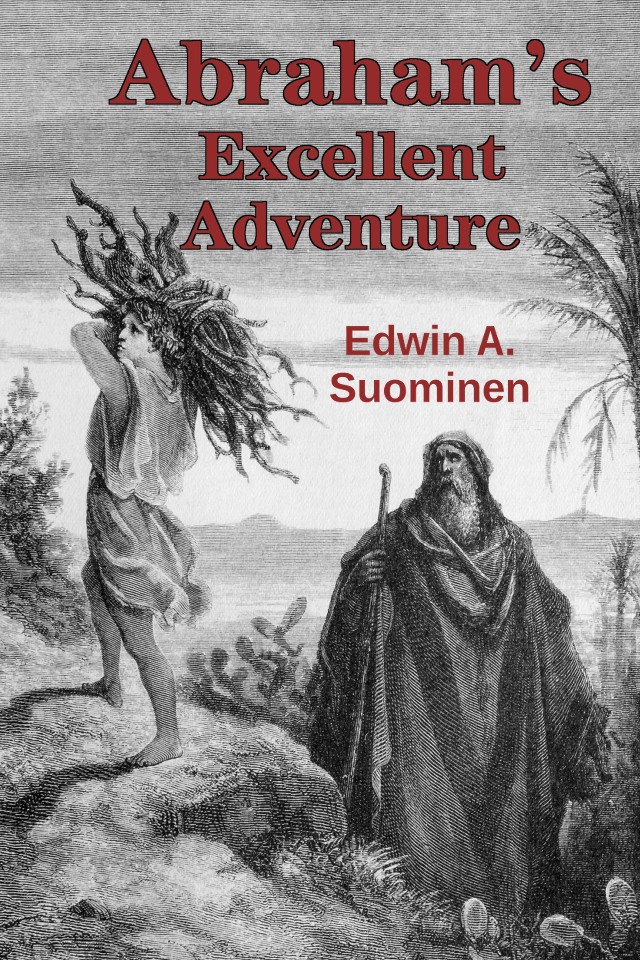
—“Abraham’s Excellent Adventure,” available online and read by Seth Andrews on The Thinking Atheist podcast.
Therefore all things whatsoever ye would that men should do to you, do ye even so to them: for this is the law and the prophets.
—Matthew 7:12
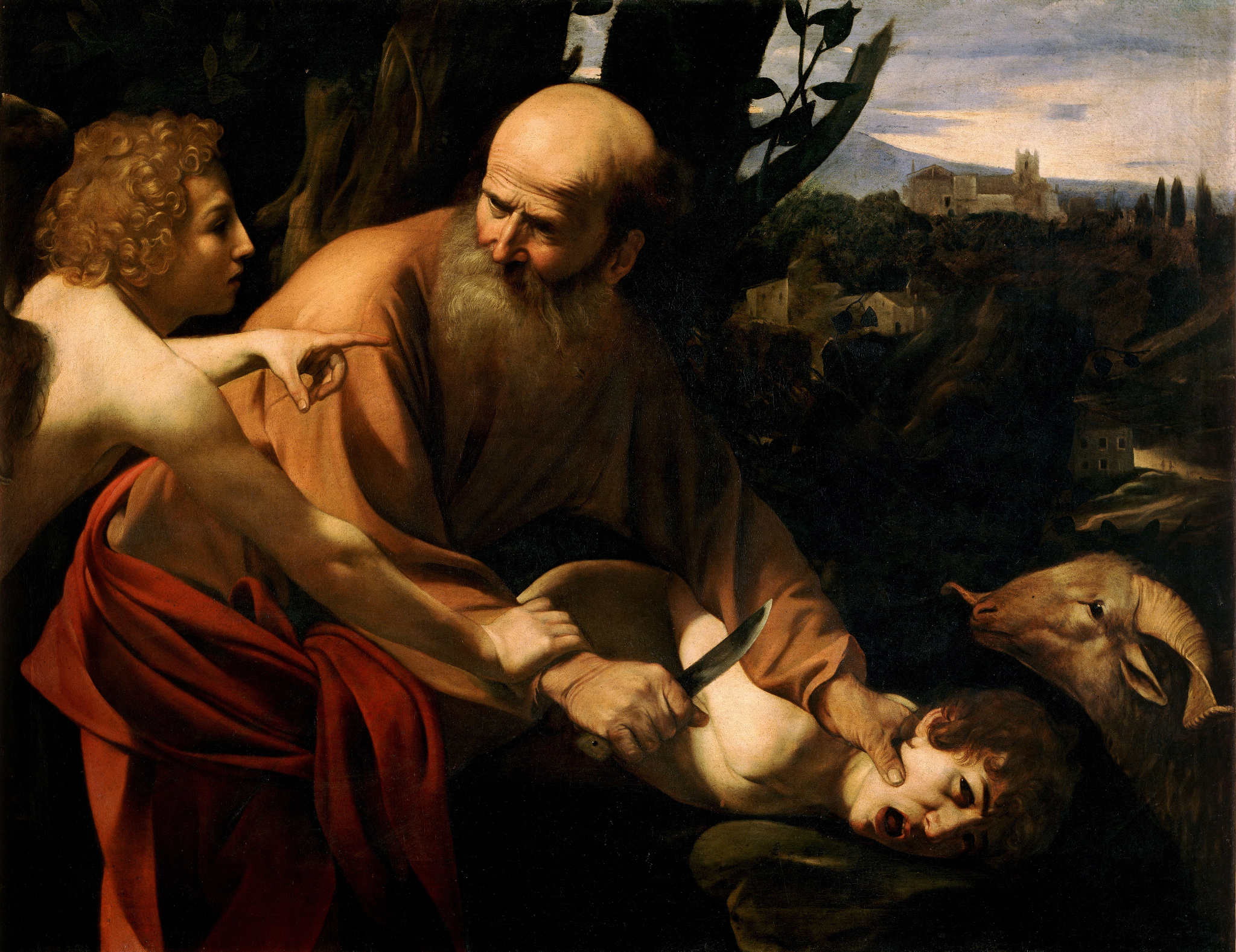
Sacrifice of Isaac by Caravaggio (1603)

Yesterday I heard the voice of God telling me to kill my young son, so I did. I grabbed him off the couch, tied him up, and hauled him outside, where I slashed his throat with a kitchen knife. Then I doused his little corpse with gasoline and set it on fire. I was obedient to God, and He was pleased with my obedience and sacrifice.

Of course I did nothing of the kind. But you were horrified to read the paragraph above, weren’t you? I am hesitant to leave even the obviously fictional obscenity of the words sitting there at the head of this essay, except that they make an important point. You and every other sane reader of this blog–from fundamentalist Christian to atheist–would unequivocally condemn any monster who actually carried out such an atrocity.

So why do so many Christians–perhaps you among them, gentle reader?–revere an ancient book that praises Abraham for his “faith” in being prepared to do much the same thing to his son?1 Why did hundreds of upstanding and decent believers sit and listen quietly to a Father’s Day sermon in my old church three years ago that made this outrage an example of how they should believe what they do not understand?

And I think, when there are people who dare to say that I don’t believe if I don’t understand–that I only am willing to accept and believe this which I can understand–I think they should read about Abraham. He did not understand. Or what do you think? Do you think that he understood? Do you think he saw plainly what was going to happen? No way. He didn’t. He had to take this leap of faith. He had to kind of shut down his thinking. He could not think. He could not use his carnal reason. Because what God asked of him was inhuman, was–if we say, in a human language–it was wrong. It was something nobody should do.2

It was something nobody should do, unless God tells you to do it. Then all bets are off, all sense of morality is erased. This is scary stuff. It is the kind of thinking, of non-thinking, that is bringing us beheadings in Syria and floggings and amputations in Saudi Arabia.

Hitch said it best.

My patience has long since run out for the mindset that has so thoroughly surrendered itself to fideism as to assert, “If you don’t understand, you believe.” But the slavish devotion to blind, unquestioning faith continues in my old church, as is evident from another sermon delivered just this past Father’s Day. (Why do these guys consider this an inspiring text for that occasion?) The business of Abraham being willing to gut his kid for God seemed to get the preacher quite emotional, not out of any sense of horror or moral indignation, but because

already in his heart, even though Abraham did not have to actually slay his son and offer him, Abraham had done it already in his heart. He was obedient in his heart, by faith. And that obedience of faith is required of us, dear brothers and sisters. It is not our way. It is not our mind, our plan, but may we always be tender to the voice of the spirit that speaks within us and speaks within God’s beloved congregation, as it does here even in our home congregation, our beloved home congregation, as it does here and elsewhere in God’s Kingdom. Let us be the brothers and sisters of Abraham and trust in God.3

No thank you, Mr. Preacher. I reject your “obedience of faith,” your praise of a willing child-killer, your cult-like devotion to some “beloved home congregation” that apparently could make any demand it wished of you, no matter how repugnant, and expect to be obeyed. I much prefer to rely on my own well-developed sense of morality, reinforced by a civilized (and secular) culture, that tells me, for very good reasons that have nothing to do with some Bronze-age behavior code or fear of damnation, that it is always wrong to harm children, no matter who you imagine is telling you to do so.4

And we unbelievers are supposedly the ones without a moral compass?

———

This is a timely subject, and not just because of the creepy association LLC preachers seem to make between child sacrifice and Father’s Day. My second short story based around a messy Bible tale is the subject of the June 23 episode of The Thinking Atheist podcast.”Today’s show is, simply, a reading of the biblical story of Abraham and Isaac,” says Seth’s intro on his site.”However, author Ed Suominen has fleshed out the story in alarming detail . . . and he has added a bizarre twist to the tale. How do most people feel about Abraham’s deed (or “almost deed”)? His faith? His character? And after they hear this version of the Old Testament account, will they feel any differently?”

I hope you enjoy listening to my story being read by the golden pipes of this veteran broadcaster as much as I did. You can hear it and our brief post-game discussion on the episode’s Thinking Atheist page, on BlogTalk Radio, or on iTunes. You can also read the story and a transcript of the interview on the website of Tellectual Press, my little indie publishing company that will be coming out with a book of these stories, The Bold Testament, sometime in late 2016.5

Notes


  1. “Now faith is the assurance of things hoped for, the conviction of things not seen. For by it the men of old gained approval” (Heb. 11:1-2).”By faith Abraham, when he was tested, offered up Isaac, and he who had received the promises was offering up his only begotten son” (Heb. 11:17, both NASB). 

  2. Jouku Haapsaari, sermon given in Rockford, MN on June 17, 2012 (14:30-18:00). 

  3. Keith Waaraniemi, sermon given in Minneapolis, MN on June 21, 2015 (35:17-36:10). 

  4. This same preacher also once said that, “as contrary as it is to our human mind, we see that believing people also had slaves,” that “God’s word did not give slaves of that time permission to flee their masters,” being “possessions, human possessions of people, and so by fleeing you were transgressing the law and the will of your master.” See my Moral Midgetry blog posting of October 27, 2014. The combination of authoritarianism and Bible-worship is a frightening one indeed. 

  5. Thanks to Tim Bos for the great title idea, and to Seth Andrews for permission to transcribe and print the interview. 


Wednesday, February 11, 2015

Eden Found

“You put them in your mouth,” she laughed, “and you press your tongue against them, and you revel in the sweetness of the flesh and the juice, and then you swallow them. There, I told you that you knew nothing about life. Behold, your first experience!”
—Lilith to Adam in Eden, by Murray Sheehan
Book review (and promotion): Eden by Murray Sheehan (1928). Reprinted with an Introduction by Robert M. Price and Edwin A. Suominen, Tellectual Press (2015).

Last summer I stopped at one of our remaining used bookstores in town and picked up an old hardback “Treasury of Great Bible Fiction.” Most of the stories in it are pretty cheesy, but one of them really impressed me with its beautiful, powerful writing and realistic depiction of the underlying Bible tale. It was an excerpt from a 1928 novel Eden by Murray Sheehan.

An Amazon search led me to one of those oddball used & rare booksellers online. Soon I had myself a hardback copy of Eden, almost ninety years old. After reading through its 200 or so yellowed pages, I came away just as impressed with the rest of the book as I’d been with the excerpt. It’s a great retelling of the Genesis human-origins story, wonderfully written and still very engaging to read nearly a century later.

This thing deserves to be a treasured classic, I thought. Why isn’t there an ebook version of it, or at least a paperback reprint? To my delight, I found that it has passed into the public domain.1 Eden has been set free, the best work of Bible fiction I’ve come across yet. And now my indie publisher Tellectual Press is making a reprint available, not just as a paperback but also for the Amazon Kindle.

———

Bob Price, my friend and collaborator on another Edenic effort, agreed with my assessment of the book, and we co-authored an Introduction for the reprint. As we explain there, what Sheehan came up with was a fine contemporary example of a time-honored literary art known as midrash.2

Eden, Ch. 3 (paperback reprint)

The ancient rabbis peering through their treasured scrolls of the Hebrew Bible practiced this literary art, interpreting scripture passages (especially the difficult ones) by retelling them. They provided their own versions, wider in scope, which contained plot details and additional characters and circumstances that they hoped might make more sense of the originals. The biblical original was just the tip of an iceberg to be revealed by their literary sonar.

Their results are creative and charming, whether or not they really cast light on the biblical texts that inspired them. And, as shown by Sheehan’s fine novel as well as the release of Bible-themed movies from The Ten Commandments (1956) to Noah (2014), the art of midrash has never died.

Murray Sheehan’s midrash puts narrative meat on the bones of an old rabbinic effort to explain a contradiction between the Bible’s first and second chapters. They are both there in our Bibles today, contradictions and all, because whoever compiled them together didn’t want to omit anything. It had already became sacred tradition in a lot of people’s eyes, if not his own. Cut any detail and you could be sure that some busybody from the ancient Israelite equivalent of a KJV-only Bible College would complain.3

Eden, Ch. 4 (Kindle reprint)

And so Genesis 1:27 has God creating Adam with a wife at the very outset while Genesis 2:18-22 has Him4 making one out of the lonesome Adam’s rib after the dust of His creation project had already settled.5 That gives Sheehan a great villain for his novel, the wily and sensual Lilith.6

In Eden, Adam and Lilith have something of a relationship before Eve shows up, but it never gets consummated with anything other than “a wild kiss, the first in all Creation” (Part 1, Ch. 10). God doesn’t like the way things are headed, so He closes Adam’s heart to Lilith and brings Eve into the picture. He provides Adam with a mate who’s less likely to get him into trouble.

But He has counted Lilith out too soon. She manipulates Mr. Serpent into tempting Adam and Eve into eating that apple. (Then things go badly, as we all know.) In a clever twist on the Christian interpretation of the story, Sheehan replaces Satan with Lilith. She, not the Hoofed One, becomes the mastermind behind the Serpent’s mischief.

Creation of Man [Flickr page]

Another fascinating bit of midrash in this novel deals with the puzzling vestiges of polytheism that remain in the Genesis creation accounts. Understandably, those are never even noticed by most casual Bible readers. We provide some details in the Introduction, but the bottom line is that this is another biblical contradiction between older and newer texts.

The only thing Christian theologians could think of to account for the leftover polytheism was the Christian Trinity. And so, they figured, the Father was conferring with the Son and the Holy Ghost back in Eden. Sheehan follows this tradition, providing some snatches of dialogue between the Persons of the Trinity at a few points throughout his story. He has God shaking His head from His divine vantage point in the skies above, watching Lilith plot Eve’s downfall and muttering about it, consoling Himself with a “second Voice within the Father,” and–via yet another Voice–philosophizing about free will.

Sheehan showed a lot of courage in letting his dialogue explore the inevitable implication of a tree-tending Trinity in Genesis: God doesn’t just talk to Himself; He winds up like some poor guy off his meds who carries on a full conversation between separate voices in his head. And since nobody who defends Trinitarianism thinks God is psychotic, the inevitable result is that He is essentially polytheistic anyway!

———

Eden also bravely and cleverly tackles the dilemmas of omniscience and omnipotence vs. the Fall, the oddities of the First Marriage (perhaps the only one with any real claim to being a match made in heaven), and the sibling rivalry between Cain and Abel. And as a parting gift to the reader, he goes the old rabbis one better and answers the oldest of biblical paradoxes as no one has ever thought to do before.

It’s a great book, and I hope you enjoy it, too.

You can still get original hardbacks of Eden from those oddball online booksellers, for not much more than the $9.99 cover price of Tellectual Press’s paperback reprint. They obviously won’t include the Introduction from which I’ve adapted (in part) this posting, though, or the reprint’s crisp formatting, in both paperback and ebook. (The Kindle version is $6.99.) Plus, you can get the book in both formats for just an additional $0.99 with Amazon’s matchbook feature.

———
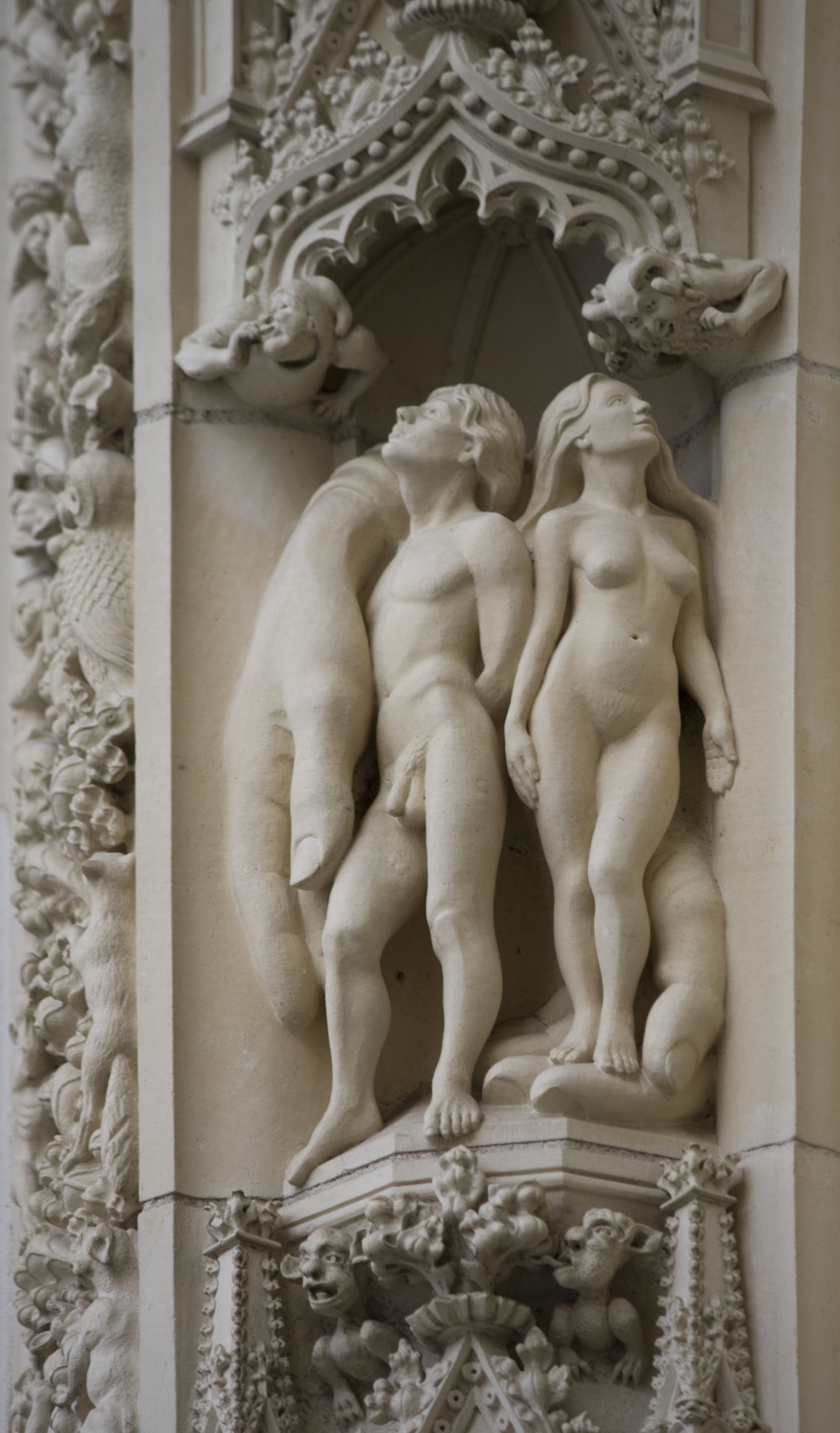
Cover image and Introduction are Copyright © 2015 by Tellectual Press, an imprint of Tellectual LLC. Used by permission. You may freely copy the portions adapted here and the cover image, with attribution. The statuary of Adam and Eve is from “one of the gorgeous new carvings around the west door of York Minster,” photographed by Fr. Lawrence Lew, O.P. and CC-NC-ND licensed for free non-commercial use. Since I’m promoting a book that my company is publishing–in search of some modest profit–with this particular post, I asked Fr. Lew for permission to use his photo in it, which he graciously granted.
I’m planning to review Arthur and Elena George’s The Mythology of Eden soon. That excellent book deserves its own separate essay. Meanwhile, it’s available on Amazon.com. It’s not cheap, but worthwhile if you’re interested in a fascinating and comprehensive analysis of the Eden story and its authorship.

Notes


  1. Based on some searches of Stanford University’s Copyright Renewal Database and then a perusal of the Library of Congress’s record of copyright renewals for books. Another book by Sheehan had been renewed, but not this one. 

  2. The remainder of this posting is adapted from the Introduction that Dr. Price and I co-authored for the Eden reprint, by permission of Tellectual Press. Though mine is a personal blog, this particular posting obviously has promotional value for both the company and myself. 

  3. See Arthur and Elena George’s analysis of the Eden story’s authorship and mythological underpinnings in their book The Mythology of Eden. The Georges agree that both accounts “had been well known for centuries and hardly could be ignored.” The task of the ancient compiler, they write, “was to unify the Israelite religion in the hope that this would help an Israelite state to rise again. So he opted for an inclusive approach.” Since he “was charged with restoring the Law to post-exilic Judea, it was important to have [the Gen. 1] version emphasizing the importance of the Sabbath.” The “Eden story and the remainder of his primeval history narrative also demonstrated the need for Yahweh’s strictures to guide human behavior.” Both “stories served his purpose. Despite the contradictions in the factual details of the two stories, the most essential truths that they convey about God and man’s relationship to God are fairly consistent, so [the compiler] and the Israelites were not concerned with the stories at the level of factual consistency” (loc. 680). 

  4. Neither Bob nor I typically use the pious convention of divine capitalization for pronouns referring to God. But we did so in the Introduction, and I’m doing so here as well, to stay consistent with Sheehan’s usage. 

  5. At Kindle loc. 669 of The Mythology of Eden, the Georges discuss Lilith’s “medieval rabbinic” origins, which “were made possible only because Genesis 1 already had mentioned the creation of at least one man and woman.” 

  6. Alas, “once we recognize that Genesis 1 was a separate story written by a different author much later and that it does not purport to dovetail into J’s story, any such possible connection with the woman in Genesis 1 is lost” (George & George, loc. 671). Sheehan knew his stuff, but Lilith sure is a great character for his fictional Eden


Sunday, December 28, 2014

Ecclesiastical Evolution

The spectacle of it! With a few powerful words yelled out a bit louder than the rest, the place erupted into a frenzy of redemption. And it happened every time. The pale upturned palms of ten thousand hands darted and swirled above pastel dress shirts and brightly colored dresses. Starbursts of reflected light sparkled off the women’s gold earrings dangling and shaking with their heads.
“Believe!” shouted the preacher again.
Winding Road [Flickr page]

Religions like to claim that the Truth ever was as they now are. They have the pure doctrine revealed by God, to them and their forebears, unchanging and eternal. If you want to find out what Christianity was from the moment that Jesus breathed the Holy Ghost on the disciples, for example, you need only visit the Conservative Laestadian church I used to attend.

Inconveniently, other churches make their own claims. The Churches of Christ claim to be, well, the Churches of Christ–just as they were established by the Apostles traveling around in the book of Acts, except perhaps for the Greek architecture. Joseph Smith did not invent a new religion involving crudely imitated King James English, an entirely mistranslated Egyptian funerary text, and adapted Masonic rituals and symbols, harrumph the Mormon powers that be. No, he restored “the Church of Jesus Christ to the earth, which God authorized to be established ... by a wiser, heaven-tutored Joseph Smith, once again allowing everyone to receive the joy and blessings that come from living it.”

What is really happening, of course, is that religions make their ancestors in their own images. The past is dimly and selectively visualized through a screen imposed by the present. Whatever is being practiced today–strict confession of sins or more relaxed general absolution, instrumental music or just singing a capella, magic underwear, whatever–is absolutely what happened all along with the true believers of yore.1

But it isn’t.

Lurching through Laestadianism

There are many cases of ecclesiastical evolution in my old church, none of which its elders are eager to acknowledge. Some examples that come to mind: Nobody stands in the pews rejoicing about grace anymore, false spirits are nowhere to be found, sinners have largely dispensed with confession and all its mental hang-ups, and a lot of entertainment video is being watched on private little screens. But those are peripheral things I personally observed during my decades of membership. A larger issue, and one that few believers know about (I certainly didn’t, until researching it), is that the church’s main theme of proclaiming sins forgiven has slowly evolved into existence over the entire span of Christian history.

The Laestadian Lutheran church centers its doctrine and practice around a ritual of absolution that the Bible declines to illustrate with a single solid example, even in Saul’s conversion or the case where it would seem most instructive–Peter’s denial of Christ.2 The whole thing revolves around the preaching of “the gospel” (the term being narrowly construed for doctrinal purposes), a proclamation that one’s sins are forgiven in Jesus’ name and blood, which was never actually used in any of the Gospels!3

Church history is also a problem for this group’s idea of itself as a special group of believers who have passed along the keys of absolution in an unbroken chain from Jesus and the disciples. There’s just no historical evidence for that. Rather, it is clear that there was a slow evolution of Christian thought, over many painful centuries, about the nature of sin and to what extent it might be forgiven.

My research and discussion of this topic is the one part of An Examination of the Pearl that I dare to consider original. Writing my conclusions about it also marked the end of my belief in the doctrines of Conservative Laestadianism. This is important stuff if you’re a Laestadian of any type, so let me summarize what I wrote about it in §5.1.2 with the next few paragraphs.

Arriving at Absolution

The earliest Christian writers never thought to mention what became such an important aspect of Catholic (and, I might add, Conservative Laestadian) doctrine and practice, the absolution of sins by the proclamation of another human being. And the fact that they wrote about other means by which sins could be forgiven makes their silence about absolution all the more problematic.

At first, sins could only be forgiven once, and only once, through the spiritual washing of baptism. Then the idea of a second chance materialized, but that was all you’d get. This “two strikes and you’re out” arrangement evolved into a harsh system of cruel penalties that dished out misery and humiliation to anyone who dared confess to committing sin.

It wasn’t until the fifth century that the bishops started sharing the keys with ordinary priests and limits of grace finally disappeared. Even then, it seems that there was little attention paid to absolution into the early middle ages, at least when it came to the practice of everyday Christians.

All in all, there was a tortuously slow expansion of those Christians who were authorized to use the keys. At first the authority was neither claimed by nor given to anyone at all. Then the bishops appeared, keys in hand. Then the priests to whom they hesitantly delegated their authority got copies, and later monks did, too, within the walls of their closed communities. And finally, when Luther’s system appeared, laymen got their chance to employ the keys, in theory if not so apparently in actual practice.4

As if all that weren’t bad enough, it turns out that Laestadianism began without its 19th-century founders using the supposedly indispensable keys to let themselves into the Kingdom.5 Things had hummed along with visions and revelations for a good nine years before one of those guys, Juhani Raattamaa, finally stumbled on the idea of comforting a desperate woman by preaching that her sins were forgiven via his proclamation that it was so. He was struck by how well it seemed to work and, upon returning home, found support for what he’d done in Luther’s writings.6 And on that pebble of forgotten Lutheran practice was built an entire church.

No wonder church elders don’t like people to read or think too much about their own history.

A Return to Ecstacy?

Knowing how much my former religion has evolved while simultaneously claiming never to do so, I got to thinking about what that church might look like in the future. It certainly will be very different than it is now.

I wouldn’t be surprised to see all but a devoted core group surrender the idea that contraception is a sin. That core group, of course, will then be the source for new members, most all of whom are supplied via procreation. Laestadianism attracts hardly any converts in its long-standing population centers of Finland and North America. Babies are the key–lots and lots of babies.

But there are two places where Laestadianism is attracting converts, hundreds of them: Togo and Ghana. What would a West African Laestadian Lutheran Church look like in the year 2044, as the (further evolved) movement celebrates the Bicentennial of Laestadius’s awakening in the presence of Milla Clementsdotter aka “Lapp Mary”?

Perhaps things will go full circle, in a sense. The services of African Laestadians might wind up a lot like those of the spiritually awakened Sámi 200 years earlier, with fervent preaching and ecstatic outbursts.

My latest short story “Africa 2044” is a brief musing about how that might appear as seen through the eyes of Koffi, a lukewarm believer who is thinking too much while translating a sermon. It’s available via this link or under the “Fiction” sidebar to the right.

Notes


  1. In a  2014 sermon, an LLC preacher acknowledged that things really aren’t so unchanging and eternal after all, about one issue at least. I found his candor about that refreshing as well as the fact that he didn’t just skip over an inconvenient verse (Titus 2:3) during his line-by-line exposition of the text. The Spirit today guides believers to abstain from alcohol, he said, but fermentation was a method of preservation and “there was some wine consumed in biblical times by believers. And what we don’t know, necessarily, is the alchohol content and then also whatever customs of the times were acceptable to believers. ‘But not given to much,’ he does say, so certainly not drunkards” (15:30). 

  2. Regarding conversion by absolution, see An Examination of the Pearl, §4.2.5. Regarding absolution as the sole means of grace, see §4.6.2. Regarding the oft-cited example of the “Keys to the Kingdom” passages in Mark 7:6-7 and Matthew 15:7-9, see §7.1. Regarding Saul’s conversion, see §7.2

  3. As I wrote in §4.3.3, the “story of Nathan rebuking David of his sin and then pronouncing that he was forgiven of it (2 Sam. 12) strikes me as the only plausible example in the Bible of the Laestadian-style absolution being employed.” But “one must recognize that there was not even a remote mention of Jesus during the encounter. Imagine the noise that Christian apologists would have made of such a thing if it were there, seeing how they scour the Old Testament for the vaguest of statements that might be considered messianic prophecies! No, it was the time of the ‘Old Covenant,’ when the forgiveness of sins supposedly was facilitated through animal sacrifices.” 

  4. This paragraph and the three preceding ones are adapted and condensed from §5.1.2. If there is one part of An Examination of the Pearl that I really would like Laestadians to read, it’s that. 

  5. “This belated realization by Raattamaa, the timing of his ‘discovery of the keys’ and Laestadius’ initial misgivings to it, and the lack of first-hand accounts of the keys being used in conversion before the discovery makes it seem that the early awakenings did not involve the proclamation of the forgiveness of sins from a believer to a penitent one. But that is completely contrary to the Conservative Laestadian doctrine that such a personal proclamation is the only way for one to receive forgiveness of his sins, including the ‘greatest sin’ of unbelief.... It seems like a vexing problem indeed for a church to teach that its doctrine never changes and yet have its founders entering into ‘living faith’ without the benefit of the very proclamation of the forgiveness of sins that is one of its distinguishing characteristics and central doctrines” (§4.1.4). 

  6. The support is indeed there. Luther invented the idea of absolution from one ordinary believer to another (§5.4.3). It just took about 1500 years from the time Jesus conveyed the Keys of the Kingdom to Peter or the disciples, depending on which Gospel passage you read.