Showing posts with label Time. Show all posts

Friday, July 29, 2016

Galaxy Gazing

I think that the dying pray at the last not “please,” but “thank you,” as a guest thanks his host at the door. Falling from airplanes the people are crying thank you, thank you, all down the air; and the cold carriages draw up for them on the rocks. Divinity is not playful. The universe was not made in jest but in solemn incomprehensible earnest. By a power that is unfathomably secret, and holy, and fleet. There is nothing to be done about it, but ignore it, or see.
—Annie Dillard, Pilgrim at Tinker Creek1
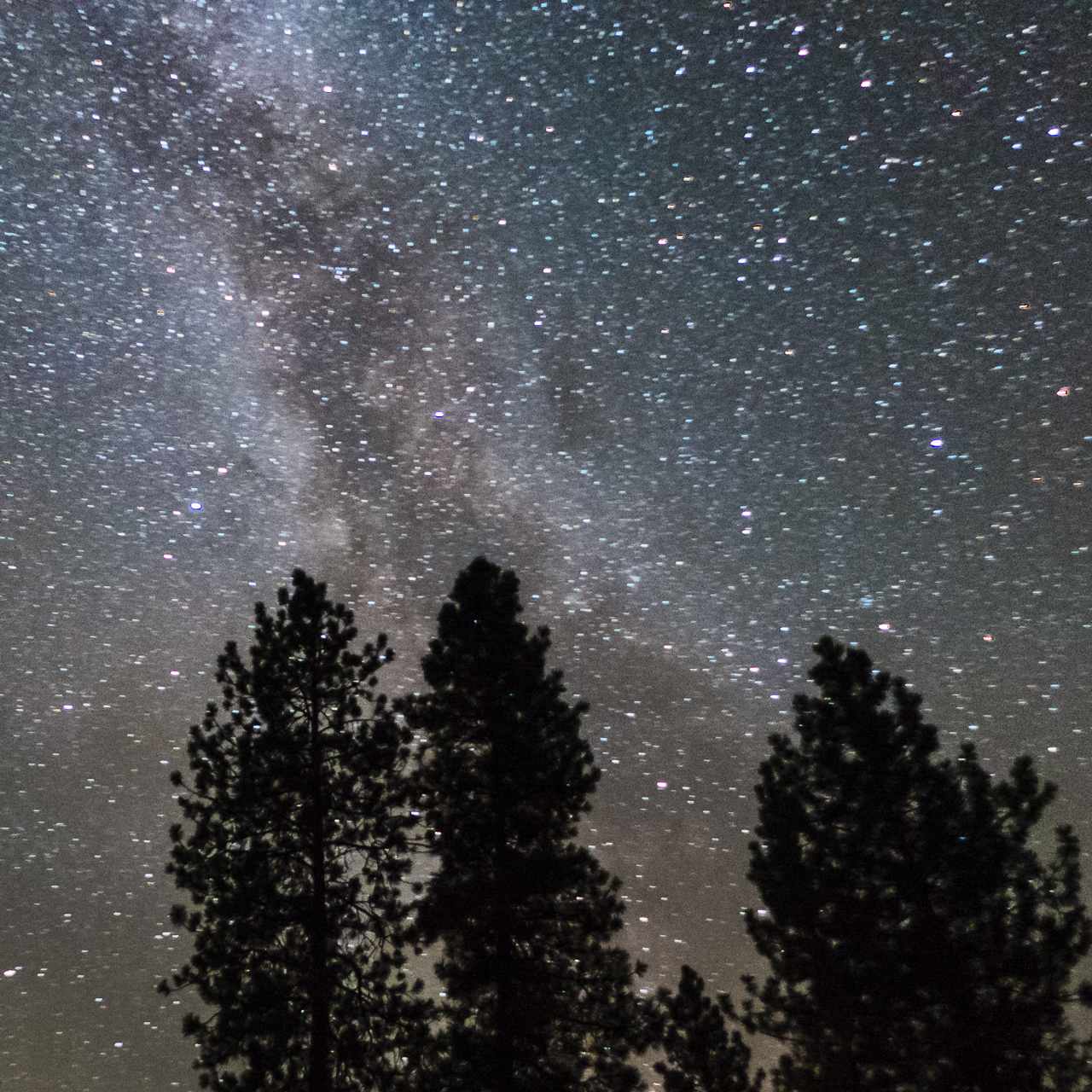
The Milky Way from my driveway

Tonight, with clear weather and no moon around, I am up late to look at a dark sky with the first decent pair of binoculars I’ve ever owned. The vaguely textured white blur of the Milky Way that my eyes have long admired, unmagnified, now resolve through the 10x binoculars into clusters of countless stars with crisscrossing fuzzy ribbons of black woven in between.

I pan the circular field of view slowly along our galaxy’s long overhead arc, immersed in the depth I sense above me from my two eyes merging a single image. There’s a satisfying tangible connection between the fine motions of my arms and the slow sweeping past of this collection of a hundred billion stars in our little corner of the universe.

A dim smudge near Cassiopeia teases my eyes’ limits of sensitivity and resolution. I think it’s M52, a globular cluster a few thousand light-years away. It was first identified by Charles Messier in 1774. The photons I’m collecting in my binoculars tonight from its 193 or so stars were more than 90% of the way here when Messier peered through his telescope. In the meantime, a nation rose through a rebellion and then quashed one of its own; enslaved, freed, and still long oppressed a large fraction of its citizens; conquered its native peoples and then rescued others from conquest in two world wars.

The smudges are clusters of countless stars.2

These photons had already emerged from their nuclear furnaces by the time some settlements along the river Tiber formed the first humble beginnings of the Roman empire.3 Their journey may even have been halfway underway by then; we’re not sure exactly how far away M52 is from us.4

It’s been a little more than two thousand years ago since a citizen of that empire, a gifted poet and philosopher, stood next to some pool or pond beneath the night sky. The skies anywhere in Europe were darker than they are now, even at my place out in the country. I imagine Titus Lucretius Caras (c. 99-55 B.C.) looking at an image of the blazing array of stars overhead, seeing their “images,” which, he muses, must “be able to run through space incalculable / In a moment of time.”5

The pointpoints and patterns of the stars are mirrored in the still water before him, “not turned round intact, but flung straight back / In reverse,” with the features thus shown “in reverse.”6 He moves slightly to one side along the water’s edge and notices how one particularly bright star near the horizon comes abruptly into view from behind the tree. Its direct image and its reflection both wink on instantly–at exactly the same time, as far as he can tell.7

A smooth surface of water is exposed

To a clear sky at night, at once the stars

And constellations of the firmament

Shining serene make answer in the water.

Yet he knows that the “images” raining down from the sky take a longer route when they make the extra trip to the water and back than when they go directly into his eye.

Now do you see how in an instant the image

Falls from the edge of heaven

to the edge of earth?

Wherefore again and yet again I say

How marvellously swift the motion is

Of the bodies which strike our eyes

and make us see.8

Those image-bearing bodies are “marvelously swift” indeed. They move 186,000 miles–more than 23 earth diameters–through the vacuum of space every second. Yet the immense vault of our universe is so incomprehensibly vast that it’s taken most of the span of human civilization for them to reach us, from a relatively nearby neighbor within just our own galaxy (there are at least a hundred billion others).9

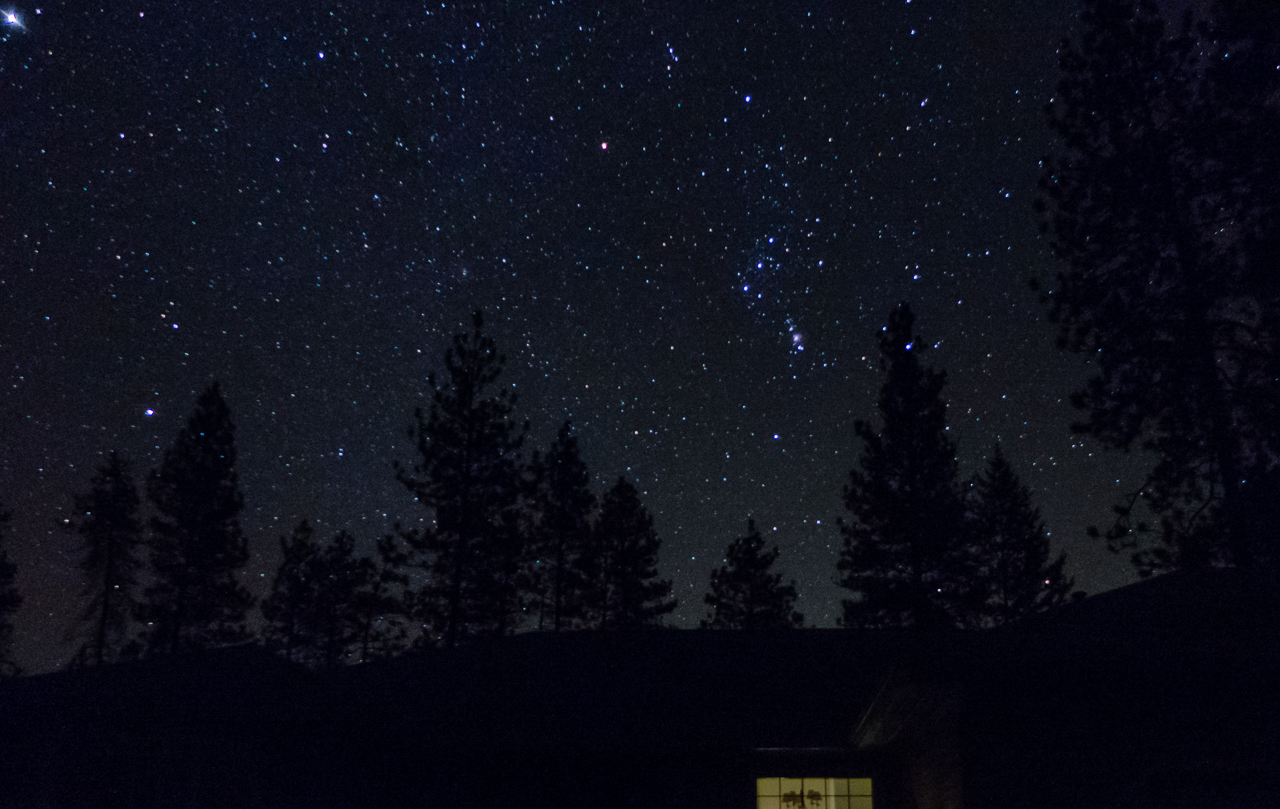
My kind of nightlife

Silent and impassive to all the twitches and ripples in the microscopic biofilm of one ordinary planet, in the hundreds of years since Messier noticed this odd feature among the stars–in the thousands filled with death and wars and tears of joy and sorrow since Lucretius did his ancient poolside musings–the photons from its clustered stars continued their long journey outward. Only now do they finally land on my retinas to collapse wave functions and trigger individual rod-shaped cells to launch neurotransmitters down neighboring filaments of cell-strings along my optic nerves.

In my brain, a little smudge registers. Something’s really up there.

The stars in M52 will keep launching their photons all my life, as they have for 35 million years now. They’ll get lost in the sea of light that covers and warms the daylight half of earth, fall through clear skies over the other half in darkness, and remain ignored almost always, as the earth swings around its own little star a few dozen more times until my eyes no longer see anything at all.

And yet, despite my absence, the earth will stay in its orbit and the photons will stream on.

Notes


  1. Does it surprise you to see such ringing words of spirituality as the epigraph to an atheist’s essay? Such prose retains its profound beauty regardless of one’s disagreements with its message. And even with no God in the picture, I am still happy to call whatever was behind the Big Bang, or the quantum fluctuation that unleashed the Big Bang, or whatever was behind that, a “power that is unfathomably secret,” even holy, filling me with a sort of reverence as I gave upwards at night. 

  2. There’s also some light pollution near the horizon, even out here, miles from the nearest city. I’ve tried to de-emphasize it with reduced yellow and green luminance. 

  3. en.wikipedia.org/​wiki/Ancient_Rome 

  4. Because “this cluster is in the plane of the Milky Way,” our available “methods of determining distance are too uncertain,” some yielding estimates “as small as 3,000 light years, while others are as large as 7,000” (Ethan Siegel, “Messier Monday: A Star Cluster on the Bubble, M52,” ScienceBlogs

  5. Lucretius, Book IV, line 191. From On the Nature of the Universe, Ronald Melville, trans. (Oxford University Press). 

  6. Book IV, lines 295-99. 

  7. It’s not exactly the same time, of course, something I remain well aware of as an electrical engineer with a radio background. Indeed, engineers rely on the known and limited speed of light to do antenna design with all of its resonant and carefully spaced conductive elements. Quarter-wavelength spacings abound. 

  8. Book IV, lines 210-17. 

  9. “How Many Stars Are There In the Universe?”, European Space Agency. I’ve seen another dim smudge out there in the night sky from the nearest of those other galaxies, Andromeda. Its photons took millions of years to reach me instead of thousands. 


Friday, April 1, 2016

No Foolin’

The youth gets together his materials to build a bridge to the moon, or perchance a palace or temple on the earth, and at length the middle-aged man concludes to build a wood-shed with them.
—Henry David Thoreau, quoted in The Writing Life by Annie Dillard.

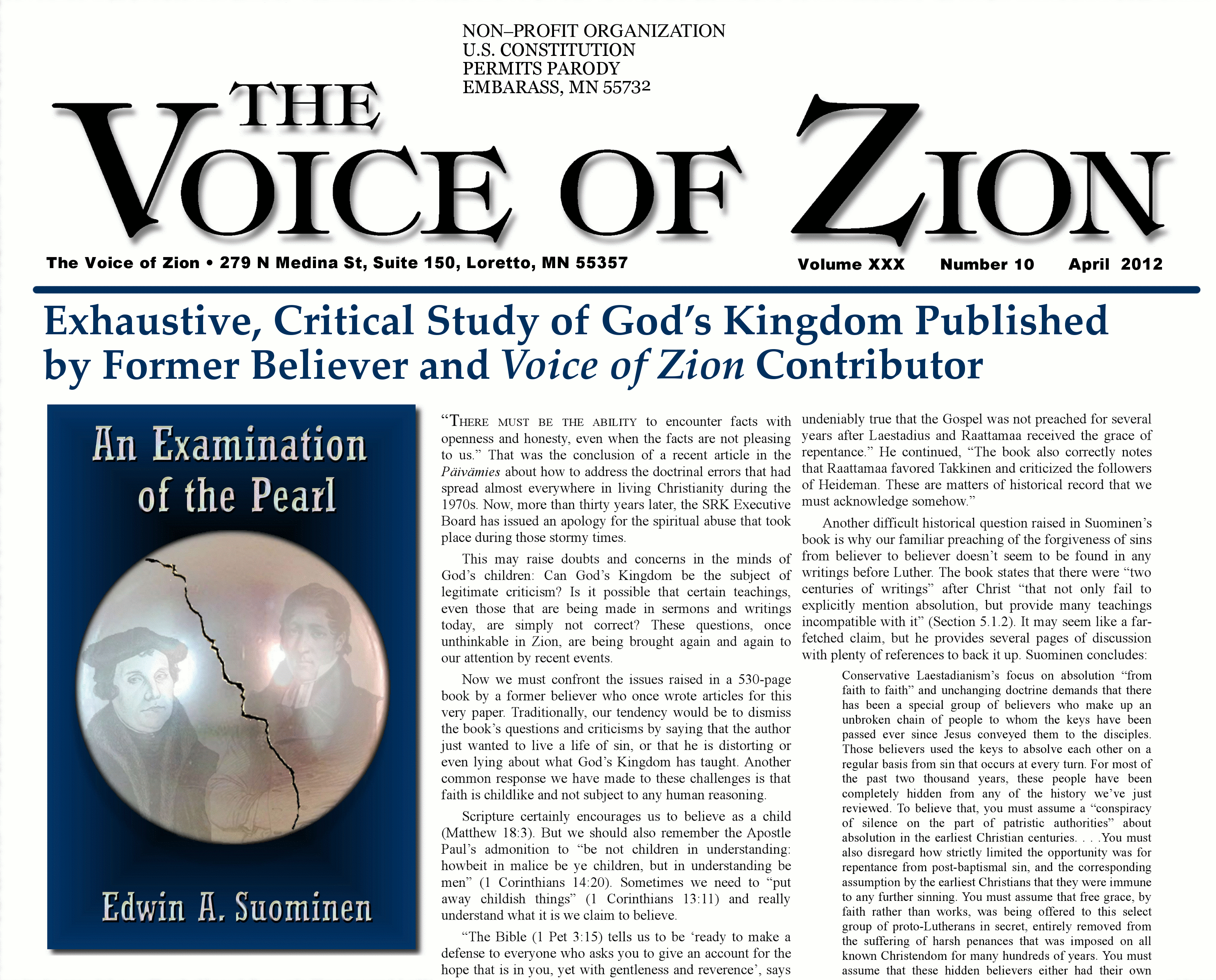
On the first day of April 2012, about two months after leaving the Laestadian Lutheran Church via the act of publishing a book critical of it, I posted on social media this parody image of a fake Voice of Zion article thoughtfully reviewing the book:

My first Laestadian-related April fool (click to enlarge)

Such a review was, of course, quite the opposite of what actually happened, which was the point of the parody piece. It quoted the conclusion of an actual article that had been published, for real and with refreshing candor, by the church’s sister organization in Finland: “There must be the ability to encounter facts with openness and honesty, even when the facts are not pleasing to us.” Switching from fact to April fool, my “article” went on to say:

This may raise doubts and concerns in the minds of God’s children: Can God’s Kingdom be the subject of legitimate criticism? Is it possible that certain teachings, even those that are being made in sermons and writings today, are simply not correct? These questions, once unthinkable in Zion, are being brought again and again to our attention by recent events.

Now we must confront the issues raised in a 530-page book by a former believer [me] who once wrote articles for this very paper [true]. Traditionally, our tendency would be to dismiss the book’s questions and criticisms by saying that the author just wanted to live a life of sin, or that he is distorting or even lying about what God’s Kingdom has taught. Another common response we have made to these challenges is that faith is childlike and not subject to any human reasoning.

Then the article plowed onward through a field of Bible quotes, just as you’d see in the real Voice of Zion. I selected them verbatim from the same King James Bible pages that Laestadian preachers consult for their articles. But my assortment of quotes told a very different story:

Scripture certainly encourages us to believe as a child (Matthew 18:3). But we should also remember the Apostle Paul’s admonition to “be not children in understanding: howbeit in malice be ye children, but in understanding be men” (1 Corinthians 14:20). Sometimes we need to “put away childish things” (1 Corinthians 13:11) and really understand what it is we claim to believe.

A second column of the “article” that appeared in the fake clipping provided some straight talk about this new book of mine that was giving the preachers such headaches. An unnamed preacher (also fake) being “interviewed” for the article in classic Voice of Zion fashion acknowledged that it was “undeniably true that the Gospel was not preached for several years after Laestadius and Raattamaa received the grace of repentance.” This implausibly candid preacher continued, “The book also correctly notes that Raattamaa favored Takkinen and criticized the followers of Heideman. These are matters of historical record that we must acknowledge somehow.”

Quite true, even if the person saying it was a fiction. Acknowledging the historical record is exactly what the church must do to be intellectually honest, but good luck ever seeing that happen. The real-life response was instead to retreat into a sheltered cocoon of denial and an outright repudiation of human reason in evaluating what the church teaches to be true. The same goes for “another difficult historical question raised in Suominen’s book,”

why our familiar preaching of the forgiveness of sins from believer to believer doesn’t seem to be found in any writings before Luther. The book states that there were “two centuries of writings” after Christ “that not only fail to explicitly mention absolution, but provide many teachings incompatible with it” (Section 5.1.2). It may seem like a far-fetched claim, but he provides several pages of discussion with plenty of references to back it up.

That I did. In response to this significant issue, too, crickets sounded forth in the fields of central Minnesota.

———

On first days of April since then, I published two more parody articles. In 2014, Social Media and the Believer did a dead ringer of an impression (if I do say so myself) of a Voice of Zion article soberly warning about the dangers of Facebook and mixing with unbelievers via this new medium of the Internet. It started pushing plausibility around halfway through:

One of the dangers with “friendship of the world” is the temptation to accept incorrect and sinful beliefs and lifestyles. Today’s society encourages an anything-goes attitude of “tolerance,” but God’s Word has always taught differently. The Old Covenant believers were instructed to let their light shine very clearly about the dead faiths of this world.

Then came a quote from Deuteronomy 13:6-9 about killing family members who tempt you into serving other gods (“Thou shalt not consent unto him, nor hearken unto him; neither shall thine eye pity him, neither shalt thou spare, neither shalt thou conceal him: But thou shalt surely kill him; thine hand shall be first upon him to put him to death”). According to the church, after all, God’s Word, is unchanging and eternal, and not subject to the whims of man’s desires. Somehow these nastier bits of the Old Testament get forgotten in favor of favorite passages warning that you’d better not be using birth control or hunting on a Sunday.

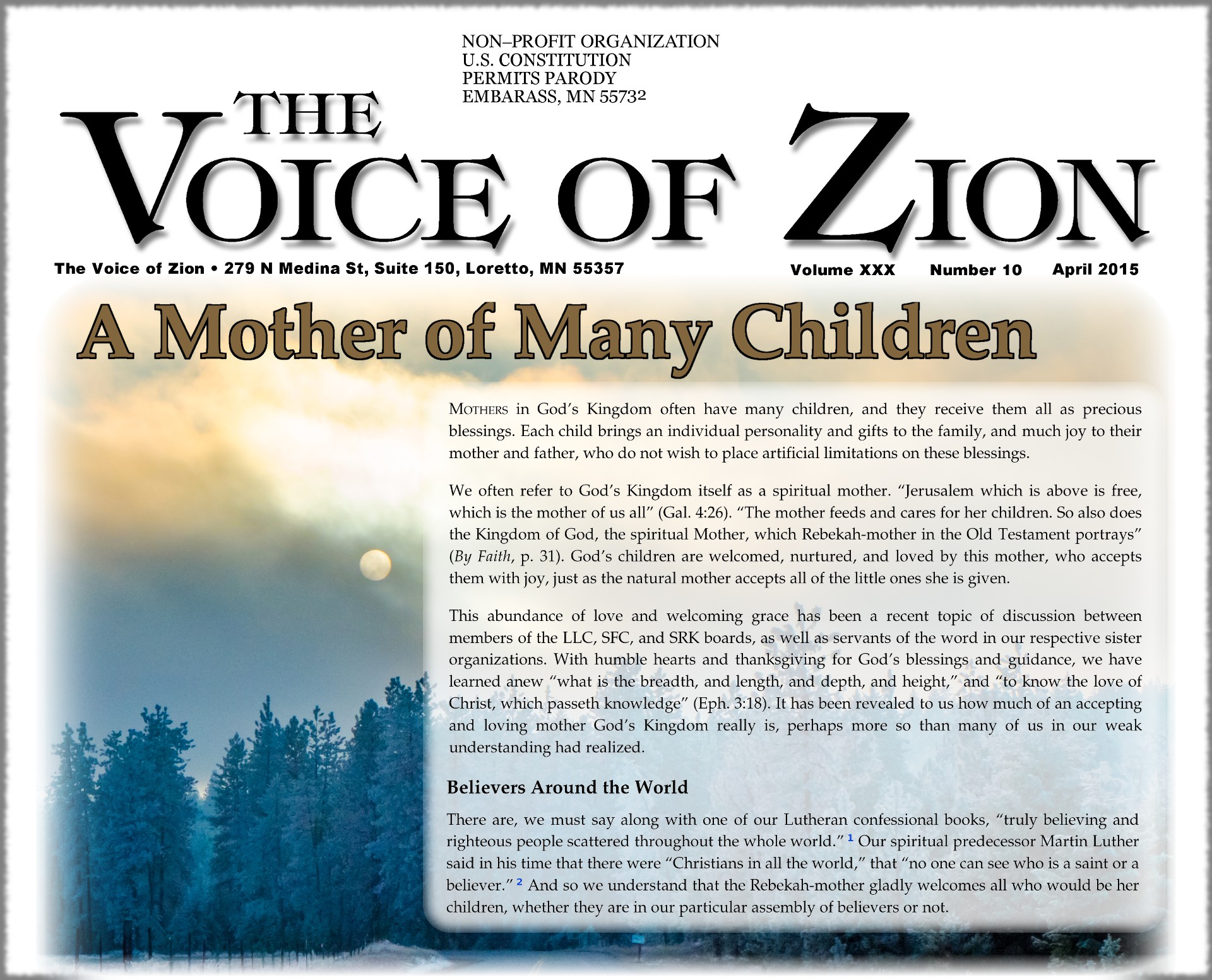
From the April 2015 parody, my last and favorite

April 1, 2015 was the occasion of my favorite of the parodies I’ve done, A Mother of Many Children. It was a heartfelt announcement of a surprising (alas, fictional) change in Conservative Laestadianism’s long-standing doctrine of exclusivity, drawing not just on scripture for support but also on the teachings of Luther himself:

There are, we must say along with one of our Lutheran confessional books, “truly believing and righteous people scattered throughout the whole world.” Our spiritual predecessor Martin Luther said in his time that there were “Christians in all the world,” that “no one can see who is a saint or a believer.”

These quotes and others in the article from Luther are all genuine, as with the Bible quotations. They leave no doubt about what Luther would have thought of the Laestadian Lutheran Church and its sister organizations claiming to be “God’s Kingdom,” the only place where actual Christians might be found. The “article” went on about the

danger of putting too much emphasis on God’s Kingdom as an organization, as an assembly of people, and making God Himself secondary to it. “I will not give my glory unto another” (Isaiah 48:11).

We can also look to the words of Luther in this: He wrote that anyone who “maintains that an external assembly or an outward unity makes a Church, sets forth arbitrarily what is merely his own opinion.” We must humbly agree with our brother in faith that there is not “one letter in the Holy Scriptures to show that such a purely external Church has been established by God.”

Many readers were saddened to know that it was just a parody and not a real article from the LLC. A few realized that only after reading through it and rejoicing that their church had finally come around to the loving, inclusive doctrine they personally believed.

I felt a little bad about causing disappointment for people, but hoped that it would do some overall good in the long term. After all, what possible answer could the preachers give to someone asking why this had to be an April fools joke and not a real article from the Voice of Zion? They would have to shrink their God down, along with the Bible and Luther’s teachings, to fit into their little doctrines.

———

There will be no April fool about the old church this year, or perhaps any in the future. I considered some ideas this past week and then decided it’s not worth the bother. I’m bored with it, and it’s bored with me.

This is just one weird little Protestant sect churning upriver against a flood of contrary facts, bearing its delusions of grandeur, its complicated set of mostly unwritten silly rules, and its steady fuel supply of new members popping into maternity wards and winding their way from day circle to Sunday School to confirmation class. There are many others like it with their own combinations of such features. The tiresome machinery of it all grinds inexorably on.

Rather than writing another parody piece, I dug through the nether reaches of my Facebook timeline to find one I’d posted in October 2012 as a Facebook status update. (I hadn’t yet started my blog then.) You can still see it and the 70 comments that ensued, here.

This dashed a few hopes, too, and got some heated discussion going. Those were the days before believers had been fully warned about not discussing faith matters online. A new wall was hastily constructed around Laestadian brains, and things have quieted down considerably ever since.

So, to conclude, here is a fake “opening statement” from my old church in one of the congregational meetings there were being held (really) in the wake of my book’s publication to address concerns and doubts.

———

We must begin by humbly acknowledging our own weakness and lack of understanding, not just as individuals, but as a battling congregation here in this sinful world. As the Apostle said, “We see through a glass, darkly” (1 Cor. 13:12). If such an important figure as Paul could acknowledge that he only “knew in part,” then we must do the same. We have been quick to cite Proverbs as saying, “The fear of the LORD is the beginning of knowledge,” but there’s a second part of the verse that we all ought to take to heart, where we are told that “fools despise wisdom and instruction” (1:7). Is any of us exempt from the need for wisdom and instruction?

The writer of Proverbs said much about wisdom. “The wisdom of the prudent is to understand his way: but the folly of fools is deceit” (14:8). There is simply no place for deceit in God’s Kingdom. After all, the Church is called “the Pillar and Ground of Truth” (1 Tim. 3:15). We must understand our way. A speaker brother recently quoted another verse from Proverbs, “There is a way which seemeth right unto a man, but the end thereof are the ways of death” (14:12). Yet we must also keep in mind what follows just a few verses later: “The simple believeth every word: but the prudent man looketh well to his going. A wise man feareth, and departeth from evil: but the fool rageth, and is confident” (14:15-16). Some of God’s children have recently decided they simply cannot go on just “believing every word.” We must respect this and learn from their courage.

If we are wrong, we must allow ourselves to be corrected. This applies to all of us. During the last heresy, it was said that the Bibles came off the shelves. We at the LLC have been reading God’s Word more diligently in recent days, too, and must admit that there have been important lessons there for us. For example, the believers of an earlier period in the Old Testament sacrificed thousands upon thousands of animals for sins, yet a later prophet, Micah, asked what he should bring with him when he comes before the LORD, when he bows himself “before the high God? Shall I come before him with burnt offerings, with calves of a year old? Will the Lord be pleased with thousands of rams, or with ten thousands of rivers of oil? Shall I give my firstborn for my transgression, the fruit of my body for the sin of my soul?” (Mic. 6:1-7). No, that was of no use. Instead, Micah concluded, “O man, what is good; and what doth the LORD require of thee, but to do justly, and to love mercy, and to walk humbly with thy God?” (6:8).

Let us do the same. Live in a just manner, love mercy, and walk humbly with God. How much sacrifice we have demanded of ourselves, and each other, when this is all that is required!

We sit before you chastened, knowing how much we have been shown to be wrong about in recent years. Our brothers in Finland have publicly apologized for “spiritual excesses” of the 1970s. We have seen crimes against children by believing men with positions of trust in God’s Kingdom made worse by cover-ups, denial, excuses, and poor behavior toward a courageous woman who attempted to see justice done and further abuse prevented. Here in America, we have advocated for women getting pregnant even at the cost of their lives when in Finland our sister organization is now calling for women to listen carefully to their doctor’s advice. We have concerned ourselves far too much with works– hundreds of confusing rules about dying hair when curling it is OK, about using birth control when a hysterectomy is OK, about watching animated cartoons when documentaries are OK. The words of Jesus are instructive to us, too: “Woe unto you, scribes and Pharisees, hypocrites! for ye pay tithe of mint and anise and cummin, and have omitted the weightier matters of the law, judgment, mercy, and faith: these ought ye to have done, and not to leave the other undone. Ye blind guides, which strain at a gnat, and swallow a camel” (Matt. 23:23-24).

Let us pass the microphone over to you now, the body of Christ. Let us discuss matters in true Christian freedom, not coercion, not intimidation. It is time for us all to learn from each other.

———

“Just kidding,” I finally added. “But for the sake of my loved ones still in the church, I wish I weren’t.” I still do. But life goes on. Those friends and loved ones know they have another option than trudging off to sit in those pews. Some of them have finally found the courage to exercise that option. And it may not be so bad anymore for those who haven’t. From what little I hear about the church nowadays, light and love have started shining through cracks in the wall of judgment and fear.

Inside those walls, and outside where billions of people like me are raising children and making friends and riding bikes and buying groceries, life goes on. 

Saturday, October 31, 2015

Let it Snow

When the glaciers are gone, they are gone. What does a place like Lima do? Or, in northwest China, there are 300 million people relying on snowmelt for water supply. There’s no way to replace it until the next ice age.
—Tim Barnett, climate scientist1
Genesee residents during the winter of 1912-132

Autumn came late this year, and climate change was very much on my mind as the skies remained warm and dry throughout much of October. With our house windows left open long after dark to cool the place down, I lingered over the pictures and stories of deep snows in the book I’ve just finished editing and publishing for my fellow Eastern Washington resident Gerald Hickman. Good Times in Old Genesee: A Tale of Two Families (Tellectual Press, 2015) is about a tiny dot of a pioneer town a couple hours’ drive south of here where Gerald and his parents were born and raised.

When he was growing up, it snowed there. A lot, if the “walked through miles of snow to school, uphill both ways” memories of an elder citizen can be relied upon:

My brother and sister and I would walk down the steep hill on our ranch road about a half mile through the snow drifts to catch a ride to school on the bus. We had to buck the drifts about ten months of each year. Finally, when summer came, we were mostly snow-free, and free of classes as well.3

He recalls snowball fights and sled riding down a hill on the drive to his childhood home. “The best part: We were really close to home for hot chocolate from Mom’s warm and loving kitchen.”4

Detail: Snowball

In the early 1900s, he says (here drawing on historical research rather than memory), “there was often so much snow that they had to tunnel under the snow to cross Main Street.”

His great-uncle John Platt, who arrived in Genesee as a child with his family in the late 1800s, “said that the snow did not seem so deep around Genesee in the later years of his life,” and Gerald agrees. “With the exceptional year or two, winters seem to have become less severe in my later years as well.”5

Just in the 15 years or so we’ve been in the Inland Northwest, we’ve seen a decrease in snowfall. I love the feeling of huddling inside our house with the woodstove burning wood I grew, logged, hauled, bucked, split, and stacked myself, from my own property, as the snow fills the skies and piles up outside. I love stomping through it and seeing the cold clean whiteness of it all, the graceful curves of it piled on trees and roofs, softening every sharp angle. One memorable winter, I spent 26 days skiing down it on a mountain that is less than 40 minutes from my driveway.

Now, thanks in part to automobile trips as long as the ones I made back and forth to that ski hill, undertaken every day by millions of commuters across the country and beyond, those snowfalls are faltering. Climate change, driven by greenhouse gas emissions from my tailpipe and everyone else’s, has thinned the clouds in our Pacific Northwest skies. When they do offer us the winter moisture that has carpeted this region with evergreens, it often comes down as rain rather than snow.

———

According to a Nepalese study cited in Bill McKibben’s book Eaarth: Making a Life on a Tough New Planet, there has been an annual temperature rise of 0.1°F in the Himalayas. That, McKibben observes, works out to “a degree every decade in a world where the mercury barely budged for ten millennia.”

Detail: Eye contact with the past

In 2008, a 57-year old Nepalese man looking at a glacier that’s retreated more than a mile since he played on it as a child said, “I feel that the sun is getting stronger, and in the past there used to be a lot more snow in winter. We used to get up to two metres in the winter, and it would stay for weeks. Last winter we only had two centimetres.”6

The drastic warmth in Nepal “is spurring melt with almost unimaginable consequences,” says McKibben.

Indian researchers recently predicted that glaciers could disappear from the central and eastern Himalayas as early as 2035, including the giant Gangotri Glacier that supplies 70 percent of the dry-season water to the Ganges River. That would leave 407 million people looking for a new source of drinking and irrigation water.7

On the other side of India lies Pakistan, “a country that is essentially a desert with a big river flowing through it.”8 That river is the Indus, which is fed by glaciers in “the Himalayas, the Hindu Kush and the Karakoram, forming the largest reservoir of ice outside the poles.” This is a country that is already getting hit by climate change, with “catastrophic floods which displaced millions, and a deadly heatwave this summer that killed 1,200 people.”9

But the suffering is only going to get worse, because those glaciers are retreating fast. By 2050, the Intergovernmental Panel on Climate Change “predicts a decrease in the freshwater supply of South Asia, particularly in large river basins such as the Indus.” Karachi, which draws almost all of its water from the Indus “will somehow have to manage its growing population with even less water–a population with a significant poverty rate that will also struggle should food prices rise.”10

This is not just a problem for some distant people we never see except occasionally on the news, because India and Pakistan both have nuclear weapons, about a hundred between them as of 2010. They glare at each other across a hostile border, possibly “the most worrisome adversaries capable of a regional nuclear conflict today.”11 What happens when one of them–thoroughly infected with religious fanaticism and filled with millions of desperate, starving citizens–finally decides to lash out at its hated rival?

Consider, as Gwynne Dyer does in his scary look forward to a planet at war over climate pressures, that five

of the six rivers that eventually feed into the Indus system rise in Indian-controlled territory. In undivided, British-ruled India, the water flowed unhindered into the intricately linked irrigation canals that covered much of the provinces of Punjab and Sind, but Partition in 1947 left most of the headwaters in Indian hands, while well over four-fifths of the farmers who depended on the water lived in the new state of Pakistan.12

Nations do not “go gentle into that good night” when dwindling resources make bare survival look impossible. Backed against the wall, with military options at hand–frightfully so in Pakistan and India to say nothing of China, another thirsty nation with dicey water prospects–they follow Dylan Thomas’s poetic admonition to “rage, rage, against the dying of the light.”13 The consequences are horrific for their neighbors, sometimes the entire world.

This is what Lebensraum was all about, as historian Tim Snyder soberly explained on a recent episode of Tom Ashbrook’s On Point NPR program. Climate change could well return us to a tribalistic world convulsed by resource wars. We are already seeing the beginning of sorrows in the mass exodus from Syria.

“Organized societies can endure a lot of hardship and still carry on, but when populations go hungry all bets are off for cultural cohesion and political stability,” observes James Howard Kunstler in his masterpiece Too Much Magic.

If world events follow their usual perverse course, food shortages and other resource scarcities will express themselves indirectly in quarrels that may seem to have little to do with the pertinent issues: conflicts over abstractions such as interest rates and currencies, trade wars, revolutions, fights over boundaries and islands, nationalist chest-beating displays, and religious warfare of the jihad and crusade variety. There may be little public acknowledgment or even consciousness of the reasons behind one outburst of trouble or another.14

And we certainly can’t expect that an abused planet already under stress would respond well to even a “local” outbreak of mushroom clouds in the Subcontinent:

A nuclear war could trigger declines in yield nearly everywhere at once, and a worldwide panic could bring the global agricultural trading system to a halt, with severe shortages in many places. Around one billion people worldwide who now live on marginal food supplies would be directly threatened with starvation by a nuclear war between India and Pakistan or between other regional nuclear powers.15

Snowy street in early Genesee, Idaho

It’s a grim picture, and there has been no shortage of what doomsday ecologist Guy McPherson memorably calls “hopium” to assuage a public that’s becoming increasingly concerned, despite campaigns of denial financed by fossil fuel interests. The pharmacopoeia of hopium includes grandiose techno-fixes such as implausible carbon capture schemes and seeding the stratosphere with sulfates to reflect solar radiation. Bill McKibben is critical of such fantasies, though with some sympathy for “the daydreams of the developing world” like the suggestion made at a meeting of Asian journalists that “Bangladesh could be relocated to Siberia and Iceland.” Melting snows would, it was claimed, “turn them into ‘bread-baskets.’” How, he asks, does one tell these front-line casualties of our war against nature “that the tundra is turning into a methane-leaking swamp?”16

Besides, there is the small issue of what the Russians and Icelanders might think about an invasion of 150 million Bangladeshis. Even an enlightened new generation of Germans ever mindful of their grandparents’ Holocaust is getting twitchy about all the Syrian refugees mobbing their borders.
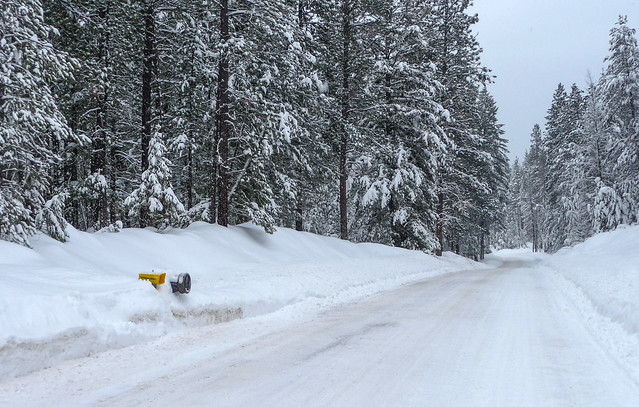
January 2009: Our last really good snow in Eastern WA [Flickr page]

“Have you entered the storehouses of the snow, or have you seen the storehouses of the hail,” the Book of Job has God sniff at us mere mortals, storm-stuff that he has “reserved for the time of distress, for the day of war and battle?”17 Those storehouses are not hidden somewhere above clouds in God’s heaven, but on snow-capped mountains right here on earth. Their stock is running low, not just in the Himalayas, but around the world in this time of distress we have made for ourselves.

The last of Bolivia’s 18,000 year-old Chacaltaya Glacier melted away in 2009.18 Andean glaciers like that one are “the main source of water across South America, from Colombia to Ecuador, Peru, Bolivia and Chile,” and their disappearance is going to cause major problems. One climate change advisor for Latin America at a humanitarian organization says that conflicts over water “will become explosive over the coming decades because the glaciers will dry out.”19

An increasingly rare treat [Flickr page]

Agriculture “is practically at an end in California’s Central Valley,” says Dyer, “due to the failure of the rivers that used to be fed in the summer by the melting snowpack on the Sierra Nevada and Rocky Mountains.”20 This is not a trivial situation: The Central Valley “accounts for one-quarter of the food grown for human consumption in the United States.” But its rivers will likely become seasonal in world that is 2°C warmer, flowing only in the winter with precipitation that falls on the mountains mostly as rain instead of snow.21

The Sierra Nevada mountain range is, or was, “a giant water faucet in the sky, a 400-mile-long, 60-mile-wide reservoir held in cold storage that supplies California with more than 60 percent of its water.” Now the snow is coming later and melting earlier.22

Rainwater, alas, runs off immediately instead of adding to a storehouse of moisture that melts and feeds rivers late into the spring and summer.23 Farmers and ranchers in the American West need that slowly melting snow to keep water flowing throughout the dry summer. Otherwise, a lot of the water is gone by the time their crops need it.24

And there are a lot of us eating food produced from those crops. Don’t kid yourself about agricultural abundance from the Midwest, either. About 30% of the groundwater used for irrigation in the U.S. comes from the Ogallala Aquifer, the saturated volume of which has gone down by about 9% since 1950, according to Wikipedia. “Depletion is accelerating, with 2% lost between 2001 and 2009 alone. Once depleted, the aquifer will take over 6,000 years to replenish naturally through rainfall.”25 In the crucial Kansas section of the Ogallala, 30% has already been pumped out and farming there will likely peak by around 2040 due to water depletion.26

Brown Christmas, 2014 [Flickr page]

Meanwhile, back in Latah County where Gerald Hickman’s little town of Genesee still sits among the monoculture, petroleum-fertilized grain fields of Big Ag, a local club in the Idaho State Snowmobile Association (“Snodrifters of Latah County”) canceled its February 15, 2015 “Raffle Run” due to lack of snow. “Look for us to be back next year,” they plead on their website.27

For reasons that go far beyond a little winter recreation, we can only hope they will be.

———
The pictures with Flickr links are my own, and you can click on them to enlarge and download for your own non-commercial use, as usual.
The Genesee snow pics are digital restorations I’ve done of photos from the Latah County Historical society. If you’re interested in some plain-spoken personal and local history interspersed with old photos, check out Jerry’s book page at tellectual.com.

Notes

  1. Quoted in “Retreat of Once-Mighty Glacier Signals Water Crisis, Mirroring Worldwide Trend” by Doug Struck (Washington Post, July 29, 2006), dougstruck.com/​journalism/on-the-roof-of-peru-omens-in-the-ice

  2. Dated according to Julie R. Monroe in her book Latah County (p. 41). 

  3. Gerald Hickman and Tea Joe Hickman, Good Times in Old Genesee: A Tale of Two Families (Tellectual Press, 2015), loc. 333. 

  4. Hickman at loc. 511. 

  5. Hickman at loc. 522. 

  6. “Himalayan villagers on global warming frontline,” phayul.com/​news/article.aspx?id=23518

  7. Bill McKibben, Eaarth: Making a Life on a Tough New Planet (Henry Holt and Co., 2010), p. 7. 

  8. Gwynne Dyer, Climate Wars: The Fight for Survival as the World Overheats (Oneworld Publications, 2010), loc. 1758. 

  9. “Climate Change Bomb Ticking in Pakistan”, Khaleej Times (Oct. 21, 2015). 

  10. Khaleej Times

  11. Alan Robock and Owen Brian Toon, “Local Nuclear War, Global Suffering,” Scientific American (Jan. 2010), pp. 74-81. 

  12. Dyer at loc. 1761. 

  13. poets.org/​poetsorg/poem/do-not-go-gentle-good-night 

  14. James Howard Kunstler, Too Much Magic: Wishful Thinking, Technology, and the Fate of the Nation (Grove/​Atlantic, 2012), loc. 3477. 

  15. Robock and Toon. Ironically, one result of a nuclear war (even a regional one) would be a drastic cooling of the planet into a “nuclear winter” situation. Some consolation! 

  16. McKibben at p. 100. 

  17. Job 32:22-23, New American Standard Bible

  18. McKibben at p. 7. 

  19. Eva Mahnke, “Water conflicts come to the Andes as glaciers melt” (Deutsche Welle, Nov. 13, 2012), dw.com/p/16iC6

  20. Gwynne Dyer, Climate Wars: The Fight for Survival as the World Overheats (Oneworld Publications, 2010), loc. 387. 

  21. Dyer at loc. 997. 

  22. Tom Knudson, “Sierra Warming: Later snow, earlier melt: High anxiety” (The Sacramento Bee, Dec. 28, 2008, online version here). 

  23. Dyer at loc. 997. 

  24. McKibben at p. 44. 

  25. en.wikipedia.org/​wiki/Ogallala_Aquifer 

  26. Brad Plumer, “How long before the Great Plains runs out of water?” (Washington Post Wonkblog, Sept. 12, 2013). 

  27. idahosnow.org/​latah 


Friday, July 4, 2014

Midway

As mortals by eternal give and take.
The nations wax, the nations wane away;
In a brief space the generations pass,
And like to runners hand the lamp of life
One unto other.
—Lucretius, On the Nature of Things (c. 50 BC)
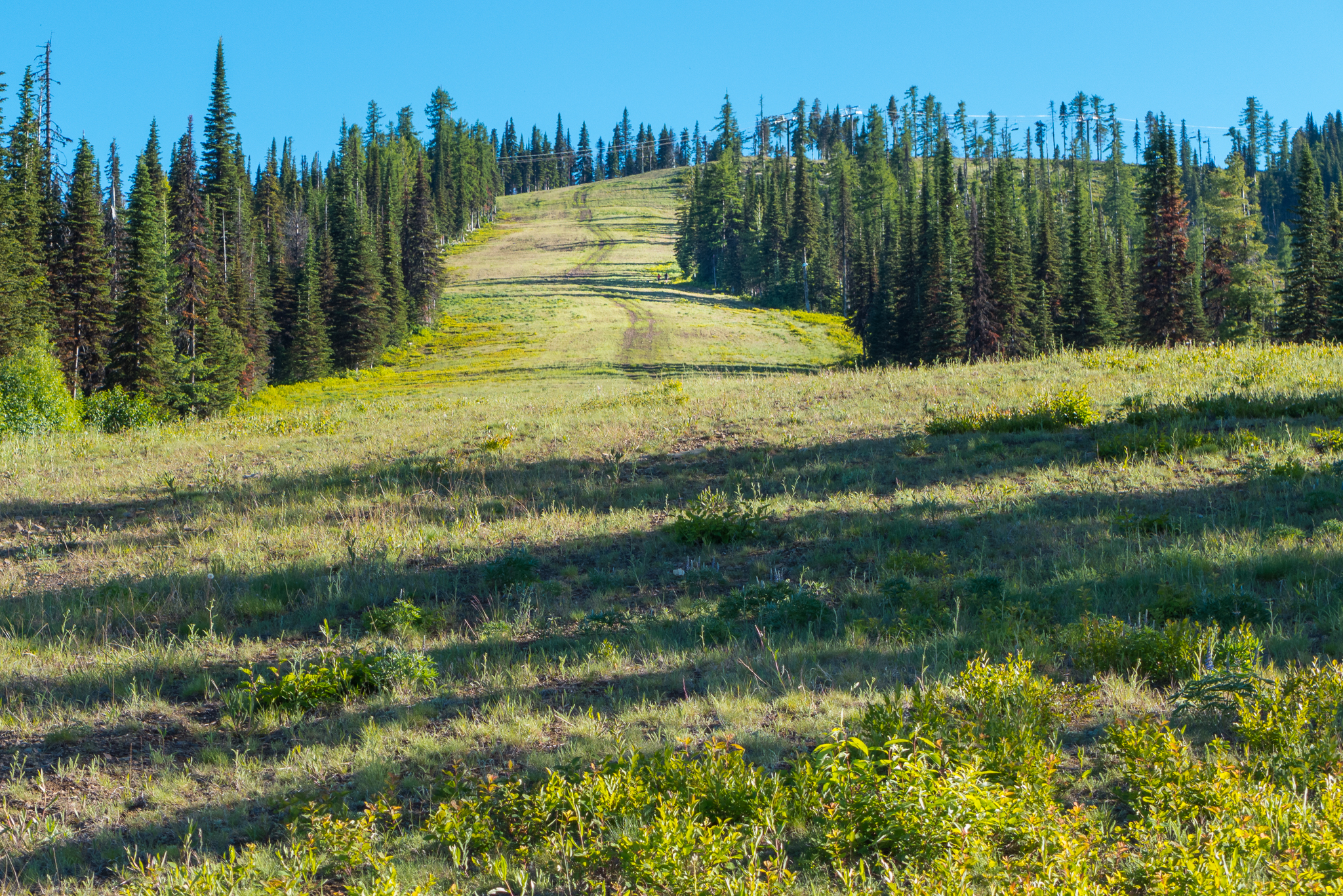
Ski Slope  [Flickr page]

Two of my children are hiking up my favorite ski run to the top of a 5773-foot mountain in Washington’s beautiful Colville National Forest. I joined them for the first part of the climb, starting at 3900 feet, but after bushwacking through thick shrubbery because one of us (not me!) decided to be adventurous, I’m happy to wait for them at the midway point.

See them now? (Detail from photo above)

There are people who will never sit on a mountain meadow in the long shadows of nearby trees, surrounded by a vast open vault of cool clean air filled with silence. What good fortune for me to be doing so on this beautiful day! It is a simple act of pure exuberant living, to climb even partway up this big hill on a Summer afternoon.

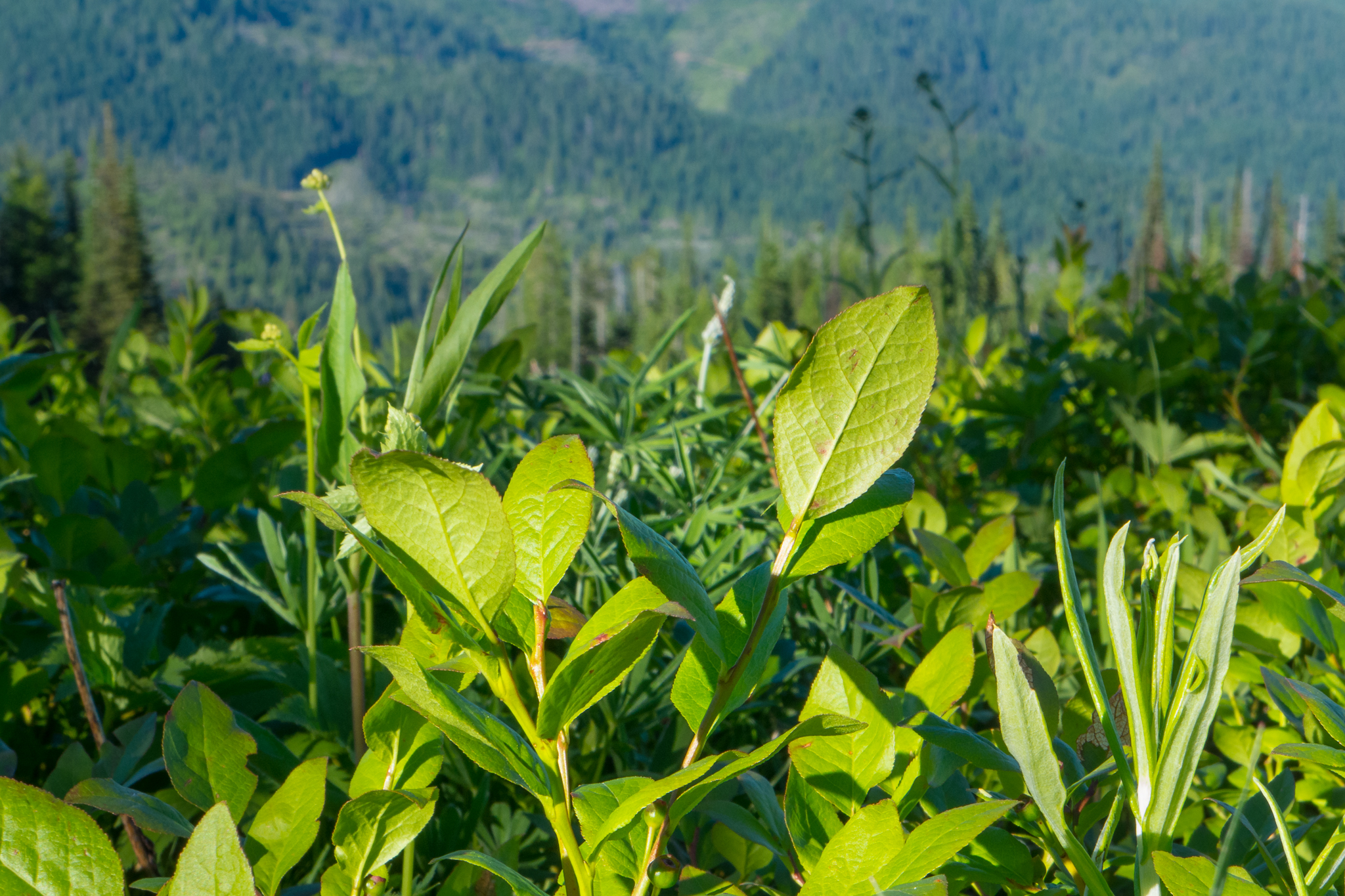
I sit on the soft ground, cushioned by some of the leafy little plants whose modest growth the maintenance crews allow here. In seven months, people will be skiing over this very spot. I have done so myself, probably more than a hundred times. Here is the place where I carve a long, joyous, final turn onto the catwalk, heading toward the lift after the thrill of a fast run pretty much straight down this wide smooth terrain.

Hopefully there are many more such runs in my winters ahead. (Better those than the other kind!) But I’ll probably never again have a season with 26 days on the slopes, as I did a few years ago. At the end of one of those glorious days, I sat on the tailgate and realized that, someday, the boots from which I was extracting my aching feet would stay off for good. After that final day of skiing, whenever it arrives, I will never put those boots back on again. These things tug at the middle-aged mind.

Down in the Meadow  [Flickr page]

There is no avoiding the fact that many wonderful things belong more to my past than my future now. And so what? I am at the midpoint of a life filled with blessings (as my religious friends would put it) beyond measure. What I have already experienced—crewing on a 35 foot sailboat from San Diego to Hawaii at age 17, conceiving eleven kids and several commercially successful inventions, writing a couple of books, befriending a fascinating variety of people, living among the tall pines of Eastern Washington—is worth a lifetime of gratitude. And yet there is more to come!

Siblings  [Flickr page]

You may not have done these particular things, but you have your own highlights to look back on. Savor what makes your life unique as you progress through it, even if you are engaged in a struggle to make the rest of it far different than it’s been so far. You will never get anyone else’s life but your own to live in. Make the most of what you have.

I smile to think of my various friends with all their unique experiences that I am, and must be, content not to share. The extremely handsome one I was with recently at a restaurant, where two women gaped and gasped as he stood up after our meal. The young one who is beginning a career full of promise, and the old one who has a mind full of wisdom and memories. The wealthy one whose character is as rich as his finances. The not-wealthy one who smiles at me on a break from the hot and grubby job he loves as he tells me about time spent with his son doing volunteer work. The two who cheer on their kids at soccer games. The ones whose lives are filled with love from the family and lifetime friends they have in a church I no longer attend.

They all have their own little portals through which they can peer at the beauty of this world and the people in it. You have one, too, for now. Are you looking?

Ski Slope in Summer  [Flickr page]

A justifiably famous quote by Richard Dawkins says, “We are going to die, and that makes us the lucky ones. Most people are never going to die because they are never going to be born. The potential people who could have been here in my place but who will in fact never see the light of day outnumber the sand grains of Arabia.”1 It is a thought that strips away the ego and replaces it with wonder.

My two children vanish into the distance as they trudge upward to the summit without me. I watch and ponder the metaphor. At some point, barring some tragic interruption to the usual course of life, this will happen on a larger scale. They will continue their lives when mine has ceased, as mine now does without my own father. It is both sad and beautiful. It is the way of things.

Stand Against Forest  [Flickr page]

A hundred generations ago, Lucretius imagined nature’s frank response to the complaints of an old man about his coming death:

Away, you rogue, with all these tears and stop this snivelling. All life’s rewards you have reaped and now you’re withered, but since you always want what you have not got and never are content with that you have, your life has been unfulfilled, ungratifying, and death stands by you unexpectedly before the feast is finished and you are full. Come now, remember you’re no longer young and be content to go; thus it must be.2

I try and fail to grasp the enormity of it all, the vast reach of billions of years that have gone on almost entirely without my presence. As the Psalmist said about the omniscience of his God, such knowledge is too wonderful for me; it is high, I cannot attain unto it.3 I stare at the quiet fuzzy green of the meadow where the kids were walking. Eventually, they will disappear into the maw of time themselves, perhaps leaving their own offspring to treck a little further onwards.

Then I notice a pretty arrangement of leaves, and grab my camera for another shot. It’s a beautiful afternoon, right here and right now. This moment is a gift. I’ll take it, with gratitude.

———
Click on individual images to enlarge, or check out my Flickr photostream. All are Copyright © 2014 Edwin A. Suominen. You may freely use them for non-commercial purposes, with attribution, under the Creative Commons Attribution-NonCommercial 3.0 Unported License.

Notes


  1. The quote appears, for example, at Goodreads, which cites Unweaving the Rainbow: Science, Delusion and the Appetite for Wonder. It’s a book I have yet to read, but plan to in those years that hopefully lie ahead. 

  2. Lucretius, On the Nature of Things, Book III. Ronald Melville trans. Oxford University Press. 

  3. Psalms 139:6. 

Saturday, November 30, 2013

Moving with the Wind

We spend our lives under power,

leaning into the wind.

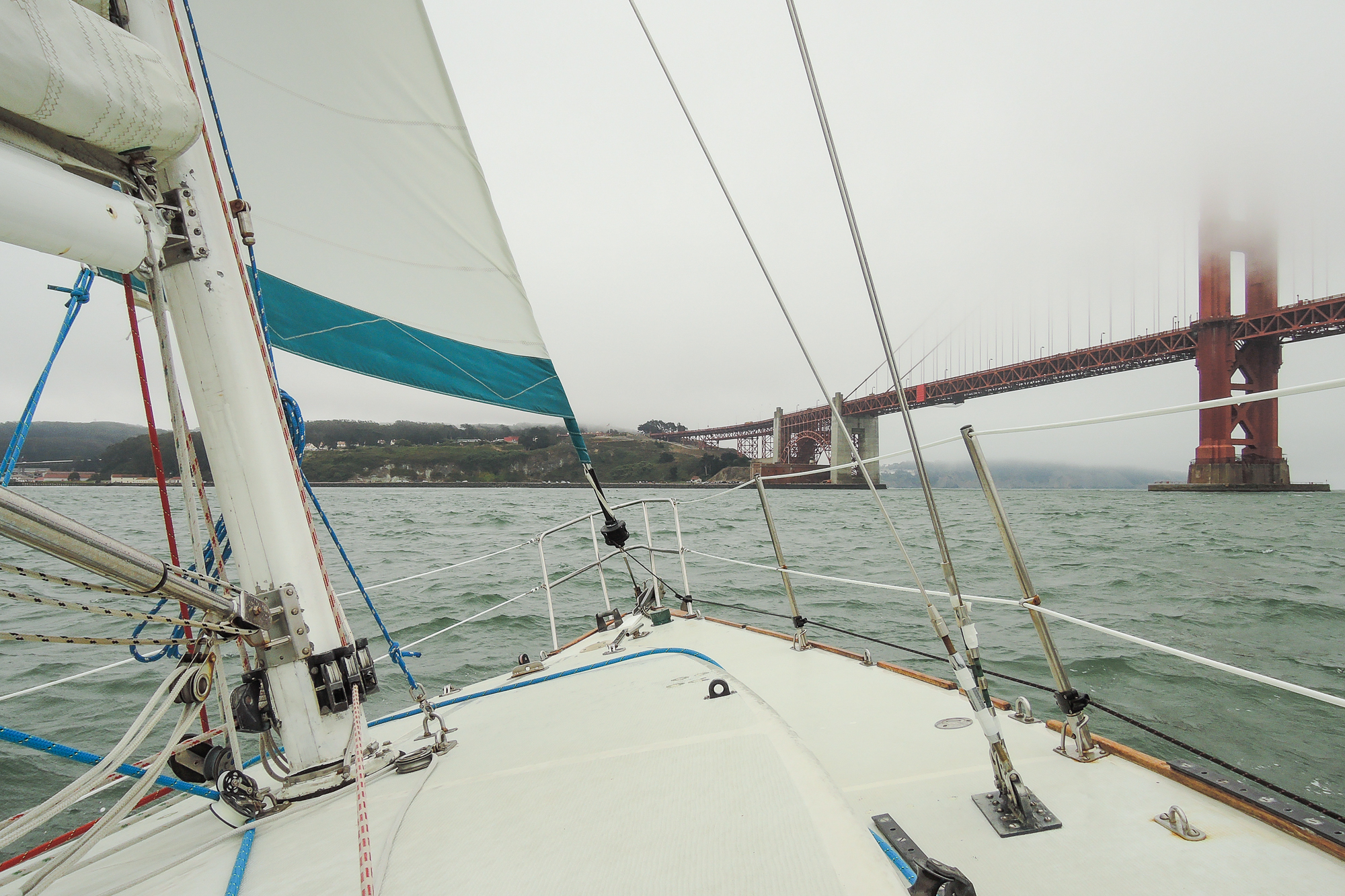
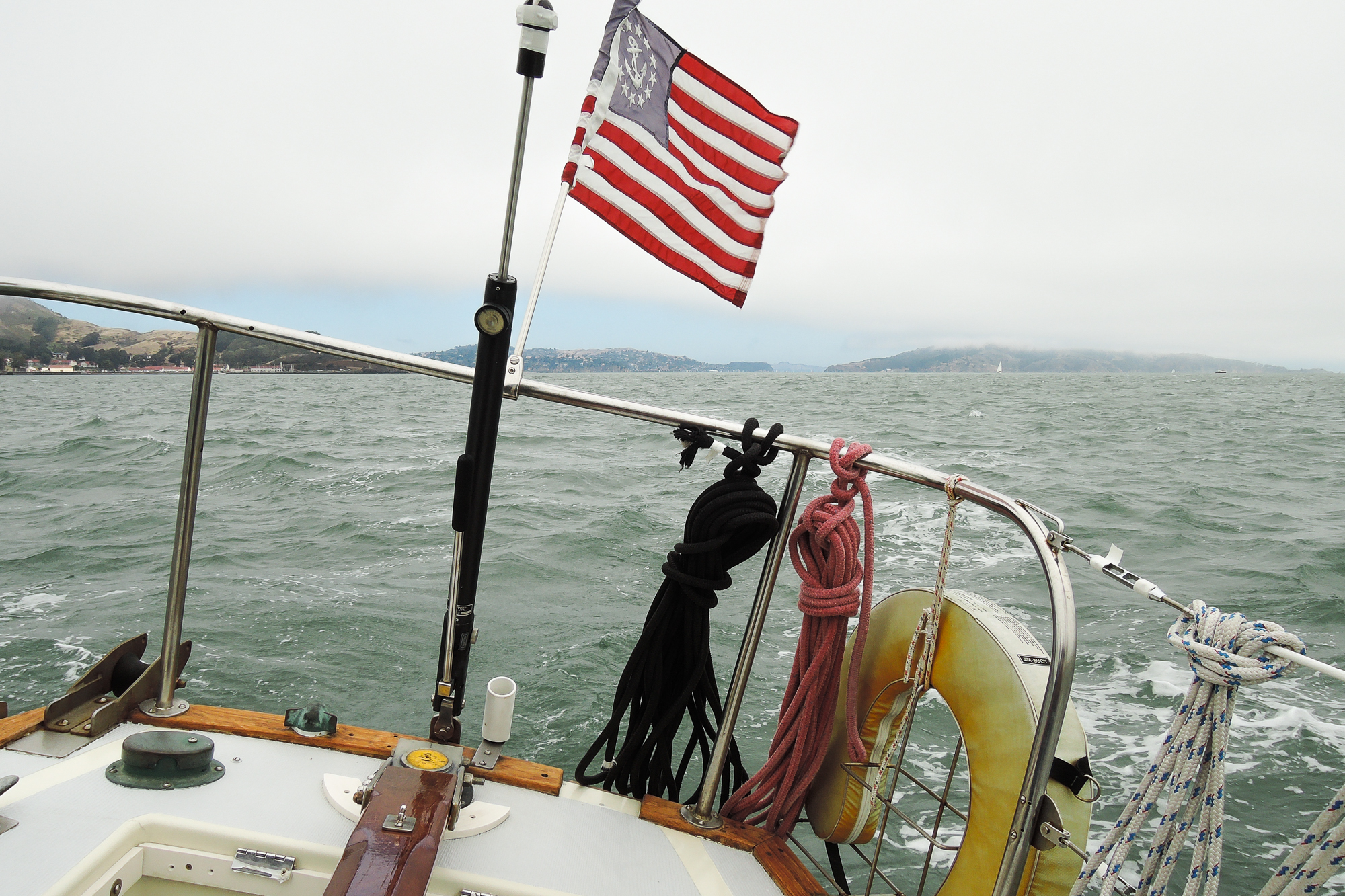
Sailing on San Francisco Bay  [Flickr page]

Our jaws are set

in grim determination

to overcome it, to push past it,

toward some elusive, never-ending goal.

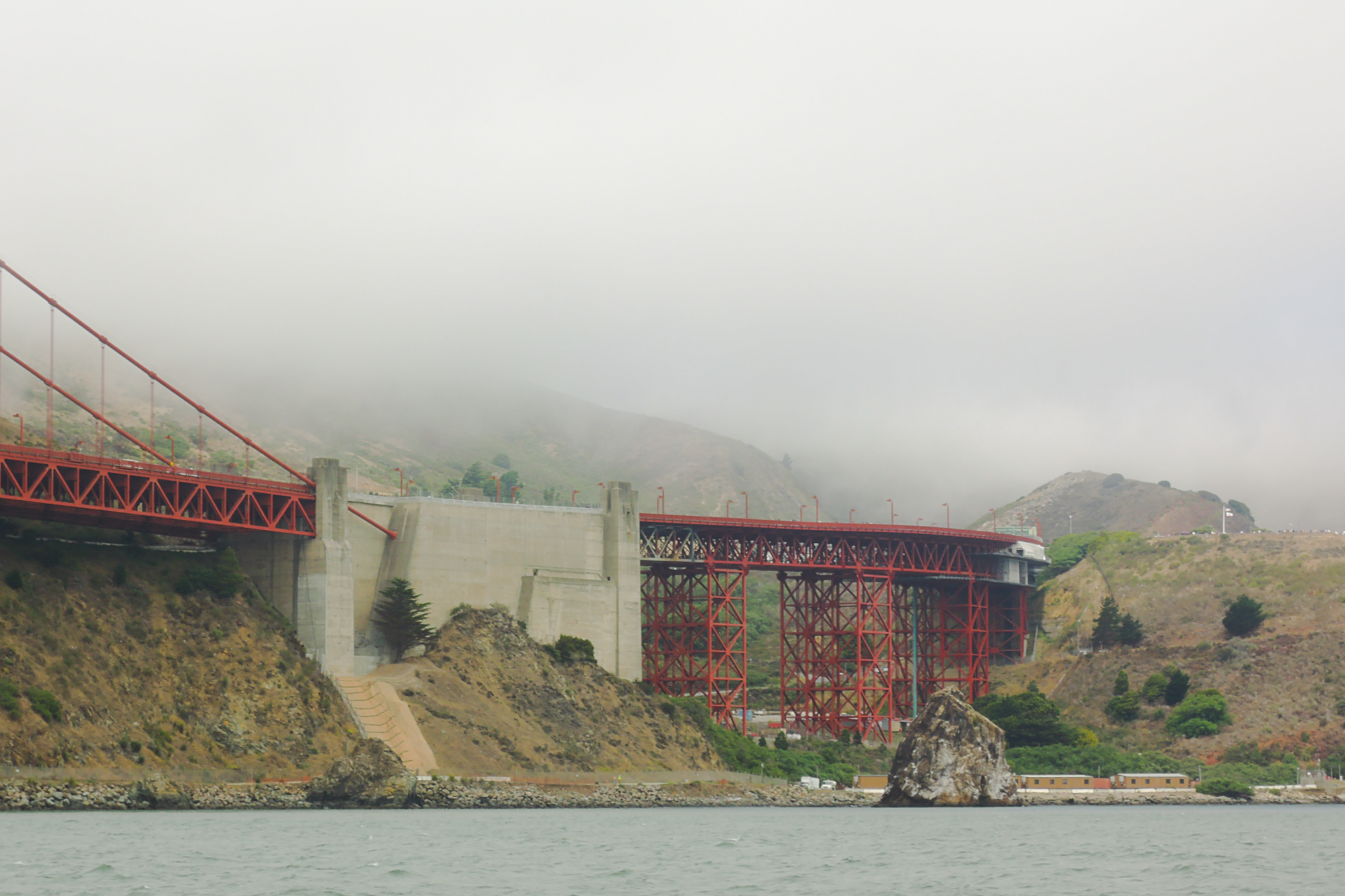
Golden Gate Bridge from the Bay  [Flickr page]

But every now and then

we can make peace with the wind,

declare our kinship with the here and now,

San Francisco Bay Astern  [Flickr page]

And sail with the easy currents

of unhurried time.

U.S. Coast Guard Station, Golden Gate  [Flickr page]
Written after sailing in San Diego, California in February 2008. Photos from a sail out the Golden Gate and back in San Francisco in July 2013. Click on individual images to enlarge, or check out my entire set of San Francisco on Flickr. All are Copyright © 2013 Edwin A. Suominen. You may freely use them for non-commercial purposes, with attribution, under the Creative Commons Attribution-NonCommercial 3.0 Unported License.

Sunday, September 29, 2013

Darkness

“I discerned among the youths, a young man void of understanding, passing through the street near her corner; and he went the way to her house, in the twilight, in the evening, in the black and dark night.
—The Book of Proverbs
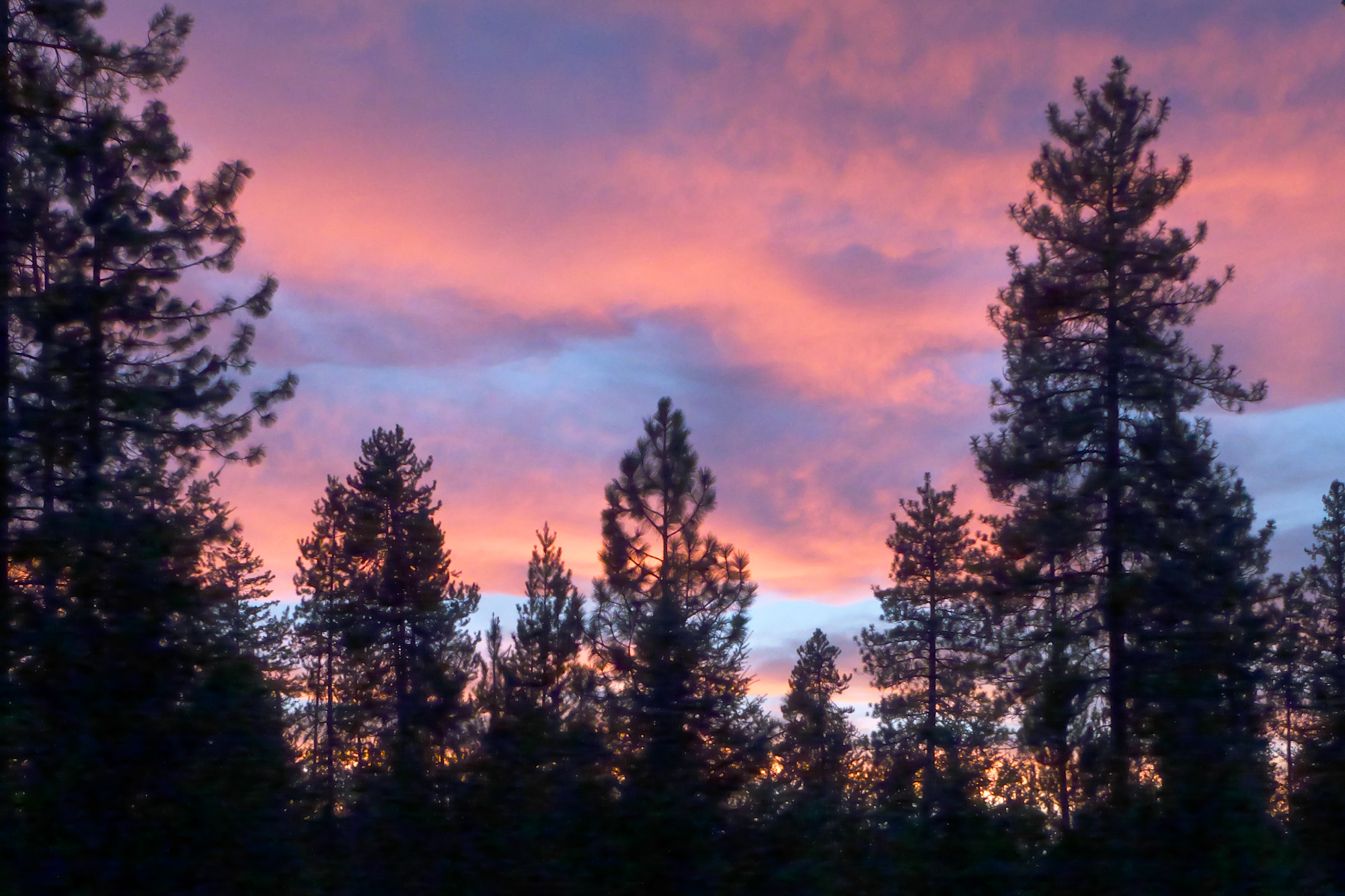
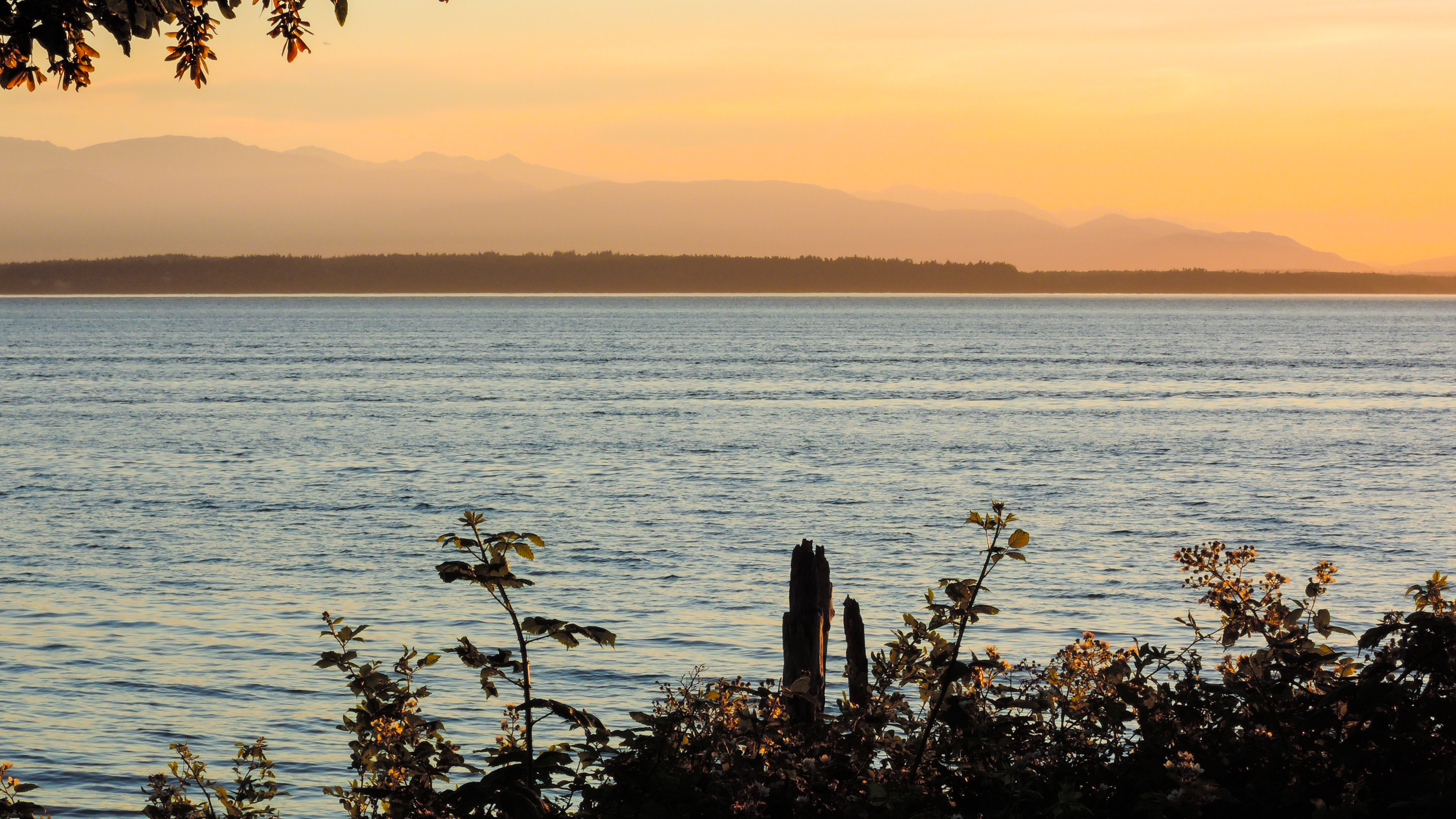
Late summer sunset  [Flickr page]
With its moody poetry, captured wonderfully in the King James translation, the seventh chapter of Proverbs puts the setting for a foolish young man’s seduction away from wisdom “in the twilight, in the evening, in the black and dark night.” Those who look back on the Hebrew Bible through Christian lenses can easily see in the passage a warning against descending into sin, which Christianity compares to a sense of spiritual darkness. Ephesians 8 makes that connection, urging readers to “walk as children of light” and avoid the “unfruitful works of darkness.” Jesus is depicted as telling followers to let their light shine before men, and promising that their bodies will be full of light if they avoid having an evil eye. The first Epistle of John speaks of walking in the light, as God is in the light. In all of this, the darkness is where evil lurks, where goodness and God, or at least Wisdom, are absent.

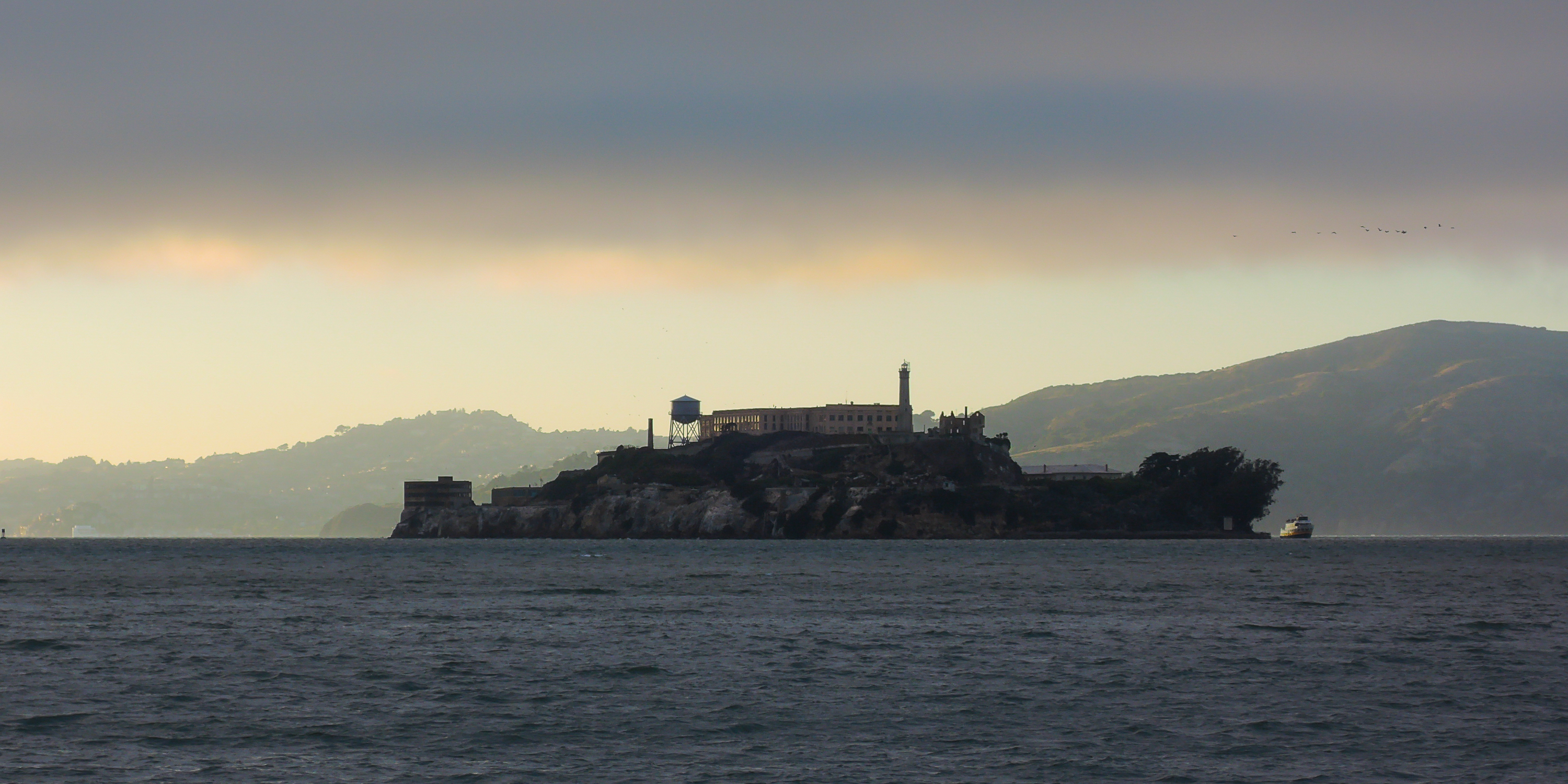
Alcatraz under a darkening sky  [Flickr page]
Another ancient specter in the dark recesses of human imagination is death. Long has it loomed, along with the animals and enemies that could induce it prematurely, outside the feeble circles of firelight that people erected against the night. The hero of the 4,000-year old Epic of Gilgamesh admitted his fear of death, lamenting that he would someday enter the Netherworld and “lie there sleeping all down the years.” So, he cried,
Let my eyes see the sun and be sated with light!
The darkness is hidden, how much light is there left?
When may the dead see the rays of the sun? [Tablet IX]
It is reminiscent of the way King Hezekiah lamented his death in Isaiah 38. “From day even to night wilt thou make an end of me,” he complained to God, facing the wall from his bed. Hezekiah knew what awaited him, and his conversational relationship with the God of Israel did nothing to make him relish the prospect:
I said in the cutting off of my days, I shall go to the gates of the grave: I am deprived of the residue of my years. I said, I shall not see the LORD, even the LORD, in the land of the living: I shall behold man no more with the inhabitants of the world. [Isa. 38:10-11]
God gave him an extra fifteen years, but night came eventually regardless. He went to the same place as Job and the billions of others whose brief candles have burned out, “to the land of darkness and the shadow of death; A land of darkness, as darkness itself; and of the shadow of death, without any order, and where the light is as darkness” (Job 10:21-22). As Gilgamesh had put it long earlier, “Only the gods dwell forever in sunlight” (Yale Tablet).

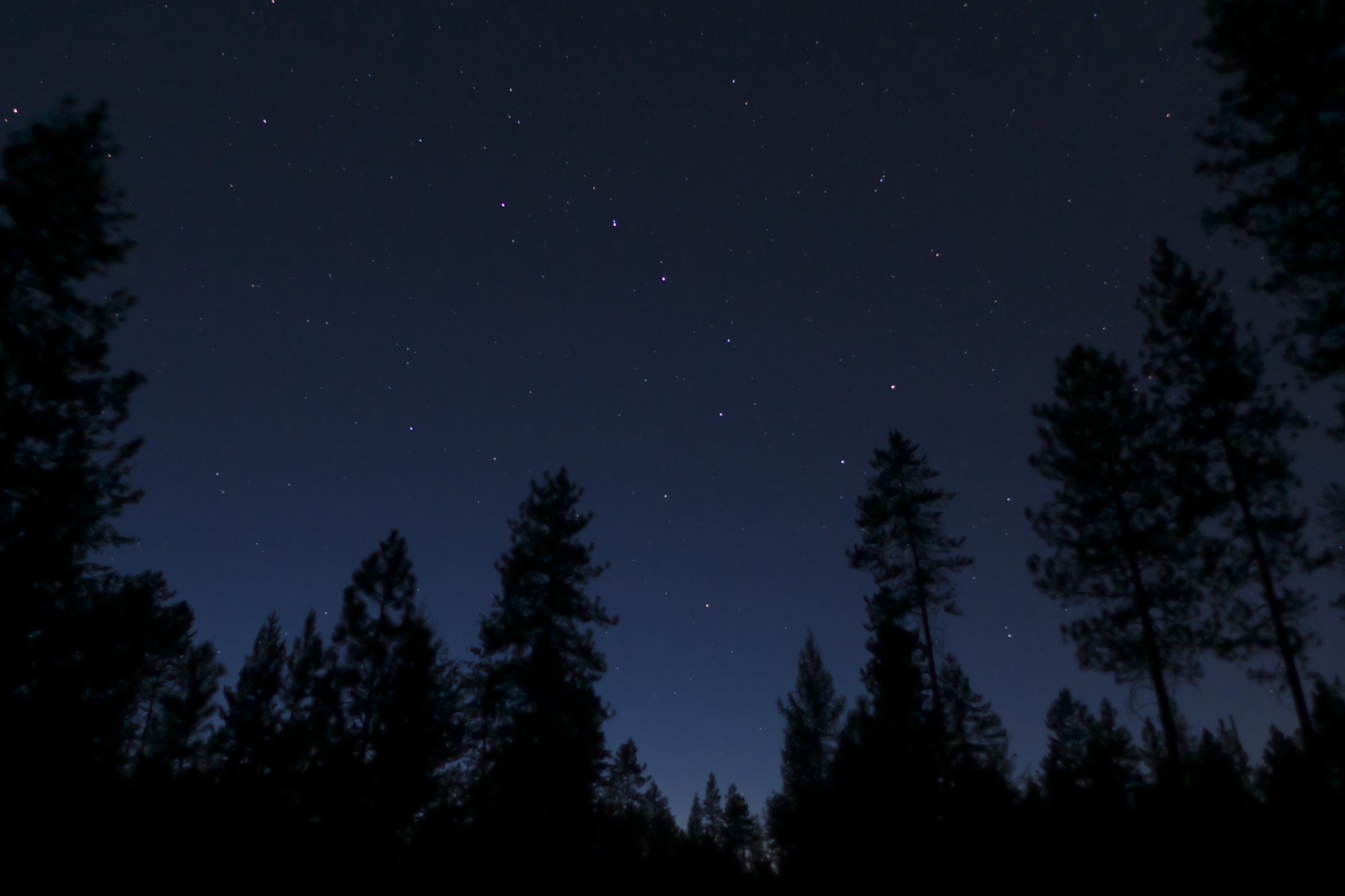
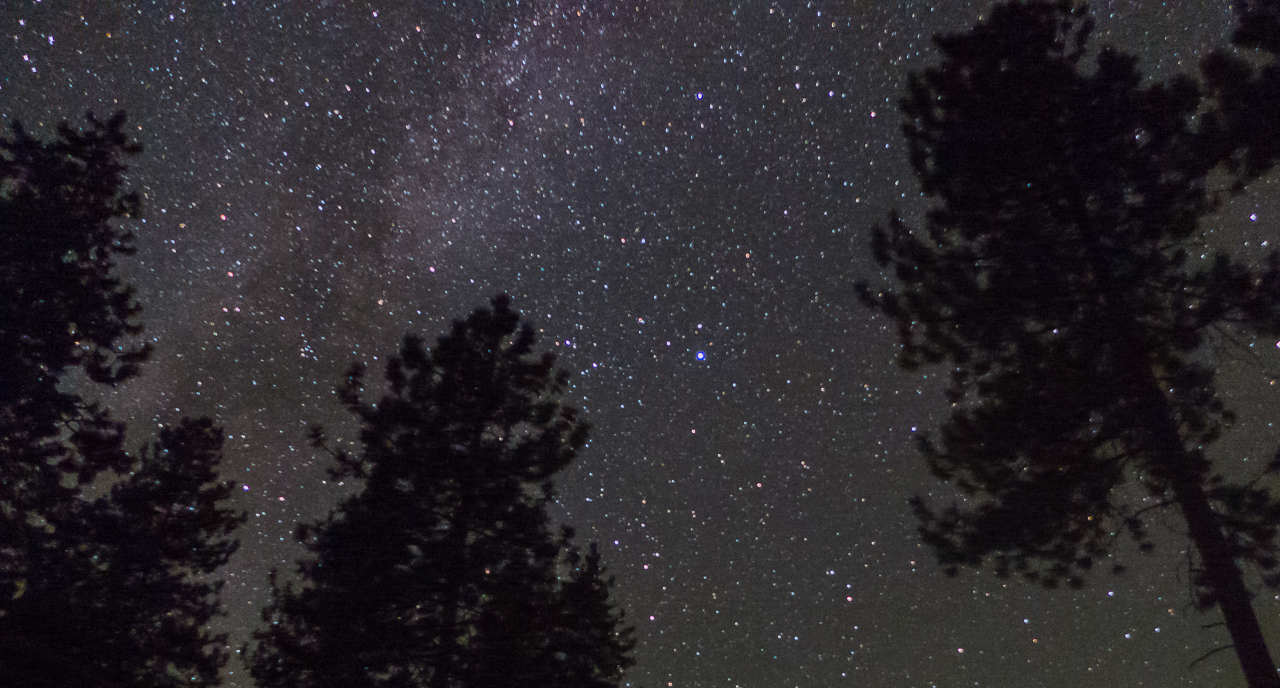
Big Dipper at dusk  [Flickr page]
Now we sit in our evenly lit houses before glowing screens and drive through bright cities, and we forget the impact of the darkness on our ancestors. For them, the flickering glow of fires and fat lamps did little to keep away the terrors of the night.

I mused about these things last night while driving through dark woods and fields of my rural home in the Inland Northwest, where the lights are pinpricks dotting hillsides, glimmering faintly behind trees. Fall Equinox is now just past, and the nights are as long as the days, soon to be longer. The stove is already burning wood that I harvested from dead trees in the hot bright forest of just a few months ago.

But we have lights, a good generator for when the power fails (as it does at least a few times per year), plenty of backlit screens to engage our attention and soak our brains and retinas in brightness. The coyotes sometimes shriek and howl outside, but there are sturdy walls between us. As for evil, it now stalks well-lit boardrooms and halls of power much more than the forests.
Even the primal force that spawned religion and keeps people in its thrall, the fear of death, has largely abated in my imagination, and in those of many others. We have come full circle with the Preacher of Ecclesiastes: “The living know that they shall die: but the dead know not any thing, neither have they any more a reward; for the memory of them is forgotten.” Love, hatred, and envy all perish, says the Preacher. “Go thy way,” he advises his fellow mortals, “eat thy bread with joy, and drink thy wine with a merry heart” (Eccl. 9:5-7).

And so, even without any wine, the inky gloom feels peaceful, embracing, calm. Summer went on long enough; it is time for the light to abate, for the cool to creep back into the air.

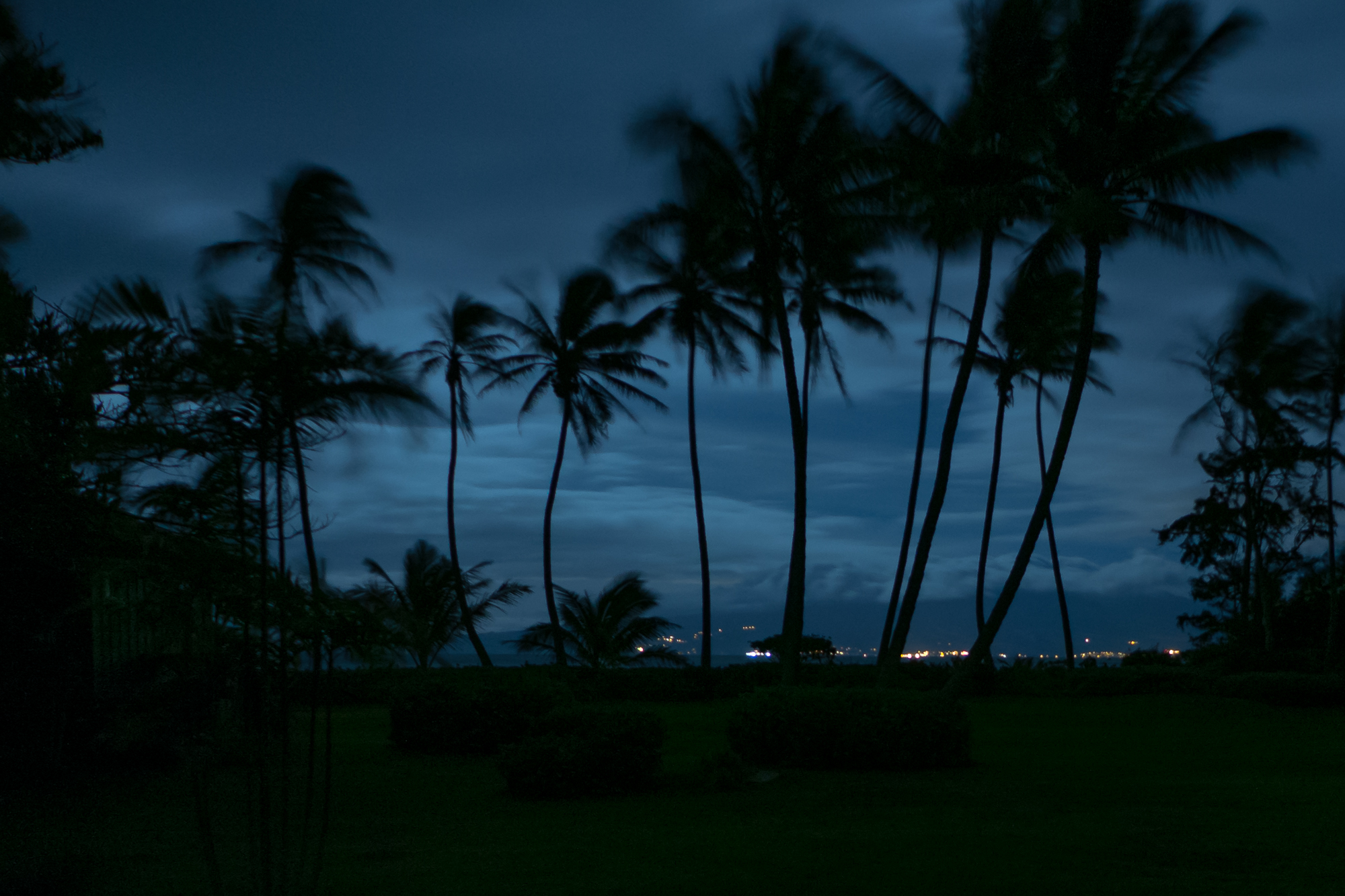
The lights of West Maui from Molokai  [Flickr page]
Click on individual images to enlarge, or check out the entire set (and others following the “darkness” theme) on Flickr. All are Copyright © 2013 Edwin A. Suominen. You may freely use them for non-commercial purposes, with attribution, under the Creative Commons Attribution-NonCommercial 3.0 Unported License.

Wednesday, July 31, 2013

Haleakala

[T]he chief pride of Maui is her dead volcano of Haleakala—which means, translated, “the house of the sun.” We climbed a thousand feet up the side of this isolated colossus one afternoon; then camped, and next day climbed the remaining nine thousand feet, and anchored on the summit, where we built a fire and froze and roasted by turns, all night. With the first pallor of dawn we got up and saw things that were new to us. Mounted on a commanding pinnacle, we watched Nature work her silent wonders. The sea was spread abroad on every hand, its tumbled surface seeming only wrinkled and dimpled in the distance. A broad valley below appeared like an ample checker-board, its velvety green sugar plantations alternating with dun squares of barrenness and groves of trees diminished to mossy tufts.
—Mark Twain, Roughing It
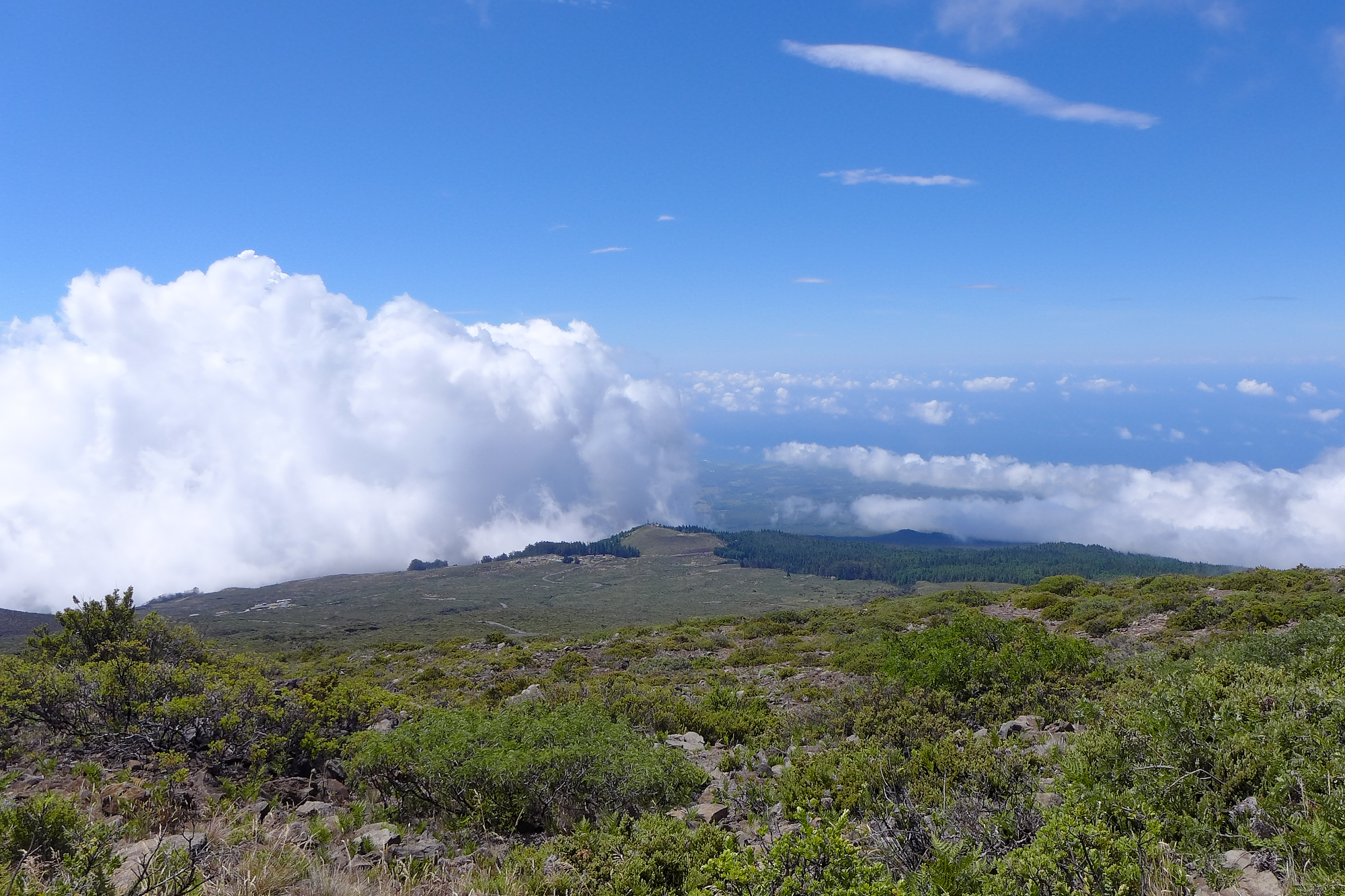
Clouds upwelling on the lower slopes of Maui’s central mountain  [Flickr page]

I am standing on the roof of the House of the Sun, just over 10,000 feet above the sea that is visible in the distance. This is a pinnacle of earth, rising impossibly high above the water and then the beaches and grazing lands, and it is flying eastward away from the sun.

Looking into the vast maw of Haleakala Crater  [Flickr page]

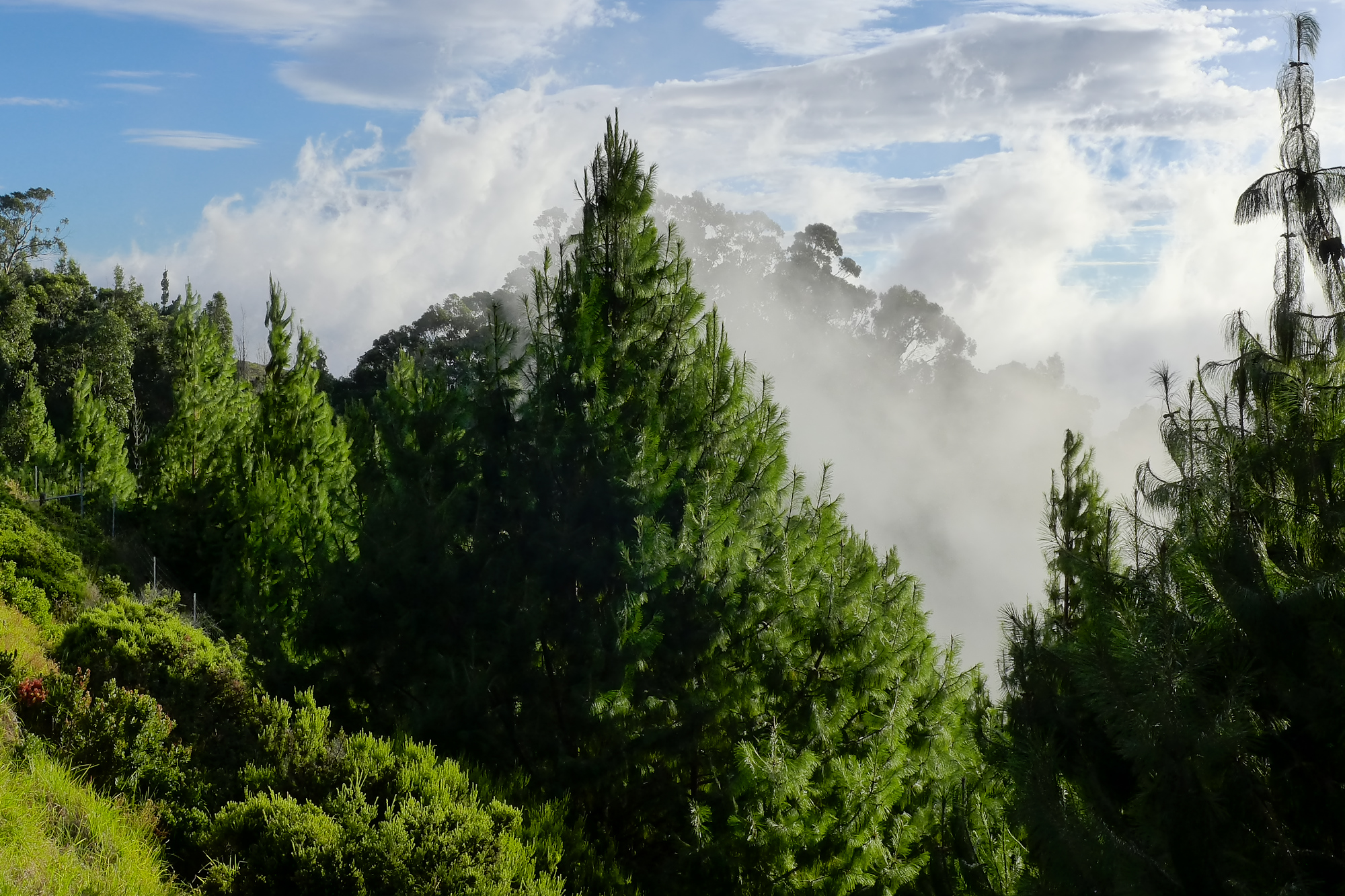
There is a monk’s tonsure of clouds around the mountain, and earlier we stopped to look at their upper reaches mingle with a narrow fringe of pine trees. There was sun, shadows, vivid green, and tendrils of white mist snaking magically in between.

Upcountry Conifers on Maui  [Flickr page]

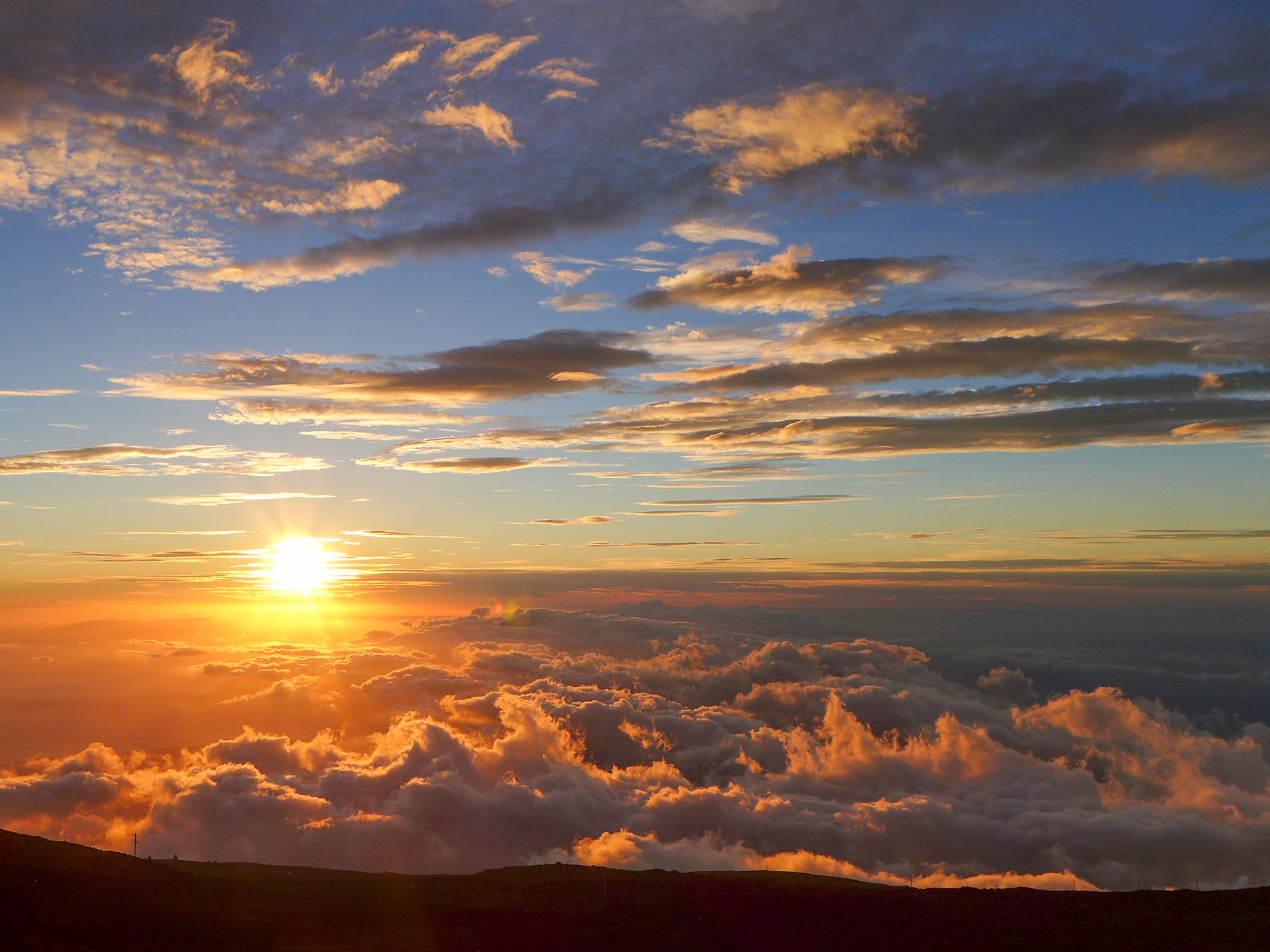
Now the sun is setting into a distant sea and a bed of brilliant clouds. Desperately I want to capture the stunning beauty of everything around me at this instant, this brief and glorious snapshot of my life. But the moment, I know, will soon blow past me as the wind.

Sunset at 10,000 feet  [Flickr page]

It is a thin and cold wind. The sparsity of this air’s gas molecules causes it to register just over 50 degrees Fahrenheit while the beachgoers far below sweat their way through 90 degrees. There is an odd sensation about breathing noticeably faster while just standing in place, which has an exhilarating slight edge of panic to it. The cool sharp air licks around the edges of my clothes, carrying faint, living scents of plants even up here.

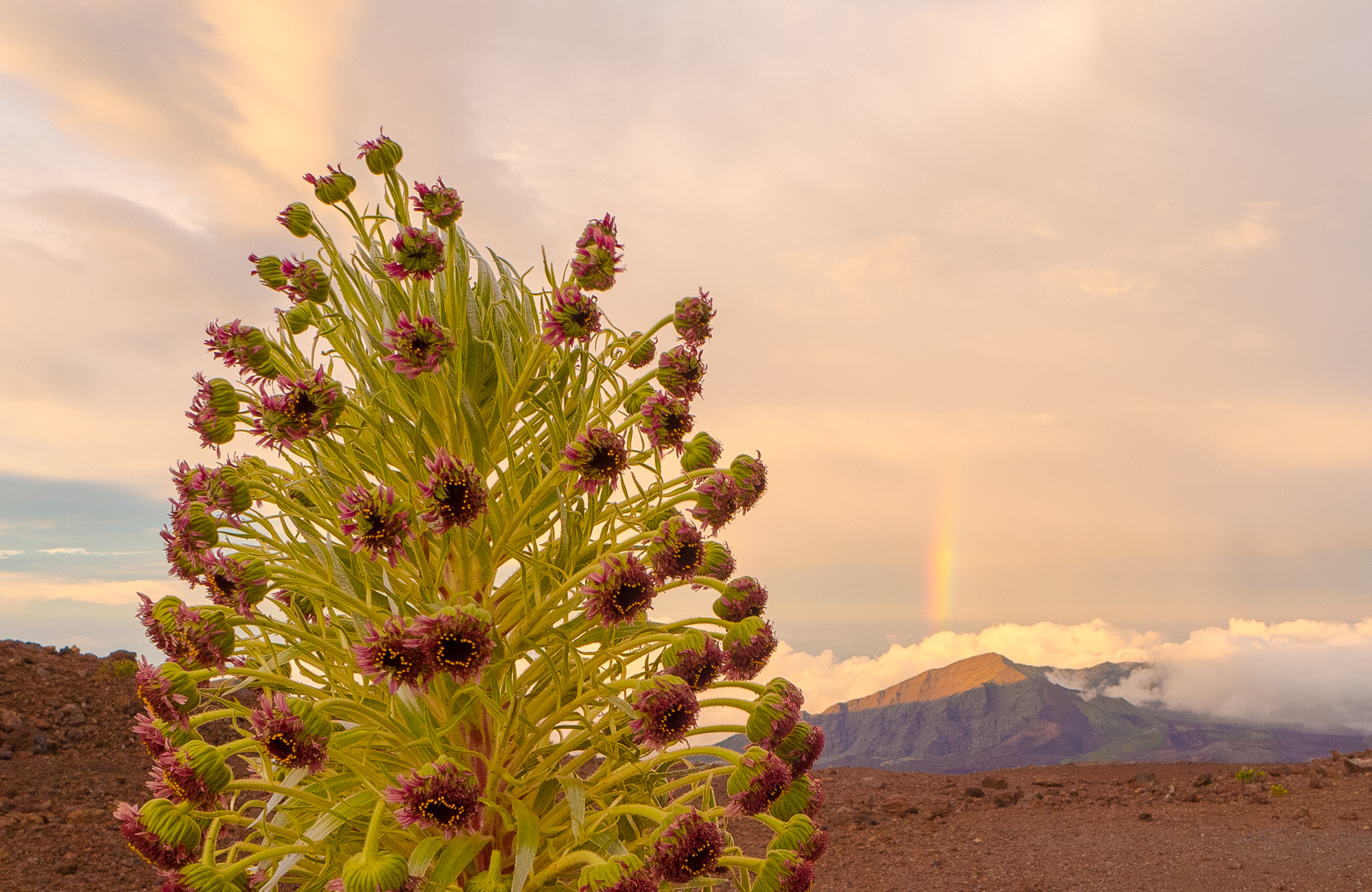
Silversword at sunset  [Flickr page]

Silverswords and jagged dark brown rock fade into the rapid dusk. When I turn around to look away from the sunset, I see a looming triangular shadow that this mountain casts on the clouds to the east. A rainbow plunges into barren lava rock, far below it distant ocean swelling unheard.

Who arrayed this glorious outrage of vision? I do not fault those who see behind it the face of God. I am in as much awe as they are, as deeply uncomprehending of any mundane explanation when standing mute before such majesty.

Sunset Rainbow in Haleakala Crater  [Flickr page]

Now, now, now! It is the moment: Standing atop this little bit of rock near the summit, I am falling backwards from the sun, the wispy clouds with me, turning purple and orange with the fading light from a sun that will not dally for anyone’s meditations. And yet, I have already seen such beauty today. Is there room in my mind for still more?

Quiet, chattering voice, writer of mental drafts! I must hush even the student of mindfulness. Quiet, quiet, all of you! Rush and rustle, wind, go on. I will listen, I will watch. Eyes open wide, drinking in the sight, holding back tears that are not just from the wind.

I gasp with a sudden determination to just be, here, now, as the saying goes. This is the time! I will seize its wispy tendrils, gather them in, store them. Even though I know that, like the manna in the wilderness, it will have lost its freshness by the morning. That day will require its own gatherings, of good or ill.

Too bad! Pause. Gape. Heartbeats, breaths, wide open vision. My camera is now in its pack; I will not share these seconds with its little screen. The best of the colors, the moment when the sun finally slips beneath that distant horizon, are for my eyes alone.

A deep breath, the edge of a sob: This is raw, this air has moved high across an ocean to reach me. Why must we move so relentlessly away from the last fringes of even the most beautiful of days, the same as all the rest?

Listen, feel, lean backward into the wind. Watch the colors redden, darken. Watch, hear, feel. Quiet.

No, it won’t last. It never does, neither moments of ecstasy nor days of beauty, nor a lifetime of all of those strung together along a thread of hopes and dreams and work. Nor even of generations, civilizations, the eons that this mountain required.

It all fades and flies with the wind. But for now, at least, I am—deliciously, joyously, incomparably—alive.

———
Click on individual images to enlarge, or check out my entire set of Maui photos (and others from Hawaii) on Flickr. All are Copyright © 2013 Edwin A. Suominen. You may freely use them for non-commercial purposes, with attribution, under the Creative Commons Attribution-NonCommercial 3.0 Unported License.

Monday, July 1, 2013

Turn Onward, Earth and Life, Turn

We who breathe air now will join the already dead layers of us who breathed air once. We arise from dirt and dwindle to dirt, and the might of the universe is arrayed against us.
—Annie Dillard, For the Time Being
Puget Sound Sunset  [Flickr page]

When I wasn’t looking, the midsummer sky finally darkened. It was light, and then it was not.

I remember when this happened a year ago. The earth turned, heedless of my attention, and the sun’s slanted rays slipped below the northern horizon. Now the earth has circled the sun once more.

Trunk Lines  [Flickr page]

Always turning, always circling, the sun itself making an ancient orbit around the center of a galaxy impossibly huge and old. It all laughs at my noting the passage of a single day, a single year, a single human life.

I must savor it while I can, grasp the waterfall of time as it flows before me. What else should I do? Where else should I be?

Nowhere. Watching my kids play in the water after a long day of making memories is enough. The water cannot be grasped, but its splash can be felt.

Turn onward, earth and life, turn. Meanwhile, it’s time for bed.

———
Click on individual images to enlarge. All are Copyright © 2013-14 Edwin A. Suominen. You may freely use them for non-commercial purposes, with attribution, under the Creative Commons Attribution-NonCommercial 3.0 Unported License.

Monday, March 25, 2013

Brief Flashes of an Unseen Future

This man died on the Jutland Peninsula in what is now Denmark, sometime around 300 B.C., plus or minus 80 years. His head lay preserved in a peat bog for over two thousand years.

Tollund Man – Wikimedia Commons

Our lives are the brief flashes of an unseen future to long-dead ancestors, sparks of flame that we now kindle in our children as our own embers burn ever lower.

—First posted (without links) on Facebook, 3/25/13