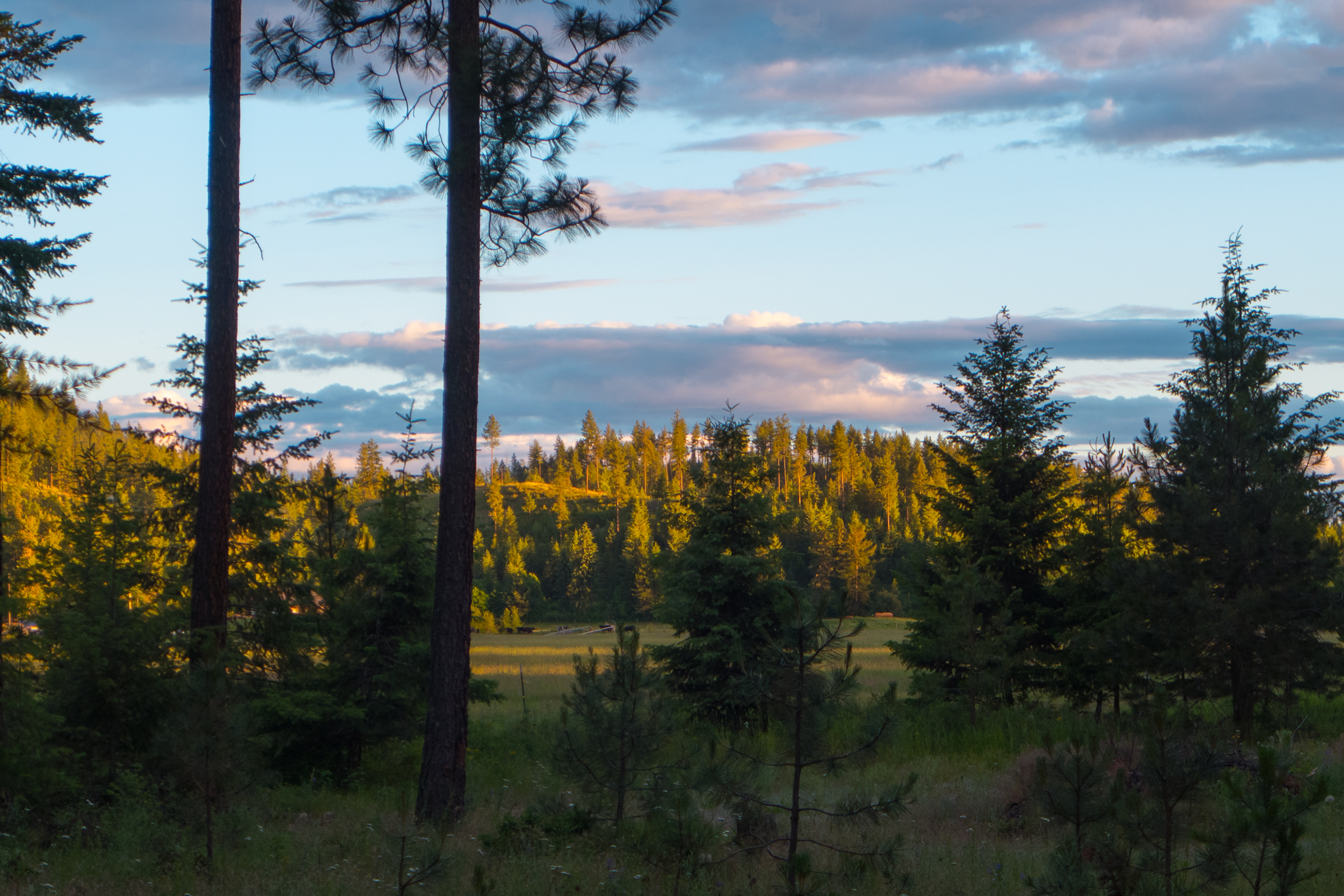
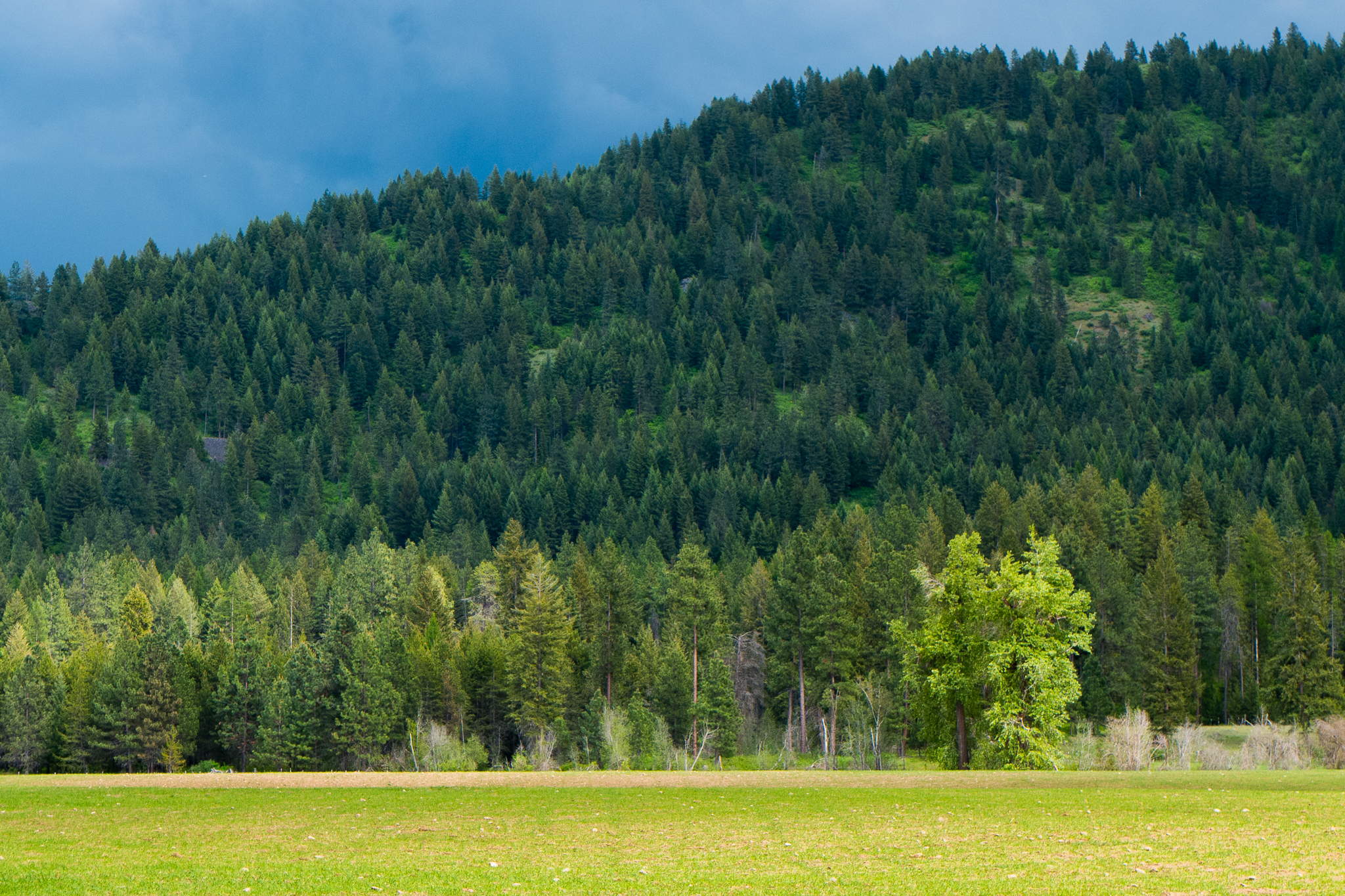
Everything was as it should be, except that it wasn’t. We were living in two worlds. The old one, which never seemed more beautiful, had not yet vanished; and the new one, about which we knew little except to fear it, had not yet arrived.
—Carol Blue, widow of Christopher Hitchens, on his cancer diagnosis. In Hitchens, Mortality (2012).
This essay has sat lurking in my head for weeks now, threatening to
force me into verbally confronting a reality that has borne silent
witness in the hot forest and the burning skies. Instead of writing, I
chopped wood and stacked it and then retreated into the stale
artificial coolness of my air-conditioned house. When it was cool
enough outside, I carried my folding chair to shaded places between
the trees and read my books.
As the summer wore on, the ground went dusty and the birds grew
quiet. The rich smells of my living forest faded into the dessicated air.
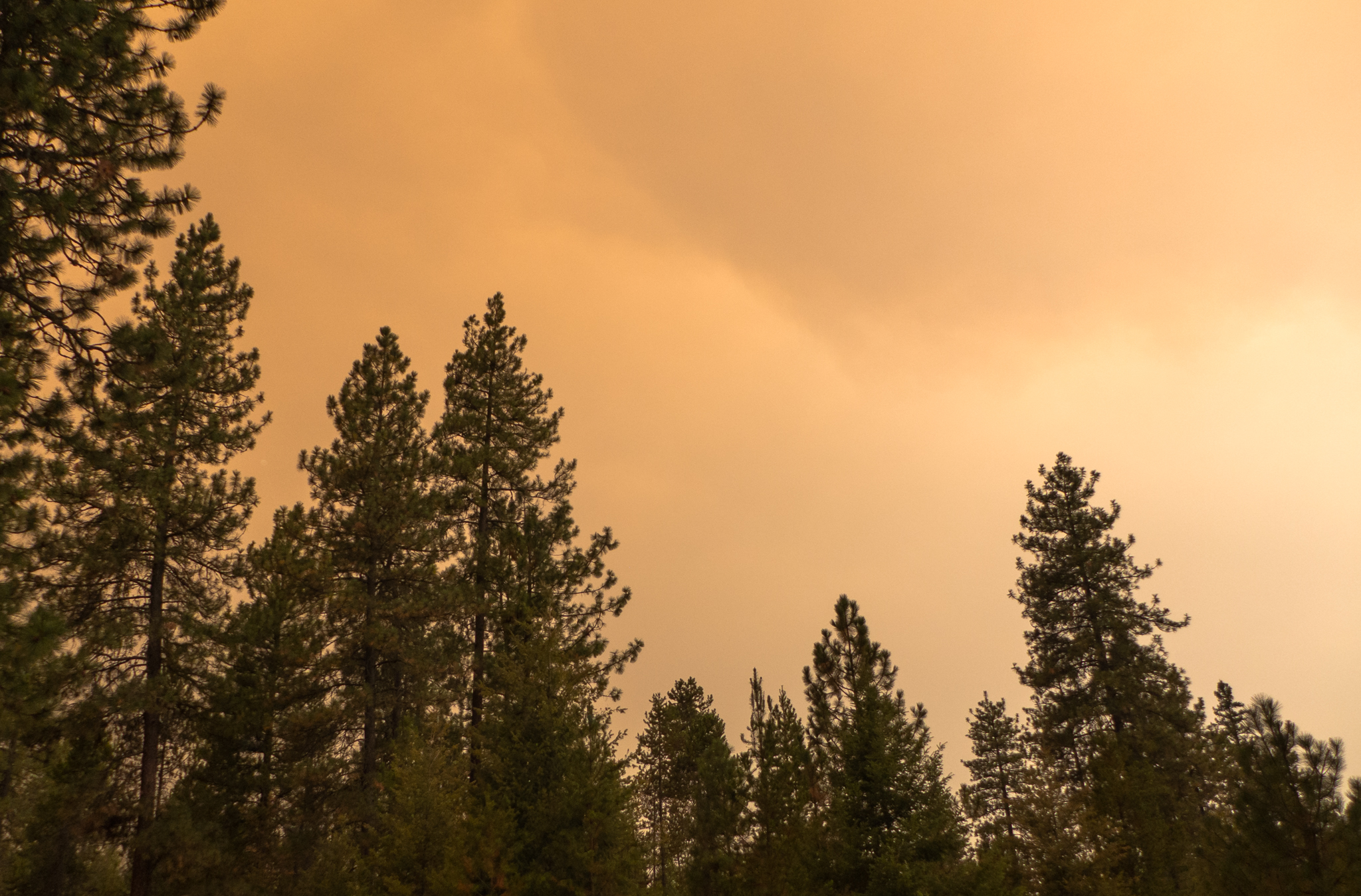
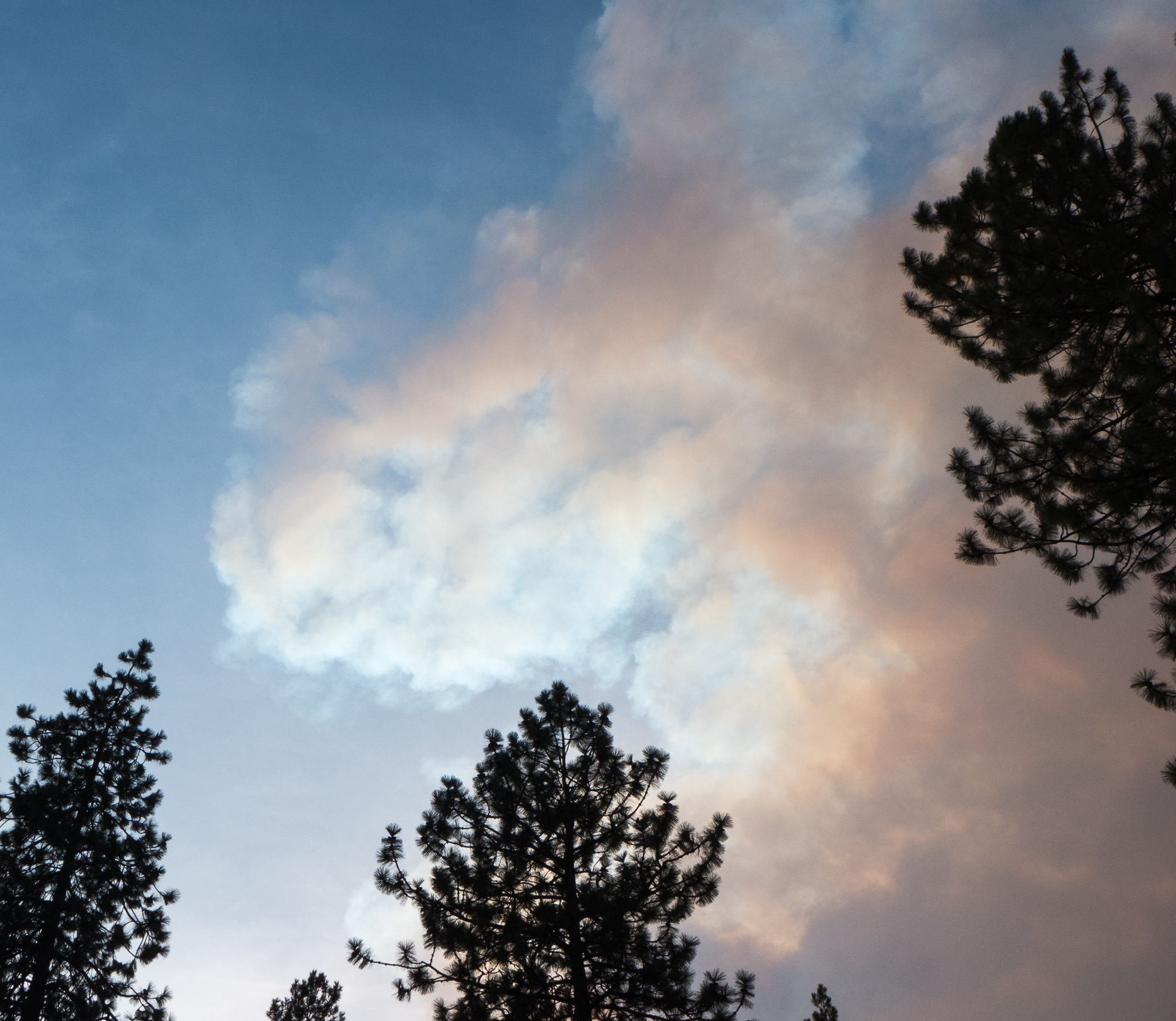
Then the wildfires began. Plumes of smoke drifted in, for days and
then weeks. I stayed inside, obsessively checking fire update pages on
Facebook. I drew the shades and watched movies in the dark.
For the first time, I took to watering the century-old trees within
reach of my well. It may save them, for this year at least, from the
bark beetles whose white larvae wriggled around the scarred surface of
firelogs I’d cut from their dead neighbors. Several times per day for
weeks now, I’ve pounded holes into parched earth near trunks six feet
around, shoving the end of a long hose down to dribble fifteen gallons
per hour into the dirt around their stressed roots. I have borrowed
nearly twenty thousand gallons from the acquifer beneath me to pay the
balance due to old ponderosa pines that expect more than what the
skies have given them this year.
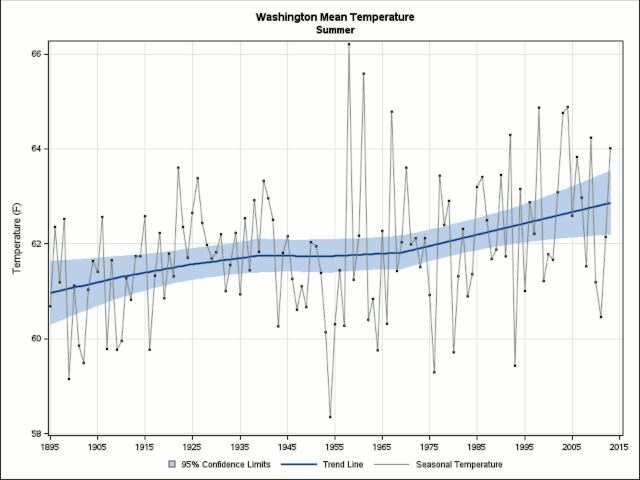
Getting worse by degrees
Except for two tenths of an inch that fell one glorious day in July,
it has not rained here since May. This summer has been hotter than
these trees or I have ever experienced in these woods. And now they
are burning, thousands of acres turned into smoke and ash, in all
directions.
“Across the Northwest U.S., a region known for its damp climate, its
rainforests, and for often cool and wet weather,” observes writer and
outstanding climate blogger Robert Marston Fanney, “wildfires have
been exploding. This summer, heat and dryness settled over the region
in a months-long drought and heatwave.” And he adds something I’ve
thought myself, having lived in Arizona for many years and now in
Eastern Washington: “The climate of the Desert Southwest has been
forced into Northern California, Oregon, Washington, and Montana.”
The forest floor is dry and gray and withered. Sad little clouds of
dust stir up when I walk through it, coating pale stiff lichen and
parched leaves of bearberry and Oregon grape. How much more of this
can they take?
The closest fire to me, some twenty miles away, has scorched more than
40,000 acres. Meanwhile, Washington State has had over 280,000 acres
burned out of its midsection from some giant fires that are still far
from being contained. Considered together (though they have not yet
merged, as of this writing), they form the largest wildfire in
Washington state history. The previous record was set last year.
Something is going terribly wrong.
———
“Not even people who are preoccupied with climate change like to think
about it anymore,” writes James Howard Kunstler in his excellent book Too Much Magic. “The more you explore the problem, the worse it
seems and the more hopeless you feel.”
“The whole idea of climate change is so overwhelming, you want to tune
it out,” agrees Ted McGregor, publisher of Spokane’s alt-weekly
newspaper. “But this summer, the smokey skies won’t let us. It might
seem like an insensitive time to inject politics, but we need to face
facts.”
Those facts are daunting indeed. NOAA just reported that the “combined
average temperature over global land and ocean surfaces for July 2015
was the highest for July in the 136-year period of record.”
That’s 1.46°F higher than the 20th century average. The previous
record was set in 1998.
Unless greenhouse gas emissions are restrained, the next four decades
are likely to move many parts of the planet to “a new, permanent heat
regime in which the coolest warm-season of the 21st century is hotter
than the hottest warm-season of the late 20th century.” From this
point on, we can expect about a third of the summers in the American
West to be hotter than the hottest season we experienced between
1980-1999. By mid-century, most of them will be.
That’s a drastic change for the climate of a big chunk of the United
States. And as the following map shows (from NASA’s Goddard Institute
for Space Studies), it’s one that’s been underway for some time
now. For the past fifteen years, average July temperatures in the
American West have been at least 1°F higher than they were between
1920-1980, perhaps nearly twice that.
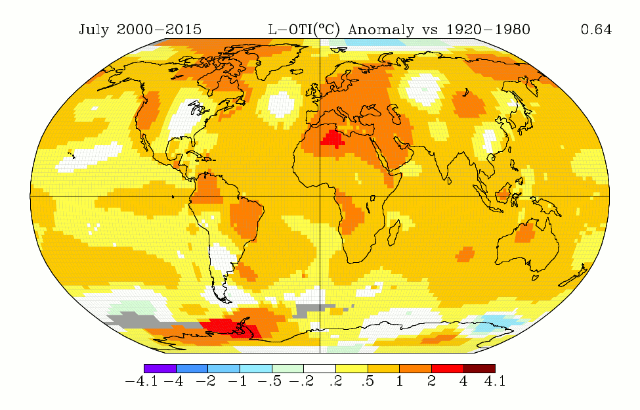
July temps for past 15 years vs. 1920-80 average
The Third National Climate Assessment, a report produced last year
by more than 300 experts and “guided by a 60-member National Climate
Assessment and Development Advisory Committee,” shows that much of the
U.S.–not just the West–was more than 1°F hotter on average between
1991-2012 compared to 1901-1960. “Summers are longer and hotter,”
the report notes, “and extended periods of unusual heat last longer
than any living American has ever experienced.” And it speaks directly
to what I’ve been seeing: “Hotter and drier weather and earlier
snowmelt mean that wildfires in the West start earlier in the spring,
last later into the fall, and burn more acreage.”
Where I live, it’s actually been worse than just earlier snowmelt: We
got almost no snow to have melted this year. Another map from the
Goddard Institute shows one reason why: Our winters are getting
warmer, too.
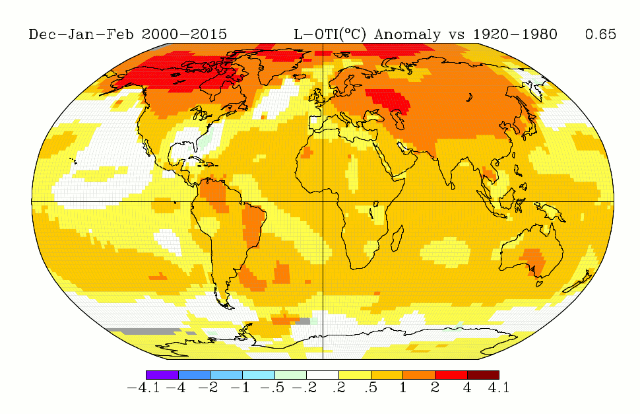
Wintertime temps for past 15 years vs. 1920-80 average
It does get cold here in the winter, with temperatures often in the
teens and below. But that almost always happens under clear
skies. When the clouds gather overhead and decide to dump some
precipitation on us, temperatures are usually hovering right around
the freezing mark.
One degree of average increase in that temperature can make for a lot
more rain than snow. And it is snow, not rain, that remains on the
shaded forest floor until March or even April in a slow melt that
soaks the trees for a burst of bright green growth each spring.
We have been getting less of that sky water, lately, in either form.
A so-called “ridiculously resilient ridge” of high pressure has parked
itself off the West Coast for much of the past three years, keeping
moisture-bearing storms from making landfall. Last year, a team of
Stanford University scientists “used a novel combination of computer
simulations and statistical techniques to show” that this
high-pressure region “was much more likely to form in the presence of
modern greenhouse gas concentrations.” Their simulations came up
with extreme high-pressure events significantly more often between a
1979-2005 interval compared to “pre-industrial” times, but only when “anthropogenic forcings” (greenhouse gas emissions) were
included along with natural forcings. The “heightened probability
cannot be explained without the anthropogenic contribution.”
It’s a significant, unprecedented weather event that we are witnessing
right before our eyes. And the likely reason we are seeing it is that
we’ve spent the past two centuries dumping the carbon that nature
accumulated over nearly 500 million years into those skies. “This
isn’t a projection of 100 years in the future,” says one of the
Stanford scientists. “This is an event that is more extreme than any
in the observed record, and our research suggests that global warming
is playing a role right now.”
Given this, and with all the talk of present and future drought, I was
surprised to see that the National Climate Assessment report
actually predicts more precipitation for our region later in this
century, between 10-20% more in fall, winter, and spring. More spring
rain might helpful. But the summer forecast is a cruel one, calling
for 20% less rain. That’s when the sap is really running and the
trees are trying to use all the sunlight from endless days that barely
dim, or to at least survive the blistering heat.
Still, for some reason, the report projects an increase of 1-5% in average soil moisture for my area by the middle of this century. I’ll take it, if that ridiculous ridge will just get out of the way.
In his book Climate Wars, Gwynne Dyer offers four conclusions that
he reached “after a year of trailing around the world of climate
change.” First is that “this thing is coming at us a whole lot faster
than the publicly acknowledged wisdom has it. When you talk to the
people at the sharp end of the climate business, scientists and
policy-makers alike, there is an air of suppressed panic in many of
the conversations.”
Panic, and despair. You can feel it welling up from the scientists who
were interviewed for John Richardson’s sobering article
this summer in Esquire. One of them, Jason Box, is an outspoken
climatologist who “escaped America’s culture of climate-change denial”
by moving to Denmark. Now he tries not to talk about the magnitude of
the problem because leaders of even that liberal country “still did
not take kindly to one of its scientists distressing the populace with
visions of global destruction.” He is thinking about a bug-out plan in
Greenland, whose melting glaciers he studies.
“Among climate activists, gloom is building,” says Richardson, and
then he lists some examples:
Jim Driscoll of the National Institute for Peer Support just finished
a study of a group of longtime activists whose most frequently
reported feeling was sadness, followed by fear and anger. Dr. Lise
Van Susteren, a practicing psychiatrist and graduate of Al Gore’s
Inconvenient Truth slide-show training, calls this “pretraumatic”
stress. “So many of us are exhibiting all the signs and symptoms of
posttraumatic disorder–the anger, the panic, the obsessive intrusive
thoughts.” Leading activist Gillian Caldwell went public with her
“climate trauma,” as she called it, quitting the group she helped
build and posting an article called “16 Tips for Avoiding Climate
Burnout” . . .
Anger is another of the emotions Dr. Box is dealing with. He has
little patience for the climate-change denialists he says “are risking
everyone’s future.” The Koch Brothers he calls “criminals” who “should
be charged with criminal activity because they’re putting the profits
of their business ahead of the livelihoods of millions of people, and
even life on earth.” But he is relieved, at least, not to “have to
bother with this bullshit anymore” in Denmark.
Kunstler thinks it’s probably more accurate to call it reality
denial. “It’s another of the universe’s jokes on us,” he adds, “that
the humans who call themselves conservatives tend to be the most avid
for squandering everything the planet affords us to live.” It’s more
than politics, though. We just don’t want to face what we have done,
and what’s in store for us. And that, says Kunstler,
has spawned a lively industry in climate change denial that is a
wholly owned subsidiary of the oil, gas, and coal industries and a
political subculture in its own right, aimed at defeating any policy
consensus that would reduce the use (and sale) of oil, gas, and
coal. Climate denial also happens to work nicely for that big chunk
of the public at large that does not want to entertain any
comprehensive change in the way we currently do things. And so the
debate about what to do about climate change decays into incoherence
as the deniers deliberately distort the facts while the
science-minded are buffaloed by such mendacity and frustrated by a
public that isn’t interested in the facts.
I’m all too familiar with head-in-the-sand behavior, thanks to my
studies of Christianity’s responses to evolution. Seeing such willful
denial gets me angry, too, though I understand that there are many
motivations for people to let themselves be misled. But, as William
Catton observed 35 years ago, “real limits not seen are not limits
repealed.”
I also acknowledge my own complicity. My flights to Hawaii and back,
to snorkel among coral reefs that will likely all be dead before I am,
have added hundreds of pounds of carbon to the skies. I eat meat and
drive a car, and had children (quite a few, as it turned out) who now
do the same. Richardson asks one of his climate scientists if he think
it would be wrong to take a transatlantic flight for his
interviews. (Unlike Al Gore with his private jet, Richardson appears
to have a healthy dislike for hypocrisy.) The scientist laughs and
replies, “You have to answer that yourself.”
Perhaps there is some cold comfort for our collective guilt in
Dyer’s second conclusion: Everyday lifestyle changes like changing
light bulbs and reduced driving are “practically irrelevant to the
outcome of this crisis.” Without “zero greenhouse-gas emissions
globally by 2050 and, preferably, 80 per cent cuts by 2030,” we are in
for a very rough ride. His third conclusion? That ain’t gonna
happen. “Maybe if we had gotten serious about climate change fifteen
years ago, or even ten, we might have had a chance, but it’s too late now.”
It is already too late for the Colorado forests that Dr. Box left
behind. They “are dying,” he says, “and they will not return. The
trees won’t return to a warming climate. We’re going to see megafires
even more, that’ll be the new one–megafires until those forests are
cleared.” I look around at the green landscape that I cherish, sullied
by smoke for weeks now, and wonder. Will my trees also die, and not
return?
Dyer’s fourth conclusion is that “mass movements of population, the
number of failed and failing states, and very probably the incidence
of internal and international wars” are correlated with increased
global temperature. There is an important point to this: International
mayhem from failed states and wars, “if they become big and frequent
enough, will sabotage the global cooperation that is the only way to
stop the temperature from continuing to climb.” This is a
geopolitical positive feedback mechanism, one involving human
behavior: Bad may prevent the prevention of worse.
Positive feedback is what makes the PA system squeal when a microphone
gets too close. Something about the current output of a system causes
future outputs to increase even more. There are natural positive
feedbacks to the global climate system, too, and they are scary
because they are completely out of our control. Once we have dumped
the carbon dioxide from our planes and cars and the methane from our
cows’ burps and farts (seriously, they are an issue), the resulting
rise in temperatures “feed back” in various ways to make temperatures
rise even faster.
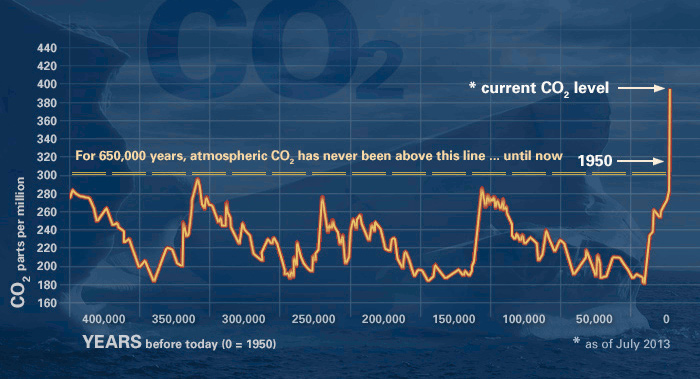
Michael Mann’s hockey stick. (We’ve now passed 400 ppm.)
That’s why increases in temperature are so dangerous even though they
look small as mere numbers–unless you are sweating out a hot summer
or wondering why it hardly snows anymore. “So far we’ve been the cause
for the sudden surge in greenhouse gases and hence global
temperatures,” says Bill McKibben,
but that’s starting to change, as the heat we’ve caused has started
to trigger a series of ominous feedback effects. Some are fairly easy
to see: melt Arctic sea ice, and you replace a shiny white mirror
that reflects most of the incoming rays of the sun back out to space
with a dull blue ocean that absorbs most of those rays. Others are
less obvious, and much larger: booby traps, hidden around the world,
waiting for the atmosphere to heat.
The biggest of those booby traps is found in the ground and under the
seas of the Arctic, which is warming faster than any part of the
planet. There are “immense quantities of methane natural gas locked up
beneath the frozen tundra, and in icy ‘clathrates’ beneath the
sea. Methane, like carbon dioxide, is a heat-trapping gas; if it
starts escaping into the atmosphere, it will add to the pace of
warming.” And it is doing just that. “In 2007, atmospheric levels of
methane began to spike.”
“Arctic permafrost ground that has been frozen for many thousands of
years is now thawing because of global climate change, and the results
could be disastrous and irreversible,” warns the Woods Hole Research
Center. It’s releasing not just methane but also carbon dioxide. And
then, after these additional greenhouse gases have been added to what
we are continuing to dump into the atmosphere, you can guess what
happens: The temperature goes up faster still. There is an acceleration of climate change, “which in turn causes more thawing
of the permafrost. This potentially unstoppable and self-reinforcing
cycle could constitute a calamitous ‘tipping point.’”
Another example: The forests and oceans are getting less efficient
as carbon sinks as we add more carbon. The trees are stressed from
heat and drought. Millions of them are getting killed off by bark
beetles that aren’t being controlled by cold enough winters or the
trees’ natural defenses.
We started this mess in just the past century, mostly, when we began
extracting and burning fossil fuels. Once the temperature had gone up
enough, the feedback mechanisms got established. Now, the freight
train is moving down the tracks, heading downhill, and it’s getting
away from us. We’re not even trying to slow it down; we just continue
to add more and more carbon, faster than ever. Drill, baby, drill.
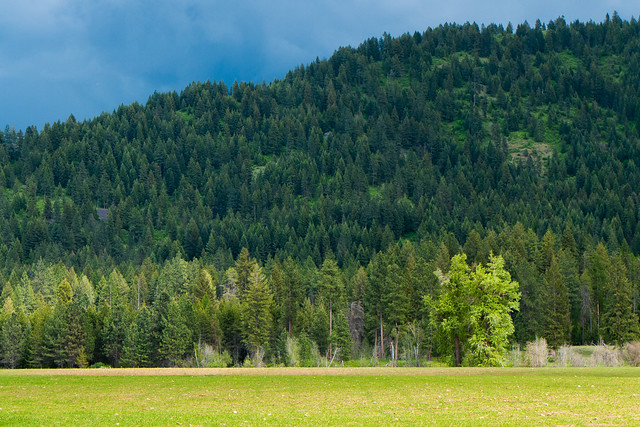
What I stand to lose. That cottonwood is already dead. [Flickr page] After attending a community meeting a few days ago about the monster
of a fire near us, I realized that yet another nasty feedback
mechanism is at work in the forests of Eastern Washington. It involves
bad consequences of over-stressed resources, system collapse.
When lightning sparked a small fire in the Huckleberry mountains west
of here, thousands of acres were already burning to the north. Our
local fire chief had lent out resources for other fire districts to
help fight those. That’s just what you do. It was a terrible night,
with dry lightning sparking fires seemingly all around us and then
strong winds fanning the flames.
Unfortunately, when yet another chief called him for help with a few
acres burning in the Huckleberry Mountains, he was forced to
decline. It pained him to do that, he said, both personally and
professionally, but there was no choice. He couldn’t leave his own
fire district defenseless, especially on such a night as that. The
whole state–indeed the entire American West–was stretched to the
breaking point. Yet if he had been able to answer that call, the
fire might have been stopped with just dozens of acres burned instead
of thousands.
And so another tipping point was reached. The local fire fighting
system was overwhelmed and the Carpenter Road fire has burned forty
thousand acres of forest near our home. What else is in store for us,
this year, and next year, and the one after that?
It’s stressful enough just thinking about next week. Despite
aggressive efforts and over four hundred personnel working the fire,
the monster has just jumped its main fire line, Springdale-Hunters
Road. And there is yet another “red flag warning” heading our way
tomorrow. “CRITICAL FIRE WEATHER CONDITIONS ARE LIKELY,” shouts the
all-caps message from the National Weather Service. “A COMBINATION OF
GUSTY WINDS, LOW RELATIVE HUMIDITY, AND WARM TEMPERATURES WILL CREATE
HIGH FIRE GROWTH POTENTIAL.”
They might as well just extend a red flag warning to the entire
planet, from this point on.
———
Apocalypse Now is of course the title of a great old movie. The pictures with Flickr links are my own, and you can click on them to enlarge, as usual. Clicking on the others takes you to links from their original sources. And please take a look at the excellent if horrifying
RobertScribbler blog.
Notes