Showing posts with label Book Review. Show all posts

Saturday, February 27, 2016

Judging Jesus

Think not that I am come to send peace on earth: I came not to send peace, but a sword.
—Jesus of Nazareth (Matt. 10:34)
Book review (and promotion): Blaming Jesus for Jehovah by Robert M. Price. With a Foreword by Valerie Tarico. Tellectual Press (2016).
Bob Price’s new book

Growing up as a Christian, there was one hero figure in my imagination who stood above all others, even above my parents. I didn’t have quite as distinctive a picture of him as I did of my father who helped me string wire on the roof for ham radio antennas or my mother who managed a photography studio, but somehow he was still better than they were. For the most part, I believed this.

Jesus was, you see, utterly perfect. He was so amazing and special that it really isn’t even appropriate to refer to him as a person, even though he walked the earth for some thirty years in human form, performing amazing feats and never succumbing to any of the sins that endlessly plague all of us mere mortals.

I was told that, having risen from the dead up to heaven to be with God (an even less clearly defined hero figure), Jesus looked down at us all the time and sat with us during church services. “Where two or three are gathered in his name,” there he’d be.1 And of course we were constantly telling each other that our sins were forgiven in his “name and precious blood.”

There was no room for any human failings in “our Lord and Savior Jesus Christ,” the innocent unblemished Lamb who offered himself as a final, perfect sacrifice on our behalf. The preachers never tired of reminding us how frequently and miserably we all sin, but not so with Jesus. He never did, not even once. If he had sinned, the implication went and was sometimes even expressed out loud, then all that forgiveness we were doing in his name and blood just wouldn’t work.

———

It took the sharp eye of a young friend who’d left the church while I was still in it to make me aware of any problems with this narrative. He pointed out that Matthew 5:22 has Jesus teaching, “whosoever shall say, Thou fool, shall be in danger of hell fire,” and yet Jesus himself calls people fools in Matthew 23.2

I came across other examples of behavior that didn’t seem particularly Jesus-like as I tiptoed warily into reading what skeptics had to say and–for the first time with clear eyes–the Bible itself. One of those skeptics, Valerie Tarico, pointed out how Jesus’ behavior could seem downright bigoted. In her book Trusting Doubt, she recalled how

a Canaanite woman, a non-Jew, calls out, begging Jesus to heal her daughter, who is possessed by demons. “Lord, Son of David,” she calls him. But he ignores her. Finally, his disciples get sick of her following them and shouting, and they ask him to send her away.

Then “Jesus tells her he was sent only to the lost children of Israel. She keeps begging.” In the end, Jesus heals her daughter, but not before enduring a degrading conversation with him. She “came and knelt before him. ‘Lord, help me!’ she said.”

He replied, “It is not right to take the children’s bread and toss it to their dogs.”

“Yes, Lord,” she said, “but even the dogs eat the crumbs that fall from their masters’ table.”

Then Jesus answered, “Woman, you have great faith! Your request is granted” (Matt. 15:25-28).

This did not impress Dr. Tarico:

If the image doesn’t bother you, try to imagine an American slave or a South African Black having to do and say the same things to get health care for her child. “Please, sir, even the dogs eat the crumbs that fall from their masters’ table.”3

Savior Bro: Not as meek and mild as you thought

Something troubling I came across in my own Bible reading was Jesus telling a bald-faced lie. In John 18:20, he said to the high priest, “I spake openly to the world; I ever taught in the synagogue, and in the temple, whither the Jews always resort; and in secret have I said nothing” (emphasis added). But, according to Mark 4:34, Jesus expounded on the meaning of his parables “when they were alone.”

In fact, all three Synoptic Gospels (Matthew, Mark, and Luke) give an example of Jesus doing the secret teaching he explicitly claimed he’d never done. It happened after Jesus told the crowd the parable of the sower, “when he was alone” with the disciples (Mark 4:10). They asked him about the parable.

Did Jesus say, “What’s wrong with you guys? Can’t you understand plain Aramaic?” Nope. He told them they were being let in on the mysteries (mystery, singular, in Mark) of the Kingdom that were being kept hidden from the unwashed masses (Mark 4:11; Matt. 13:11; Luke 8:10).4 He then proceeded to explain the parable to them–and them alone.

It’s a pretty bad situation for those who believe the 66 books of the Bible make up the inerrant Word of God with no contradictions. If both John and the Synoptics are telling the truth about what happened, then Jesus did not.5

So Jesus became something of a disappointment, though I could’ve lived with a slightly sub-par savior if church doctrine cut him any slack. (Alas, it doesn’t.) And a careful reading of the Old Testament left me utterly repulsed by the shitty attitude and horrible actions of our Father which art in heaven. He is, to quote Richard Dawkins’s memorable one-liner,

jealous and proud of it; a petty, unjust, unforgiving control-freak; a vindictive, bloodthirsty ethnic cleanser; a misogynistic, homophobic, racist, infanticidal, genocidal, filicidal, pestilential, megalomaniacal, sadomasochistic, capriciously malevolent bully.6

This really is no exaggeration. Read the bloodstained pages in the first half of your Bibles and you will soon see how devastatingly true it is.

———

Having long since absorbed the shock of these realizations about both Father and Son, I was delighted to have my little publishing company Tellectual Press take on Robert M. Price’s new book, Blaming Jesus for Jehovah. In it, he presents a grave and devastating conflict for Christianity: “the sheer logical impossibility that God and Jesus, as defined by the Christian creeds, could have commanded and taught the hateful things the Bible says they commanded and taught, and still be loving, just, forgiving, and merciful.”7

Dr. Valerie Tarico–much more pleasant than the God she writes about [Flickr page]

The book begins with a Foreword that was kindly provided by Dr. Tarico. She cites Dawkins’s description of the “malevolent bully” and observes that “trying to separate Old Testament from New–trying to separate Jesus from Jehovah–doesn’t solve the problem.” In fact, she says, “it is impossible,” because “Jesus himself won’t let us.”8

Bob makes that clear right away in the first chapter, entitled “The Son Who Is the Father.” He cites several passages in Matthew and John where Jesus claims a special relation to his Father in heaven and speaks about “‘inside information’ concerning his divine Father and his celestial realm.”9 Jesus knows all about God, Bob says, “because he has intimate familial knowledge, ‘a chip off the old block.’” I especially like the way Dan Barker put it in a recent interview: Jesus isn’t just “a chip off the old block”; he is the block.10

That, of course, refers to the doctrine of the Trinity, a weird theological superposition of three distinct persons of God into a single divine entity. Bob devotes a few pages to what present-day Christians think the Trinity is (but is not) and concludes with the observation that, according to that doctrine, “Jesus and Jehovah are one and the same God.”11 And even without it, there’s plenty in the Gospels to put responsibility for all those Old Testament atrocities on Jesus as Jehovah Junior.

Remember, Jesus explicitly declined to nullify the Old Testament or distance himself from what it describes his Father doing. Bob dismisses the view of many Christians “that the New Testament either exonerates the God of the Old or just plain renders him irrelevant,” which he finds a strange thing to think for those who “profess to believe that both Testaments are the inspired Word of God.” His

considered guess is that they are thinking of the Pauline notion that Christ and his gospel have superseded the Torah, the Old Testament Law. But that is quite a different matter. Paul says that the ceremonial provisions of Judaism (circumcision, kosher laws, holy days, etc.) are no longer binding since their proper purpose has been fulfilled as of the coming of Christ (Col. 2:16-17; Gal. 2:15-21; Rom. 10:4). But that has nothing to do with genocide, as if something so morally repugnant could be proper in the Old Testament dispensation but not in the New.

But, hey, who wants to look too closely? If you’re looking for an excuse to sweep Old Testament atrocities under the rug, any old broom will do.12

After spending a chapter (“Artists’ Conceptions of Jesus”) acknowledging some good stuff about Jesus, Bob goes on to summarize some of those atrocities. We are rightly horrified by the grotesque savagery of ISIS, yet

the Christian holy scripture, the Bible, explicitly ascribes the very same moral crimes to God. Islamic Caliphate killers don’t even need the Koran. There are hundreds of passages in the Holy Bible which would be more than enough to inspire their horrors. These are strong words, I know. I hate to have to write them. I hope you will have the courage to read them. It comes down to a question of your own integrity. I hope you will see that.13

Any torture that the sick minds of ISIS fanatics can cook up is, of course, a mere pinprick compared to the novel bit of nastiness introduced in the New Testament: eternal condemnation in the agonizing fires of hell. Bob gives that horror the full attention it deserves. In a couple of ample chapters, he covers the various theological attempts to justify unlimited punishment for limited humans and reveals the absurdity of the whole idea of blood atonement.

And there is more: The failure of Jesus’ prophecy about his imminent return, the failure of the Bible to provide a consistent and reliable story about him, and the problems with expecting ant-like humans to heed the warnings of an omniscient God who knows they’ll screw up regardless. This book has a lot of good stuff packed into its 166 or so pages, and I’m very proud to have been a part of its publication.

Fun while it lasts (screenshot taken Feb. 27, 2016)

There is one issue I scratched my head about while editing the book, which bears mentioning. Bob is well known as a skeptic about the existence of any actual person behind the Bible character of Jesus.14 Here’s how he put it to me in a recent phone conversation:

I think there was no Historical Jesus and the Jesus story is almost entirely based on rewriting Old Testament passages. But another likely influence was the dying and rising God myths in the Mediterranean world and also ancient Israelite religion.

In Blaming Jesus for Jehovah, however, Bob treats the existence of Jesus as a given. I asked him about that, particularly where he calls the doctrine of Original Sin “a matter of reverse engineering” by early Christians who “had to deal with the death of Jesus somehow.”15

He was executed as a criminal, but they believed he wasn’t one. So if he didn’t die for any sins of his own, and his death couldn’t have been a meaningless tragedy, whose sins did he die for? Must have been everybody else’s!16

Well, I asked, if you think there wasn’t any such person who actually lived or died, why would those early Christians have been troubled by his death? His answer was that

those who wrote our New Testament documents were not mythicists. They believed there was a Historical Jesus martyred at the hands of Rome, who died innocently. They had the problem of explaining how this could happen.

He dates the earliest Gospel, Mark, at possibly 70-80 years after the reported events, but more likely a full century afterwards. Those early Christians were thinking and writing a couple of generations removed from the event they imagined had happened. That’s plenty of time for a whole myth about a messianic savior to have developed–a “major theological adjustment” to Second Temple Judaism following the destruction of Solomon’s temple by the Romans.

With this book, Bob wanted to avoid the whole controversy of the Historical Jesus vs. the Christ Myth Theory by simply accepting the Bible’s assertions about Jesus at face value. It’s a “look through the lens of mainstream criticism,” as he put it. Even so, it’s still quite a critical and much-needed look, at the superhero figurehead of the world’s largest religion whose flaws thus far have remained largely off-limits to scrutiny.

———
The cover image is Copyright © 2016 by Tellectual Press, an imprint of Tellectual LLC. Used by permission.
Nature photography is much more my line than portraits, but I was glad to have a chance to offer Valerie Tarico some additional publicity photos, including the one shown here, during a visit in Seattle last summer. She’s a wonderful, gracious individual who just inspires you to do your best to keep up with her gentle goodwill. The picture is Copyright © 2015 Edwin A. Suominen, but it’s hers to do what she wishes with, and she’d probably be open to your inquiry should you have a good use for it.
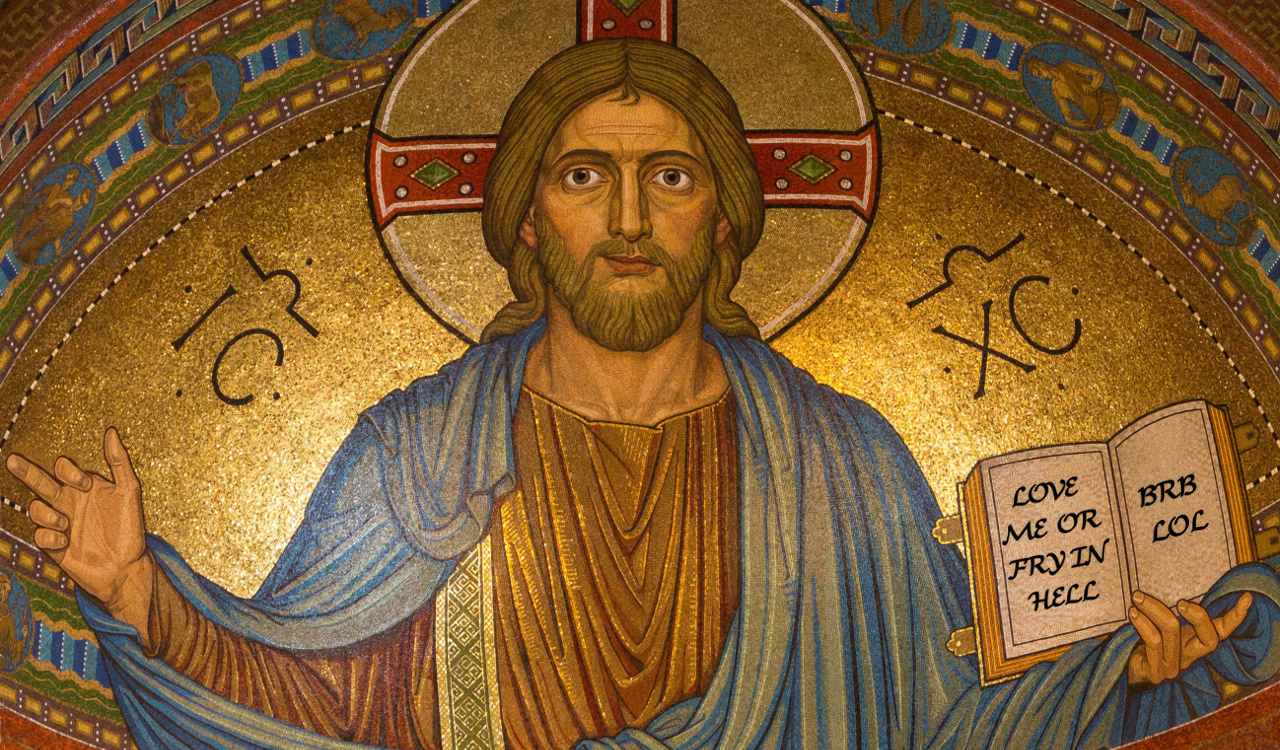
The Jesus mosaic image is adapted (obviously) from a photo reproduction of the apse mosaic of Christ Pantocrator inside the Maria Laach Abbey. The mosaic “was completed in 1911 by Father Andreas Goeser” (link), long enough for the unfortunate Fr. Goeser’s beautiful work to pass into the public domain and get co-opted with the GIMP free image processing software. My irreverent modifications consist of the smirk, the folding over of one additional finger, and a considerably revised text on the open pages. I cannot take credit for “BRB LOL,” having seen it in a meme image some time ago.

Notes


  1. Matt. 18:20. It should be added, however, that the only qualified gatherings for his attendance were those of my own church’s few hundred congregations around the world. He skipped all the untold thousands of other ones because they weren’t part of “God’s Kingdom.” 

  2. “Ye fools and blind: for whether is greater, the gold, or the temple that sanctifieth the gold? And, Whosoever shall swear by the altar, it is nothing; but whosoever sweareth by the gift that is upon it, he is guilty. Ye fools and blind: for whether is greater, the gift, or the altar that sanctifieth the gift?” (Matt. 23:17-19). 

  3. Valerie Tarico, Trusting Doubt: A Former Evangelical Looks at Old Beliefs in a New Light (Oracle Institute Press, 2010; previously published 2006 as The Dark Side), Ch. 5 (available online). 

  4. The Revised Standard Version translates the word as “secrets” (secret, singular, in Mark), which makes the problem even more apparent. Both the KJV and NASB use the term “mysteries” (and “mystery”). 

  5. These four paragraphs, the footnote above, and the rest of this one are adapted from my first book, An Examination of the Pearl, Section 7.1 (“The Gospels”). Robert M. Price told me in 2011 that he believes this to be a case of an intentional contradiction between John and the Synoptics. The writer of John “rejects the esotericism of Mark and changes the story,” which he also did to avoid the “unseemly” stories of Jesus not carrying his own cross and not wanting to go through with his suffering. “For John, there was no private teaching in the Markan, Gnostic sense.” (Gnosis was secret spiritual knowledge not shared with everybody else.) “Everything is public, though some do not hear because they are not of his flock. Thus within John’s retold narrative Jesus is telling the truth.” 

  6. Richard Dawkins, The God Delusion (Houghton Mifflin, 2006). 

  7. Robert M. Price, Blaming Jesus for Jehovah: Reconsidering the Righteousness of Christianity (Tellectual Press, 2016), p. 19. 

  8. Price (Tarico Foreword) at p. 8. 

  9. Price at p. 29. 

  10. Dan Barker, interviewed by Seth Andrews on The Thinking Atheist podcast, Feb. 16, 2016

  11. Price at p. 38. 

  12. Price at p. 65. 

  13. Price at p. 55. 

  14. See, e.g., my blog posting Myth, Method, and the Will to Believe about a lecture by the same name that Bob gave on the topic. 

  15. Hat tip to Jonathan Bernier, who noted this issue in a Facebook post

  16. Price at p. 95. 


Tuesday, September 22, 2015

The Forgiver

For we, like children frightened of the dark

Are sometimes frightened in the light–of things

No more to be feared than fears that in the dark

Distress a child, thinking they may come true.

—Lucretius, On the Nature of Things, c. 50 BC, tr. Ronald Melville.
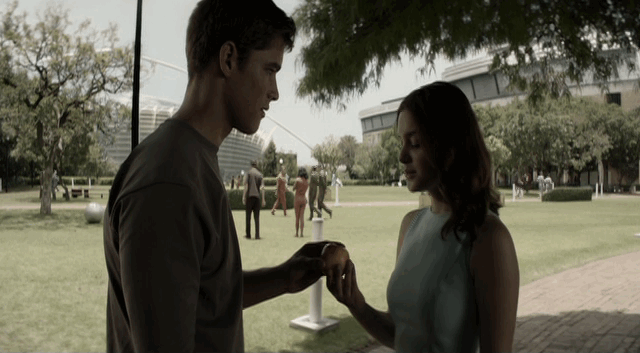
Forbidden fruit: The new Receiver tries to do some giving.
Review: The Giver by Lois Lowry. Houghton Mifflin (1993). Movie adaptation produced by The Weinstein Co. (2014).

The other week, I watched The Giver on DVD with my wife and a few of my kids. It’s a 2014 film adaptation of Lois Lowry’s 1993 book about a future collectivist society that does away with all but a bland, utilitarian remnant of human emotion and ambition. “The community” has even eliminated history from the minds of its people, with one significant exception.

A single chosen individual, the “Receiver of Memory,” is designated to take care of recalling past civilizations and events. This exalted and burdened person is set apart with an exclusive collection of books and memories, which he keeps to himself except to cryptically advise the Elders in their decision-making.

Eventually, the Receiver takes on an apprentice, to whom he passes all that knowledge and memory. The selection of a new Receiver “is very, very rare,” as the community’s Chief Elder tells her community at the Ceremony of Twelve,1 where young people are being assigned their occupations with much fanfare, and without any say in the matter. “Our community has only one Receiver. It is he who trains his successor.”2

The story’s hero, Jonas, is named as that successor. “I thought you were The Receiver,” Jonas tells him during their first teaching session, “but you say that now I’m The Receiver. So I don’t know what to call you.” Call me The Giver, the old man says.3 And from him Jonas goes on to learn some amazing and troubling things. His life will never be the same again.

———

Around the end of 2010, one of my daughters had been assigned the book in school, and I wound up reading it myself. At the time, I was in the early stages of researching the doctrine and history of my old church. The things I was starting to learn would turn my own life upside-down and result in my first book, An Examination of the Pearl, about a year later.4

I was stunned by the parallels between Lowry’s sheltered, intellectually stunted community and the “Kingdom of God” in which I’d been struggling. After a lifetime as one of “God’s children,” I’d finally started to look at my odd little church in a clear-headed way. What I was seeing disturbed me a great deal, and so I put together a listing of church writings with footnotes stating some of my concerns. I had it printed and bound into a dozen softcover copies that I shared with a few friends in the church. Oops.

In September 2010, I was hauled before the church board of trustees and preachers for a stressful, coercive, and emotional meeting about my little copy-shop book. “Are you really believing?” I was asked. Beyond some concern about how I could dispute what “God’s Word” teaches regarding Adam and Eve and Noah’s Ark, there wasn’t much substantive discussion of what the book actually had to say. It was mostly about me for having said it.

Repent or Else

They told me the book was an expression of my doubts, which would have been best kept to myself or private conversations. It could be dangerous if it fell into the wrong hands, they said. It would leave the impression among outsiders that there are dif­ferences of opinion in “God’s Kingdom.” And it is certainly not something that believers should be reading. After over two hours of this, the meeting concluded with the understanding that I was to retrieve copies of the book.5

Just a few months after that experience, here I was reading about a closed community of myriad rules and “appropriate remorse” and public apologies, where uncomfortable history was extinguished from memory, where intractable rule-breakers were released to “Elsewhere.” And I was seeing a frightful near-future version of myself in Jonas, not some lofty hero but simply a wide-eyed seeker of truth–unable to tolerate cen­sorship and propelled by an irresist­ible call to look at reality, at long last, come what may.

Comparing Lowry’s all-controlling community with Christian funda­mentalism doesn’t seem to be a unive­rsal or even a com­mon interpretation of her book,6 but she would be happy to let me keep it as my own. “A book, to me, is almost sacrosanct: such an individual and private thing. The reader brings his or her own history and beliefs and concerns, and reads in solitude, creating each scene from his own imagination as he does.” And I was certainly interested to see her recall a “man who had, as an adult, fled the cult in which he had been raised” telling her “that his psychiatrist had recommended The Giver to him.”7

———

The first thing that jumped out at me was the rigid structure of rules that govern life both in Lowry’s dystopia and for the “believers” in the Laestadian Lutheran Church. Community members are careful to maintain “precision of language,”8 while believers do not swear, tell dirty jokes, or speak light-heartedly about faith matters. Each family unit of the community receives two children–no more–while believing parents are to accept as many children as they are “given”–no less. Community girls are instructed to keep their hair ribbons “neatly tied at all times”9 while believing girls are instructed not to wear earrings, make-up, or spaghetti straps.

Even a minor rule like the one against bragging (there is “never any comfortable way to mention or discuss one’s successes without breaking the rule against bragging, even if one didn’t mean to”) is best followed by steering clear of occasions where breaking it would be too easy.10 Thus believers have restrained themselves from playing violins in orchestras where they might get “puffed up” in their talents, even if they would just be one of many players helping to produce one of the few types of music to which they can listen in good conscience. Thus many an athletic Laestadian boy has walked home while his unbelieving sort-of friends go off to football practice. God’s glory must not be given to another, and the world cannot become too close.

And then there are those Stirrings, which begin for young Jonas with a dream about a girl his age. He describes it to his parents during a “sharing-of-feelings” rap session they are expected to do over dinner each day. (“Be free,” the board members would tell us during the many congregational meetings of my youth.) In the dream, he and the girl were in front of a tub in the House of the Old, where the elderly get cared for in their final days.11

“I wanted her to take off her clothes and get into the tub,” he explained quickly. “I wanted to bathe her. I had the sponge in my hand. But she wouldn’t. She kept laughing and saying no.”

His father asks Jonas about the strongest feeling he experienced during the dream.

“The wanting,” he said. “I knew that she wouldn’t. And I think I knew that she shouldn’t. But I wanted it so terribly. I could feel the wanting all through me.”12

His parents look at each other and Jonas is then told about the Stirrings.

He had heard the word before. He remembered that there was a reference to the Stirrings in the Book of Rules, though he didn’t remember what it said. And now and then the Speaker mentioned it. ATTENTION. A REMINDER THAT STIRRINGS MUST BE REPORTED IN ORDER FOR TREATMENT TO TAKE PLACE.13

In the dystopia of The Giver, the treatment is medication, taken every day to deaden a person’s natural sex drive until it finally disappears in old age. In Laestadianism, the treatment is the forgiveness of sins–dispensed in a sermon every Sunday and, if parents are following recommended procedure, in the words of absolution being preached to their children at bedtime every night.

Believe all sins forgiven in Jesus’ name and precious blood, the young innocents are told, night after night by parents or siblings. That proclamation offers redemptive relief for all sins, and does the job in most cases, certainly from sinful thoughts of providing erotic bathing assistance to the cute girl or boy next door. If one’s Stirrings have moved beyond mere fantasy to masturbation or–heaven forbid–to a little kissing and heavy petting behind the garage where the yard light don’t shine, guilt pangs may persist despite the generic assurance of forgiveness. The preachers recommend confession in such cases.

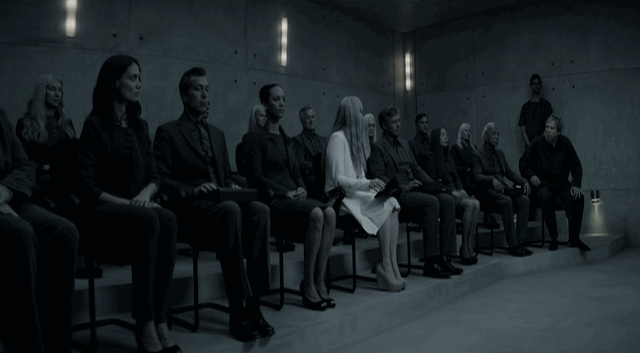
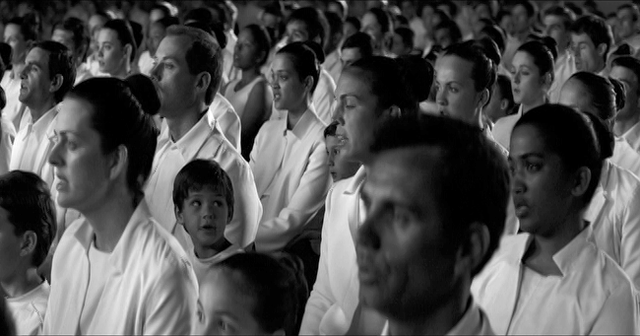
The assembled community: Looks a lot like church to me.

Confession was a big deal in Laestadianism during my childhood. Most sins beyond mere impure thoughts, doubts, etc. were considered to remain on the conscience until one had spoken of them “by name.” It was not an absolute requirement to confess, but was widely expected, at least for those infractions falling into a non-biblical category of “name sins,” a category that was often referred to but never very specifically defined.14 A 1978 article from the church newsletter pretty well encapsulates how things were back then:

It is never an easy matter to repent of sins for the flesh fights against the Spirit. But sin has a name, and those named sins will not go away without our speaking of them to a dear brother or sister. We are assured that we can freely go to a dear one and open our heart. But those sins that have affected the congregation of God are to be re­pented of before the con­gregation; otherwise we will not receive freedom.15

That last part about repentance before the congregation offers a hint of the public confessions that people often made after the Sunday morning service when I was a kid. In my congregation and at least some others in North America, members would head up to the front of the church after the ser­mon and ask the en­tire con­gregation for forgiveness of various sins.

During the congregational “caretaking” meetings that were a regular Saturday night event, where some issue or person(s) of concern would be discussed with much emotion, such repentances would go on and on.16 I’ll always remember one of them in particular, from a young father who dutifully walked up to the microphone and asked forgiveness of the congregation for “reading filthy literature.” Poor guy. It was probably just a paperback novel with a vague sex scene or two.

With all those memories in my head, you can see why I saw some Laestadian parallels in Jonas’s recollection of his friend Asher showing up late to class:

“When the class took their seats at the conclusion of the patriotic hymn, Asher remained standing to make his public apology as was required.”

“I apologize for inconveniencing my learning community.” Asher ran through the standard apology phrase rapidly, still catching his breath. The Instructor and class wait­ed patient­ly for his ex­planation. The students had all been grinning, because they had listened to Asher’s explanations so many times before.

“I left home at the correct time but when I was riding along near the hatchery, the crew was separating some salmon. I guess I just got distraught, watching them.

“I apologize to my classmates,” Asher concluded. He smoothed his rumpled tunic and sat down.

“We accept your apology, Asher.” The class recited the standard response in unison.17

“I’d like to ask forgiveness for, er, reading filthy literature,” the Laestadian Asher stammered, looking down at the floor. Believe all your sins forgiven in Jesus’ name and blood, replied the congregation with their standard response, in unison.

———

Back in those bad old days, there was another chilling parallel to The Giver. It was release from the community, the Laestadian form of which we called “binding.” Believers would be bound in their sins, and any requests they made to be forgiven would be denied unless it was decided that they were being specific and penitent enough about the issue at hand. Usually, there was some “false spirit” at the heart of the matter, which needed to be exorcised by being named in the confession.

This was a sad outcome of many “care­taking meet­ings” that were common­ly held to discuss the spiritual state of individual congregation members. Such a meeting was considered the third step in Jesus’ instructions regarding the rebuke of a brother who has caused offense (Matt. 18:15-16). Offense was taken not so much for individual actions against another member but as a result of the wayward one’s observed sins (e.g., acquiring a television) or erroneous doctrinal views.

In a 1971 newpaper article, the Finnish counterpart to my North American Laestadian church had set forth the binding procedure in no uncertain terms: “If the ones spoken to do not humble themselves to repentance, consider them pagans and publicans and refuse them membership in the association. The disobedient are not to be greeted with the greeting of God’s children.” My old church took “precisely the same stand in America” three years later.18

“For a contributing citizen to be released from the community was a final decision, a terrible punishment, an overwhelming statement of failure.”19 In The Giver, release was just to “Elsewhere.” Nobody but the Planning Committee knew exactly where the released person went.20 We readers, along with a wiser and sadder Jonas, come to realize that release actually involves death, not mere departure.

The horror and injustice of the community killing off its members–not just for disobedience, but for perceived unfitness at birth or just running out the clock on one’s old age–is what propels Jonas to take drastic action as the apprentice Receiver. Obviously, it would be a stretch to draw much of a parallel there, but it’s worth mentioning what a sad impact the Laestadian practice of binding did have on people.

Beyond the gate: Actually a good place to be. [Flickr page]

I personally witnessed it several times as a youth. It is quite unforgettable to see people ask the congregation for forgiveness at a meeting held concerning their spiritual affairs and receive only cold silence as a response. Sometimes they would sit gamely at their table at the front of the church while the meeting continued to the bitter end, often late into the night. And sometimes they would reach their breaking point and storm out of the building, ending the meeting of their own accord. I saw it go either way. Both outcomes were heartbreaking to the subjects as well as the congregation members who sincerely believed that the soul of their brother or sister hung in the balance that night.

There could be a good deal of secret resentment even when one had jumped through the hoops set before him. Grumbling behind the back of the church elders was the only possible relief. To approach them with concerns about their activities carried the very real danger of seeming unrepentant and becoming subject to yet another meeting. Instead, for a couple of years to come, the public face remained one of compliance and thankfulness for the opportunity of correction. In many cases the corrected one was probably so beaten down by the experience as to feel a Stockholm-syndrome sense of gratitude.21

The last case of binding I’ve heard of happened ten years ago, and that’s quite a late anomaly. The Finnish counterpart to my old church issued an apology of sorts in 2011 for “errors [that] were able to expand almost everywhere in our Christianity,” though it puts the blame on individuals rather than the supposed­ly inerrant community, er, Mother con­gregation.22 But the trauma and col­lective memory of it still lurks behind the rebukes taking place in every private board meeting with a wayward believer. There is usually no alternative but to accept what you are told and repent of your supposed sin if you want to continue being considered “heaven acceptable.”

———

One “morning, for the first time, Jonas did not take his pill. Something within him, something that had grown there through the memories, told him to throw the pill away.”23 He has gotten some of the forbidden knowledge into his head, and a bit of color has started seeping into his black-and-white world.

It hasn’t been an altogether pleasant transformation:

He found that he was often angry, now: irrationally angry at his groupmates, that they were satisfied with their lives which had none of the vibrance his own was taking on. And he was angry at himself, that he could not change that for them.

He tried. Without asking permission from The Giver, be­cause he feared–or knew–that it would be denied, he tried to give his new awareness to his friends.24

The reactions are mixed. Asher gets uneasy when Jonas tells him to look at some flowers very carefully, wondering if something is wrong. In the film adaptation, Fiona (the girl of Jonas’s bathtub dream) takes more readily to this scary new Jonas and his crazy ideas. “There is something wrong. Everything’s wrong. I quit,” Jonas tells her in response to the same question Asher had asked.25 He persuades her to quit taking her own stirring-stopper medication, too, and some difficult consequences ensue.

Ultimately, the Receiver of Memory cannot remain in the community. He knows too much. He feels too much. The community insists on keeping itself ignorant of what he has learned. It will not raise up its eyes from the safe grey sameness of doctrinal familiarity to look–really look–at the world he now sees all around.

“Listen to me, Jonas,” the old Giver tells a sobbing Jonas. “They can’t help it. They know nothing.”26 And then Jonas leaves the community of his birth and up­bring­ing, to a new and scary but joy­ous place–outside for the first time, inside never again, and the better for it.

———
The film (IMDb page) hasn’t been highly rated by critics or viewers. But I loved it, and not just because of the connection I felt with the story. The book is a Newberry Medal winner and has sold more than 10 million copies.
The three screenshots are from The Giver film, reproduced under “fair use” for purposes of review and commentary. The photo is Copyright © 2013 Edwin A. Suominen. Click to enlarge, or check out my Flickr photostream. You may freely use it for non-commercial purposes, with attribution, under the Creative Commons Attribution-NonCommercial 3.0 Unported License.

Notes


  1. “Ceremony of Advancement” in the film adaptation, since it has the kids being 16 years old, not 12, at the time their assignments are given (DVD playback at 06:50). 

  2. The Giver, p. 61. 

  3. p. 87. 

  4. Self-published January 2012, for Amazon Kindle, in print, and available for free reading at examinationofthepearl.org

  5. Adapted from An Examination of the Pearl, Section 1.2, “Disputation.” 

  6. Daniel D’Addario, “Lois Lowry: The dystopian fiction trend is ending,” Salon (July 10, 2014). salon.com/​2014/07/10/​lois_lowry_the_dystopian_fiction_trend_is_ending. Lowry: “People who are very conservative and feel they represent family values find that in this book. And ultraliberal people the same thing will hold true at the other end of spectrum. It happens also with theology, they’ll find it. I’ve had very conservative Baptist churches use the book as part of religious cur­riculum. Also ultra­conservative religious groups want it banned. It’s something that speaks to whomever wants to hear it. I have no control over that. I did not plan any specific political or theological interpretation, but people seem to find it.” 

  7. Lois Lowry, “Reflecting on 20 Years of The Giver,” Huffington Post (June 24, 2014). huffingtonpost.com/​lois-lowry/​the-giver-movie_b_5527063.html

  8. Once, before the midday meal at school, Jonas had said, “I’m starving.” Oops, that was a no-no. “Immediately he had been taken aside for a brief private lesson in language precision. He was not starving, it was pointed out. He was hungry. No one in the community was starving, had ever been starving, would ever be starving. To say ‘starving’ was to speak a lie. An unintentioned lie, of course. But the reason for precision of language was to ensure that un­intent­ional lies were never uttered. Did he understand that? they asked him. And he had” (pp. 70-71). 

  9. p. 23 

  10. p. 27. 

  11. Until being killed off, that is, in a nice little “release” ceremony that nobody seems to really recognize for what it is. 

  12. p. 36. 

  13. p. 37. 

  14. The following excerpt from An Examination of the Pearl, at the end of Section 4.6.3, provides some context about the Laestadian concept of “name sins”: It “is probably based on the ‘mortal sins’ that in Catholic theology must be confessed by name: ‘All mortal sins of which penitents after a diligent self-examination are conscious must be recounted by them in confession, even if they are most secret . . .’ (Catechism of the Catholic Church, para. 1456). But Luther downplayed and criticized the distinction between mortal and venial sins, criticizing theologians who ‘strive zealously and perniciously to drag the consciences of men, by teaching that venial sins are to be distinguished from mortal sins, and that according to their own fashion’ (Discussion of Confession, 89-90). Not all sins of either type ‘are to be confessed, but it should be known that after a man has used all diligence in confessing, he has yet confessed only the smaller part of his sins.’ Furthermore, he wrote, ‘we are so far from being able to know or confess all the mortal sins that even our good works are damnable and mortal, if God were to judge with strictness, and not receive them with forgiving mercy. If, therefore, all mortal sins are to be confessed, it can be done in a brief word, by saying at once, “Behold all that I am, my life, all that I do and say, is such that it is mortal and damnable”’” (p. 89). 

  15. Voice of Zion, October 1978. 

  16. These two paragraphs are adapted, with the quotation, from An Examination of the Pearl, Section 4.6.3, “Confession.” The psychological health of the current generation of Laestadians owes much to a greatly reduced emphasis on confession, and public confessions are now pretty much unheard of. 

  17. The Giver, pp. 3-4. 

  18. Päivämies No. 29, 1971, and then Voice of Zion, October 1974. These two paragraphs are adapted, with quotations, from An Examination of the Pearl, Section 4.6.4, “Rebuke.” 

  19. The Giver, p. 2. 

  20. p. 32. 

  21. These two paragraphs are also adapted from An Examination of the Pearl, Section 4.6.4. 

  22. See An Examination of the Pearl, Section 4.10.2 (“Rethinking the 1970s”). 

  23. The Giver, p. 129. 

  24. p. 99. 

  25. Film, DVD playback at 52:19. 

  26. p. 153. 


Tuesday, August 11, 2015

Faith vs. Fact: Two Opposing Sides of the Coyne

The methodological conflicts between science and religion cannot be brokered, for faith has no reliable way to find truth. It is no more compatible for someone to be a scientist in the lab and a believer in the church than it is for someone to be a science-based physician who practices homopeathic medicine in her spare time.
Faith vs. Fact
Faith vs. Fact, fascinating folio from fellow feline fan
Book Review: Faith vs. Fact by Jerry A. Coyne. New York: Viking Penguin (2015).

I’ve read about a dozen books during this hot summer of broken weather records and burning forests, most of them relating to a scientific issue that is but should not be contentious: drastic, ongoing, and potentially devastating human-caused climate change. Three of these works stand out in my mind.

Under a Green Sky by paleontologist Peter Ward tells an engaging tale about cataclysmic extinction events while cautioning about our headlong rush into what might well be another one, caused not by volcanic activity or an asteroid but our reckless burning–in a slim century of explosive human activity–of fossilized carbon that took millions of years to accumulate. Paolo Bacigalupi makes similar warnings using fiction in The Water Knife, “a near-future thriller that casts new light on how we live today and what may be in store for us tomorrow.” (Hint: You’re screwed, especially if you live in Arizona or Nevada.)

And then there is an autographed hardback volume that especially weighed heavy in my hands as I sat sweating in the evenings among my drying trees. It’s significant to me not just because it addresses the mindset of those who deny the slow changes happening right outside their windows, but because it represents the single biggest shift in my own little life: from faith to fact. The goal of its author, evolutionary biologist and religion critic Jerry Coyne, is for people to do what came so hard for me as a Christian fundamentalist, and apparently does for millions of Americans in the thrall of our fossil-fueled Western lifestyle: “produce good reasons for what they believe–not only in religion, but in any area in which evidence can be brought to bear.”1

“Nothing less than the future of our planet is at stake” when it comes to climate-change denialism, and Dr. Coyne devotes a few pages of his book to a discussion of that.2 Despite “the nearly unanimous view of climate scientists that the earth is warming because of human-generated emissions of greenhouse gases,” a dismaying number of Americans and their congressional representatives have no interest in slowing our massive dumping of carbon into the atmosphere. To him and me both, the “ability of people to ignore inconvenient truths that conflict with their faith, whether or not the faith be religious, is astonishing.”3 Yet I had that ability myself, too, ignoring and denying all the evidence against the Laestadian Christianity that long had been the most important aspect of my life.4

That form of faith was a religious one, of course, which is almost entirely the focus of Coyne’s book rather than some secular faith in Fox News pundits and talk radio. They are not entirely disconnected: He notes a correlation between church attendance and acceptance of scientific realities about evolution, the Big Bang, the Earth’s age, and human-caused global warming.5 (You can guess which way the correlation goes; sermons are not known for encouraging scientific thinking.)

Faith vs. Fact is a personal book to me for a couple more reasons that are worth mentioning before (finally!) proceeding into a detailed review of it. The odd little sect in which I was raised gets mentioned: “Laestadianism, a conservative branch of Lutheranism, considers itself the only true faith: only its roughly 60,000 adherents are eligible for salvation, with the billions of others on earth doomed to eternal torment.” Not at all inaccurate, but possibly not the way Laestadianism would like to be introduced to thousands of people.6

Laestadianism gets some exposure (Faith vs. Fact, p. 84)

And it was a real thrill to see my name listed alongside various personal heroes of mine–Dan Barker, Richard Dawkins, Peter Boghossian, Sean Carroll, Dan Dennett, Sam Harris, John Loftus, the late Victor Stenger–when Dr. Coyne thanked some “diverse friends and colleagues” for help and encouragement on his acknowledgements page. After his reading and offering comments about a book of my own, some enjoyable correspondence, and a warm conversation about cats and atheists (not unrelated topics, really) at a conference where we finally met, I would be honored to call Dr. Coyne a friend.

So, full disclosure, an unbiased reviewer of this book I am not. But let’s go ahead and take a deeper look.

Competitors for Truth

“Science and religion,” writes Coyne in his Preface to the book, “are competitors in the business of finding out what is true about our universe.”7 This pretty much summarizes his thinking on the topic, and he makes it abundantly clear which side he judges to be the winner.

All the revelations in all the world’s scriptures have never told us that a molecule of benzene has six carbon atoms arranged in a ring, or that the Earth is 4.5 billion years old. It is this asymmetry of knowledge that, despite religion’s truth claims, make its adherents embrace the fallacious claim that religion and science occupy separate magisteria.8

That NOMA (non-overlapping magisteria) claim was advanced by Stephen Jay Gould in hopes that religion and science could get along somehow. Coyne devotes several pages to dismantling Gould’s idea of a “potential harmony through difference of science and religion, both properly conceived and limited.” The problem, Coyne says, is that one word properly, because “real religion is frequently and stubbornly improper.” Religion tends to trespass on the boundaries of science, even though it rarely happens the other way around: The “vast majority of scientists are happy to pursue their calling as an entirely naturalistic enterprise.”9 This “reliance on naturalism” is

not an assumption decided in advance, but a result of experience–the experience of men like Darwin and Laplace who found that the only way forward was to posit natural rather than supernatural explanations. Because of this success, and the recurrent failure of supernaturalism to explain anything about the universe, naturalism is now taken for granted as the guiding principle of science.10

As a scientist (or an engineer, to add my own experience into the mix), you don’t gaze upward for answers when you’re working in the lab, except maybe if a buzzing light fixture is generating electromagnetic interference. Coyne offers the amusing yet powerful example of someone who spends their life looking in vain for the Loch Ness monster. After all that effort, “stalking the lake with a camera, sounding it with sonar, and sending submersibles into its depths,” they find nothing. Which is more sensible at that point, he asks,

to conclude provisionally that the monster simply isn’t there, or to throw up your hands and say, “It might be there; I’m not sure”? Most people would give the first response–unless they’re talking about God.11

The reason, of course, is that there is so much at stake–an eternity of reward or punishment, one’s entire social network–when it comes to talking about God. I remember consciously denying myself the mental luxury of even allowing for the possibility of His absence. What a delicious relief it was when I finally could!

One scientist who has taken Coyne’s difficult but honest first option, after 20 years of investigation, is Dr. Susan Blackmore. “At some point something snapped,” she writes in a 2010 essay. “Instead of struggling to fit my chance results into yet another doomed theory of the paranormal, I faced up to the awful possibility that I might have been wrong from the start that perhaps there were no paranormal phenomena at all. I had to change my mind.”12 It’s an inspiring story, and I find Blackmore’s absence in this section of the book a bit unfortunate, a lost opportunity to point out that it can be done by a principled thinker.

Can’t We All Just Get Along?

Coyne has little patience for NOMA, for the efforts by theologians and science popularizers alike to avoid the appearance that a competition even exists between science and religion. Simple self-preservation makes it attractive for the liberal religious, while a strategic desire “to avoid alienating religious people” motivates scientific organizations.13 For their separate reasons, they all want to let religion save face by granting it some invisible sphere of truth outside the world of observation and explanation. That he terms “accommodationism,” a harmful “weakening of our organs of reason by promoting useless methods of finding truth.”14

Accommodationist cat: Will trade much-tabbed book for tummy rub

Some science-savvy theologians claim that their sophisticated forms of faith offer “other ways of knowing” what science hasn’t yet explained. There are indeed plenty of those questions; one that Coyne mentions is why the speed of light is constant in a vacuum. Fine, he says: Provide some concrete faith-based answers, and “tell us not only what those answers are, but how they would convince either nonbelievers or members of other faiths. And let those ‘other ways of knowing’ make predictions in the same way that science does.”

But of course they don’t, and can’t. He offers a parallel to the challenge Christopher Hitchens made to believers for an example of ethical behavior only they could perform. The Coyne challenge is this: “[G]ive me a single verified fact about reality that came from Scripture or Revelation alone and then was confirmed only later by science or empirical observation.”15 Neither challenge has ever had a credible response.16

It’s not just that religions are incompatible with science, Coyne says. Unlike science, whose many different disciplines “share a core methodology based on doubt, replication, reason, and observation,”17 religion is splintered into countless varieties that are incompatible with each other. Yet “this incompatibility wasn’t inevitable: if the particulars of belief and dogma were somehow bestowed on humans by a god, there’s no obvious reason why there should be more than one brand of faith.”18

This argument resonates with me for a reason Coyne probably never thought of when he made it: patent law. I’ve obtained over a dozen patents, for commercially successful technology. What those pieces of paper give you is the right to exclude others from making and using what you’ve invented, a right that you can then license and sell to others, or exercise yourself to avoid competition during the 20-year patent term.19 Now, an omnipotent God has the ultimate patent. He could just squash everything but the One True Religion that he supposedly invented, and that would be that. But that doesn’t happen, because there is no such patent holder.

Something else I’ve done is to spend an embarrassing number of hours studying and writing about those “particulars of belief and dogma” in all their hair-splitting details–not just between Protestantism and Catholicism, not just between different forms of Lutheranism, but between different forms of Laestadian Lutheranism. So I offer a hearty secular Amen to another excellent point Coyne makes along those lines: “Given that most religious people acquire their faith through accidents of birth, and those faiths are conflicting, it’s very likely that the tenets of a randomly specified religion are wrong. How can you tell if yours is right?”20

Uh, because the guys in suits who are telling you that it is too right are really, really sure of it–because their fathers in suits who told them about it were, too? Never mind those other guys at the “heretic” church one town over, who are telling a story whose differences are slight but of incomprehensible importance, and who have no less basis for making their own claims. Yeah, right.

At this point in my review, and in my life, I have the blessed freedom to offer the real answer to that dilemma, for those uncomfortable pew-sitters reading this who are suffering through the churnings of doubt: Revelation without observation is bullshit. A more refined and civilized statement, perhaps, is Coyne’s summary of his claims about the co-existence of religion and science. But it is no less direct. The two

are incompatible because they have different methods for getting knowledge about reality, have different ways of assessing the reliability of that knowledge, and, in the end, arrive at conflicting conclusions about the universe. “Knowledge” acquired by religion is at odds not only with scientific knowledge, but also with knowledge professed by other religions. In the end, religion’s methods, unlike those of science, are useless for understanding reality.21

Come on, now, Jerry. Stop being all nice and diplomatic and vague, and tell us what you really think!

The Chimpanzee in the Room

For most everyone in the United States and probably many other places around the world, mentioning science and religion together will evoke a third topic: evolution. “While not the only scientific theory that contradicts scripture,” Coyne observes, “evolution has implications, involving materialism, human exceptionalism, and morality, that are distressing to many believers.”22 But, as I observed in my first book after confronting those issues, then still a troubled believer of sorts in theism if no longer my childhood fundamentalism, theological imperative does not equal truth.23

The truth about evolution is simply undeniable to any reasonably informed and thoughtful individual. As Coyne (who has spent decades working directly in the field) notes, “it is supported by mountains of scientific data–at least as much data as support the uncontroversial ‘germ theory’ that infectious diseases are caused by microorganisms.”24 Indeed, we see the deadly results of evolution in action, right before our eyes, whenever new generations of those microorganisms acquire new resistances to our dwindling stocks of effective antibiotics.

And yet denial persists, to an astounding degree. Coyne summarizes the results of a 2014 Gallup poll: “fully 42%” of Americans polled “were straight biblical young-Earth creationists, agreeing that humans were created in our present form within the last ten thousand years.” Fewer than one in five “accepted evolution the way biologists do, as a naturalistic, unguided process.” The reason is not a lack of evidence, which is simply overwhelming–countless thousands of published findings from numerous scientific disciplines. Nor is it a lack of opportunity for people to learn about that evidence; Coyne notes that “we live in an age of unprecedented science popularization.”25 Indeed, he has been one of the forces behind that with his own book, deservedly a best-seller, Why Evolution is True.

This is not about the evidence. It is about a fearful, irrational denial of reality by those who cannot afford to deviate from the party line of their precious religions. In the concluding pages of Evolving out of Eden, Dr. Robert M. Price and I reflected on the mindset of the Christian fundamentalist, a place I myself had still been uncomfortably occupying not long earlier. Things get difficult for him, we wrote,

if he peers outside the safety of church society and “healthy” reading materials to glean some awareness of the many other theological problems lurking in the tall grass of science. He may recognize himself (and Jesus!) as an evolved primate, and Original Sin as an absurd doctrine built on unscientific sand. The very rationale of the atonement collapses, along with all those “sins” his pastor carries on about, which come to look like natural, even healthy traits that allowed his ancestors to replicate and eventually produce him. The God of all Creation he once praised while musing over every tree and sunset goes quiet and cold, fading into an impersonal set of laws and forces that forms life out of randomness shaped by countless acts of suffering and death.

It should be no surprise to see so many Eden dwellers turn away from all this and scurry back to retrenchment and denial, the burden of intellectual dishonesty and cognitive dissonance still lighter than the terrifying alternative. The only other options are to water down one’s faith with accommodationism, which brings its own dishonesty and dissonance, or abandon it altogether. But science has set forth the flaming sword, and the Garden cannot remain occupied for long.26

Coyne provides some useful discussion of the theological dangers in that tall grass, too, including a crystal-clear falsification of the whole Adam and Eve idea (pp. 126-27), experimental demonstrations “that no external force seems to be producing mutations in an adaptively useful way” (p. 138), and a thorough debunking of the “fine-tuning” argument (pp. 160-66). Faith vs. Fact is not a book limited or even really focused on the theological problems posed by evolutionary reality, but it certainly gives the reader a flavor of what is keeping those poll numbers so high, one decade after the next, while the science marches on.

Facing Facts

“The vast majority of believers don’t want their faith examined skeptically,” Coyne observes in his concluding chapter about why this all matters. Nor “do they honestly examine other faiths to find why they see their own is true and those others as false.” What religion does, instead, is to defend “its claims by turning them into a watertight edifice immune to refutation.” The preachers and imams and their faithful listeners aren’t really interested in what is true; if they were, they would acknowledge that what they are currently thinking might not be. But that is a step they do not and cannot take, despite Coyne’s eminently sensible proposition that it is “better to find out how the world really works instead of making up stories about it, or accepting stories concocted centuries ago.”

I am no longer so concerned about religion as I used to be, and I hope for the same world that Jerry Coyne wants: “one in which the strength of one’s beliefs about matters of fact is proportional to the evidence . . . where it is okay to reserve judgment if one doesn’t know the answer, and where it’s not seen as offensive to doubt the claims of others.”27 I want that world, too, and I try to live my life as if it has already arrived.

But our culture is pervaded with irrationality and stubborn beliefs in what is palpably not true, and that has a way of creeping into one’s life regardless. It is not just felt in the aftershocks of religion rejected–the loss of a social network, the worries about superstitions being taught to children, the difficulties experienced by loved ones still inside the church walls. It also manifests in outbreaks of measles caused by vaccine deniers, in the disparaging and defunding of our educational system by a disinterested and even hostile public, and in what has concerned me most during this summer of heat and drought and smoke: climate change whose human causes and even whose very presence so many are still denying.

Not something I want to lose. [Flickr page]

“Doctrines may be a frightful burden,” Willam Catton wrote a generation ago in Overshoot: The Ecological Basis of Revolutionary Change, another of the worthy books I’ve read during these past months. For, “with the prestige of antiquity and tradition, they deprive the living generation of an open-minded capacity to face facts.”28 It is a piece of the same puzzle that Coyne describes, just focused on a different form of faith–in limitless growth without consequence.

To avoid despairing of our ongoing ecological disaster, we have constructed ourselves a giant cargo cult, in which our modern “faith in science and technology as infallible solvers of any conceivable problem can be, in a post-exuberant world, just as superstitious” as the Melanasians who constructed runways in anticipation of John Frum’s return with piles of loot. Catton describes this in a chapter of his 1982 work with the eerily identical title to Coyne’s book: “Faith versus Fact.” He writes that the “modern Cargoist who expects to be bailed out of this year’s ecological predicament by next year’s technological breakthrough holds similar beliefs because of his inadequate knowledge of ecology and of technology’s role in it. Both Cargoist faiths rest upon the quicksand of fundamental ignorance lubricated by superficial knowledge.”29

This is not a faith from which I can just walk away, as I did with Christian fundamentalism, difficult as that was. So I do my empty penances (Catton: “We may come to feel guilty about stealing from the future, but we will continue to do it”) and look outside the window, air conditioner running, at my big trees that have lived through a hundred summers. They may not survive many more as hot and dry as the one that is burning the American West right now. And I find myself wishing for a sanctuary in which I might sing, to keep those facts away. But I know better, and this is the way I will always live, with a mind clear and free, still with more joy than sorrow just the same.

———
See Jerry Coyne’s book page for more information about Faith vs. Fact, a highly recommended read. If you are wrestling with doubts about a religion that you’re not sure is true anymore, and science has any part in that struggle, give yourself a few days with this work. Reality can be difficult, but the pain of trying to deny it when you know better is far worse.
My thanks to Jerry for his nice write-up of this review.

Notes


  1. Faith vs. Fact, p. xxii. 

  2. p. 246. 

  3. p. 245. 

  4. See my first book, The Examination of the Pearl

  5. Faith vs. Fact, p. 245. 

  6. The situation is actually worse than Dr. Coyne may realize. You also have to be the right kind of Laestadian to be saved, a faithful member of the correct one of at least five different splinter groups who all make their own extreme exclusivity claims. 

  7. p. xvi. 

  8. pp. 195-96. 

  9. p. 108. 

  10. p. 92. 

  11. p. 95. 

  12. “Why I Had to Change My Mind.” In Richard Gross, Psychology: The Science of Mind and Behaviour, 6th ed. (London: Hodder Education), pp. 86-87. The quote is from a draft version available online at susanblackmore.co.uk/​Chapters/Gross2010.htm

  13. p. 93. 

  14. p. xxi. 

  15. pp. 91. Back when I was a faithful Bible believer, I would have responded to the challenge with Jesus’ examples of saved and unsaved people at the moment of his second coming: “I tell you, on that night there will be two in one bed; one will be taken and the other will be left. There will be two women grinding at the same place; one will be taken and the other will be left. Two men will be in the field; one will be taken and the other will be left” (Luke 17:34-36, NASB). They didn’t realize the earth was round back when that was written, I used to think, so how would a human author know to use workday examples along with a nocturnal one? But, alas, that last part about men working in the field wasn’t in the original text, and the odds of such an accidental “revelation” never occurring in thousands of lines of Scripture are very low indeed. 

  16. pp. 227-28. 

  17. p. 86. 

  18. p. 85. 

  19. The twenty years begins on the day you file the patent application, although there are no enforceable rights until claims appear in an issued patent. Some limited term extensions are possible due to certain administrative delays in getting the patent grant, but overall, patents differ from the Mickey-mouse charade of perpetual legislative updates to copyright terms in that patented ideas do usefully pass to the public good. I expect to see Walt’s precious mouse in the public domain when he can skate over frozen hellfire, perhaps to the tune of Let it Go

  20. p. 85. 

  21. p. 64. 

  22. p. 59. 

  23. An Examination of the Pearl (2012), §4.3.1: “But theological imperative does not equal truth. It couldn’t do so even when the Church had the rack and the stake at its disposal. The facts just sit there, mute, uncaring about how vehemently people deny their existence. . . . The only alternative to accepting the overwhelming evidence of man’s non-Adamic, evolutionary origins is to say that the evidence is false and was planted by God in fossils, vestigial body parts, patterns of speciation, ongoing and directly observed evolutionary changes, and a newly discovered treasure trove of information in our own DNA that matches up remarkably with all the observations that had been made beforehand. There is absolutely nothing contradicting that evidence except some ancient Hebrew writings (which themselves contradict each other) and the mountain of theology that has piled up on top of those writings over the centuries.” 

  24. Faith vs. Fact, p. 59. 

  25. p. 60. 

  26. Robert M. Price and Edwin A. Suominen, Evolving out of Eden. Valley, WA: Tellectual Press (2013), p. 311. 

  27. Faith vs. Fact, p. 260. 

  28. Willam R. Catton, Overshoot: The Ecological Basis of Revolutionary Change. Urbana and Chicago: University of Illinois Press (1982), Ch. 5, “The End of Exuberance.” Citing an 1896 essay by sociologist William Graham Sumner. 

  29. Catton, Ch. 11, “Faith versus Fact.” 


Friday, March 20, 2015

Round Trip Trauma

Now that she had seen the world, now that she had been in it–she could not go back. She tried to imagine it, for a minute, being like Brita or Nels, accepting life where you had babies and had babies, where she would have to marry some carpenter from Minnesota. Never, she thought, and she thought of Will, his apartment with exposed brick walls–small, yes, but his, and the place quiet and clean. The two futures were so dissimilar she was sure they did not exist on the same continent.
—Hanna Pylväinen, We Sinners
Round trip [Flickr page]

A friend of mine from my old Laestadian Lutheran church told me the other day that he once went back so he could drink and get stoned with the guys there. It seems that their parents had forbidden them from hanging out with him once he attained unbeliever status, and he didn’t care for the hard-core attitude of the party crowd at his school. The school kids he did like didn’t party as much as the Laestadian guys.

So he “repented” and was allowed back into the company of his lifelong friends, free to live it up with them on Saturday nights and sit through sermons alongside them on Sunday mornings. Their well-meaning parents only witnessed the second part of that social interaction, of course. That was a while ago; his partying days are over and he has left the church for good now.

There are a lot of people who go back for a while on their way out, for a variety of reasons that are seldom so amusing as I found his to be. Fundamentalist religion exerts a powerful social and psychological pull that forces them into a return trip or two before–if they can achieve escape velocity–their final trajectory to the universe beyond. They might spend years or even lifetimes stuck in unsettled orbits around Planet Faith, well within sight of everyone down there but at a tolerable distance from whatever absurd rules and doctrines made them take off in the first place.

———

Another person provided me with a fascinating little story about how this worked in his own life for over 20 years. He “encountered something that seriously strained” his faith and “started running up against all kinds of” conflicts between science, the Bible, and faith. “I didn’t know how to deal with this stuff and eventually I even began to doubt God,” he said. There was a lot of guilt,

even though I was living a life that would seem very moral and praiseworthy by most peoples’ standards. Unable to reconcile my conflicts, I simply unplugged and became religiously inactive. I did my best to simply switch off religion from my life and I found a lot of joy and richness in my new way of being but, having never really dealt with my faith issues, I still carried a lot of my old worldview under the hood. Also, coming from a very conservative and faith-oriented family, I had to keep up appearances for my parents’ sake.

He became close with a woman in the church he “had loved from afar for years,” and

eventually it became obvious that we were headed for marriage. But she was committed to marrying someone who was strong in the faith. And to me, a faithful life together with her sounded like a wonderful future. I committed to her and to myself that I would recommit myself. And boy did I try. From the beginning I had no intention of just going along to get her to marry me. I was going to be that man of faith that I thought I should be.

But his issues with the faith remained, as did his feelings of being inadequate and unacceptable. He diligently studied the church’s publications that attempted to address those issues, but they just weren’t cutting it anymore. Indeed, he said, they were

introducing me to more problems than I had been aware of originally. More and more it seemed like the apologetic answers were falling flat. After more than 20 years I finally realized the problem. This method of answering questions, which appeared to be scientific, was actually the exact opposite of science. If you start with your conclusion and cherry pick your evidence you can “prove” anything you want. It was anti-science.

A few times around [Flickr page]

Finally one day, he came across a passage of scripture that he just couldn’t reconcile. “My brain hurt from trying,” he said. “Finally I thought, ‘Hey, maybe I don’t have to believe all of it!’ Then, a few seconds later, ‘Maybe I don’t have to believe any of it!’” And then his “entire world changed. It was like the parallax shift when you close one eye and open the other, but the view from the other eye was of a completely new world.”

His wife remains in the church but is supportive of her husband, he said, and a “huge weight has been lifted. My greatest joy now is to be able to say ‘I don’t know’ and to ponder the possibilities. The need for certainty was so much more of a burden than I realized at the time.”

It’s a powerful story, isn’t it? Does it make any difference when you learn that my correspondent wasn’t a Laestadian or even a Protestant Christian? He’d never heard of Laestadianism before running into me.1 That last deal-breaker passage of scripture he encountered was in the Book of Mormon, and the sign out in front of the building he still visits with his wife reads, “Church of Jesus Christ of Latter-Day Saints.”

There are certainly differences between the church buildings and some of their troublesome scriptural passages. But they build upon the same shifting sands of the Bible–with all its contradictions, ancient outrages, and indisputable errors. And the stories–the hundreds of stories from people disillusioned with all their varied religions–sound much the same.

Bend in the path [Flickr page]

The author of I’m (No Longer) a Mormon: A Confessional writes eloquently about her own orbit around the LDS Church. “I felt like Eve in the Garden of Eden: My eyes had been opened. I had been lied to. Worse, I had spent decades living my life for those lies, trying to fashion myself into a being that conformed to the standard of those lies.”2

Yet she stays, as do many others, and asks her readers to understand “our absolute desperation to believe what we’ve been taught, even if it makes absolutely no sense at all. Please pity us. This is no way to live, and coming out of it is pure and absolute agony.”3

She does a frank assessment of the costs and benefits. “If I walk away from this church, everything I have ever known evaporates instantly.” She would forsake her faith along with her “understanding of the way the universe operates.” She would be largely ostracized or at least “publicly lambasted” by her entire social network, and lose the support of most of her and her husband’s family.

And if she leaves? What does she get from that? “The rug pulled out from under me. Live a lie, or live with the consequences. And I’m not abandoning all and following after Truth. I’m not leaving everything for something better. I’m just leaving.”4

———

One ex-Laestadian correspondent “wanted to cave many times” but “knew I’d be back to square one.” That pull has lessened over the years, though it certainly can be a strong one. My own process of leaving is a testament to that, requiring a year of full-time effort to research and write a hefty doorstop of a book about the church: “Examining this pearl of Conservative Laestadianism was in some sense to cherish and value it. But I also had a very personal need to confront it, to stare down its threats and dismantle–to my own satisfaction at least–its most outrageous claims.”5 There is, another correspondent notes, “such a huge codependency on everything church.”

Others leave and never look back. My favorite story in that regard was one I heard secondhand about a guy who announced to his family, “Not believing. Don’t want to talk about it.” And for him, that was that. An ex-Laestadian friend of mine has much the same mindset: “No interest in returning to the dark abyss.” Another says, “Knowing how hard it was to leave the first time was part of what kept me from caving in to pressure to come back. I didn’t want to go through it again, and once I was out, I knew I wasn’t going back to stay.”

Some ex-LLCers frame the matter in terms of personal integrity:

  • “The pressure is real, although I don’t know how I would look at myself in the mirror if I went back.”

  • “I have never considered going back. Even if I did in the future for who knows what reason, I would never be a ‘real’ believer again because I don’t agree with the church, so I would just be pretending.”

“Feeling very vulnerable, awkward and emotional,” another person “cracked and repented. Two hours later I started feeling the same old anxiety creeping in.” There was the old “doubt and disbelief,” which had started going away the further this person got from the LLC. “So I knew it wasn’t a real thing, I just had put myself in a very vulnerable spot. And when I went to church, people I didn’t know very well were more happy about it than I ever was. I knew nothing had changed inside, I had to decide–did I want to be truthful to myself or did I want to conform to the group?”

It’s not an easy path, still difficult in fact, “but I think it is the right way for me to go.”

Intersection [Flickr page]

The difficulty of the path is beautifully described–again with reference to Mormonism–in Libbie Hawker’s lyrical book Baptism for the Dead. The first-person protagonist reflects on an emotionally difficult departure from her childhood faith. She’d been having a passionate affair with “X,” a traveling photographer and painter right out of The Bridges of Madison County. He’s a shadowy outsider who fit his key into the lock of her latent doubts, revealing the broader perspective of a world outside the small-town Mormonism that had so frustrated her.

They flee Rexburg, Idaho for a photography road trip, taking in the natural beauty of the American West by day and each other in motel room beds by night. But the church follows her.

A beautiful book well worth reading.

She appreciates a certain irony about that, one that contributes to the return-trip phenomenon: Only after leaving Rexburg had she “come to doubt my doubt.” Everyone she’d “ever known was in that town. I could not picture a life that didn’t revolve around my community, assuming I could still call it my community at all. Yet what else did I have? An artist I had met only days before, the interior of his car, and the shifting crowds at scenic overlooks and highway rest stops.”

As she and X drive through the Grand Tetons and she reflects on her poor gay husband back home who’d tried to fit into the Mormon mold just like she had, unsuccessfully, she muses about “this ember inside of me, an animal red, an awful crimson. No matter how I try to smother it, it continues to glow.”

She feels crippled, silently wondering to herself and to X “how even a God I don’t believe in still has the power to rub the scales from my wings, how even when I am with you I can still feel that miserable brand inside me, smoking, and how sometimes I wish I did believe, just for the simplicity of it, for the ease of knowing that to want you and to have you is wrong, absolutely, unmistakably, simply–even though it feels as right as breathing.”6

But she experienced all this with no belief in and thus no “fear of a vengeful God.” So why, she asks,

even after I left, did that wretched guilt consume me? It smoldered inside me; it obscured the world with its sickening smoke. And how could I feel so splendidly alive, so awakened to the world, with the bird in the pine trees scolding inside my head, with the pines moving in the breeze of my pulse, with the sunrise coloring my skin and my skin coloring the sunrise, and yet feel so ashamed of you, X, of my love for you, which was the very thing that had finally made me live?7

———

Our other Mormon author, Regina Samuelson, concludes her book still in the closet, still uncertain about what to do, moving “forward one step at a time, hurt but hopeful, and desperately seeking Truth, no matter how difficult that truth may be for me to cope with or accept.”

“Please help me,” she asks from behind the veil of her pen name:

Please help us. While you cannot exactly understand our position unless you, too, have experienced it, I pray fervently that this book has helped in some small way for you to relate to those of us who are searching for answers, for understanding, and for love.

We are alone.8

It does seem that way at times. But she is not alone, and neither are you. Viewed as a whole, there are thousands of people leaving Mormonism and Laestadianism and many other high-control religious groups. There are online forums and websites for apostates from the Jehovah’s Witnesses, the Exclusive Brethren, Iglesia ni Cristo, the “Truth”, and even Islam–often at significant personal risk in that last case.

You can leave, for good, if that’s what you want to do. If you’re not ready–now or ever, for your own set of entirely understandable reasons–that’s perfectly fine. Lots of people manage to have happy, fulfilled lives inside of restrictive religions. For some of them, I’d wish nothing better. And it’s not like there’s any sort of hell awaiting you after you die because you decided not to become an unbeliever.

The reality, even from the vast majority of the Bible’s indications on the subject, is that there’s no hell at all. There is just this single brief lifetime, and the grains of its remaining days are dropping through that little passage in your hourglass one by one. So, if you are ready to leave, then do it already! Enjoy those remaining days free of that “dark abyss,” making your own choices about your life and with a set of your own beliefs–whatever they are–that you can openly and honestly call your own.

———
See also my essay “Getting Out.” Click on (most) individual images to enlarge, or check out their photo pages in my Flickr photostream. All except for the cover of Libbie Hawker’s fine book are Copyright © 2014-15 Edwin A. Suominen. You may freely use them for non-commercial purposes, with attribution, under the Creative Commons Attribution-NonCommercial 3.0 Unported License.

Notes


  1. He told me, “I had to look up Laestadianism. I didn’t even know there was a fundamentalist pressure cooker form of Lutheranism. I come from Norwegian stock, so maybe I’m already LLC at the core. Double-jeopardy.” Well, there are some Norwegian Laestadians, but alas, they are the wrong kind of Laestadian in the eyes of my old church, along with the OALC, ALC, FALC, and IALC. 

  2. Regina Samuelson (a pseudonym), I’m (No Longer) a Mormon: A Confessional. Self-published (2012), p. 18. 

  3. Samuelson at p. 85. It seems she might be making more of an official exit soon, though: nolongeramormon.blogspot.com/​2014/01/im-officially-ex-mormon-by-regina.html 

  4. Samuelson at p. 176-77. 

  5. An Examination of the Pearl, Epilogue. It took me quite a while, but I can honestly say that I am over being a Laestadian or even an ex-Laestadian. These in-depth Laestadian-related essays, inspired though they are by stories I hear about people’s difficult experiences, are becoming something of a chore to write at this point. There are unlikely to be many more of them, though you can probably expect a little something on April 1 for years to come. 

  6. Libbie Hawker, Baptism for the Dead, Running Rabbit Press (2013), pp. 162-63. If you read just one book I recommend on this blog, make it that one. See libbiehawker.com/​baptism-for-the-dead

  7. Hawker at p. 179. 

  8. Samuelson at p. 183.