Wednesday, November 5, 2014

Lamentation

To see vain fools ambitiously contend
 For wit and power; their last endeavours bend
 To outshine each other, waste their time and health
 In search of honour, and pursuit of wealth.
O wretched man! In what a mist of life,
 Inclosed with dangers and with noisy strife,
 He spends his little span; and overfeeds
 His crammed desires, with more than nature needs!

—Lucretius (c. 50 BC), trans. John Dryden (1685)
Dark Skies at Dusk [Flickr page]

It is a bleak and grey morning after the 2014 midterm elections, brought to you by the Supreme Court in Citizens United v. Federal Elections Commission. Released from statutory limitations and any apparent sense of civic restraint, a handful of obscenely wealthy old men have bought themselves a Senate.1

Welcome to the new American dystopia, a replay of medieval feudalism where the many are once again doomed to spend their lives impoverished and constrained in service to the few. At this early stage, the cheery bunting of democracy still remains draped on the castles that are under construction for the elites. The populace is working hard at the projects, readily carrying blocks up the scaffolding without an armed guard in sight.

No force is needed, yet. These poor folk were skillfully persuaded to work against their own interests, by a swarm of well-paid hucksters who stood shouting at the windows of their little cottages with lies and promises. Those have been effective with religions, too, for thousands of years.

Over the precipice [Flickr page]

When the shocks of discontent arise from us modern-day serfs, when we inevitably get jaded to the propaganda on our telescreens, the state security apparatus will be well prepared to fend off whatever pitchforks we might want to rustle up. Even as I write this and you read it, a shadowy network of automated surveillance follows our activities.2

At present, few people can be bothered to care. One of the senators who fought most vocally against it has now lost his office. The state security network will prove to be a convenient amenity for the oligarchs who, with a few billion more in installment payments, finally complete their purchase of our government.

It is time for a good loud lamentation, following an old biblical tradition. This one was pointed out to me, in an entirely different context having nothing to do with politics, by my new acquaintance, the gracious Daniel N. Gulotta. I’ve taken the King James text of Jeremiah 20:7-9 and 13-18 and (presumptious of me, yes) edited it to be more engaging for modern readers.

I omitted the middle part of the lamentation because it deals with specific enemies and vengeance. Our problems, I think, are more with who and what we have evolved to be. “As society invented more abstract ways to represent food, land, and labor with money and credit logs,” says Deirdre Barret in her insightful book Supernormal Stimuli: How Primal Urges Overran Their Evolutionary Purpose (Norton, 2010),

one individual could amass personal property worth a hundred or thousand times that of another. There is also, obviously, a compelling instinct to provide for one’s offspring; this is practically synonymous with whose genes will survive. However, people previously provided for their offspring mostly until maturity, with occasional provisioning for them and for grandchildren if the family remained together. Now the powerful and rich can direct these instincts at supernormal family estates, trust funds that endure for generations, and, in the case of monarchies, permanent rulership for the family.

This “may even apply within a democracy,” adds Barrett. Yes, it may indeed, and that is what we are now seeing.

Twilight [Flickr page]

O LORD, you have deceived me, and I was deceived.

You are stronger than I, and have prevailed.

I am in derision daily. Everyone mocks me.

For since I spoke, I cried out, I cried violence and spoil,

because the word of the LORD was made a reproach unto me,

and a derision, daily.

Then I said,

“I will not make mention of him, nor speak any more in his name.”

But his word was in my heart as a burning fire shut up in my bones,

and I was weary with forbearing,

and I could not stay.

Cursed be the day in which I was born:

Let not the day when my mother bore me be blessed.

Cursed be the man who brought the news to my father,

“A boy is born unto you,” making him very glad.

And let that man be like the cities that the LORD

overthrew and did not repent of it.

Let him hear the cry in the morning, and the shouting at noon,

because he did not kill me in the womb,

so that my mother might have been my grave,

and her womb always pregnant with me.

For what purpose did I come forth out of the womb to see labor and sorrow?

That my days should be consumed with shame?3

Lights Above and Below [Flickr page]

Old Jeremiah sure knew how to vent. At least for the moment, with the First Amendment mostly intact (no thanks to President Obama’s harrassment of reporters like the courageous James Risen), we in the United States still can enjoy that remnant of our liberty.

———
Click on individual images to enlarge, or check out my Flickr photostream. All are Copyright © 2014 Edwin A. Suominen. You may freely use them for non-commercial purposes, with attribution, under the Creative Commons Attribution-NonCommercial 3.0 Unported License.

Notes


  1. The last part of this sentence is after a tweet by “T Gard” (@Michiganborn58): “Well it looks like the #KochBrothers bought themselves a Senate.” It wasn’t just them–Sheldon Adelson is another obscenely wealthy old man who unfortunately comes to mind. And the corporations have been busily investing in politicians for their own purposes, too. 

  2. All blatantly unconstitutional, of course: “The right of the people to be secure in their persons, houses, papers, and effects, against unreasonable searches and seizures, shall not be violated, and no Warrants shall issue, but upon probable cause, supported by Oath or affirmation, and particularly describing the place to be searched, and the persons or things to be seized.” Thankfully, in a unanimous decision, the Supreme Court has recently re-affirmed the relevance of the Fourth Amendment in Riley v. California (June 25, 2014, slip op. 13-132), holding that a warrant is indeed necessary to rummage through the contents of a person’s smartphone. 

  3. Adapted from Jeremiah 20:7-18 (KJV)


Monday, October 27, 2014

Moral Midgetry

The defenders of slavery relied on the Bible. The Bible was the real auction block on which every negro stood when he was sold. I never knew a minister to preach in favor of slavery that did not take his text from the Bible.
—Robert G. Ingersoll, Interview in The Denver Republican (1884).
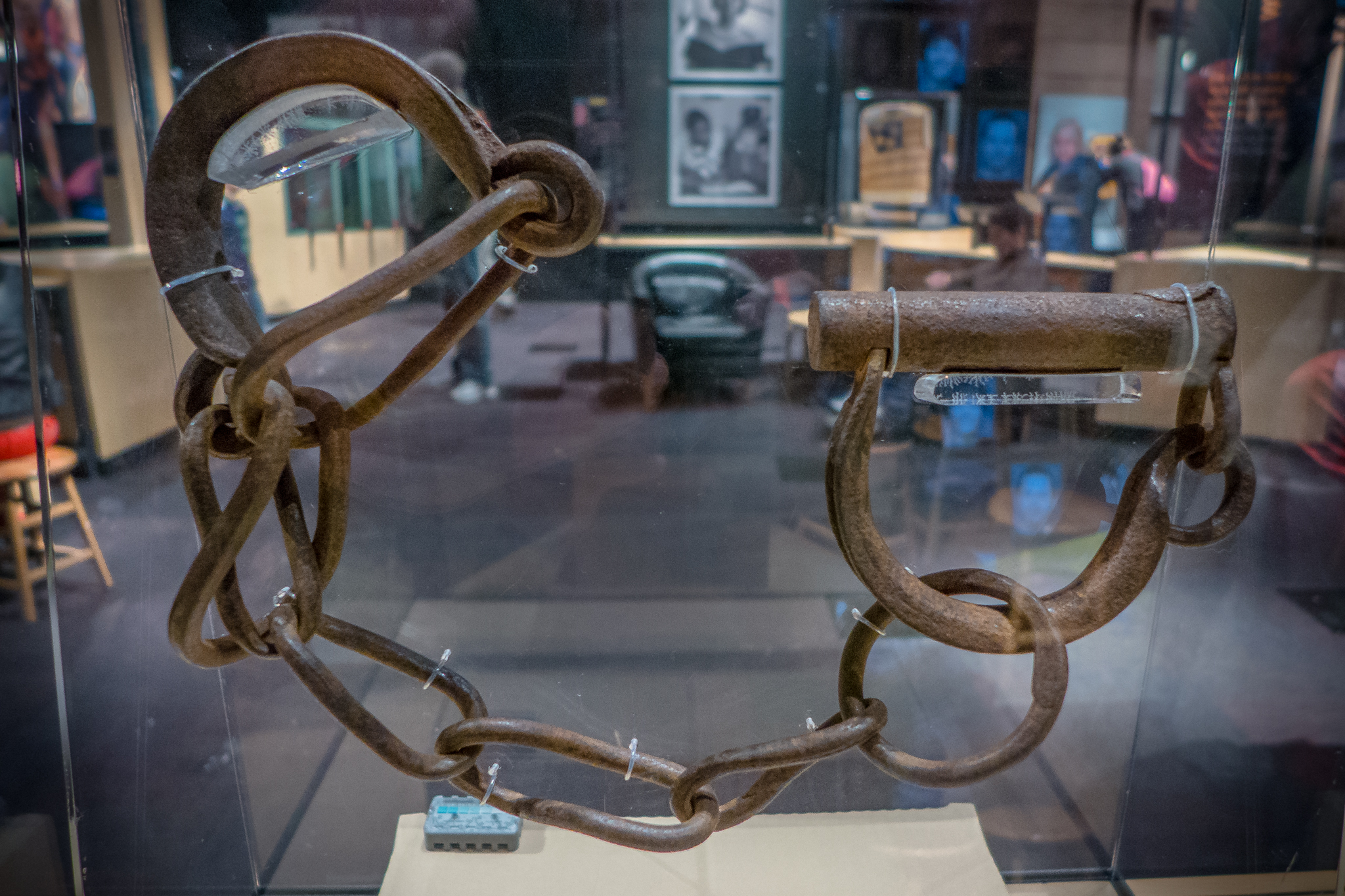
Slave Shackles [Flickr page]

On a Sunday evening in October 2014, a kind and decent man sat at the pulpit of a Minnesota Laestadian church before a bunch of kind and decent people and asked for God to open His word during their services. The grace of Jesus Christ is a gift that gives perspective to all things in life, he noted in his mild midwestern voice during two minutes of prayerful conversation with the Heavenly Father.

Then it was time to read from God’s Word. The sermon text was the entirety of a “very beautiful letter” of the New Testament, the Epistle to Philemon. This letter was supposed to have accompanied an escaped slave, Onesimus, back to his Christian master Philemon. It requested that Philemon treat the runaway as he would treat Paul himself, charging any wrongdoing to Paul’s account instead of the slave’s.

This text came to mind, the preacher said, because it fit in with the theme for that Sunday: the commandment of love. A haze of peaceful familiarity settled over the proceedings as the preacher’s words about love and grace rang out in the room. And then he started talking about slavery:

But it so happened that this Onesimus departed–left, fled–his post as a slave or as a servant. Of course, we have our own history in our country with slavery that goes back to the time of the Civil War. None of us knew that time, but it was a reality in our country, and has been a reality in many, many areas of the world through the world’s history.1

A reality, yes, and a horrible one. Where was this headed?

In many “worldly” churches–the ones whose pastors fifty years ago had stood arm in arm with protesters against fire hoses and snarling dogs, asking for equality and dignity–the listeners would sit contentedly, knowing they were starting on an uplifting trajectory. In some of those sanctuaries, their ride would be smooth and steady, the brotherhood of all men quietly affirmed by the time they all walked with polite little smiles toward the exits and their separate lives. In other places with words like “Full Gospel” and “Holiness” on the signs outside, the listeners would brace themselves in roller-coaster pews, knowing that they were all ratcheting slowly upward toward a climax of indignation and then wave after wave of praise and pleas for justice and eventual deliverance from this vale of tears.

But those things do not happen in Laestadian services. What happened was the preacher saying slavery indeed had been a reality “and it was acceptable in the time.”

Acceptable to whom? Not to the slaves, one would imagine, or to that Jesus character who said you should do unto others as you would have done unto you.2 But it was certainly acceptable to those who claimed ownership of other human beings. And to the Roman ruling elite whose grudging favor was being courted by the guys writing Gospels and Epistles of this new Christian religion, slavery was an indispensable part of the system.3 Proper moral stories had to be told, a delicate political line had to be walked, or all bets were off for this emerging competitor to the Roman gods.

None of that was discussed in the sermon, nor could it be even if the preacher privately appreciated such nuances. The text was set firm and black and durable on the gilt-edged page that lay open before him, bound tight with all the rest of its pages written by a hundred nameless men but really, We Believe, by God Himself. Human factors, historical factors, simply do not apply to these particular words.

And so the preacher, a fine man who grew up in an ethnically diverse neighborhood and had recently spoken eloquently about respecting other cultures and people who are different, kept his mouth open while his religion made crazy words come out about slavery:

And, as contrary as it is to our human mind, we see that believing people also had slaves, like this Philemon. And the instruction to God’s Children is: Whatever calling you have been called into, that we would fulfill that calling. God’s word did not give slaves of that time permission to flee their masters. They were possessions, human possessions of people, and so by fleeing you were transgressing the law and the will of your master.

These issues “are too big for us to understand in our time,” he added, perhaps wincing at the ugliness of what he had just left dangling in the air. Better shroud the awful sight from view, add a little of what Daniel Dennett calls the pious fog of modest incomprehension. “But so it was,” the preacher said, and then went on to talk about “something great that had happened in the life of Onesimus,” his conversion to the religion of his slave master.

Poor Onesimus, not yet a Believer, might have had a pang of “conscience over the fact that he fled his master.” We can imagine, the preacher said, “that Paul would have told him that it’s not acceptable that you do this, that you flee from your master.”

The sin, you see, was not on the part of the man who presumed to own another person as a slave, who forced a fellow human being into servitude and treated him as property. Rather, the one who needed repenting was the slave escaping captivity. By fleeing his master, “he did wrong to Philemon.”4 But, happily, Onesimus repented and became one of God’s Children. The sermon then turned to weightier matters, eventually touching on the recent Ministers’ and Wives camp where concerns about contraception, school sports, and certain types of jewelry had been discussed.

———

Is there any rational voice loud enough to be heard in a place where such a sermon is taken seriously? Is there a message clear enough to penetrate such profound isolation from the very basics of human decency? I browse through my catalog of words, deliberate over my tidy and efficient combinations of words, and my sentences are as frail little twigs poking against a concrete dam.

The people who sat and listened politely to this sermon are educated and intelligent. They work and function and raise children in a civilized society of the year 2014. They have smartphones in their pockets and purses. They bid on contracts and buy cereal when it is on sale and consult with teachers about how their children are doing in school.

But what a thick wall of devotion encloses their otherwise functional minds when the preachers start talking! It is an environment designed to suffocate all independent thought, and does so with marvelous effectiveness. It so completely blocks anything said from “the world”–no matter how clearly written or loudly shouted–that people with tender consciences remain sitting in their pews while a man tells them about the need for submission to the ownership of human beings as property.

I give the preacher credit, at least, for not sugarcoating or avoiding the reality of his chosen text. Perhaps a few of his listeners might consider, if nothing else, what some other parts of the Bible have to say about slavery.

Exodus 21 provides God’s Children (you know, those “Old Covenant believers”) with detailed instructions on slave ownership. They could force one of their own people into slavery, so long as freedom was made available after six years. But if one of those Believing masters had supplied his Hebrew slave with a wife during that time, neither the wife nor any children they had together could leave with him. They were the master’s property, the result of his divinely approved slave breeding program.

Only if “the slave plainly says, ‘I love my master, my wife and my children; I will not go out as a free man’” could he remain with them, in permanent servitude that was marked by a hole punched in his ear.5 Thus the system twisted the bonds of ordinary family love into chains around its victims’ wrists. It reminds me of the way cult-like religions keep their troubled followers within the walls. Sure, you can leave, they say. Everyone is free to believe or not believe. But your family stays with the Master, and the relationship between you will never be the same again.

God’s unchanging, eternal Word makes some further provisions for when “a man sells his daughter as a female slave.” Yes, his daughter. She “is not to go free as the male slaves do” after the six years are up. Not unless the new master first explores his three additional options: to get a refund on the merchandise (“he shall let her be redeemed”), to pass her off to his son, or, if “he takes to himself another woman,” to keep feeding, clothing, and screwing the slave as well.6

Slaves could get beaten, but not to death. At least not immediately. “If a man strikes his male or female slave with a rod and he dies at his hand, he shall be punished. If, however, he survives a day or two, no vengeance shall be taken; for he is his property.”7

Those who adopt such madness as the Word of God forfeit all credibility about matters of morality. When they shrug and accept the idea of people being consigned as chattel in the forced service of others–because an ancient Book says so–you can ignore their proclamations about right and wrong. When they tell you that it is human reasoning that makes you hesitate to join them in their conclusions, you may rightly suspect everything else you are hearing from them as nonsense.

And when they preach about a Heavenly Father who approved slavery but frowns on kids playing sports at school or desperate mothers slowing their endless floods of pregnancies or young women putting jewelry in their ears, you might consider what kind of company you are keeping.

———
“Moral Midgetry” was also the title of Episode 8 in Season 3 of HBO’s TV program The Wire. My watching that program is of course a sin, unlike the enslavement of human beings in the ancient world. I am wracked with guilt.

Notes


  1. I am reluctant to give a citation for these quotes because I think this preacher really is a good and loving person, far better than the doctrines he is called to preach. But a defense of slavery is just not something I’m willing to let go unchallenged. Nor will I critique it without leaving a reference to the source that people can check out for themselves. As of this writing, the sermon is available here, and this first portion of interest starts at the 9:45 mark. Today’s writing has saddened me. But I feel a moral imperative of my own, no less urgent than the stirrings of the Spirit that drive these guys to say often fine but sometimes outrageous things. 

  2. Mark 12:28-34; Matthew 22:35-40. See Wikipedia’s article on the Great Commandment

  3. Ever wonder why the Gospel of John goes on so much about “the Jews,” in that faintly menacing tone? It was written late, long after Rome had destroyed Jerusalem and lost patience with its Jewish subjects. Christianity was trying to distance itself from its Semitic roots and doing its best at political ass-kissing. The fourth version of its hero’s history pointed the finger of blame about the crucifixion in a convenient direction, away from the Romans who were the ones routinely ordering and carrying out brutal executions of insurrectionists. 

  4. So, apparently, did the Israelites cheat Pharoah of his due when they escaped from Egypt. Oops, never mind–that time, God was on the side of the slaves. 

  5. Exodus 21:2-6. Scripture quotations taken from the NASB

  6. Exodus 21:7-11. 

  7. Exodus 21:20-21. 


Monday, October 13, 2014

Neighbor Encounters

Which now of these three, thinkest thou, was neighbour unto him that fell among the thieves? And [the lawyer] said, He that shewed mercy on him. Then said Jesus unto him, Go, and do thou likewise.
The Gospel of Luke
Finally got a print of this to the homeowner  [Flickr page]

My first stop on this evening’s brief walk was to a house I’ve gone past many times since taking a picture of it last winter. It’s a beautiful old place. Christmas lights lining the edges of its front porch windows put a nice sharp border on them. A sodium-vapor street lamp suffused the fresh snow with an amber glow. Blue-gray clouds hung low in the night sky behind it all, lit up by stadium lights at the school nearby.

I’d been wanting to give whoever lives there a print of that picture, and tonight I did. The homeowner was quite happy to get it, thanking me several times and saying how nice it looked. I thought so too, I said, and we wished each other a good night. Then I continued my walk, toward another house in the neighborhood.

This was the home of a good Samaritan who had found something of ours with enough identification on it to give us a call. I rang the doorbell and a woman about my age answered, holding a baby. He was a cute little guy, at that perfect age where they are light and round and eager to smile about nothing. After identifying myself, I surprised the woman and me both by asking if I could hold him for a minute.

“It’s been a while since I’ve held one this small,” I said. She thought about it for a second and then handed him over. I stood there for a while, bouncing a stranger’s baby in my arms, looking in at the warmth of her home and hearing the racket of little voices in the background. I said, “Would you like to guess how many I have?”

There were other young faces appearing now, along with her husband who had called me about my missing stuff. Somebody guessed, “Seven?”

“Nope,” I said. “Go higher.” I handed the baby back.

The woman was surprised and pleased at this development. She had thirteen, she said, and it was nice to meet somebody who had a big family, too. Finally, after a couple more guesses, edging upward and then overshooting the mark, my own statistic was revealed: eleven kids.

We talked for a while, the bunch of us standing at their threshold with the pleasant air of an Indian summer evening leaving everybody indifferent about the door hanging open. There was a blur of little bodies whizzing back and forth pushing toy trucks on the wood floor. Smiling faces everywhere. It’s a beautiful family, I told them, and meant it. We compared notes, touching on highlights of experiences that the other would understand.

I told them about when I’d seen a red-headed guy with his line of red-headed offspring following behind in the aisle of a Wal-Mart. A bunch of stuff was stacked on pallets in between us, so he didn’t notice me and my own crew of little followers as he made his way toward the auto parts and sporting goods. I looked over and said, in that loud rude voice I’d heard many times myself, “Look at all those kids! And they’re all so young!” He turned to glare at me, and then saw me smiling with all my kids standing right there, and he laughed.

These neighbors of mine did, too, and then they shared a story of their own, as Jesus looked at us all from a painting hanging on the wall behind them. I gave them my phone number—again, as they hadn’t kept it once they got hold of me—along with my address down the street, and invited them to call.

I think they just might. Who knows; perhaps we will get together sometime and enact one of those chaotic Sunday afternoon scenes that were so familiar in my life. Two big piles of kids merge at the front door in a cloud of chaos and then pairs of them go off to play or swap stories in the barracks downstairs. Meanwhile, the four parents try to sit and talk.

Our home doesn’t have any crosses or religious pictures on the walls. No Bibles sit on our shelves anymore, stuffed with Sunday School homework papers that will remain untouched until the drive to church next week. I hope that absence wouldn’t trouble them, any more than their Jesus portrait bothered me. Whether they believe like I did for many years or like I do now, people are valued here just the same.

Welcome, neighbor.