Thursday, June 19, 2014

Plagues from Denial

What wonder is it then, if the mind misses everything except what it is itself intent on? So from small signs we draw great inferences and lead ourselves into error and delusion.
—Lucretius, On the Nature of Things [c. 50 BC]
We still can’t help looking upward. [CC-NC photo credit: Xin Li]

Living near a university campus provides me with an opportunity to hang out with intelligent and interesting college students from time to time. I’ve made new friends and had enjoyable visits with members of the Secular Student Alliance at Eastern Washington University, formerly the Eastern Atheists club. Most of its members are college students about half my age, but they have been very welcoming toward the old fart from the neighborhood who attends meetings and shows up at some of their parties.

One of the club’s recent activities was a debate with a very decent Christian named Daniel Kim about science and theism. I volunteered to participate because I knew Daniel would be an engaging and honest debate partner, and because I enjoy spending time with the people in the club. Daniel wanted to record the debate for posting on YouTube, so if you want to see why I have not taken up a career in acting or modeling, here it is:

I do get a bit exasperated with the stock creationist arguments that bubble forth even in an environment of reasonable discourse, like foam materializing from seawater that splashes against the rocks. Whether they are repeated with nods and smiles from a thoughtful person like Daniel or spewed forth on the Internet by agenda-driven organizations like the Discovery Institute, all creationist arguments are ultimately descendants of a single common ancestor: personal incredulity.1 We humans are all too eager to believe in some invisible creator over scientific explanations that we are either unwilling (due to faith or social commitments) or unable (due to limits on time, education, or imagination) to personally understand.

From Did God Really Say?, LLC “Timely Topics” presentation, 2012.

Despite my occasional impatience, I certainly know how much a person’s thinking, how the boundaries of one’s willingness to learn, can be constrained by the need to think only dogmatically correct thoughts. My entire childhood religion was founded on the premise that a first human pair had been duped by a talking reptile thousands of years ago, infecting us all with Original Sin and necessitating the sacrifice of a perfect God-man to set things right.

For an abundance of reasons, there is no way to reconcile that story with the reality that science shows us, despite valiant attempts by earnest writers who want to have their disproven Pauline theology and evolution, too. Ironically, it is this very myth that is now being recited in my old church as reason to turn away from the unsettling questions being whispered among the troubled faithful. The (mythical) serpent asked, “Did God really say…?”, and we know how that worked out, so don’t you go asking, either!

I gave Daniel a copy of Evolving out of Eden, which I wrote in cooperation with Dr. Robert M. Price, and he graciously accepted it with thanks. I hope he gets something out of it. Perhaps with a bit more time, the vision that Ingersoll had over a hundred years ago will finally be realized in this country: “Science, freed from the chains of pious custom and evangelical prejudice, will, within her sphere, be supreme. The mind will investigate without reverence and publish its conclusions without fear.” 2

Ma, most of them still don’t think we’re cousins. [CC-NC photo credit: Xin Li]

With some slight reformatting for web publication, here is an excerpt of the book that speaks candidly to what, unfortunately, remains as a pig-headed persistence of a thoroughly disproven viewpoint. For my own part in this co-authored writing, I speak with the zeal of the converted, knowing what an iron grip that mindset had on me, too, for such a long time.

———

Plagues from Denial

We [Price and Suominen], along with many of the theistic evolutionists whose writings we criticize, find it infuriating how creationists deny the reality—and wonder—of evolutionary theory. Its explanatory power is stunning; all the scientific puzzle pieces fit into place, from anthropology to zoology. It is difficult to emphasize enough just how strong the evidence is, yet most Americans doggedly persist in remaining ignorant of it. Worse, the most devout among them view it as almost a holy calling to enforce that same ignorance on their children and churches.

For those not blinkered by an outdated dogma, there is no longer any debate about the truth of evolution. The debate has been over for a hundred years. The evidence has continued to pile up, in new fields like molecular genetics that Darwin couldn’t have dreamed of. We have long since reached the point where evolution—micro, macro, human—is no more productive a topic for argument than computing epicycles in case that “theory” of Copernicus turns out to be wrong, after all.
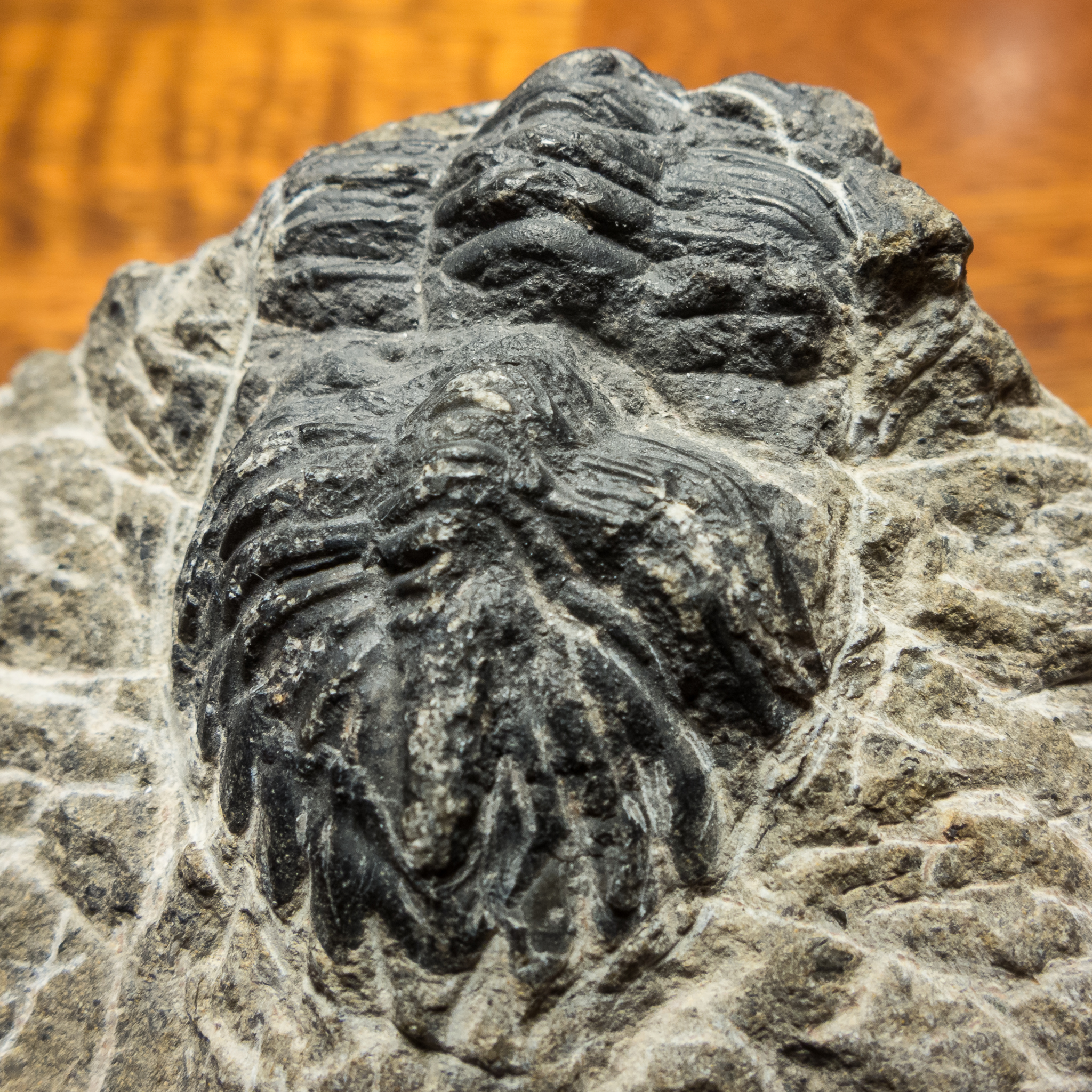
My very own Trilobite fossil, tangible evidence of life that’s been extinct for at least 250 million years.  [Flickr page]

Two of our pious scientists put it frankly to their Christian brethren: “When there is a near-universal consensus among scientists that something is true, we have to take that seriously, even if we don’t like the conclusion” (Giberson and Collins 2011, 29).3 Sure, there are some crackpots who reject what is squarely in front of their faces, even a few educated ones who ought to know better. But the “percentage of scientists who reject evolution is very small—so small that in most large gatherings of scientists you would not find even one person who rejects the theory of evolution” (p. 30).

The fact is that creationists are just parasites, living off the intellectual metabolism generated by the hard work of real thinkers while contributing nothing but the fever of the camp revival. They crave respectability for their faith, but they show nothing but contempt for the careful research of the scientists who find the hard data that they persistently ignore and deny. “There are no transitional forms!”, they whine, despite a wealth of fossils showing various types of intermediates (Prothero 2007).4

Meanwhile Neil Shubin goes to Greenland year after year to dig for a fossil evidencing the transition from water to land. And he finds it, too: Tiktaalik roseae.5 Did the creationists gather at the Field Museum to examine this extraordinary find that plugs the evidenciary hole they had been complaining about? Of course not. They just go on talking, about smaller holes.

———
Two images in this post are from a Flickr user who has made them available (as of this writing) under the Creative Commons-Noncommercial license, as I have for my Trilobite fossil photograph. Note that my legal usage of these materials, under the CC license terms extended as of this posting, does not imply any endorsement or agreement with this blog posting by the photographer.
Evolving out of Eden is Copyright © 2013 by Robert M. Price and Edwin A. Suominen, All Rights Reserved: Excerpted here by permission of Tellectual Press.

Notes


  1. “Intelligent Design,” as Leonard Krishtalka has memorably said, is just creationism dressed up in a cheap tuxedo. See this fine 2002 article by Adrian L. Melott in Physics Today. Melot aptly sums up the situation: “The position of an ID creationist can be summarized as: ‘I can’t understand how this complex outcome could have arisen, so it must be a miracle.’” ↩

  2. Robert G. Ingersoll, Lecture on Gods ↩

  3. Giberson, Karl W., and Francis S. Collins. 2011. The language of science and faith. Downers Grove, IL: InterVarsity Press. ↩

  4. Prothero, Donald R. 2007. Evolution: What the fossils say and why it matters. New York: Columbia University Press. ↩

  5. See, e.g., tiktaalik.uchicago.edu (accessed January 2013). “Tiktaalik roseae, better known as the ‘fishapod,’ is a 375 million year old fossil fish which was discovered in the Canadian Arctic in 2004. Its discovery sheds light on a pivotal point in the history of life on Earth: when the very first fish ventured out onto land.” ↩

Tuesday, June 10, 2014

Problems with Paul

To see that one has been mistaken in one’s manner of apprehending the past is not a loss but a gain. It is always better, safer, and more profitable, to know that one does not know, than to go on building on a basis that is imaginary.
—W.C. van Manen, “Paul” (1902)
Book review (and promotion): A Wave of Hypercriticism: The English Writings of W.C. van Manen, edited by Robert M. Price. Tellectual Press (Valley, WA 2014). For the Amazon Kindle and Barnes & Noble Nook, and in trade paperback.

My former church, like many other forms of Christian fundamentalism, teaches that “the Holy Scriptures are the highest authority and standard by which matters of soul and doctrines of salvation are judged.” One must simply accept, “by faith” and without interference from biblical scholarship, “the Holy Scriptures, both Old and New Testaments, as the divinely inspired and revealed Word of God.” This little formula of blind acceptance is articulated in the church’s monthly newspaper, which laments, “We live in a time in which the authority, holiness, and inerrancy of the Holy Bible has been placed under doubt and suspicion by those who challenge it as a divine revelation of God’s will toward men.” 1

Actually, though, there have been waves of questions lapping at the scriptural foundations for a long time now. As have the complaints from those trying to keep things propped up, like this one from the second century A.D.: “Now this heresy of yours does not receive certain Scriptures; and whichever of them it does receive, it perverts by means of additions and diminutions, for the accomplishment of its own purpose; and such as it does receive, it receives not in their entirety.” 2

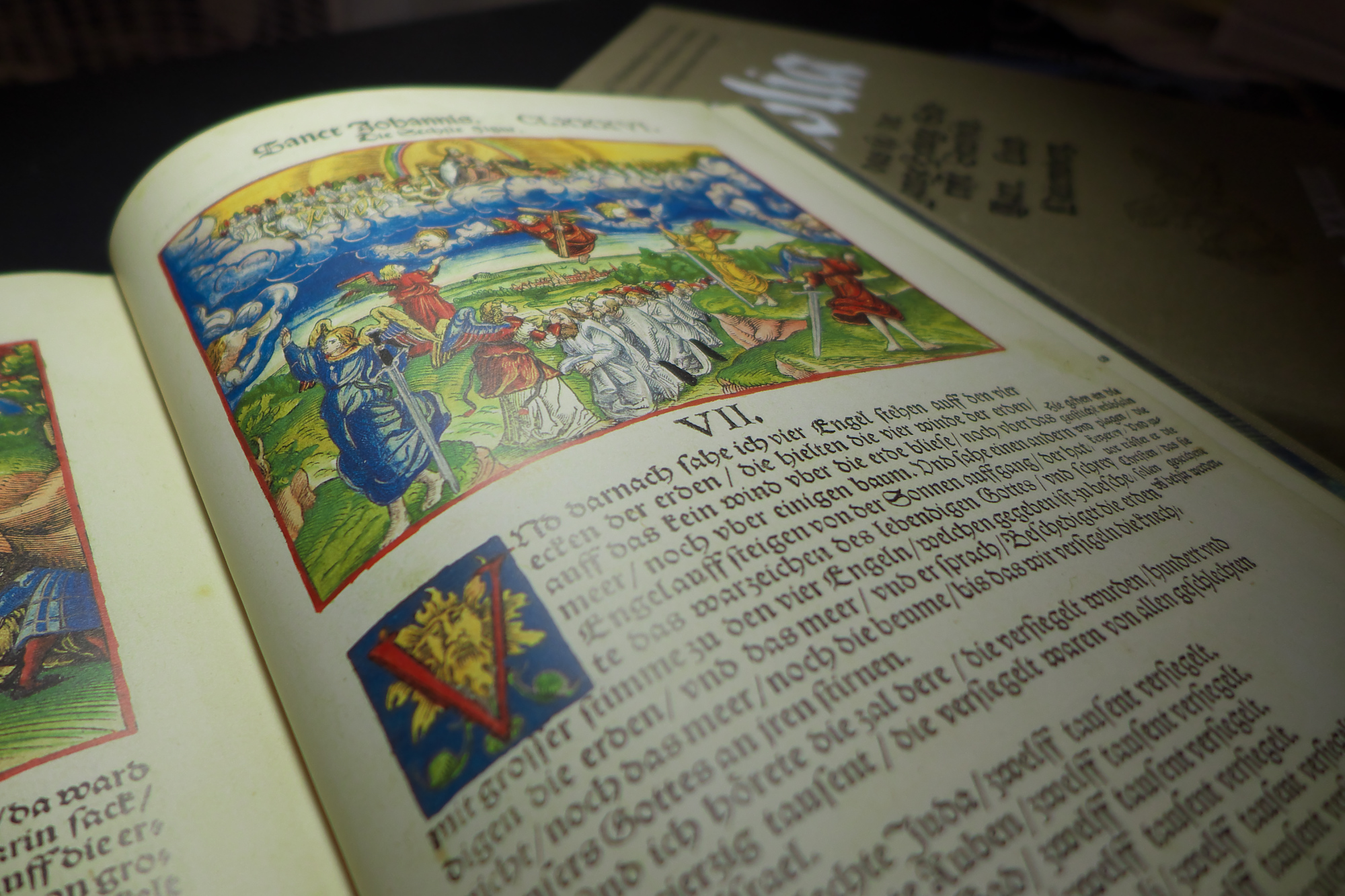
Facsimile reproduction of Luther’s German Bible  [Flickr page]

For all his literalism, sola scriptura, and fervent medieval piety, Martin Luther did a bit of picking and choosing of scripture himself. There were some surprised expressions on the faces of my former brethren when I told them that Luther was critical of the book of James, who he said

does nothing more than drive to the law and its works; and he mixes the two up in such disorderly fashion that it seems to me he must have been some good, pious man, who took some sayings of the apostles’ disciples and threw them thus on paper; or perhaps they were written down by someone else from his preaching.

That wasn’t all; Luther wrote that he could not put Hebrews “on the same level with the apostolic epistles,” noting that some of its teachings seem “to be against all the Gospels and St. Paul’s epistles.” Jude clearly seemed to him a copy of 2 Peter, and he also had problems with Revelation and Esther.3

One of the many theological squabbles Luther got himself into was with the humanist Catholic reformer Desiderius Erasmus, who was “perhaps the real progenitor of what would become the thoroughly modern approach to reading the Bible,” the Higher Criticism.4 This approach led to questions about Moses and then Jesus. Had Moses really delivered the 613 commandments of the Torah? Had Jesus really preached the Sermon on the Mount? Or were these much later collections of material from disparate sources? 5

By the early 1800s, some of the epistles that had been attributed to the Apostle Paul were being questioned. Now this was a big deal, because the Pauline epistles are critical to Protestant Christianity. As my friend Robert M. Price puts it, Paul was not crucified for you, but it is Paul who tells you what Jesus’ death meant.

Dr. Price summarizes what the 19th-century critics were doing to Paul in his new book The Amazing Colossal Apostle. The first to deny Pauline authorship to one of the epistles was Friedrich Schleiermacher (1768-1834): “Although he accepted 2 Timothy and Titus as Pauline, he rejected what he termed ‘the so-called First Epistle of Timothy.’ In an 1807 essay, he showed how this epistle contradicted all other Pauline materials in the New Testament.” Before long, “other scholars widened the scope of the investigation and discovered many of the same relations and contrasts between the Pastoral Epistles (1 and 2 Timothy and Titus) on the one hand and the remainder of the Pauline letters on the other. Today, virtually all critical scholars agree that the Pastoral Epistles are not the work of the historical Paul.” 6

Then F.C. Baur (1792-1860), “the founder of the Tübingen School of New Testament criticism, whittled down the Pauline canon even further.” He was left “with only the four Hauptbriefe (‘principal epistles’), 1 and 2 Corinthians, Galatians, and Romans, as authentic and unassailable, minus a few questionable passages here and there.” 7 The waves were getting stronger, crashing against the old foundations that Luther had lain. But at least his cornerstone, Paul’s Epistle to the Romans, remained. It was, Luther said in his preface to Romans, “the most important piece in the New Testament. It is purest Gospel.”

Bible Criticism: A Prickly Issue  [Flickr page]

Around the turn of the twentieth century, along came a “wave of hypercriticism” from some impudent Dutch theologians. Nothing was to be spared, not even Romans. Notable among these critics, the so-called Dutch Radicals, was Willem Christiaan van Manen. In a 1898 essay, “A Wave of Hypercriticism,” he observed of the situation, “Was it not enough that criticism had left untouched only four authentic epistles” in the New Testament? The critics had been a demanding bunch, now that the penalties for questioning Holy Writ were limited to verbal attacks and no longer involved a gruesome and painful death. Their efforts were not appreciated by the old guard:

“Righteous” indignation, reasonable trembling, ill-concealed conservatism, joined hands with lukewarmness and lack of desire for impartial research. Yet the fact cannot be denied that this wave of hypercriticism is rejected by the “best critics of Germany.” But rejected does not mean destroyed. The scruples mentioned are not done away with, the arguments are not weakened.

Van Manen’s 1898 essay is one of a few that he wrote in English, which have seen little exposure. In The Amazing Colossal Apostle, Dr. Price suggests “that the revolutionary hypotheses of van Manen were never given a chance.” He thinks “it is not that the Dutch Radical critical paradigm was tried and found wanting; it was found distasteful and not tried. But the rationalizations of our vested interests lose some of their hold on us if we come to recognize them for what they are.” He hopes that “the time is finally ripe for van Manen, once dismissed with scorn like Nietzsche’s mad prophet, to receive his due and a sympathetic hearing. Like light from the farthest stars, his shocking tidings have taken a long time to reach us, but perhaps now we are ready to see and comprehend” 7

Tellectual Press’s new book

In furtherance of that, Dr. Price has asked my company Tellectual Press to publish a book compilation of these English-language essays by van Manen, which we have entitled, like van Manen’s introductory work quoted above, A Wave of Hypercriticism. He’s contributed an Introduction and an Afterword, and oversaw my efforts to make van Manen readable by splitting up his monumentally long paragraphs. The book is now available for the Amazon Kindle, the Barnes & Noble Nook, and in trade paperback.

Van Manen “began as a skeptic, eager to debunk and to refute” those few of his fellow countrymen who were questioning even the Hauptbriefe, says Dr. Price in his Introduction, adding that the deeper van Manen “delved into the issues and the arguments, the more he began to see their point and, worse yet, to suspect they were right.” Van Manen was finally able to shrug off the shackles of pious obligation, directing himself, as he urged others in 1898, to undertake “free and impartial research as to the authenticity of the Pauline leading epistles.”

Bob Price proclaims van Manen. Apologies to Gustav Doré.

If you want to get “acquainted with the Pauline leading epistles” for the purpose of arriving at “a possible answer to the question as to their origin,” van Manen urges you to “read and study them according to form and contents without cherishing beforehand a decided opinion as to their origin.” Simple, sensible advice. Who can argue with it?

Yet how many Bible readers and proponents (the latter category far outnumbering the former) are mentally capable of such a dramatic step, even today? They “cherish beforehand” a most decided opinion indeed, not just about Romans, Corinthians, et al., but the entire motley collection of sixty-six ancient books. Many have a hard time acknowledging any flaws in the supposedly inerrant “Word of God,” even about the most blatant and transparent contradictions.8

Whether they “begin by accepting the authenticity or not,” van Manen admonishes his fellow scholars to “always leave room for the opposite opinion.” Otherwise, their attempts to explain the text “is not free but bound, bound to tradition, bound to fiction.”

You can see why even liberal Protestants have a hard time with this. What’s at stake, says Dr. Price in his Afterword, “is the undermining of the very foundation of Protestant theological authority: the Apostle Paul.” A hundred years after the Wave of Hypercriticism reached the last bricks in the edifice of a Christianity that still dominates our social and political discourse, perhaps it’s time to take uncover our eyes and take a look.

Notes


  1. Laestadian Lutheran Church, Voice of Zion, March 2007. Similarly, the Päivämies newspaper of the LLC’s Finnish counterpart complained, “Nowadays, even in Finland, some church workers call into question the Bible’s revelation of God” (No. 17, 2006). ↩

  2. Tertullian, “Prescription Against Heresies,” Ch. 17. In Philip Schaff, ed., Ante-Nicene Fathers, Vol. 3. ↩

  3. It is quite an irony that one of the two men for whom the Laestadian Lutheran Church was named would have been in hot water with the church elders for his reservations about these books. See An Examination of the Pearl, §4.3.4, for my original of this summary with references. ↩

  4. Theodore P. Letis, “From Lower Criticism to Higher Criticism: Joseph Priestly and the Use of Conjectural Emendation.” Journal of Higher Criticism, 9/1 (Spring 2002), 31-48. Available at depts.drew.edu/jhc/LetisPriestley.pdf. ↩

  5. Thanks to Dr. Price for these three sentences, as well as his thoughtful review of this entire blog posting. ↩

  6. Robert M. Price, The Amazing Colossal Apostle: The Search for the Historical Paul (Signature Books), loc. 729. ↩

  7. Id., loc. 1003. ↩

  8. For example, was Jesus’ grandfather Jacob or Heli? Was Abiathar the high priest when King David ate the consecrated bread, as Jesus said, or his father Ahimelech, as 1 Samuel says? Did Judas splatter his guts out after falling headlong (on something sharp, presumably) in the field he bought, or did he hang himself? Matthew says one, while Acts says another, and doing both would be quite a trick. ↩

Monday, June 2, 2014

Eventide

Beauty and grace are performed whether or not we will or sense them. The least we can do is try to be there.
—Annie Dillard, Pilgrim at Tinker Creek
Pacific Northwest Paradise  [Flickr page]

The sun is moving slowly downward and to the north on its gradual summer arc toward night. Under its warm and lowering light, the tall trees cast long shadows into the open spaces of the woods.

Tall Trees, Long Shadows  [Flickr page]

A familiar winding path unfolds before me between the most senior tenants of these sacred acres. The path has been cleared of the riotous younger growth that is busily asserting itelf among the reddened old trunks. Deep-textured pine bark wraps the big trees, glowing warm and bright where the evening sunshine makes its way in spots, here and there, past the leaves and needles that strain for the light of this day and season.

I find a favorite sitting spot next to one of the trees, where the ground slopes comfortably upward toward the trunk, cushioned by an interwoven mat of pine needles. The cat is on some other business this time, but the dog has joined me. She sniffs and snuffles the forest floor, regularly wandering back to nuzzle and induce me to run my fingers through the tangles in her long fur.

Light voices of a neighbor’s visitors add a rare human note to the dog sounds, sporadic bird songs, and muted rush of an occasional passing car. This spot is near an edge of the acreage, where I can hear some evidence of other people even if none can be seen.

My hands rest on the long Ponderosa needles, feeling their sharpness as my scalp senses the texture of the tree trunk on which it leans. Innocuous little bugs crawl onto me, and I let them, knowing that a shower awaits inside the house. The smell of forest duff and sap wafts through the still-warm evening air.

Profusion  [Flickr page]

Above me spreads at a canopy of branches and needles, dark browns and greens contrasting with the blue of a mostly cloudless sky. I note the new segments that top eighty-foot high trees with six new inches of fresh light green. They are at least twice my age, these old pines, and healthy. They still grow, relentlessly and silently, and I hope they will continue to do so long after I am gone.

New Growth  [Flickr page]

The younger trees—too many of them despite all my efforts—have new tips on their branches also. Leafy undergrowth fills out the forest floor, along with moss and lichen, ants and bugs, and, beneath it all, coarse soil that still holds the moisture of recently melted snow.

It is all so ordinary, this quiet interlude with the natural world, yet sadly beyond the grasp of the billions who frantically chase the tails of their lives in sterile cities or grind out an existence amidst poverty and oppression. My own family is largely oblivious to the charms of this little piece of forest, rarely venturing into it with me except when the boys grudgingly and noisily help with thinning or the next season’s firewood.

We are products and dependents of nature, but just in the lifetime of these big trees around me, most of humanity has removed itself from much contact with it. Even with all my affection for these woods, I am merely a transitory visitor here. In a few minutes, I will return to my framed and furnished house and bathe in water pumped up from far below this green surface, warmed for the comfort of my cold-intolerant naked skin. I will go eat something—probably some convenient glob of food boxed up in a distant factory, assembled from ingredients trucked in from still other distant places.

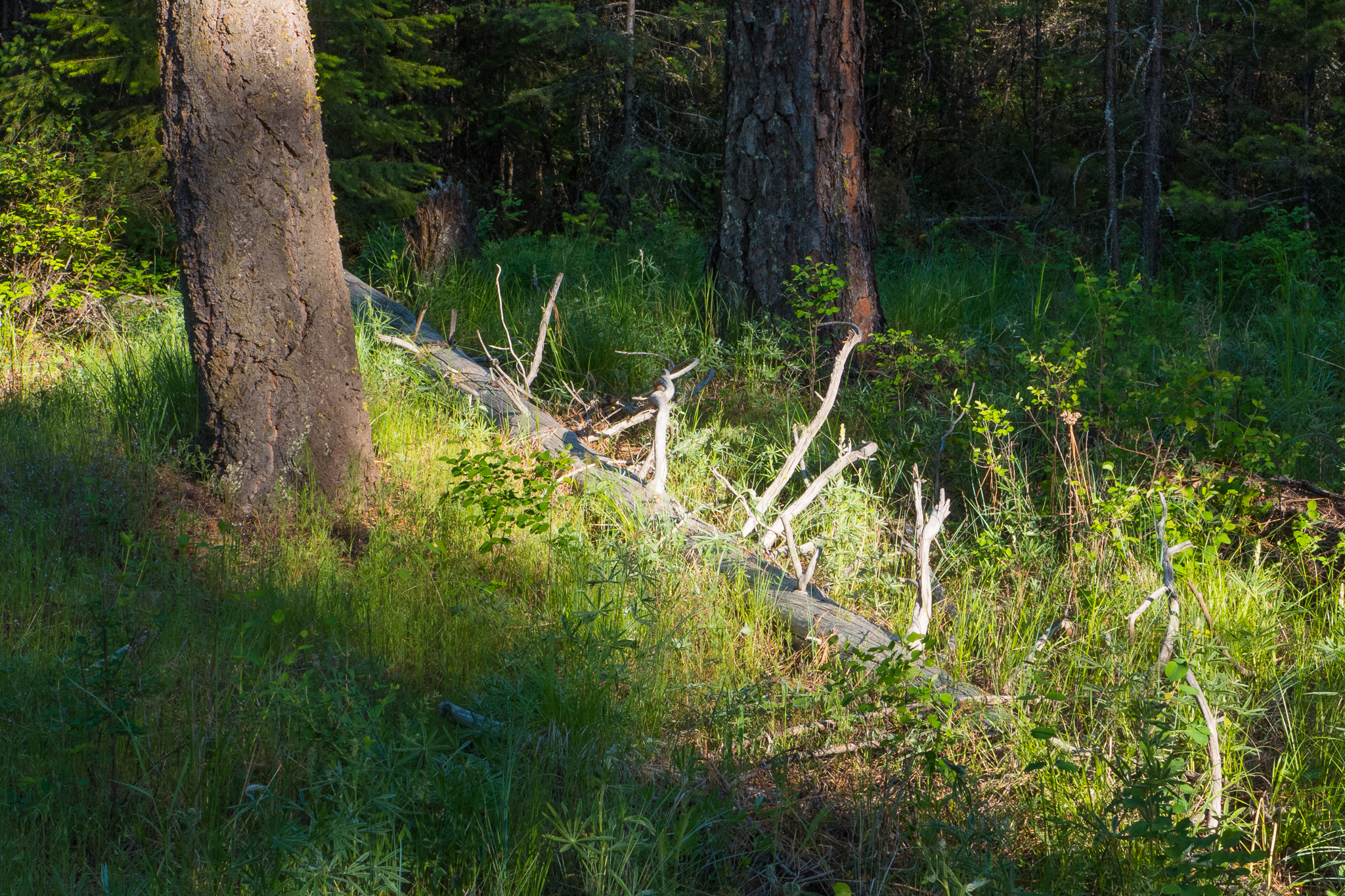
Light on the Fallen One  [Flickr page]

But my lunch will not be far from here, at least. Still seeing the trees through windows, I will reflect on this moment in the forest by writing on a computer whose plastic materials and glowing screen, interconnected wonders of semiconductor hardware, and many-layered complexity of software coding represents untold thousands of hours of cumulative human effort, far away from simple places like this. I will review and process the photographs shown here, which were taken with a metallic oxide semiconductor sensor containing some ten million light-sensitive elements, stored in a postage-stamp sized memory card that holds sixteen billion 8-bit words of digitized information. More of my time will be occupied (happily) fussing over the images on my computer screen, using a toolbox of sophisticated image processing algorithms, than the few quiet moments I spend actually seeing them, in real life.

Fresh Fir Needles  [Flickr page]

It’s a bit absurd in its way, this brief dropping in on a patch of nature and then turning away to resume a cozy existence ensconsed in the comforts of my nearby house and technological toys. But there are plenty of sacred places maintained by humans who visit them less frequently than my regular walks through these woods. This is my own quiet conifer cathedral, where I am both caretaker and congregant, and only birds are singing.

———
Click on individual images to enlarge, or check out their photo pages in my Flickr photostream. All are Copyright © 2014 Edwin A. Suominen. You may freely use them for non-commercial purposes, with attribution, under the Creative Commons Attribution-NonCommercial 3.0 Unported License.