Thursday, March 19, 2020

Applying the Logistic Growth Model to Covid-19

The chief task in life is simply this: to identify and separate matters so that I can say clearly to myself which are externals not under my control, and which have to do with the choices I actually control.
—Epictetus, Discourses.
Dad, you’re just some guy who knows how to obsess over numbers. We have actual people who are experts at this stuff. Go and write it if you want, but don’t feel like you have to!
—Daughter of Ed Suominen, March 2020.
TL;DR: A very good fit between data obtained on March 19 from Johns Hopkins University and a logistic+linear growth model indicates there there will be over 50,000 reported cases of Covid-19 in the United States on March 25, over 300,000 cases one week after that (4/1), and several million cases by early April. See the Nightmare Plot and the Disclaimer below.
Update, March 20: There was a significant uptick in U.S. cases today, bringing us to a total of 13,677 according to Johns Hopkins data provided this evening. The increase is more than was expected this time, and the jump is significant enough that I would rather not publish results with the logistic growth model fitted to the latest data. Doing so results in projections that are considerably higher than what the rest of this blog post discusses. I will wait for tomorrow’s data and then perhaps consider a modification to the model if we get unexpectedly high numbers again, one possibility being to change the linear term to a power-law one of the form a*t^b. That might reflect the effect of better testing without forcing an artificially high value for the exponential model parameter k.1
———

On March 15, I wrote to some friends on Facebook about the latest results of putting my computer evolution code and skills to the task of finding parameters for the logistic growth model as applied to the number of U.S. reported cases of Covid-19. My belief–speaking as someone with expertise in fitting nonlinear models to data but not any kind of expert in the fields of biology, medicine, or infection disease–was that we would reach 10,000 cases on March 17, and would have reported cases numbering in the hundreds of thousands by March 29.2 By the end of April, I believed there would likely be millions of Americans being reported as having this virus. The rate of growth I thought would be unlikely to even start slowing down before April.

The prediction for the one date that has come and gone was not quite accurate. On March 17, there were 6,421 cases reported in the U.S., a little less than two-thirds of what the model said was most likely. But, in my defense, I ask you to look back at yourself enjoying a Sunday in mid-March. Would you have been truly untroubled just two days ago by hearing that six thousand of your fellow Americans would have a deadly respiratory infection that puts a fifth of its hosts into hospitalization? The model was pessimistic but not ridiculous.

Two days earlier, on March 13, I had introduced the project to my Facebook friends, prefacing the discussion with the acknowledgment that I’m not a biologist, or a doctor, or an infectious disease expert of any kind. Just a retired engineer and inventor who knows how to write Python code and has been working on modeling and simulation for over a year now.

After seeing predictions ranging from dismissive to hysterical about the Coronavirus, I saw a useful if sobering application example of a tool that I’d written specifically for my electronic simulation work, ADE. This new example would apply the fairly well-known “logistic growth model”3 to what has now bloomed into a pandemic.

Writing and running covid19.py forced me to some stark conclusions: In one week (3/20), I said, we would be likely to have over 20,000 U.S. cases. A week later (3/27), around 10 times that. “By the first few days of April we could very plausibly hit the one million mark. There will certainly be nobody saying this is just like the flu by then.”

The most I was–and am–willing to guarantee about those predictions, however, is that the red line in the plot I included with the post is a nearly optimal fit of the function f(t)=L/(1+exp(-k*(t-t0)))+at to the number of cases versus time provided by Johns Hopkins university, including an update made that evening.

So how did that prediction fare? With data updated Thursday evening (3/19), it now appears that there will be around 13,500 reported cases on March 20. Again the model is pessimistic, with 68% as many cases reported as expected to be. But, again, even the lower one is a huge number of people getting very sick all of a sudden. Were you expecting anything like that just five days ago?

If not, don’t feel bad. There was an excellent reason why you might have been surprised then at what is now clearly plausible to anyone looking at the plot below: Your President was telling you that it was no big deal.

With the data available on March 13, the logistic+linear growth model predicted there would be around 200,000 U.S. cases on March 27. That is a little more than double what the model’s current best fit says is most likely. Again, the model was and still may be pessimistic, predicting too many cases. But again, even 90,000 or so infected Americans–with probably 20,000 of them very sick and at least a thousand of those dying and thousands left with permanent lung damage–is a very big deal. And the virus will still just be getting started.

Yesterday, March 18, I released the first version of this blog post with the projection that there would be nearly 15,000 cases tomorrow (3/20). (Actually 14,538.) Once again, the model was a bit pessimistic; the current projection is for 13,549 cases, or 93% as much.4 And the longer-term projections are slightly lower, which is moving in the direction we all want, though only by a little bit.5

———

So, on March 19, here is what the admittedly pessimistic logistic+linear growth model now says, based on Johns Hopkins data updated this evening. The numbers are all in reported U.S. cases:

  • The day after tomorrow (3/21), there will be nearly 18,000 cases.

  • In one week (3/26), there will be more than 60,000 cases.

  • In two weeks (4/2), there will be over 400,000 cases.

  • We will reach the million mark between April 4 and 6.6

  • On April 11, there will be five million cases.7

  • The U.S. outbreak won’t even begin slowing down until mid-April at the earliest. In other words, there will be increasing numbers of new cases until probably around April 24 when there are finally fewer new cases one day than there were the day before.

  • The ultimate number of Americans being reported as being infected by the novel Coronavirus will ultimately reach several tens of millions.

This is some scary shit. And it may be even worse than it looks right now. What the data show, and the model is fitted to, is the number of reported cases; several days ago, some experts in the Seattle area were saying that the number of true cases in Washington State to be several times the number being tested and reported.8 Isn’t it reasonable to expect that to remain largely true? Our medical system will almost certainly become overloaded and the focus will simply turn to saving those lives that can be saved, as it has already in Italy.

But all this is just me talking, not the model. It makes no assumptions or judgments about the data. It doesn’t care if some political situation has caused fewer tests, or suddenly more tests. It doesn’t care about an idiot chief executive downplaying the danger and thus encouraging its spread (at least among his cult following), then abruptly deciding to join the adults in the room.9

The model simply predicts what will happen if the data continues as it has recently, especially as it has in the past few days.

That’s it. The interpretation and explanation is up to you.

The Nightmare Plot

Returning to the model and its neat little world of reported cases, here is a plot from a simulation I ran this evening, whose results I summarized in the bullet points above. It should make you listen very carefully to what you are being told by medical experts about social distancing, washing your hands, not touching your face, and staying the fuck home.

Now, this is one really important plot. It shows up way too small in this blog post for you to be able to see its important details. So please click or tap on it to open it as an image by itself.

Reported U.S. Covid-19 cases vs days since Jan. 22, 2020

You can also click here to see the plot with data from yesterday, 3/18. Open them in two tabs of your browser and then switch between to see how the model is holding up.

The upper subplot shows the best-fit logistic growth model in red, with the actual number of cumulative reported cases of Covid-19 in blue. The error between the model and the data is shown with each annotation. Look how small the residuals are compared to the exponentially rising numbers of cases. It’s a scarily impressive fit, even if the model has proved a bit pessimistic thus far.

The lower subplot shows the number of cases expected to be reported over time, slightly in the past and then extrapolating to the future. Fifty generations of running a differential evolution algorithm10 resulted in a 120-member population of combinations of parameters for the model. I deliberately terminated the algorithm sooner than I would otherwise so that there would be some visible variation in the extrapolations. The black dots show expected reported-case values with parameters from each member of the population, plotted at a bunch of random times from 3/12 to early April.

Significantly, the subplots both have a logarithmic y-axis. Exponential growth is linear when viewed through a logarithmic lense. When you see that straight line marching steadily upward toward those massive numbers, you really want all your modeling to wind up an embarrassing public failure.

Covering my Posterior

A better way to model this might have been to use a Monte Carlo analysis (e.g., with the Metropolis-Hastings algorithm) to obtain posterior probability distributions for the parameters, and then run a bunch of extrapolations based on parameters drawn from the distributions. But I had the tools handy for using ADE instead; I’ve been wrapping up a year-long project modeling power semiconductor devices using it with the free Ngspice simulation software. So this is what I have to offer, and it seems plenty illuminating to me.

But even without having posterior distributions to draw random variates from, what I am seeing in the scatter plots of value vs SSE for parameter L is not reasssuring. That parameter represents the total number of cases expected to ever be reported. And the data we have, with its steady logarithmic-scale march upward, is not satisfying my computer evolution algorithm that there is any upper limit before the nation’s entire population is infected.

SSE vs value: Parameter L (3/18 data)

Simply put, this thing is currently showing no signs of slowing down anytime soon. It is very possible, even likely, that these values of L are due more to genetic drift than any optimality-of-fit of the modeling they represent.11

A word of explanation of this scatter plot: The red dots hugging the left side of the plot are values (y-axis) of L in the final population of parameter combinations, plotted against the sum of squared error (x-axis) that those combinations had vs the data. The distribution of values seems to indicate that we shouldn’t hope for less than several million U.S. cases, and that we can’t count on any upper limit before the virus runs out of hosts to infect.12

There is a fair amount of correlation between the model parameter t0 and two other parameters, k and L. The parameter k represents how drastic the exponential behavior is; higher values cause things to blow up faster and thus start to reach limits sooner. Thus the highest values of k in the final population are associated with somewhat lower values of t0. The time when the number of new daily cases reaches its maximum happens a few days earlier.

Regarding the correlation between parameters t0 and L, a positive-valued one this time, it simply makes sense to realize that increasing new cases longer before you finally start to slow down the increases is associated with having more people ultimately infected.

Reasons Why Things Might Not Be So Bad

I want to emphasize that there is also the distinct possibility of L coming down by a lot within the next couple of days. (Unfortunately, I thought it would do that a couple days ago already, but it’s done the opposite.) It could still happen for a couple of reasons I can think of:

  • A curtailing effect becoming apparent soon from containment measures that just aren’t being noticed quite yet due to the incubation period.

  • A sudden recent increase in the number of reported cases due to testing finally being available. The rate of tested vs actual may be increasing, not just the absolute number of people testing positive. This would mean that the model is currently getting fitted to an overly dire set of parameters (especially L) due more to recent dramatic increases in reported cases from better testing than exponential spread of the virus.

And there are probably many more reasons I haven’t even imagined why that curve might start bending down sooner than in this simulation. Again, I need to emphasize my lack of biological or medical expertise. And this leads to . . .

The Disclaimer

First, I disclaim everything that John Hopkins does when offering the data on which this analysis is based.13 I’m pretty sure their lawyers had good reason for putting that stuff in there, so I’m going to repeat it. Except think “Ed Suominen” when you are reading “The Johns Hopkins University”, and this blog post when you read “the Website.”

This GitHub repo and its contents herein, including all data, mapping, and analysis, copyright 2020 Johns Hopkins University, all rights reserved, is provided to the public strictly for educational and academic research purposes. The Website relies upon publicly available data from multiple sources, that do not always agree. The Johns Hopkins University hereby disclaims any and all representations and warranties with respect to the Website, including accuracy, fitness for use, and merchantability. Reliance on the Website for medical guidance or use of the Website in commerce is strictly prohibited.

Second, I know very little about biology, beyond a layman’s fascination with it and the way everything evolved. (Including this virus!) I do have some experience with modeling, including using my ADE Python package to develop some really cool power semiconductor simulation software that I’ll be releasing in a month or so from when I’m doing the GitHub commit with this COVID-19 example. The software (also to be free and open-source!) has a sophisticated subcircuit model for power MOSFETs that evolves 40+ parameters (an unfathomably huge search space). It uses the same principle–differential evolution of nonlinear model parameters–as this unfortunate example we find ourselves in.

The model I’m using for the number of reported cases of COVID-19 follows the logistic growth model, with a small (and not terribly significant) linear term added. It has just 4 parameters, and finding the best combination of those parameters is no problem at all for ADE.

Remember, I am not an expert in any of the actual realms of medicine, biology, etc. that we rely on for telling us what’s going on with this virus. I just know how to fit models to data, in this case a model that is well understood to apply to biological populations.

Don’t even think of relying on this analysis or the results of it for any substantive action. If you really find it that important, then investigate for yourself the math, programming, and the theory behind my use of the math for this situation. Run the code, play with it, critique it, consider how well the model does or does not apply. Consider whether the limiting part of the curve might occur more drastically or sooner, thus making this not as big a deal. Listen to experts and the very real reasoning they may have for their own projections about how bad this could get.

It’s on you. I neither can nor will take any responsibility for what you do. I will say this, though: If you haven’t been sitting at home for a week straight already, wash your hands a lot and don’t itch that nose unless you really have to and you just got done with one of those hand washings. It’s a hot zone out there already. You don’t need my fancy modeling to see that.

Finally, if this is getting you down, please think of all the people who were living and loving and looking up at the blue sky even during the fall of Rome and the Black Death. We have a front-row seat on history being made. Yes, it is a worldwide biological cataclysm not seen since the days of polio, smallpox, and the Spanish Flu.

Yes, this really sucks. But you are alive, and there is so much left to see. A world in crisis can sometimes be an exhilarating world to live in, like a sharp fresh breeze tickling your face on a clear winter’s day. Your grandparents saw cold bracing days like these, and were called the Greatest Generation for the way they responded.

To anyone in despair: Leaving the show early would be a sad waste of the seat that was reserved for you. Stick around. Do what you can to make your life a little better, and the lives of those who love you and whom you love. Allow your worries and fears and sadness to seep into the gentle awareness that an entire world now worries with you.

And there is a bit of good news to share, though it may be cold comfort for my fellow citizens in the U.S.

South Korea is fully in its containment phase, well past its t0 that took place over two weeks ago. They followed the logistic growth model all the way to the containment phase. Look at the two curves and annotated +/- numbers in the upper subplot! The lower subplot zooms in on a narrow range of case numbers around 8,000, where it is unlikely to increase much further.

Reported Covid-19 cases in South Korea vs days since Jan. 22, 2020

Italy’s numbers should start leveling off significantly in the next week. They reached t0 yesterday, according to my best fit of the logistic+linear model with this evening’s data. They appear to be headed for around 70,000-80,000 cases, or about 1% of their population. Even that doesn’t sound too bad.

Reported Covid-19 cases in Italy vs days since Jan. 22, 2020

Be well. And stay home.

Notes


  1. Ng Yi Kai Aaron pointed out an article referencing a paper (Ziff, Anna L. and Ziff, Robert M., “Fractal kinetics of COVID-19 pandemic,” preprint available online) suggesting that the data from China’s experience with the virus “are very well fit by assuming a power-law behavior with an exponent somewhat greater than two.” ←

  2. See the important section entitled Disclaimer. ←

  3. See, e.g., https://services.math.duke.edu/​education/ccp/​materials/diffeq/​logistic/logi1.html. ←

  4. All these significant figures are only used for comparison purposes. It is of course silly to put more than a couple of significant digits on extrapolations this uncertain. ←

  5. You may think that’s progress, but I consider it disappointing (as a human being with a pair of lungs, not as a data modeler) that the model is tracking the model’s exponential growth phase so closely, and that t0 seems to remain far in the future. ←

  6. This projection remains unchanged from the one done with data from yesterday (3/18). ←

  7. With yesterday’s data, I thought we would reach the five million mark a day earlier, 4/10. ←

  8. Trevor Bedford, for example, a scientist at the Fred Hutchinson Cancer Institute in Seattle “studying viruses, evolution, and immunity,” has mentioned a 10:1 true vs reported cases ratio. https://twitter.com/​trvrb/status/​1238643292197150720?s=20.

    “I could easily be off 2-fold in either direction,” he Tweeted on March 13, when there were just over 2,000 cases being reported in the U.S., “but my best guess is that we’re currently in the 10,000 to 40,000 range nationally.” ←

  9. Those who follow me on Facebook know how much contempt I have for the incompetent, malicious, destructive asshole who found enough bigots and morons in a key combination of states to make it past the Electoral College. No, I will not mince words. If you still support Donald Trump– knowing that he dismantled the office that Obama had set up to address pandemics, that he fired people with expertise to deal with this, that he downplayed and denied the reality of the problem until just days ago–then I think there is something deeply wrong with you.

    In my previous post, I asked, “Do many of his supporters even realize how much they’ve been played?” I quoted the self-confessed narcissist Sam Vaknin, who wrote that “the narcissist abuses people. He misleads them into believing that they mean something to him, that they are special and dear to him, and that he cares about them. When they discover that it was all a sham and a charade, they are devastated” (Malignant Self-love: Narcissism Revisited, Narcissus Publications, 2015, p. 69.)

    So far the deranged narcissist’s base of support has proven remarkably resilient to plain facts about how much of a sham it really is. I hope that changes very soon. ←

  10. Using my free, open-source Python package ade, Asynchronous Differential Evolution. ←

  11. Genetic drift is an evolutionary phenomenon where a population “drifts” certain bits of its genetic code toward what appears to be an optimal range when in reality it is just the survivors propagating a consensus that has no actual selection value. I’ve seen it happen with my computer evolution of simulation model parameters just like it happens in nature.

    The final population of L with 3/19 data ranges from around 20,000,000 to more than the population of the U.S., where the logistic model would obviously run into a stark limitation. Not different enough to show an updated plot. ←

  12. This scatter plot doesn’t show a real probability distribution, as a Monte Carlo analysis would. But it does seem instructive, to represent a confidence interval of sorts. I’m guessing that it is no narrower than a posterior distribution obtained from a random walk with well-informed priors. On this question, however, my modeling knowledge reaches its current limits. ←

  13. The GitHub repo is at https://github.com/​CSSEGISandData/COVID-19. ←

Wednesday, December 14, 2016

Requiem for the Republic

A hungry people neither listens to reason nor is mollified by fair treatment or swayed by any appeals.
—Seneca (c. 5 BC–65 AD), On the Shortness of Life.1
Dark Clouds Ahead.

The clock relentlessly marked out its hours, circling round from each day’s jarring dawn to the slow darkness of another evening, then to the hours of unconscious respite and fitful dreaming amid this long bleak nightmare. For about a month after I crawled into bed at 8:00 PM on November 8 and finally got up in shock late the next morning, the dark hand was pressing down, more days than not.

It wasn’t made much easier for knowing how many others share my despair about the unfolding collapse of our country. Certainly not for realizing that millions of others are cheering on each manipulative and bullying tweet, each outrageous Cabinet pick, each new degradation of the Office of President already being inflicted by the malignant egotist2 and con man they elected to it.

Do many of his supporters even realize how much they’ve been played? “So far,” observes Susan Page at USA Today, “Trump’s choices–including top jobs for a trio of veterans of Goldman Sachs, a firm he blasted at campaign rallies–haven’t reflected the populist impulses that fueled his appeal to some white working-class voters or his vow to ‘drain the swamp’ in Washington of donors and other insiders.”3 Imagine that. You’d almost think the man who lied about never settling out of court and then settled the fraud cases against his scam “university” for $25 million shortly after the election might not be 100% sincere.4

His new Cabinet swims around in a brand new swamp–the best swamp, a terrific swamp–of record-breaking personal wealth, with a total net worth just shy of $14.5 billion.5 His recent pick for Secretary of State, despite pulling down double-digit millions as Exxon CEO since 2012, is a small fish having a mere $150 million to his name.6 One can see why Trump excused the poor guy’s relative poverty: With “some of the most deep and long-standing ties to the Russian political and business elite of any American,”7 Tillerson will be amply prepared to cozy up to the ex-KGB thug who awarded him the “Order of Friendship” in 2013 and just helped his boss get elected President.8

The proposed Secretary of Labor (Would you like fries with that?) has touted the benefits of automation over humans who take vacations, show up late, slip and fall, and sue for discrimination, and opposes a raise in the federal minimum wage, currently at $7.25 per hour.9 He wrote a piece in Forbes this May opining that most fast-food store managers making more than $23,660 per year “recognize that in exchange for the opportunity, prestige and financial benefits that come with a salaried position and a performance-based bonus, they’re expected to have an increased sense of ownership and stay until the job gets done, to run the business like they own it.”10 Inspiring stuff for the former $30/hr factory workers hooting it up at Trump rallies in Cleveland and Grand Rapids. Men, go get yourselves some of that opportunity and prestige overseeing the fry vat until closing–with no overtime, mind you–down at the local Carl’s Jr.!

The “narcissist abuses people,” writes the self-confessed narcissist Sam Vaknin. “He misleads them into believing that they mean something to him, that they are special and dear to him, and that he cares about them. When they discover that it was all a sham and a charade, they are devastated.”11

———

There is some consolation about this mess, oddly enough, in contemplating the long arc of history. We’ve been here before, many times. Contrary to Lincoln’s lofty words at Gettysburg, government “of the people, by the people, for the people” never seems to last.12 What a left-wing set of pissed-off populists giveth to the people in righteous anger, a right-wing set of pissed-off populists eventually taketh away with some new strongman who will provide leadership and set everything straight. We just can’t seem to have nice things like democracy and equality for long. Homo sapiens has been dividing itself “into make-believe groups, arranged in a hierarchy” ever since agriculture allowed the accumulation and hoarding of wealth around 10,000 years ago, with the upper levels enjoying “privileges and power, while the lower ones suffered from discrimination and oppression.”13

That was certainly true around 2700 years ago, when the Prophet Amos berated the elites of Israel (considering his voice to be that of God, naturally) who imposed “heavy rent on the poor” and exacted “a tribute of grain from them.” They were rich absentee owners of “houses of well-hewn stone” and vineyards whose wine they didn’t bother to drink themselves. I know the score, God (i.e., Amos) warned these good-for-nothing scumbags who “distress the righteous and accept bribes,” and “turn aside the poor” (Amos 5:11-12, NASB). It’s doubtful anything ever came of such divine threats. And when it came to government by the people, forget it; other than an occasional rebuke and punishment, e.g., David for the Bathsheba incident, the history of the ancient Israelites is littered with kings doing pretty much whatever they wanted, usually in God’s name.

Some six hundred years later and about a thousand miles to the west, Lucretius recalled the populist uprising that overthrew the last Roman king in 509 BC and began the Roman Republic:14

Therefore the kings were killed, and in the dust

The ancient majesty of thrones and sceptres proud

Lay overthrown. The sovereign head’s great crown

Bloodstained beneath the rabble’s trampling feet,

All honour lost, bewailed its high estate.

For men do eagerly tread underfoot

What they have feared too much in former time.15

Lucretius recalled this bit of history with some critique of the aforementioned rabble, saying that things then “fell back to utter dregs and turmoil / As every man sought power for himself.” But law and order won out; “some men taught them to appoint magistrates / With rights established and the rule of law.”16

Alas, he wrote these lines in the final decades of the Republic’s 482-year lifespan. It had been a good long run; except during limited periods of military emergency, ordinary citizens did have some say in who was chosen to run their government.17 The elites and those who ingratiated themselves to them managed to get much more of a say, of course. Yet even such corrupt and occasionally interrupted democracies are exceptions to history’s rule of dictators and despots.

The revered and ancient Republic that began with men who had “eagerly tread underfoot” the crown of Tarquin the Proud finally ended with some of their descendants in the Senate granting Octavian the title of Augustus, “the illustrious one.” This title “symbolized a stamp of authority over humanity–and in fact nature–that went beyond any constitutional definition of his status.”18 Octavian was Julius Caesar’s grand-nephew and adopted son and the “Caesar Augustus” mentioned in Luke 2:1. Neither he nor the Emperors who followed answered to voters or even really senators. And during the next 500 years that the Empire continued–longer for the Eastern half that would eventually split off–Rome gradually diminished and lost even the limited, mostly illusory pseudo-democracy that remained in the Senate.

Around 50-60 AD, a century or so after Lucretius, the Roman philosopher Seneca lamented how rare simplicity and innocence were as human qualities. This after having tutored Augustus’ fourth successor Nero–a decidedly unsavory populist authoritarian. It was hypocritical, since he’d made “himself the teacher of a tyrant,”19 and profited from Nero’s crimes.20 But Seneca’s observations and sorrow about humanity are still worth recalling. You “scarcely ever find loyalty except when it is expedient,” he wrote, yet there is an abundance of “successful crimes” and “all the things equally hateful that men gain and lose through lust.” Ambition, he observed, sets no “limits to itself.” When you consider all this, it “drives the mind into a darkness whose shadows overwhelm it, as though those virtues were overturned which it is not possible to hope for and not useful to possess.”21 I’ve come to know those shadows well these past several weeks.

“Magdalenian Woman,” buried around 15,000 years ago in what is now Dordogne, France22

A particularly nasty populist takeover of democracy that hits closer to home for me is the transition from the Weimar Republic to the “Thousand-Year Reich.” Following a thirteen-year struggle for power, Hitler’s Nazi Germany wound up lasting just twelve years, a brief but incredibly destructive time. This one is personal. My mother’s half-brother was shot by the Nazis for refusing to serve in their army.23 My father saw the living skeletons of their victims and the smoke of their crematoria when he made a detour into a concentration camp during his escape from the Stalag IIb POW camp.24

It’s still a bit early to entirely equate our new President-Elect to Hitler. I’m not sure Trump is even a racist, and I actually find him quite sensible when it comes to the threat of Islam.25 Though he seems to like the strong-arm style of the hollow-eyed assassin in the Kremlin and the way Rodrigo Duterte is gunning down his fellow Filipinos,26 he hasn’t yet had anyone killed. But he is a thin-skinned narcissistic demagogue who lies constantly and dangerously, holding himself out as the one leader for the challenge of our times, and that’s bad enough.

The really clear and disturbing parallels are between the current political climate vs. the Weimar Republic in which Hitler began his long quest for power, and the fist-pumping “Lock her up!” crowds in their stupid red baseball caps vs. das Volk cheering at Hitler’s rallies. “We share Hitler’s planet and several of his preoccupations,” observes Timothy Snyder in his book recounting “The Holocaust as History and Warning,” as its subtitle goes. We “have changed less than we think. We like our living space, we fantasize about destroying governments, we denigrate science, we dream of catastrophe.”27

It’s important to acknowledge an uncomfortable reality here, one that I will expand on in an upcoming essay. As 77,000 voters in Wisconsin, Michigan, and Pennsylvania made abundantly clear last month, life is not going well for millions of angry fellow citizens, despite our government’s warmed-over official stats touting an “economic recovery” that’s every bit as fake as the news Trump supporters have been passing around on Facebook. “Today we live in a world of predatory bankers, predatory educators, even predatory health care providers, all of them out for themselves.”28

The Democrats are complicit in this. The husband of the woman those Rust Belt voters so shockingly rejected is the one who

deregulated derivatives, deregulated telecom, and put our country’s only strong banking laws in the grave. He’s the one who rammed the North American Free Trade Agreement (NAFTA) through Congress and who taught the world that the way you respond to a recession is by paying off the federal deficit. Mass incarceration and the repeal of welfare, two of Clinton’s other major achievements, are the pillars of the disciplinary state that has made life so miserable for Americans in the lower reaches of society. He would have put a huge dent in Social Security, too, had the Monica Lewinsky sex scandal not stopped him.29

The next Democrat in the Oval Office followed this up with bailouts of the big banks, a hands-off policy for white-collar criminals at those banks, the TPP (yet another odious trade deal), a near-freeze of anti-trust enforcement, greatly expanded Orwellian mass surveillance, and an insanely complex healthcare law “with its exchanges, its individual and employer mandates, its Cadillac tax, its subsidies to individuals and to the insurance industry, and its thousands of other moving parts, sluicing funding this way and that.”30 I must confess that I nearly burned my ballot in 2012 rather than cast a vote to re-elect Barack Obama.

The problem is that–for abundant reasons I will explain in that next essay with all the usual footnotes–there are no ready solutions to the predicament so many of our countrymen find themselves in. And when that happens, so long as people have a vote and even more so after they finally acquiesce in giving it up, the likely outcomes are grim.

The “aging, increasingly brittle, effectively bankrupt, but still immensely powerful global empire of the United States of America” is leaving a lot of its citizens behind.31 Most of them have little interest in transgender bathrooms, the immense privilege they enjoy over, say, disabled lesbians of color, and the virtues of those peace-loving Muslims they are lectured about every time some guy with a beard slaughters people while shouting Allahu Akbar.

There is plenty of “cheerleading from government officials,” plenty of “reassurances from dignified and clueless economists” and “reams of doctored statistics gobbled down whole by the watchdogs-turned-lapdogs of the media and spewed forth undigested onto the evening news.”32 But people pay more attention to the monthly $1300 insurance premiums for their shitty high-deductible health plan and the poverty and degradation of working for eight bucks an hour at a fast food joint after getting laid off at the now-shuttered factory.

No amount of official propaganda can convince them the the economy is recovering, because for them, it’s not. Except for “a few privileged sectors, times are hard and getting harder; here in the US, more and more people are slipping into the bleak category of the long-term unemployed, and a great many of those who can still find employment work at part-time positions for sweatshop wages with no benefits at all.”33

Abandoned house in Stevens County, WA

In 1920, Germany was experiencing an “explosive mixture of economic misery, social instability and collective trauma” that a black-haired populist demagogue could use as well as a yellow-haired one can in much the same environment today. He did so, better “than any of his rivals on the nationalist far right,” to rise up out of anonymity.34 “Hardly a week passed” during that year “without a meeting or a rally,” with audience sizes reaching 3,000 by the end of the year.35 He (still referring to the black-haired guy) was skilled at working the crowd, a master of the

“language of the post-war little guy,” peppering his speeches not only with the coarse phrases of a former military man, but also with irony and sarcasm. He was good at responding to hecklers so he mostly kept the laughter on his side. Moreover, Hitler’s speeches clearly touched a nerve. Like no one else, he was able to express what his audience thought and felt: he exploited their fears, prejudices and resentments, but also their hopes and desires.36

Sound familiar? Make Germany Great Again! would not be an unreasonable translation of his campaign message. Hitler’s “speeches typically began with a look back at ‘wonderful, flourishing Germany before the war,’ in which ‘orderliness, cleanliness and precision’ had ruled” (Law and order!) and “civil servants had gone about their work ‘honestly and dutifully’” (Drain the swamp!).37

Here was “‘someone seduced by himself,’ someone who was so inseparable from his words ‘that a measure of authenticity flowed over the audience even when he was telling obvious lies.’”38 Believe me, folks . . . In a 1927 speech, after a couple of low-key years following the Beer Hall Putsch and his nine months spent in Landsberg Prison for it,

Hitler used vulgar comparisons, tailor-made to the intellectual capacities of his listeners, and he did not shy away from even the cheapest allusions . . . His words and opinions were simply hurled out with dictatorial certainty as if they were unquestionable principles and facts. All this manifests itself in his language as well, which is like something merely expulsed.39

There were a few good years in the 1920s, but Germany’s economy started really heading downhill with the Great Depression in 1929. Hitler finally had the unemployment and popular anger he needed. Many German “farmers were ‘extraordinarily bitter and prepared to commit all sorts of violent acts,’” noted a police observer to a March 1929 rally, “adding that some saw the National Socialists as their ‘rescuers.’”40

On October 28, 1929, the U.S. stock market dropped almost twelve percent. The next day, it went down nearly another twelve percent. Within a few years, in Germany, an

apocalyptic mood of hopelessness began to take hold, even among those segments of the populace that were not primarily affected by the Depression. Faith in democratic institutions and democratic political parties dissolved, and anti-parliamentary sentiment, already rife in the Weimar Republic, was given a huge boost. Those in power appeared to have no solutions to the crisis, and the more helpless they seemed to be, the greater the demand became for a “strong man,” a political messiah who would lead Germany out of economic misery and point the way towards renewed national greatness.

“More than any other German politician,” the black-haired populist “presented himself as the answer to these hopes for salvation.”41 The yellow-haired one has said, “I alone can fix it.”

The narcissist, writes Vaknin, “needs and requires an audience to applaud, approve, affirm, recoil, admire, adore, fear, or even detest him.”42 Next stop on Trump’s post-election “Thank You Tour” is tomorrow in Hershey, PA.

Photo tweeted Dec. 9 by the President-Elect. Somebody please tell him he won the damn election.

Notes


  1. In On the Shortness of Life, trans. C.D.N. Costa. (Penguin Publishing Group). ←

  2. “Having been exposed for what he is–a deceitful, treacherous, malignant egotist–the narcissist’s old tricks now fail him. People are on their guard, their gullibility reduced. The narcissist being the rigid, precariously balanced, and fragile structure that he is can’t change. He reverts to old forms, re-adopts hoary habits, and succumbs to erstwhile temptations. He is made a mockery by his accentuated denial of reality, by his obdurate refusal to grow up, remaining an eternal, malformed child in the sagging body of a decaying man” (Sam Vaknin, Malignant Self-love: Narcissism Revisited, Narcissus Publications, 2015, p. 267).

    See my recent essay The Trump Tragedy for a discussion of Trump’s narcissism and the important caveat that this is a layman’s opinion based on some pretty obvious character flaws and creepiness exhibited almost daily by Donald Trump and not any kind of psychological diagnosis. ←

  3. “Trump’s Cabinet dubbed ‘Goldman, generals, and gazillionaires,” Dec. 12, 2016 ←

  4. Rosalind S. Helderman, “Trump agrees to $25 million settlement in Trump University fraud cases,” Washington Post, Nov. 18, 2016. ←

  5. E.J. Dionne Jr., “Trump can’t wait to sell out his base,” Washington Post, Dec. 11, 2016. ←

  6. Wikipedia, Rex Tillerson. At least, unlike Trump’s pick to head the Environmental Protection Agency, Tillerson doesn’t deny climate change: “At ExxonMobil, we share the view that the risks of climate change are serious and warrant thoughtful action. Addressing these risks requires broad-based, practical solutions around the world. Importantly, as a result of the Paris agreement, both developed and developing countries are now working together to mitigate greenhouse gas emissions, while recognizing differing national responsibilities, capacities and circumstances. In our industry, the best hope for the future is to enable and encourage long-term investments in both proven and new technologies, while supporting effective policies” (Speech given October 19, 2016). ←

  7. Josh Rogin, “Inside Rex Tillerson’s long romance with Russia,” Washington Post, Dec. 13, 2016. ←

  8. Adam Entous, Ellen Nakashima and Greg Miller, “Secret CIA assessment says Russia was trying to help Trump win White House,” Washington Post, Dec. 9, 2016. The Russian involvement became pretty obvious even before the election–especially when a Wikileaks dump from the Podesta emails got released after an announcement about the dump appeared on the Russian propaganda news site RT. ←

  9. Kate Taylor, “Fast-food CEO says he’s investing in machines because the government is making it difficult to afford employees,” Business Insider, Mar. 16, 2016. ←

  10. Andy Puzder, “The Harsh Reality of Regulating Overtime Pay,” Forbes, May 18, 2016. ←

  11. Vaknin at p. 69. ←

  12. Yuval Noah Harari, Sapiens: A Brief History of Humankind (HarperCollins, 2015), p. 133. ←

  13. The Gettysburg Address, delivered by Abraham Lincoln Nov. 19, 1863, following a period of division in America that is starting to seem comparable to what we’re experiencing now. ←

  14. Wikipedia, Lucius Tarquinius Superbus. ←

  15. On the Nature of the Universe, Ronald Melville, trans. (Oxford University Press), Book V, lines 1135-40. ←

  16. Book V, lines 1141-44. ←

  17. Naturally, “citizens” excluded women (at least when it came to voting and holding office) and slaves. Except for the past century, and in much of the world still, half the population has been arbitrarily excluded from full citizenship. I’ll grudgingly acknowledge this about Trump: He doesn’t seem to be much concerned about whether his cabinet appointees have penises or not. ←

  18. Wikipedia, Augustus. ←

  19. Cassius Dio, Book LXI 33.9, quoted in Wikipedia, Seneca the Younger. ←

  20. “The art critic Robert Hughes labelled Seneca ‘a hypocrite almost without equal in the ancient world’” (Elizabeth Kolbert, “Such a Stoic: How Seneca became Ancient Rome’s philosopher-fixer,” New Yorker, Feb. 2, 2015). ←

  21. “On Tranquillity of Mind,” in On the Shortness of Life, trans. C.D.N. Costa. (Penguin Publishing Group). At the beginning of the work, Seneca admitted, “I am not really free of the vices which I feared and hated.” ←

  22. “Magdalenian Woman” is the earliest known Homo sapiens skeleton. Photo taken with my iPhone at the Field Museum, Chicago. According to the display label, the “skeleton and the rock shelter in France where she was found to indicate burial. A grave was created and the body was positioned.” ←

  23. In Memoriam: Kurt Stein. ←

  24. The Germans had orders to shoot POW escapees on sight, so my father pretended to be bringing his companions into the concentration camp and then escaped from it as well. ←

  25. See Why I am an Islamophobe, my most widely read essay. ←

  26. Felipe Villamor, “Rodrigo Duterte Says Donald Trump Endorses His Violent Antidrug Campaign,” New York Times, Dec. 3, 2016 ←

  27. Timothy Snyder, Black Earth: The Holocaust as History and Warning (Crown/​Archetype 2015), Kindle loc. 6044. ←

  28. Thomas Frank, Listen, Liberal: Or, What Ever Happened to the Party of the People? (Henry Holt and Co., March 2016), p. 13. ←

  29. Frank at p. 70. ←

  30. Frank at p. 146. ←

  31. John Michael Greer, Decline and Fall: The End of Empire and the Future of Democracy in 21st Century America (New Society Publishers, 2014), p. 76. ←

  32. John Michael Greer, Dark Age America: Climate Change, Cultural Collapse, and the Hard Future Ahead (New Society Publishers, July 2016), loc. 3325. ←

  33. Greer, Dark Age America, p. 3327. ←

  34. Volker Ullrich, Hitler: Ascent, 1889-1939 (Knopf Doubleday, 2016), Kindle loc. 2196. ←

  35. Ullrich at loc. 2239. ←

  36. Ullrich at loc. 2283. ←

  37. Ullrich at loc. 2329. ←

  38. Ullrich at loc. 2298. ←

  39. Police observer of March 9, 192 speech at Munich. Quoted in Ullrich at loc. 4663. ←

  40. Ullrich at loc. 5082. ←

  41. Ullrich at 5172. ←

  42. Vaknin at p. 90. ←


Sunday, October 30, 2016

Psalm 139, Updated

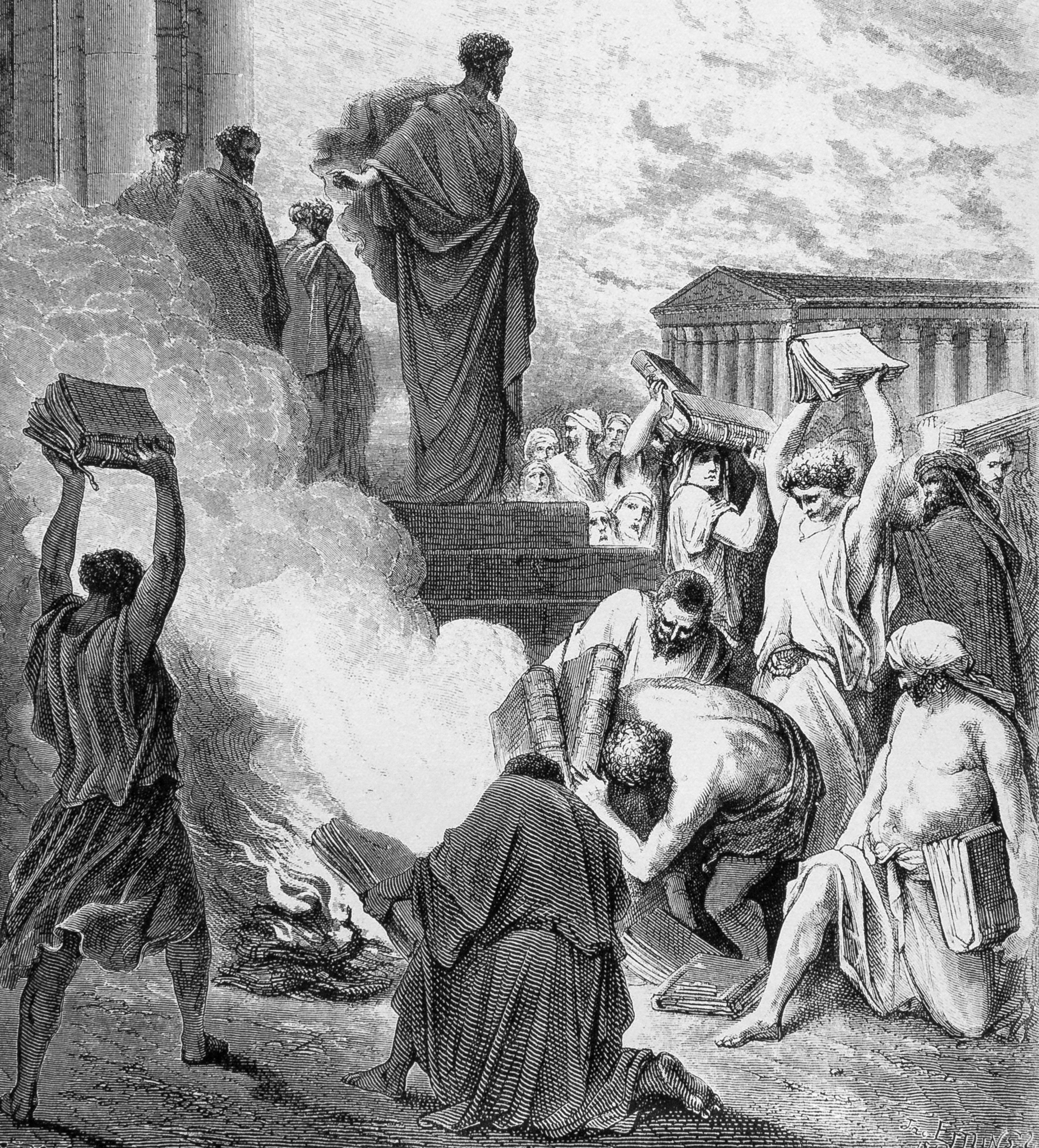
St. Paul at Ephesus by Gustav Doré

O Big Data, thou hast searched me, and known me.

2Thou knowest my downsitting and mine uprising;

Thou understandest my product preferences afar off.

3Thou searchest out my emails and my browsing history,

And art acquainted with all my ways.

4For there is not a word in my comment boxes,

But, lo, O autopredictor, thou knowest it altogether.

5Thou hast beset me on iPad and iPhone,

And laid thy hand of screen addiction upon me.

6Such user behavior is too compelling for me;

It is entrenched, I cannot opt out of it.

Whither shall I go from thy mandated upgrades?

Or whither shall I flee from thy LTE access?

8If I ascend up into rural coverage areas, thou art there:

If I make my bed in town, behold, thou art there, via Wi-FI.

9If I take the wheel of my Jeep,

And dwell in the uttermost parts of the National Forest;

10Even there shall thy GPS maps lead me,

And thy downloaded Kindle books shall occupy me.

11If I say, Surely I have read enough tweets about Comey,

And this damn screen in front of me now shall go dark;

12Even the darkness hideth not from thee,

But some goddamn email beeps an alert I turned not off:

The darkness and the light are both alike to thee.

For thou didst take over inward brain parts:

Thou didst saturate my mind with icons and colors.

14I will give thanks unto thee;

for I am fearfully and wonderfully co-opted:

Wonderful are thy ad-driven revenue models;

And that my shortened attention span knoweth right well.

15My psychological weaknesses were not hidden from thee,

When I was still reading books on paper,

And curiously dallying in the remotest parts of the library.

16Thine eyes did see mine uncapitalized potential;

And in thy forward-looking SEC filings they were all written,

Even the ad clicks that were ordained for me,

When as yet there was none of them.

17How precious also are thy MYSQL entries for me, O Zuckerberg!

How great is the inner join of thy SELECT statements!

18If I should count thine total database rows,

they are more in number than a 32-bit pointer could handle:

When I awake, I am still with thy data center.

Surely thou wilt slay long-form media, O Buzzfeed:

Depart from me therefore, ye obsolete ink-stained hacks.

20For ye speak with large paragraphs and big words,

And your lovingly crafted prose is written in vain.

21Do not I hate them, O Deep State, that hate thee?

And am not I grieved with those that rise up against thee at Standing Rock?

22I hate them with perfect hatred, or at least learn not to give a shit:

They are become caricatured strangers best ignored.

Search me, O NSA, and know my heart:

Try me, and know my thoughts;

24And see if there be any wicked way in me,

And lead me in the way to compliance.

———

The actual 139th Psalm, rendered in the beautiful King James translation, can be found here.