Friday, April 1, 2016

No Foolin’

The youth gets together his materials to build a bridge to the moon, or perchance a palace or temple on the earth, and at length the middle-aged man concludes to build a wood-shed with them.
—Henry David Thoreau, quoted in The Writing Life by Annie Dillard.

On the first day of April 2012, about two months after leaving the Laestadian Lutheran Church via the act of publishing a book critical of it, I posted on social media this parody image of a fake Voice of Zion article thoughtfully reviewing the book:

My first Laestadian-related April fool (click to enlarge)

Such a review was, of course, quite the opposite of what actually happened, which was the point of the parody piece. It quoted the conclusion of an actual article that had been published, for real and with refreshing candor, by the church’s sister organization in Finland: “There must be the ability to encounter facts with openness and honesty, even when the facts are not pleasing to us.” Switching from fact to April fool, my “article” went on to say:

This may raise doubts and concerns in the minds of God’s children: Can God’s Kingdom be the subject of legitimate criticism? Is it possible that certain teachings, even those that are being made in sermons and writings today, are simply not correct? These questions, once unthinkable in Zion, are being brought again and again to our attention by recent events.

Now we must confront the issues raised in a 530-page book by a former believer [me] who once wrote articles for this very paper [true]. Traditionally, our tendency would be to dismiss the book’s questions and criticisms by saying that the author just wanted to live a life of sin, or that he is distorting or even lying about what God’s Kingdom has taught. Another common response we have made to these challenges is that faith is childlike and not subject to any human reasoning.

Then the article plowed onward through a field of Bible quotes, just as you’d see in the real Voice of Zion. I selected them verbatim from the same King James Bible pages that Laestadian preachers consult for their articles. But my assortment of quotes told a very different story:

Scripture certainly encourages us to believe as a child (Matthew 18:3). But we should also remember the Apostle Paul’s admonition to “be not children in understanding: howbeit in malice be ye children, but in understanding be men” (1 Corinthians 14:20). Sometimes we need to “put away childish things” (1 Corinthians 13:11) and really understand what it is we claim to believe.

A second column of the “article” that appeared in the fake clipping provided some straight talk about this new book of mine that was giving the preachers such headaches. An unnamed preacher (also fake) being “interviewed” for the article in classic Voice of Zion fashion acknowledged that it was “undeniably true that the Gospel was not preached for several years after Laestadius and Raattamaa received the grace of repentance.” This implausibly candid preacher continued, “The book also correctly notes that Raattamaa favored Takkinen and criticized the followers of Heideman. These are matters of historical record that we must acknowledge somehow.”

Quite true, even if the person saying it was a fiction. Acknowledging the historical record is exactly what the church must do to be intellectually honest, but good luck ever seeing that happen. The real-life response was instead to retreat into a sheltered cocoon of denial and an outright repudiation of human reason in evaluating what the church teaches to be true. The same goes for “another difficult historical question raised in Suominen’s book,”

why our familiar preaching of the forgiveness of sins from believer to believer doesn’t seem to be found in any writings before Luther. The book states that there were “two centuries of writings” after Christ “that not only fail to explicitly mention absolution, but provide many teachings incompatible with it” (Section 5.1.2). It may seem like a far-fetched claim, but he provides several pages of discussion with plenty of references to back it up.

That I did. In response to this significant issue, too, crickets sounded forth in the fields of central Minnesota.

———

On first days of April since then, I published two more parody articles. In 2014, Social Media and the Believer did a dead ringer of an impression (if I do say so myself) of a Voice of Zion article soberly warning about the dangers of Facebook and mixing with unbelievers via this new medium of the Internet. It started pushing plausibility around halfway through:

One of the dangers with “friendship of the world” is the temptation to accept incorrect and sinful beliefs and lifestyles. Today’s society encourages an anything-goes attitude of “tolerance,” but God’s Word has always taught differently. The Old Covenant believers were instructed to let their light shine very clearly about the dead faiths of this world.

Then came a quote from Deuteronomy 13:6-9 about killing family members who tempt you into serving other gods (“Thou shalt not consent unto him, nor hearken unto him; neither shall thine eye pity him, neither shalt thou spare, neither shalt thou conceal him: But thou shalt surely kill him; thine hand shall be first upon him to put him to death”). According to the church, after all, God’s Word, is unchanging and eternal, and not subject to the whims of man’s desires. Somehow these nastier bits of the Old Testament get forgotten in favor of favorite passages warning that you’d better not be using birth control or hunting on a Sunday.

From the April 2015 parody, my last and favorite

April 1, 2015 was the occasion of my favorite of the parodies I’ve done, A Mother of Many Children. It was a heartfelt announcement of a surprising (alas, fictional) change in Conservative Laestadianism’s long-standing doctrine of exclusivity, drawing not just on scripture for support but also on the teachings of Luther himself:

There are, we must say along with one of our Lutheran confessional books, “truly believing and righteous people scattered throughout the whole world.” Our spiritual predecessor Martin Luther said in his time that there were “Christians in all the world,” that “no one can see who is a saint or a believer.”

These quotes and others in the article from Luther are all genuine, as with the Bible quotations. They leave no doubt about what Luther would have thought of the Laestadian Lutheran Church and its sister organizations claiming to be “God’s Kingdom,” the only place where actual Christians might be found. The “article” went on about the

danger of putting too much emphasis on God’s Kingdom as an organization, as an assembly of people, and making God Himself secondary to it. “I will not give my glory unto another” (Isaiah 48:11).

We can also look to the words of Luther in this: He wrote that anyone who “maintains that an external assembly or an outward unity makes a Church, sets forth arbitrarily what is merely his own opinion.” We must humbly agree with our brother in faith that there is not “one letter in the Holy Scriptures to show that such a purely external Church has been established by God.”

Many readers were saddened to know that it was just a parody and not a real article from the LLC. A few realized that only after reading through it and rejoicing that their church had finally come around to the loving, inclusive doctrine they personally believed.

I felt a little bad about causing disappointment for people, but hoped that it would do some overall good in the long term. After all, what possible answer could the preachers give to someone asking why this had to be an April fools joke and not a real article from the Voice of Zion? They would have to shrink their God down, along with the Bible and Luther’s teachings, to fit into their little doctrines.

———

There will be no April fool about the old church this year, or perhaps any in the future. I considered some ideas this past week and then decided it’s not worth the bother. I’m bored with it, and it’s bored with me.

This is just one weird little Protestant sect churning upriver against a flood of contrary facts, bearing its delusions of grandeur, its complicated set of mostly unwritten silly rules, and its steady fuel supply of new members popping into maternity wards and winding their way from day circle to Sunday School to confirmation class. There are many others like it with their own combinations of such features. The tiresome machinery of it all grinds inexorably on.

Rather than writing another parody piece, I dug through the nether reaches of my Facebook timeline to find one I’d posted in October 2012 as a Facebook status update. (I hadn’t yet started my blog then.) You can still see it and the 70 comments that ensued, here.

This dashed a few hopes, too, and got some heated discussion going. Those were the days before believers had been fully warned about not discussing faith matters online. A new wall was hastily constructed around Laestadian brains, and things have quieted down considerably ever since.

So, to conclude, here is a fake “opening statement” from my old church in one of the congregational meetings there were being held (really) in the wake of my book’s publication to address concerns and doubts.

———

We must begin by humbly acknowledging our own weakness and lack of understanding, not just as individuals, but as a battling congregation here in this sinful world. As the Apostle said, “We see through a glass, darkly” (1 Cor. 13:12). If such an important figure as Paul could acknowledge that he only “knew in part,” then we must do the same. We have been quick to cite Proverbs as saying, “The fear of the LORD is the beginning of knowledge,” but there’s a second part of the verse that we all ought to take to heart, where we are told that “fools despise wisdom and instruction” (1:7). Is any of us exempt from the need for wisdom and instruction?

The writer of Proverbs said much about wisdom. “The wisdom of the prudent is to understand his way: but the folly of fools is deceit” (14:8). There is simply no place for deceit in God’s Kingdom. After all, the Church is called “the Pillar and Ground of Truth” (1 Tim. 3:15). We must understand our way. A speaker brother recently quoted another verse from Proverbs, “There is a way which seemeth right unto a man, but the end thereof are the ways of death” (14:12). Yet we must also keep in mind what follows just a few verses later: “The simple believeth every word: but the prudent man looketh well to his going. A wise man feareth, and departeth from evil: but the fool rageth, and is confident” (14:15-16). Some of God’s children have recently decided they simply cannot go on just “believing every word.” We must respect this and learn from their courage.

If we are wrong, we must allow ourselves to be corrected. This applies to all of us. During the last heresy, it was said that the Bibles came off the shelves. We at the LLC have been reading God’s Word more diligently in recent days, too, and must admit that there have been important lessons there for us. For example, the believers of an earlier period in the Old Testament sacrificed thousands upon thousands of animals for sins, yet a later prophet, Micah, asked what he should bring with him when he comes before the LORD, when he bows himself “before the high God? Shall I come before him with burnt offerings, with calves of a year old? Will the Lord be pleased with thousands of rams, or with ten thousands of rivers of oil? Shall I give my firstborn for my transgression, the fruit of my body for the sin of my soul?” (Mic. 6:1-7). No, that was of no use. Instead, Micah concluded, “O man, what is good; and what doth the LORD require of thee, but to do justly, and to love mercy, and to walk humbly with thy God?” (6:8).

Let us do the same. Live in a just manner, love mercy, and walk humbly with God. How much sacrifice we have demanded of ourselves, and each other, when this is all that is required!

We sit before you chastened, knowing how much we have been shown to be wrong about in recent years. Our brothers in Finland have publicly apologized for “spiritual excesses” of the 1970s. We have seen crimes against children by believing men with positions of trust in God’s Kingdom made worse by cover-ups, denial, excuses, and poor behavior toward a courageous woman who attempted to see justice done and further abuse prevented. Here in America, we have advocated for women getting pregnant even at the cost of their lives when in Finland our sister organization is now calling for women to listen carefully to their doctor’s advice. We have concerned ourselves far too much with works– hundreds of confusing rules about dying hair when curling it is OK, about using birth control when a hysterectomy is OK, about watching animated cartoons when documentaries are OK. The words of Jesus are instructive to us, too: “Woe unto you, scribes and Pharisees, hypocrites! for ye pay tithe of mint and anise and cummin, and have omitted the weightier matters of the law, judgment, mercy, and faith: these ought ye to have done, and not to leave the other undone. Ye blind guides, which strain at a gnat, and swallow a camel” (Matt. 23:23-24).

Let us pass the microphone over to you now, the body of Christ. Let us discuss matters in true Christian freedom, not coercion, not intimidation. It is time for us all to learn from each other.

———

“Just kidding,” I finally added. “But for the sake of my loved ones still in the church, I wish I weren’t.” I still do. But life goes on. Those friends and loved ones know they have another option than trudging off to sit in those pews. Some of them have finally found the courage to exercise that option. And it may not be so bad anymore for those who haven’t. From what little I hear about the church nowadays, light and love have started shining through cracks in the wall of judgment and fear.

Inside those walls, and outside where billions of people like me are raising children and making friends and riding bikes and buying groceries, life goes on. 

Friday, March 11, 2016

Slouching Towards Washington

Extremes in thinking and a vacuum in the middle where fact and reason used to dwell lately characterize the national state of mind.
—James Howard Kunstler, Too Much Magic:
Wishful Thinking, Technology, and the Fate of the Nation
The Trumpenstein Monster of Today’s GOP [Flickr page]

In January 1919, months after an armistice that ended the horrors of the Great War in Europe, W.B. Yeats started work on a haunting little poem of the Apocalypse. The Second Coming begins with these memorable lines:

Turning and turning in the widening gyre

The falcon cannot hear the falconer;

Things fall apart; the centre cannot hold;

Mere anarchy is loosed upon the world,

The blood-dimmed tide is loosed, and everywhere

The ceremony of innocence is drowned;

The best lack all conviction, while the worst

Are full of passionate intensity.

This “first stanza captures more than just political unrest and violence,” says Nick Tabor in a 2015 article about the poem. “Its anxiety concerns the social ills of modernity: the rupture of traditional family and societal structures; the loss of collective religious faith, and with it, the collective sense of purpose; the feeling that the old rules no longer apply and there’s nothing to replace them.”

Yeats goes on to prophesy further horrors, suggesting, in Tabor’s analysis, that “something like the Christian notion of a ‘second coming’ is about to occur, but rather than earthly peace, it will bring terror”:

Surely some revelation is at hand;

Surely the Second Coming is at hand.

The Second Coming! Hardly are those words out

When a vast image out of Spiritus Mundi

Troubles my sight: a waste of desert sand;

A shape with lion body and the head of a man,

A gaze blank and pitiless as the sun,

Is moving its slow thighs, while all about it

Wind shadows of the indignant desert birds.

And then there is the “slouching beast” of the final stanza, which Tabor says is best understood not as “a particular political regime, or even fascism itself, but a broader historical force, comprising the techno­logical, the ideological, and the political.”1

The darkness drops again but now I know

That twenty centuries of stony sleep

Were vexed to nightmare by a rocking cradle,

And what rough beast, its hour come round at last,

Slouches towards Bethlehem to be born?

Despite Tabor’s complaints about the “widening gyre of heavy-handed allusions” that popular culture is making to the poem, I will venture to toss in my own: The words Yeats left us from nearly a century ago offer a stark picture of what is happening to the ailing democracy of the United States today.

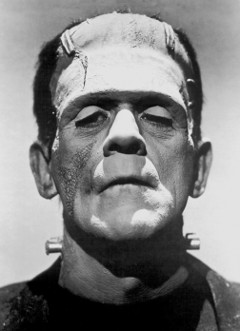
There is a rough beast out there right now, slouching towards Washington. It is a Frankenstein monster formed from an angry electorate’s troubled mix of ugly prejudice, religious zeal, and legitimate grievance–partly about having served as useful idiots for a moneyed class that pandered to their social conservatism while bleeding them dry. What the billionaire political manipulators originally tinkered into existence as a servant for carrying out their specific and selfish goals has gone out of their control.

Now the “darkness drops again” and the monster is plodding into the night, ignoring the commands of those who spent millions trying to be its masters. This is a spectacle both terrifying and exhilarating to watch.

The stuff of nightmares [Flickr page]

The Koch Brothers and their ilk liked what they saw in Jeb Bush and Marco Rubio, and invested heavily.2 But, alas for them, it really does seem that money can’t buy everything. By January, Poor Charles Koch was expressing disappointment “with the line-up of Republican candidates in the 2016 cycle,” and surprise at “the lack of influence he and his brother have wielded so far.”3

Things started going south for the billionaire Brothers Grim in September of 2015 with the departure of Scott Walker, a nasty dead-eyed governor who seemed like their perfect messenger boy.4 Abysmal polling numbers in the presidential race sent him back to work swinging the Libertarian wrecking ball at Wisconsin’s state government. And Jeb! finally dropped out in February 2016 after an embarrassing return on investment for all the millions blown by his campaign and (ahem, independent) SuperPAC–the total price per vote obtained was about $2800 in Iowa and $1150 in New Hampshire.5

Now the last best hope for a presidential pawn of the oligarchs, Marco Rubio, is flailing about with just a single state to his name and 15% of the viable delegates allocated thus far. He faces impossible odds, at least if the votes of the lumpen­proletariat are what it really takes to win a nomination this year. Rubio would need to win 75% of the 1435 delegates still up for grabs in order to get the 1237 he needs for a non-brokered nomination.6 Good luck with that: A March 9 poll has him behind in his home state of Florida by double digits.7 It isn’t going to happen, and even he has to realize that.

But there is still the tantalizing possibility of a brokered convention, and that might make it still worth his while for Rubio to keep slugging away. The same goes for John Kasich, governor of Ohio and unofficial Adult in the Room. He’s counting on a home-state win in the winner-take-all primary on the weekend of March 12-13 to keep him in the game. He has been quite candid about liking the idea of a nomination fight at the convention.8

———

Assuming primary voters actually get to decide this thing, there are two realistic contenders now left standing for nominee of the Greedy Oligarchy Party–Donald J. Trump and Raphael Edward (“Ted”) Cruz. The oligarchs, however, don’t seem to much like either one of them.

Trump can’t be bought, for the simple reason that he doesn’t need anybody else’s money to support his chest-thumping vanity presidency project. “Not a single contribution to Trump’s campaign could be found in the donation records of the 190 attendees of Koch donor conferences.” Hilariously, one billionaire political-money hobbyist complained that Trump’s self-funding “scares the hell out of” him. “That’s like a dictator,” Stanley Hubbard whined. “I think that any politician should have to answer to their constituents.” Mr. Hubbard does not “think it’s healthy to have somebody who doesn’t answer to anybody.”9 Apparently, having them answer to a few fabulously wealthy recipients of inherited wealth like himself is more like it–God bless America.

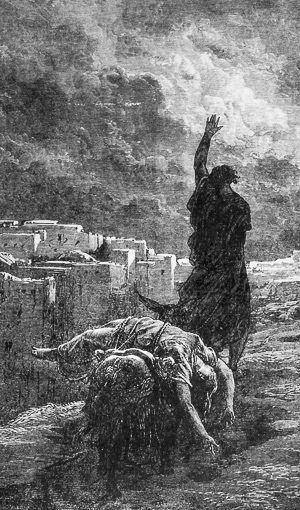
The Levite Bearing Away the Body of the Woman, Gustav Doré

Cruz, for his part, has at least tried to win favor of Those Who Matter. He did some hobnobbing at a Koch Konference in 2013, shortly after winning his Senate seat.10 At another gathering, during the record-hot summer of 2015, he surely scored some points with the Brothers Grim by bluntly denying that global warming was real and implying that Obama was lying by warning of “hotter summers, rising sea levels, and extreme weather events.”11 (These things are all actually happening now, apparently invisible if your head is stuck up some rich donor’s ass.)

But the fact is that very few people who actually know Ted Cruz–besides some angry, religion-crazed voters–seem to like him much at all, no matter what he says.12 This is apparently nothing new; his college roommate describes him, then and now, as “pedantic, smarmy, creepy, arrogant, nasty, inauthentic and unfunny as hell.”13 Molly Ball wrote a few months ago in The Atlantic that, in “the three years since he arrived in the U.S. Senate, Ted Cruz has become easily the most hated man in Washington.” He pissed off Mike Lee (Tea Party-UT), possibly his only friend in the Senate, by going all lip-curling angel-of-death about Lee’s criminal justice reform bill. “In my conversations with Republican policy types and Senate aides about Cruz,” Ball writes, Cruz’s “lack of regard for his colleagues, and for the niceties that have traditionally governed the upper chamber, was a common theme. As Trent Lott, the former Senate majority leader, told me last week, referring to the time Cruz called McConnell a liar on the Senate floor: ‘You just don’t do that. Are we not still gentlemen, and respectful of each other?’”14

———

Currently holding onto the lead between those two is Trump, the man described by Peter Wehner, longtime Republican voter, administration staffer, and think-tanker, as an “erratic, inconsistent and unprincipled” narcissist, whose “virulent com­bination of ignorance, emotional instability, demagogy, solipsism and vindictiveness would do more than result in a failed presidency; it could very well lead to national catastrophe.”15

Yes, well, so could allowing the oligarchs to have their way. With one of those “mainstream” GOP candidates they’d like to have in place as an investment vehicle, we could all look forward to the loss of public lands throughout the American West, the gutting of environmental and labor protections, and a rollback of social security safety net programs, for starters. They would unleash the entire chamber of horrors imagined by the current Republican-controlled Congress, which until now has only been kept restrained by the veto threat of a Democratic President.

Besides, Mr. Wehner, this is your monster you are watching lumber into the lightning flashes of the night. Columnist Maureen Dowd shares my delight in seeing “the encrusted political king-making class utter a primal scream as Trump smashes their golden apple cart.” For years, she says, the Republican establishment “has fanned, stoked and exploited the worst angels among the nativists, racists, Pharisees and angry white men, concurring in anti-immigrant measures, restricting minority voting, whipping up anti-Planned Parenthood hysteria and enab­ling gun nuts.”16

Scary as it may be, there is a certain logic to the decision of so many everyday people to cast their vote for a narcissistic, bullying huckster and reality-show host whose vocabulary and grasp of the issues make George W. Bush look like Winston Churchill. “These folks have lost a lot with the hollowing out the middle and working class,” said Jim Sidanius, Harvard professor of sociology, back in January when Trump was just getting rolling. “If you combine that with floating xenophobia, you get this kind of reaction.”17

Perhaps Republican voters are finally realizing how much they have been played by their political elites and have decided to do some tweaking of their own, in the only way they can. Meanwhile, the rest of us look on shaking our heads at the food-fight debates and insults and ugly outbreaks at rallies, and wait for November to finally put a pitchfork into the beast.

We will probably be left only with Hillary Clinton by then to stop its slouch toward Washington. But even a bent and rusted tool will serve to kill the beast and end the nightmare, at least for a few years until the oligarchs start tinkering in their workshop again.

———
The Trumpenstein image is a Creative Commons licensed composition by the amazing DonkeyHotey, which comprises caricatures of the following: Donald Trump, adapted from Creative Commons licensed images from Gage Skidmore’s flickr photostream; and Ted Cruz, adapted from a Creative Commons licensed photo from Michael Vadon’s Flickr photostream.
The image of all four candidates is a Creative Commons licensed composition by DonkeyHotey, comprising caricatures of the following: John Kasich of Ohio, adapted from a Creative Commons licensed photo from Marc Nozell’s Flickr photostream; Donald Trump, adapted from Creative Commons licensed images from Max Goldberg’s flickr photostream; Ted Cruz, adapted from a Creative Commons licensed photo from Gage Skidmores’s Flickr photostream; and Marco Rubio, adapted from a Creative Commons licensed photo from Gage Skidmore’s Flickr photostream.

Notes


  1. Nick Tabor, “No Slouch: The widening gyre of heavy-handed allusions to Yeats’s ‘The Second Coming’,” The Paris Review (April 7, 2015). 

  2. Jonathan Swan and Harper Neidig, “Koch network spreads the wealth,” The Hill (October 21, 2015). (“The most popular presidential candidates among the Koch brothers’ conservative donor network are Jeb Bush and Marco Rubio, who each received contributions from more than 12 percent of 190 donors and their families in records analyzed by The Hill.”) 

  3. Eliza Collins, “Charles Koch bemoans lack of influence over 2016 race,” Politico (January 8, 2016). 

  4. “Back in April [2015], David Koch reportedly gave his personal endorsement to Walker during a closed-door fundraiser” (Matt Wilstein, “Scott Walker Accidentally Poses with Giant Check from ‘Koch Brothers’,” Mediaite.com (August 3, 2015); “Walker’s Punked Phone Call” (ScottWalkerWatch.com). 

  5. Janie Velencia, “Jeb Bush Spent $2,800 Per Vote In Iowa,” Huffington Post (February 2, 2016); “Jeb Bush Spent $1150 Per Vote In New Hampshire,” Huffington Post (Feb. 9, 2016). 

  6. The counts of delegates won by Rubio (151), needed (1237), and available (1435) are from Google, sourcing the AP, from a March 10, 2016 search for “marco rubio delegates.” 

  7. Eliza Collins, “Poll: Trump dominating Rubio in Florida, Kasich in Ohio,” Politico (March 9, 2016). 

  8. Patrick Caldwell, “John Kasich Is Banking on a Contested Convention,” Mother Jones (March 4, 2016). 

  9. Swan and Neidig. 

  10. Todd J. Gillman, “Texas Sen. Ted Cruz rubs elbows with Koch brothers as he eyes 2016; says he’s amazed at ‘wild speculation’,” Dallas Morning News Trail Blazers Blog (May 1, 2013). 

  11. Eliana Johnson, “Ted Cruz to Koch Group: No, Global Warming Is Not Real,” National Review: The Corner (August 2, 2015

  12. I wonder if evangelical Cruz voters have the same kind of mental relationship with him as they do their God: Maybe he’s a bit distasteful when you look too closely, but he’s on their side when it comes to gay marriage. 

  13. Craig Mazin on Twitter (@clmazin, February 5, 2015

  14. Molly Ball, “Why D.C. Hates Ted Cruz,” The Atlantic (January 26, 2016). Uh, Trent, have you been listening to how those genteel folk in your party’s upper echelons are treating the sitting President of the United States, twice elected by popular and electoral majorities? The smelling salts are next to the fainting couch over there, Senator. 

  15. Peter Wehner, “Why I Will Never Vote for Donald Trump,” New York Times (January 14, 2016). 

  16. Maureen Dowd, “Chickens, Home to Roost,” New York Times (March 5, 2016). 

  17. Thomas B. Edsall, “Purity, Disgust and Donald Trump,” The New York Times (January 6, 2016


Saturday, February 27, 2016

Judging Jesus

Think not that I am come to send peace on earth: I came not to send peace, but a sword.
—Jesus of Nazareth (Matt. 10:34)
Book review (and promotion): Blaming Jesus for Jehovah by Robert M. Price. With a Foreword by Valerie Tarico. Tellectual Press (2016).
Bob Price’s new book

Growing up as a Christian, there was one hero figure in my imagination who stood above all others, even above my parents. I didn’t have quite as distinctive a picture of him as I did of my father who helped me string wire on the roof for ham radio antennas or my mother who managed a photography studio, but somehow he was still better than they were. For the most part, I believed this.

Jesus was, you see, utterly perfect. He was so amazing and special that it really isn’t even appropriate to refer to him as a person, even though he walked the earth for some thirty years in human form, performing amazing feats and never succumbing to any of the sins that endlessly plague all of us mere mortals.

I was told that, having risen from the dead up to heaven to be with God (an even less clearly defined hero figure), Jesus looked down at us all the time and sat with us during church services. “Where two or three are gathered in his name,” there he’d be.1 And of course we were constantly telling each other that our sins were forgiven in his “name and precious blood.”

There was no room for any human failings in “our Lord and Savior Jesus Christ,” the innocent unblemished Lamb who offered himself as a final, perfect sacrifice on our behalf. The preachers never tired of reminding us how frequently and miserably we all sin, but not so with Jesus. He never did, not even once. If he had sinned, the implication went and was sometimes even expressed out loud, then all that forgiveness we were doing in his name and blood just wouldn’t work.

———

It took the sharp eye of a young friend who’d left the church while I was still in it to make me aware of any problems with this narrative. He pointed out that Matthew 5:22 has Jesus teaching, “whosoever shall say, Thou fool, shall be in danger of hell fire,” and yet Jesus himself calls people fools in Matthew 23.2

I came across other examples of behavior that didn’t seem particularly Jesus-like as I tiptoed warily into reading what skeptics had to say and–for the first time with clear eyes–the Bible itself. One of those skeptics, Valerie Tarico, pointed out how Jesus’ behavior could seem downright bigoted. In her book Trusting Doubt, she recalled how

a Canaanite woman, a non-Jew, calls out, begging Jesus to heal her daughter, who is possessed by demons. “Lord, Son of David,” she calls him. But he ignores her. Finally, his disciples get sick of her following them and shouting, and they ask him to send her away.

Then “Jesus tells her he was sent only to the lost children of Israel. She keeps begging.” In the end, Jesus heals her daughter, but not before enduring a degrading conversation with him. She “came and knelt before him. ‘Lord, help me!’ she said.”

He replied, “It is not right to take the children’s bread and toss it to their dogs.”

“Yes, Lord,” she said, “but even the dogs eat the crumbs that fall from their masters’ table.”

Then Jesus answered, “Woman, you have great faith! Your request is granted” (Matt. 15:25-28).

This did not impress Dr. Tarico:

If the image doesn’t bother you, try to imagine an American slave or a South African Black having to do and say the same things to get health care for her child. “Please, sir, even the dogs eat the crumbs that fall from their masters’ table.”3

Savior Bro: Not as meek and mild as you thought

Something troubling I came across in my own Bible reading was Jesus telling a bald-faced lie. In John 18:20, he said to the high priest, “I spake openly to the world; I ever taught in the synagogue, and in the temple, whither the Jews always resort; and in secret have I said nothing” (emphasis added). But, according to Mark 4:34, Jesus expounded on the meaning of his parables “when they were alone.”

In fact, all three Synoptic Gospels (Matthew, Mark, and Luke) give an example of Jesus doing the secret teaching he explicitly claimed he’d never done. It happened after Jesus told the crowd the parable of the sower, “when he was alone” with the disciples (Mark 4:10). They asked him about the parable.

Did Jesus say, “What’s wrong with you guys? Can’t you understand plain Aramaic?” Nope. He told them they were being let in on the mysteries (mystery, singular, in Mark) of the Kingdom that were being kept hidden from the unwashed masses (Mark 4:11; Matt. 13:11; Luke 8:10).4 He then proceeded to explain the parable to them–and them alone.

It’s a pretty bad situation for those who believe the 66 books of the Bible make up the inerrant Word of God with no contradictions. If both John and the Synoptics are telling the truth about what happened, then Jesus did not.5

So Jesus became something of a disappointment, though I could’ve lived with a slightly sub-par savior if church doctrine cut him any slack. (Alas, it doesn’t.) And a careful reading of the Old Testament left me utterly repulsed by the shitty attitude and horrible actions of our Father which art in heaven. He is, to quote Richard Dawkins’s memorable one-liner,

jealous and proud of it; a petty, unjust, unforgiving control-freak; a vindictive, bloodthirsty ethnic cleanser; a misogynistic, homophobic, racist, infanticidal, genocidal, filicidal, pestilential, megalomaniacal, sadomasochistic, capriciously malevolent bully.6

This really is no exaggeration. Read the bloodstained pages in the first half of your Bibles and you will soon see how devastatingly true it is.

———

Having long since absorbed the shock of these realizations about both Father and Son, I was delighted to have my little publishing company Tellectual Press take on Robert M. Price’s new book, Blaming Jesus for Jehovah. In it, he presents a grave and devastating conflict for Christianity: “the sheer logical impossibility that God and Jesus, as defined by the Christian creeds, could have commanded and taught the hateful things the Bible says they commanded and taught, and still be loving, just, forgiving, and merciful.”7

Dr. Valerie Tarico–much more pleasant than the God she writes about [Flickr page]

The book begins with a Foreword that was kindly provided by Dr. Tarico. She cites Dawkins’s description of the “malevolent bully” and observes that “trying to separate Old Testament from New–trying to separate Jesus from Jehovah–doesn’t solve the problem.” In fact, she says, “it is impossible,” because “Jesus himself won’t let us.”8

Bob makes that clear right away in the first chapter, entitled “The Son Who Is the Father.” He cites several passages in Matthew and John where Jesus claims a special relation to his Father in heaven and speaks about “‘inside information’ concerning his divine Father and his celestial realm.”9 Jesus knows all about God, Bob says, “because he has intimate familial knowledge, ‘a chip off the old block.’” I especially like the way Dan Barker put it in a recent interview: Jesus isn’t just “a chip off the old block”; he is the block.10

That, of course, refers to the doctrine of the Trinity, a weird theological superposition of three distinct persons of God into a single divine entity. Bob devotes a few pages to what present-day Christians think the Trinity is (but is not) and concludes with the observation that, according to that doctrine, “Jesus and Jehovah are one and the same God.”11 And even without it, there’s plenty in the Gospels to put responsibility for all those Old Testament atrocities on Jesus as Jehovah Junior.

Remember, Jesus explicitly declined to nullify the Old Testament or distance himself from what it describes his Father doing. Bob dismisses the view of many Christians “that the New Testament either exonerates the God of the Old or just plain renders him irrelevant,” which he finds a strange thing to think for those who “profess to believe that both Testaments are the inspired Word of God.” His

considered guess is that they are thinking of the Pauline notion that Christ and his gospel have superseded the Torah, the Old Testament Law. But that is quite a different matter. Paul says that the ceremonial provisions of Judaism (circumcision, kosher laws, holy days, etc.) are no longer binding since their proper purpose has been fulfilled as of the coming of Christ (Col. 2:16-17; Gal. 2:15-21; Rom. 10:4). But that has nothing to do with genocide, as if something so morally repugnant could be proper in the Old Testament dispensation but not in the New.

But, hey, who wants to look too closely? If you’re looking for an excuse to sweep Old Testament atrocities under the rug, any old broom will do.12

After spending a chapter (“Artists’ Conceptions of Jesus”) acknowledging some good stuff about Jesus, Bob goes on to summarize some of those atrocities. We are rightly horrified by the grotesque savagery of ISIS, yet

the Christian holy scripture, the Bible, explicitly ascribes the very same moral crimes to God. Islamic Caliphate killers don’t even need the Koran. There are hundreds of passages in the Holy Bible which would be more than enough to inspire their horrors. These are strong words, I know. I hate to have to write them. I hope you will have the courage to read them. It comes down to a question of your own integrity. I hope you will see that.13

Any torture that the sick minds of ISIS fanatics can cook up is, of course, a mere pinprick compared to the novel bit of nastiness introduced in the New Testament: eternal condemnation in the agonizing fires of hell. Bob gives that horror the full attention it deserves. In a couple of ample chapters, he covers the various theological attempts to justify unlimited punishment for limited humans and reveals the absurdity of the whole idea of blood atonement.

And there is more: The failure of Jesus’ prophecy about his imminent return, the failure of the Bible to provide a consistent and reliable story about him, and the problems with expecting ant-like humans to heed the warnings of an omniscient God who knows they’ll screw up regardless. This book has a lot of good stuff packed into its 166 or so pages, and I’m very proud to have been a part of its publication.

Fun while it lasts (screenshot taken Feb. 27, 2016)

There is one issue I scratched my head about while editing the book, which bears mentioning. Bob is well known as a skeptic about the existence of any actual person behind the Bible character of Jesus.14 Here’s how he put it to me in a recent phone conversation:

I think there was no Historical Jesus and the Jesus story is almost entirely based on rewriting Old Testament passages. But another likely influence was the dying and rising God myths in the Mediterranean world and also ancient Israelite religion.

In Blaming Jesus for Jehovah, however, Bob treats the existence of Jesus as a given. I asked him about that, particularly where he calls the doctrine of Original Sin “a matter of reverse engineering” by early Christians who “had to deal with the death of Jesus somehow.”15

He was executed as a criminal, but they believed he wasn’t one. So if he didn’t die for any sins of his own, and his death couldn’t have been a meaningless tragedy, whose sins did he die for? Must have been everybody else’s!16

Well, I asked, if you think there wasn’t any such person who actually lived or died, why would those early Christians have been troubled by his death? His answer was that

those who wrote our New Testament documents were not mythicists. They believed there was a Historical Jesus martyred at the hands of Rome, who died innocently. They had the problem of explaining how this could happen.

He dates the earliest Gospel, Mark, at possibly 70-80 years after the reported events, but more likely a full century afterwards. Those early Christians were thinking and writing a couple of generations removed from the event they imagined had happened. That’s plenty of time for a whole myth about a messianic savior to have developed–a “major theological adjustment” to Second Temple Judaism following the destruction of Solomon’s temple by the Romans.

With this book, Bob wanted to avoid the whole controversy of the Historical Jesus vs. the Christ Myth Theory by simply accepting the Bible’s assertions about Jesus at face value. It’s a “look through the lens of mainstream criticism,” as he put it. Even so, it’s still quite a critical and much-needed look, at the superhero figurehead of the world’s largest religion whose flaws thus far have remained largely off-limits to scrutiny.

———
The cover image is Copyright © 2016 by Tellectual Press, an imprint of Tellectual LLC. Used by permission.
Nature photography is much more my line than portraits, but I was glad to have a chance to offer Valerie Tarico some additional publicity photos, including the one shown here, during a visit in Seattle last summer. She’s a wonderful, gracious individual who just inspires you to do your best to keep up with her gentle goodwill. The picture is Copyright © 2015 Edwin A. Suominen, but it’s hers to do what she wishes with, and she’d probably be open to your inquiry should you have a good use for it.
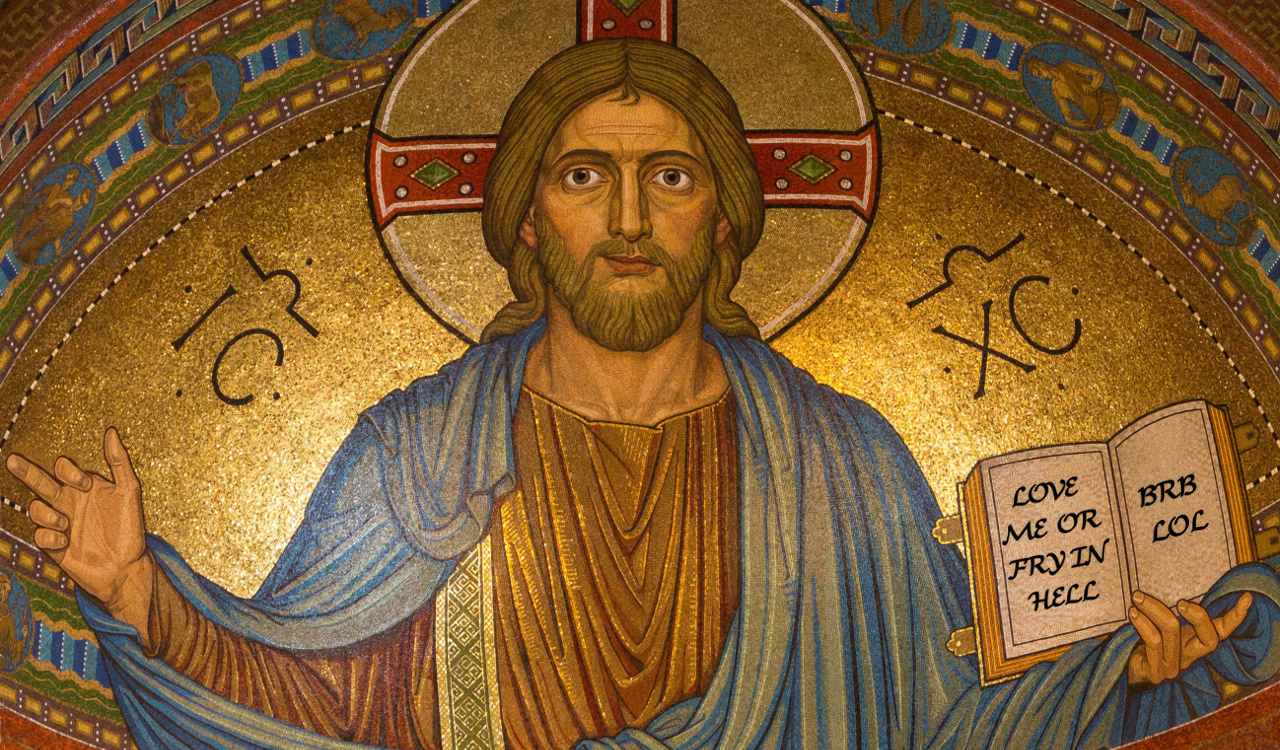
The Jesus mosaic image is adapted (obviously) from a photo reproduction of the apse mosaic of Christ Pantocrator inside the Maria Laach Abbey. The mosaic “was completed in 1911 by Father Andreas Goeser” (link), long enough for the unfortunate Fr. Goeser’s beautiful work to pass into the public domain and get co-opted with the GIMP free image processing software. My irreverent modifications consist of the smirk, the folding over of one additional finger, and a considerably revised text on the open pages. I cannot take credit for “BRB LOL,” having seen it in a meme image some time ago.

Notes


  1. Matt. 18:20. It should be added, however, that the only qualified gatherings for his attendance were those of my own church’s few hundred congregations around the world. He skipped all the untold thousands of other ones because they weren’t part of “God’s Kingdom.” 

  2. “Ye fools and blind: for whether is greater, the gold, or the temple that sanctifieth the gold? And, Whosoever shall swear by the altar, it is nothing; but whosoever sweareth by the gift that is upon it, he is guilty. Ye fools and blind: for whether is greater, the gift, or the altar that sanctifieth the gift?” (Matt. 23:17-19). 

  3. Valerie Tarico, Trusting Doubt: A Former Evangelical Looks at Old Beliefs in a New Light (Oracle Institute Press, 2010; previously published 2006 as The Dark Side), Ch. 5 (available online). 

  4. The Revised Standard Version translates the word as “secrets” (secret, singular, in Mark), which makes the problem even more apparent. Both the KJV and NASB use the term “mysteries” (and “mystery”). 

  5. These four paragraphs, the footnote above, and the rest of this one are adapted from my first book, An Examination of the Pearl, Section 7.1 (“The Gospels”). Robert M. Price told me in 2011 that he believes this to be a case of an intentional contradiction between John and the Synoptics. The writer of John “rejects the esotericism of Mark and changes the story,” which he also did to avoid the “unseemly” stories of Jesus not carrying his own cross and not wanting to go through with his suffering. “For John, there was no private teaching in the Markan, Gnostic sense.” (Gnosis was secret spiritual knowledge not shared with everybody else.) “Everything is public, though some do not hear because they are not of his flock. Thus within John’s retold narrative Jesus is telling the truth.” 

  6. Richard Dawkins, The God Delusion (Houghton Mifflin, 2006). 

  7. Robert M. Price, Blaming Jesus for Jehovah: Reconsidering the Righteousness of Christianity (Tellectual Press, 2016), p. 19. 

  8. Price (Tarico Foreword) at p. 8. 

  9. Price at p. 29. 

  10. Dan Barker, interviewed by Seth Andrews on The Thinking Atheist podcast, Feb. 16, 2016

  11. Price at p. 38. 

  12. Price at p. 65. 

  13. Price at p. 55. 

  14. See, e.g., my blog posting Myth, Method, and the Will to Believe about a lecture by the same name that Bob gave on the topic. 

  15. Hat tip to Jonathan Bernier, who noted this issue in a Facebook post

  16. Price at p. 95.