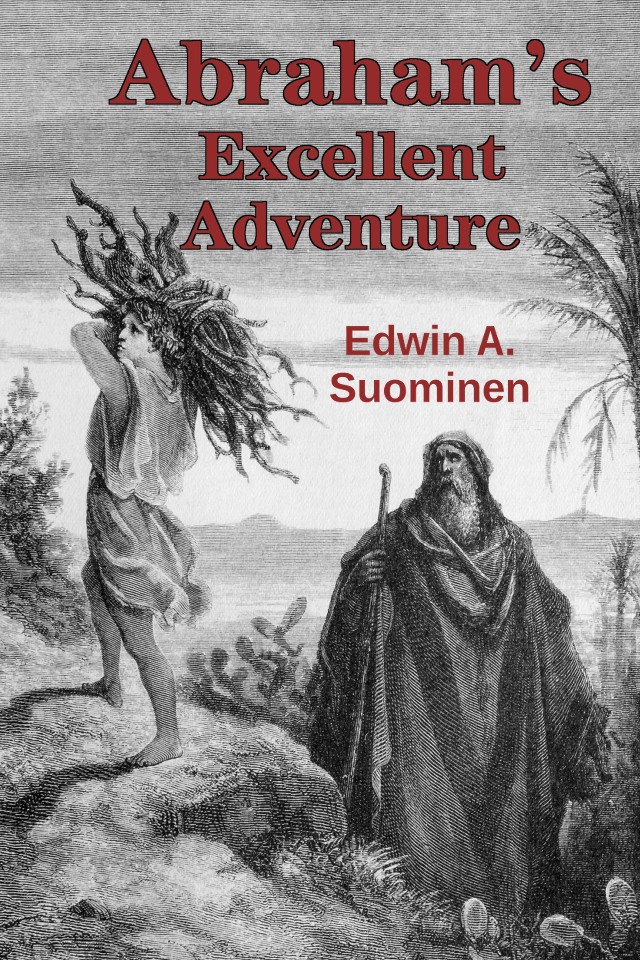
I’ve read about a dozen books during this hot summer of broken weather records and burning forests, most of them relating to a scientific issue that is but should not be contentious: drastic, ongoing, and potentially devastating human-caused climate change. Three of these works stand out in my mind.
Under a Green Sky by paleontologist Peter Ward tells an engaging tale about cataclysmic extinction events while cautioning about our headlong rush into what might well be another one, caused not by volcanic activity or an asteroid but our reckless burning–in a slim century of explosive human activity–of fossilized carbon that took millions of years to accumulate. Paolo Bacigalupi makes similar warnings using fiction in The Water Knife, “a near-future thriller that casts new light on how we live today and what may be in store for us tomorrow.” (Hint: You’re screwed, especially if you live in Arizona or Nevada.)

And then there is an autographed hardback volume that especially weighed heavy in my hands as I sat sweating in the evenings among my drying trees. It’s significant to me not just because it addresses the mindset of those who deny the slow changes happening right outside their windows, but because it represents the single biggest shift in my own little life: from faith to fact. The goal of its author, evolutionary biologist and religion critic Jerry Coyne, is for people to do what came so hard for me as a Christian fundamentalist, and apparently does for millions of Americans in the thrall of our fossil-fueled Western lifestyle: “produce good reasons for what they believe–not only in religion, but in any area in which evidence can be brought to bear.” 1
“Nothing less than the future of our planet is at stake” when it comes to climate-change denialism, and Dr. Coyne devotes a few pages of his book to a discussion of that.2 Despite “the nearly unanimous view of climate scientists that the earth is warming because of human-generated emissions of greenhouse gases,” a dismaying number of Americans and their congressional representatives have no interest in slowing our massive dumping of carbon into the atmosphere. To him and me both, the “ability of people to ignore inconvenient truths that conflict with their faith, whether or not the faith be religious, is astonishing.” 3 Yet I had that ability myself, too, ignoring and denying all the evidence against the Laestadian Christianity that long had been the most important aspect of my life.4
That form of faith was a religious one, of course, which is almost entirely the focus of Coyne’s book rather than some secular faith in Fox News pundits and talk radio. They are not entirely disconnected: He notes a correlation between church attendance and acceptance of scientific realities about evolution, the Big Bang, the Earth’s age, and human-caused global warming.5 (You can guess which way the correlation goes; sermons are not known for encouraging scientific thinking.)
Faith vs. Fact is a personal book to me for a couple more reasons that are worth mentioning before (finally!) proceeding into a detailed review of it. The odd little sect in which I was raised gets mentioned: “Laestadianism, a conservative branch of Lutheranism, considers itself the only true faith: only its roughly 60,000 adherents are eligible for salvation, with the billions of others on earth doomed to eternal torment.” Not at all inaccurate, but possibly not the way Laestadianism would like to be introduced to thousands of people.6

And it was a real thrill to see my name listed alongside various personal heroes of mine–Dan Barker, Richard Dawkins, Peter Boghossian, Sean Carroll, Dan Dennett, Sam Harris, John Loftus, the late Victor Stenger–when Dr. Coyne thanked some “diverse friends and colleagues” for help and encouragement on his acknowledgements page. After his reading and offering comments about a book of my own, some enjoyable correspondence, and a warm conversation about cats and atheists (not unrelated topics, really) at a conference where we finally met, I would be honored to call Dr. Coyne a friend.
So, full disclosure, an unbiased reviewer of this book I am not. But let’s go ahead and take a deeper look.
Competitors for Truth
“Science and religion,” writes Coyne in his Preface to the book, “are competitors in the business of finding out what is true about our universe.” 7 This pretty much summarizes his thinking on the topic, and he makes it abundantly clear which side he judges to be the winner.
All the revelations in all the world’s scriptures have never told us that a molecule of benzene has six carbon atoms arranged in a ring, or that the Earth is 4.5 billion years old. It is this asymmetry of knowledge that, despite religion’s truth claims, make its adherents embrace the fallacious claim that religion and science occupy separate magisteria.8
That NOMA (non-overlapping magisteria) claim was advanced by Stephen Jay Gould in hopes that religion and science could get along somehow. Coyne devotes several pages to dismantling Gould’s idea of a “potential harmony through difference of science and religion, both properly conceived and limited.” The problem, Coyne says, is that one word properly, because “real religion is frequently and stubbornly improper.” Religion tends to trespass on the boundaries of science, even though it rarely happens the other way around: The “vast majority of scientists are happy to pursue their calling as an entirely naturalistic enterprise.” 9 This “reliance on naturalism” is
not an assumption decided in advance, but a result of experience–the experience of men like Darwin and Laplace who found that the only way forward was to posit natural rather than supernatural explanations. Because of this success, and the recurrent failure of supernaturalism to explain anything about the universe, naturalism is now taken for granted as the guiding principle of science.10
As a scientist (or an engineer, to add my own experience into the mix), you don’t gaze upward for answers when you’re working in the lab, except maybe if a buzzing light fixture is generating electromagnetic interference. Coyne offers the amusing yet powerful example of someone who spends their life looking in vain for the Loch Ness monster. After all that effort, “stalking the lake with a camera, sounding it with sonar, and sending submersibles into its depths,” they find nothing. Which is more sensible at that point, he asks,
to conclude provisionally that the monster simply isn’t there, or to throw up your hands and say, “It might be there; I’m not sure”? Most people would give the first response–unless they’re talking about God.11
The reason, of course, is that there is so much at stake–an eternity of reward or punishment, one’s entire social network–when it comes to talking about God. I remember consciously denying myself the mental luxury of even allowing for the possibility of His absence. What a delicious relief it was when I finally could!
One scientist who has taken Coyne’s difficult but honest first option, after 20 years of investigation, is Dr. Susan Blackmore. “At some point something snapped,” she writes in a 2010 essay. “Instead of struggling to fit my chance results into yet another doomed theory of the paranormal, I faced up to the awful possibility that I might have been wrong from the start that perhaps there were no paranormal phenomena at all. I had to change my mind.” 12 It’s an inspiring story, and I find Blackmore’s absence in this section of the book a bit unfortunate, a lost opportunity to point out that it can be done by a principled thinker.
Can’t We All Just Get Along?
Coyne has little patience for NOMA, for the efforts by theologians and science popularizers alike to avoid the appearance that a competition even exists between science and religion. Simple self-preservation makes it attractive for the liberal religious, while a strategic desire “to avoid alienating religious people” motivates scientific organizations.13 For their separate reasons, they all want to let religion save face by granting it some invisible sphere of truth outside the world of observation and explanation. That he terms “accommodationism,” a harmful “weakening of our organs of reason by promoting useless methods of finding truth.” 14

Some science-savvy theologians claim that their sophisticated forms of faith offer “other ways of knowing” what science hasn’t yet explained. There are indeed plenty of those questions; one that Coyne mentions is why the speed of light is constant in a vacuum. Fine, he says: Provide some concrete faith-based answers, and “tell us not only what those answers are, but how they would convince either nonbelievers or members of other faiths. And let those ‘other ways of knowing’ make predictions in the same way that science does.”
But of course they don’t, and can’t. He offers a parallel to the challenge Christopher Hitchens made to believers for an example of ethical behavior only they could perform. The Coyne challenge is this: “[G]ive me a single verified fact about reality that came from Scripture or Revelation alone and then was confirmed only later by science or empirical observation.” 15 Neither challenge has ever had a credible response.16
It’s not just that religions are incompatible with science, Coyne says. Unlike science, whose many different disciplines “share a core methodology based on doubt, replication, reason, and observation,” 17 religion is splintered into countless varieties that are incompatible with each other. Yet “this incompatibility wasn’t inevitable: if the particulars of belief and dogma were somehow bestowed on humans by a god, there’s no obvious reason why there should be more than one brand of faith.” 18
This argument resonates with me for a reason Coyne probably never thought of when he made it: patent law. I’ve obtained over a dozen patents, for commercially successful technology. What those pieces of paper give you is the right to exclude others from making and using what you’ve invented, a right that you can then license and sell to others, or exercise yourself to avoid competition during the 20-year patent term.19 Now, an omnipotent God has the ultimate patent. He could just squash everything but the One True Religion that he supposedly invented, and that would be that. But that doesn’t happen, because there is no such patent holder.
Something else I’ve done is to spend an embarrassing number of hours studying and writing about those “particulars of belief and dogma” in all their hair-splitting details–not just between Protestantism and Catholicism, not just between different forms of Lutheranism, but between different forms of Laestadian Lutheranism. So I offer a hearty secular Amen to another excellent point Coyne makes along those lines: “Given that most religious people acquire their faith through accidents of birth, and those faiths are conflicting, it’s very likely that the tenets of a randomly specified religion are wrong. How can you tell if yours is right?” 20
Uh, because the guys in suits who are telling you that it is too right are really, really sure of it–because their fathers in suits who told them about it were, too? Never mind those other guys at the “heretic” church one town over, who are telling a story whose differences are slight but of incomprehensible importance, and who have no less basis for making their own claims. Yeah, right.
At this point in my review, and in my life, I have the blessed freedom to offer the real answer to that dilemma, for those uncomfortable pew-sitters reading this who are suffering through the churnings of doubt: Revelation without observation is bullshit. A more refined and civilized statement, perhaps, is Coyne’s summary of his claims about the co-existence of religion and science. But it is no less direct. The two
are incompatible because they have different methods for getting knowledge about reality, have different ways of assessing the reliability of that knowledge, and, in the end, arrive at conflicting conclusions about the universe. “Knowledge” acquired by religion is at odds not only with scientific knowledge, but also with knowledge professed by other religions. In the end, religion’s methods, unlike those of science, are useless for understanding reality.21
Come on, now, Jerry. Stop being all nice and diplomatic and vague, and tell us what you really think!
The Chimpanzee in the Room
For most everyone in the United States and probably many other places around the world, mentioning science and religion together will evoke a third topic: evolution. “While not the only scientific theory that contradicts scripture,” Coyne observes, “evolution has implications, involving materialism, human exceptionalism, and morality, that are distressing to many believers.” 22 But, as I observed in my first book after confronting those issues, then still a troubled believer of sorts in theism if no longer my childhood fundamentalism, theological imperative does not equal truth.23
The truth about evolution is simply undeniable to any reasonably informed and thoughtful individual. As Coyne (who has spent decades working directly in the field) notes, “it is supported by mountains of scientific data–at least as much data as support the uncontroversial ‘germ theory’ that infectious diseases are caused by microorganisms.” 24 Indeed, we see the deadly results of evolution in action, right before our eyes, whenever new generations of those microorganisms acquire new resistances to our dwindling stocks of effective antibiotics.
And yet denial persists, to an astounding degree. Coyne summarizes the results of a 2014 Gallup poll: “fully 42%” of Americans polled “were straight biblical young-Earth creationists, agreeing that humans were created in our present form within the last ten thousand years.” Fewer than one in five “accepted evolution the way biologists do, as a naturalistic, unguided process.” The reason is not a lack of evidence, which is simply overwhelming–countless thousands of published findings from numerous scientific disciplines. Nor is it a lack of opportunity for people to learn about that evidence; Coyne notes that “we live in an age of unprecedented science popularization.” 25 Indeed, he has been one of the forces behind that with his own book, deservedly a best-seller, Why Evolution is True.
This is not about the evidence. It is about a fearful, irrational denial of reality by those who cannot afford to deviate from the party line of their precious religions. In the concluding pages of Evolving out of Eden, Dr. Robert M. Price and I reflected on the mindset of the Christian fundamentalist, a place I myself had still been uncomfortably occupying not long earlier. Things get difficult for him, we wrote,
if he peers outside the safety of church society and “healthy” reading materials to glean some awareness of the many other theological problems lurking in the tall grass of science. He may recognize himself (and Jesus!) as an evolved primate, and Original Sin as an absurd doctrine built on unscientific sand. The very rationale of the atonement collapses, along with all those “sins” his pastor carries on about, which come to look like natural, even healthy traits that allowed his ancestors to replicate and eventually produce him. The God of all Creation he once praised while musing over every tree and sunset goes quiet and cold, fading into an impersonal set of laws and forces that forms life out of randomness shaped by countless acts of suffering and death.
It should be no surprise to see so many Eden dwellers turn away from all this and scurry back to retrenchment and denial, the burden of intellectual dishonesty and cognitive dissonance still lighter than the terrifying alternative. The only other options are to water down one’s faith with accommodationism, which brings its own dishonesty and dissonance, or abandon it altogether. But science has set forth the flaming sword, and the Garden cannot remain occupied for long.26
Coyne provides some useful discussion of the theological dangers in that tall grass, too, including a crystal-clear falsification of the whole Adam and Eve idea (pp. 126-27), experimental demonstrations “that no external force seems to be producing mutations in an adaptively useful way” (p. 138), and a thorough debunking of the “fine-tuning” argument (pp. 160-66). Faith vs. Fact is not a book limited or even really focused on the theological problems posed by evolutionary reality, but it certainly gives the reader a flavor of what is keeping those poll numbers so high, one decade after the next, while the science marches on.
Facing Facts
“The vast majority of believers don’t want their faith examined skeptically,” Coyne observes in his concluding chapter about why this all matters. Nor “do they honestly examine other faiths to find why they see their own is true and those others as false.” What religion does, instead, is to defend “its claims by turning them into a watertight edifice immune to refutation.” The preachers and imams and their faithful listeners aren’t really interested in what is true; if they were, they would acknowledge that what they are currently thinking might not be. But that is a step they do not and cannot take, despite Coyne’s eminently sensible proposition that it is “better to find out how the world really works instead of making up stories about it, or accepting stories concocted centuries ago.”
I am no longer so concerned about religion as I used to be, and I hope for the same world that Jerry Coyne wants: “one in which the strength of one’s beliefs about matters of fact is proportional to the evidence . . . where it is okay to reserve judgment if one doesn’t know the answer, and where it’s not seen as offensive to doubt the claims of others.” 27 I want that world, too, and I try to live my life as if it has already arrived.
But our culture is pervaded with irrationality and stubborn beliefs in what is palpably not true, and that has a way of creeping into one’s life regardless. It is not just felt in the aftershocks of religion rejected–the loss of a social network, the worries about superstitions being taught to children, the difficulties experienced by loved ones still inside the church walls. It also manifests in outbreaks of measles caused by vaccine deniers, in the disparaging and defunding of our educational system by a disinterested and even hostile public, and in what has concerned me most during this summer of heat and drought and smoke: climate change whose human causes and even whose very presence so many are still denying.
“Doctrines may be a frightful burden,” Willam Catton wrote a generation ago in Overshoot: The Ecological Basis of Revolutionary Change, another of the worthy books I’ve read during these past months. For, “with the prestige of antiquity and tradition, they deprive the living generation of an open-minded capacity to face facts.” 28 It is a piece of the same puzzle that Coyne describes, just focused on a different form of faith–in limitless growth without consequence.
To avoid despairing of our ongoing ecological disaster, we have constructed ourselves a giant cargo cult, in which our modern “faith in science and technology as infallible solvers of any conceivable problem can be, in a post-exuberant world, just as superstitious” as the Melanasians who constructed runways in anticipation of John Frum’s return with piles of loot. Catton describes this in a chapter of his 1982 work with the eerily identical title to Coyne’s book: “Faith versus Fact.” He writes that the “modern Cargoist who expects to be bailed out of this year’s ecological predicament by next year’s technological breakthrough holds similar beliefs because of his inadequate knowledge of ecology and of technology’s role in it. Both Cargoist faiths rest upon the quicksand of fundamental ignorance lubricated by superficial knowledge.” 29
This is not a faith from which I can just walk away, as I did with Christian fundamentalism, difficult as that was. So I do my empty penances (Catton: “We may come to feel guilty about stealing from the future, but we will continue to do it”) and look outside the window, air conditioner running, at my big trees that have lived through a hundred summers. They may not survive many more as hot and dry as the one that is burning the American West right now. And I find myself wishing for a sanctuary in which I might sing, to keep those facts away. But I know better, and this is the way I will always live, with a mind clear and free, still with more joy than sorrow just the same.
Notes
-
Faith vs. Fact, p. xxii. ↩
-
p. 246. ↩
-
p. 245. ↩
-
See my first book, The Examination of the Pearl. ↩
-
Faith vs. Fact, p. 245. ↩
-
The situation is actually worse than Dr. Coyne may realize. You also have to be the right kind of Laestadian to be saved, a faithful member of the correct one of at least five different splinter groups who all make their own extreme exclusivity claims. ↩
-
p. xvi. ↩
-
pp. 195-96. ↩
-
p. 108. ↩
-
p. 92. ↩
-
p. 95. ↩
-
“Why I Had to Change My Mind.” In Richard Gross, Psychology: The Science of Mind and Behaviour, 6th ed. (London: Hodder Education), pp. 86-87. The quote is from a draft version available online at susanblackmore.co.uk/Chapters/Gross2010.htm. ↩
-
p. 93. ↩
-
p. xxi. ↩
-
pp. 91. Back when I was a faithful Bible believer, I would have responded to the challenge with Jesus’ examples of saved and unsaved people at the moment of his second coming: “I tell you, on that night there will be two in one bed; one will be taken and the other will be left. There will be two women grinding at the same place; one will be taken and the other will be left. Two men will be in the field; one will be taken and the other will be left” (Luke 17:34-36, NASB). They didn’t realize the earth was round back when that was written, I used to think, so how would a human author know to use workday examples along with a nocturnal one? But, alas, that last part about men working in the field wasn’t in the original text, and the odds of such an accidental “revelation” never occurring in thousands of lines of Scripture are very low indeed. ↩
-
pp. 227-28. ↩
-
p. 86. ↩
-
p. 85. ↩
-
The twenty years begins on the day you file the patent application, although there are no enforceable rights until claims appear in an issued patent. Some limited term extensions are possible due to certain administrative delays in getting the patent grant, but overall, patents differ from the Mickey-mouse charade of perpetual legislative updates to copyright terms in that patented ideas do usefully pass to the public good. I expect to see Walt’s precious mouse in the public domain when he can skate over frozen hellfire, perhaps to the tune of Let it Go. ↩
-
p. 85. ↩
-
p. 64. ↩
-
p. 59. ↩
-
An Examination of the Pearl (2012), §4.3.1: “But theological imperative does not equal truth. It couldn’t do so even when the Church had the rack and the stake at its disposal. The facts just sit there, mute, uncaring about how vehemently people deny their existence. . . . The only alternative to accepting the overwhelming evidence of man’s non-Adamic, evolutionary origins is to say that the evidence is false and was planted by God in fossils, vestigial body parts, patterns of speciation, ongoing and directly observed evolutionary changes, and a newly discovered treasure trove of information in our own DNA that matches up remarkably with all the observations that had been made beforehand. There is absolutely nothing contradicting that evidence except some ancient Hebrew writings (which themselves contradict each other) and the mountain of theology that has piled up on top of those writings over the centuries.” ↩
-
Faith vs. Fact, p. 59. ↩
-
p. 60. ↩
-
Robert M. Price and Edwin A. Suominen, Evolving out of Eden. Valley, WA: Tellectual Press (2013), p. 311. ↩
-
Faith vs. Fact, p. 260. ↩
-
Willam R. Catton, Overshoot: The Ecological Basis of Revolutionary Change. Urbana and Chicago: University of Illinois Press (1982), Ch. 5, “The End of Exuberance.” Citing an 1896 essay by sociologist William Graham Sumner. ↩
-
Catton, Ch. 11, “Faith versus Fact.” ↩